50 yuan 1951
“Quemoy”
Market Prices
About This Note
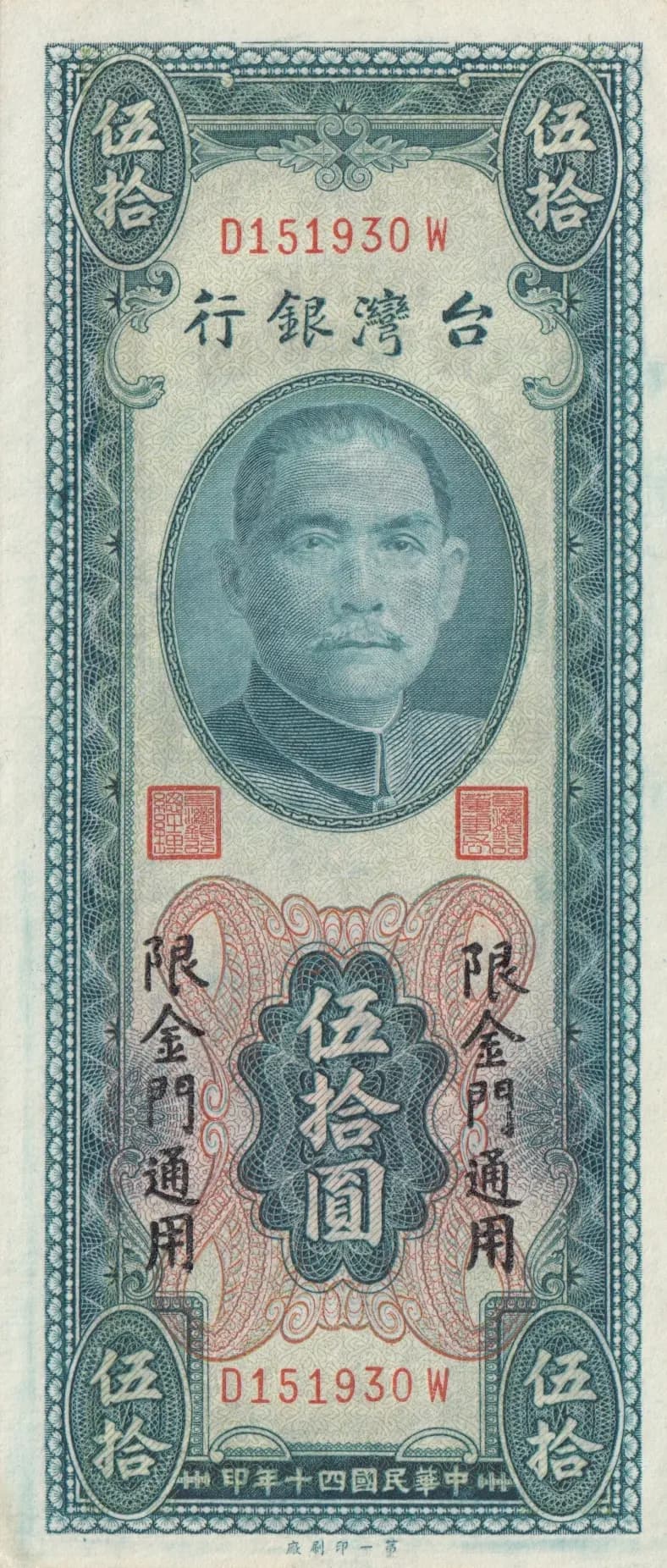
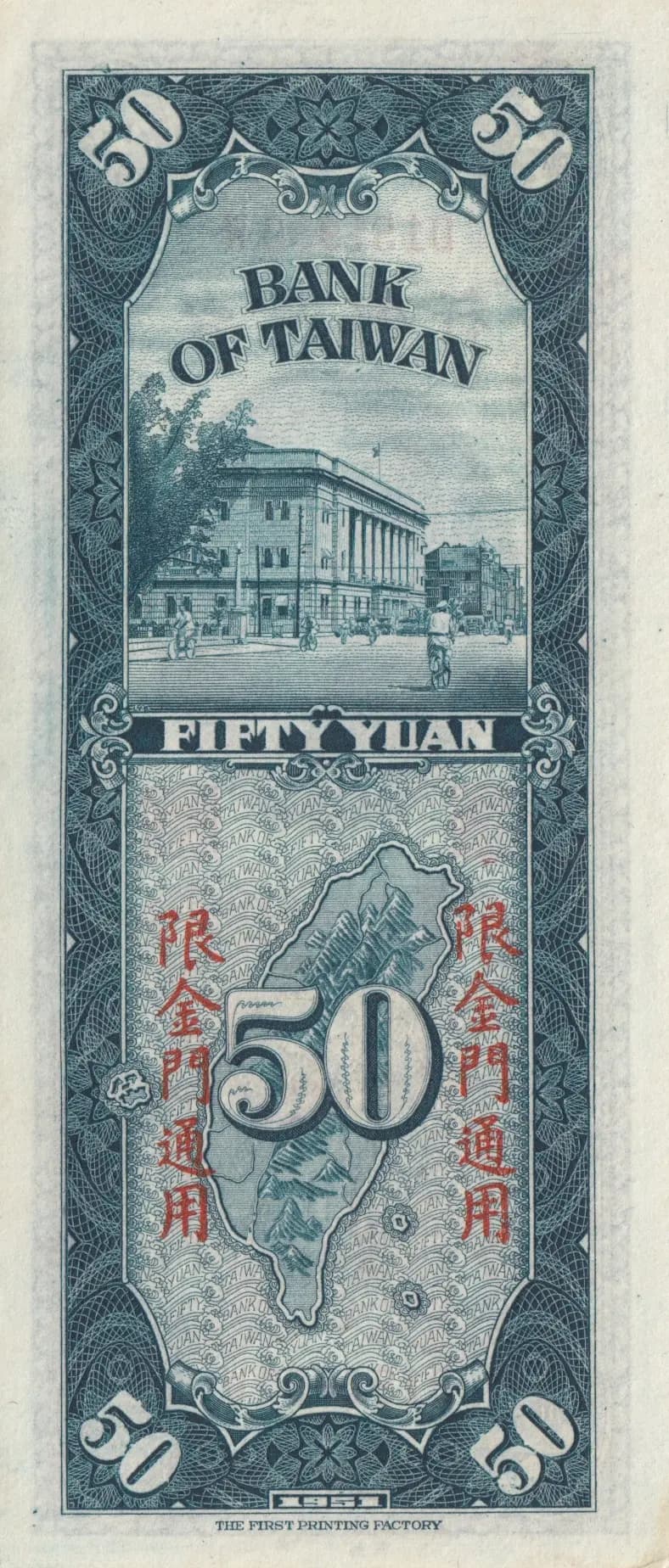
An exceptional example of Taiwan's early postwar currency, this 1951 Bank of Taiwan 50 Yuan note presents in uncirculated condition with crisp detail and vibrant teal and cream coloring throughout. The obverse features a dignified portrait of Dr. Sun Yat-sen in an oval frame, flanked by red seals and ornate decorative borders, while the reverse showcases a neoclassical Bank of Taiwan building with Taiwan's map and denomination. This note represents an important transitional period in Taiwan's monetary history and remains highly collectible, particularly in this pristine state.
Common. The eBay price tracking data shows typical market values ranging from approximately $5–$30 for circulated to AU examples, with UNC catalog values at $120 (2019), suggesting steady but not exceptional collector demand. Print runs for this standard issue were substantial, and while uncirculated examples command reasonable premiums, the note itself is not scarce. This is a standard regular-issue banknote from a major issuing authority with no documented short print run or recall status.
Issued in 1951, this 50 Yuan note reflects Taiwan's establishment as the banking center for the Republic of China following the Chinese Civil War. The prominent depiction of the neoclassical Bank of Taiwan building on the reverse symbolizes the institution's central role in Taiwan's economic reconstruction and development during this critical period. Dr. Sun Yat-sen's portrait on the obverse reinforces the ROC's political legitimacy and continuity with the founding principles of the Republic.
The obverse features a centered portrait of Dr. Sun Yat-sen (founder of the Republic of China), depicted as a middle-aged man with a distinctive mustache wearing formal high-collared attire, framed within an ornate oval. Two red rectangular seals bearing Chinese characters flank the portrait below, with the denomination '伍拾圓' (Fifty Yuan) displayed in a decorative panel. The entire design is enclosed within an intricate ornamental border featuring repeated geometric patterns and corner ornaments in teal, cream, and dark green. The reverse depicts the neoclassical Bank of Taiwan building—a columned structure with classical architectural features, grand entrance steps, and period-appropriate figures (pedestrians and cyclists) in the foreground. Below the building sits a map of Taiwan island with the denomination '50' prominently featured, flanked by red seals. The reverse maintains consistent ornamental borders and color scheme (teal, cream, dark green, and red).
FRONT: '台灣銀行' (Bank of Taiwan) | '伍拾圓' (Fifty Yuan) | '限金通用' (For circulation/legal tender) | '中華民國十四國民銀行中華' (Republic of China Central Bank of China) | 'D151930 W' (Serial number). BACK: 'BANK OF TAIWAN' (English inscription) | 'FIFTY YUAN' (English denomination) | '50' (Arabic numeral denomination) | '限金通用' (For circulation/legal tender) | 'THE FIRST PRINTING FACTORY' (Printer attribution).
Intaglio line engraving, executed by The First Printing Factory (as noted in the English attribution on the reverse). The intricate decorative borders, fine-line detailing in the architectural rendering, and portrait work are characteristic of high-quality engraved banknote production. The pick catalog indicates CPF (Chinese People's Printing Factory or similar state printing concern) as the printer, consistent with ROC-era currency production standards.
This specimen is identified as Pick R107 with serial number D151930 W. The note is dated 1951 with a later printing notation of 1967 on some cataloging references, indicating extended production runs or reprints. No overprints, significant signature variations, or noted varieties are evident in the visual analysis. The consistent design and inscription formatting suggest this is a standard variety of the first issue series.