50 yuan- Matsu 1970
“Matsu”
Market Prices
3 salesAbout This Note
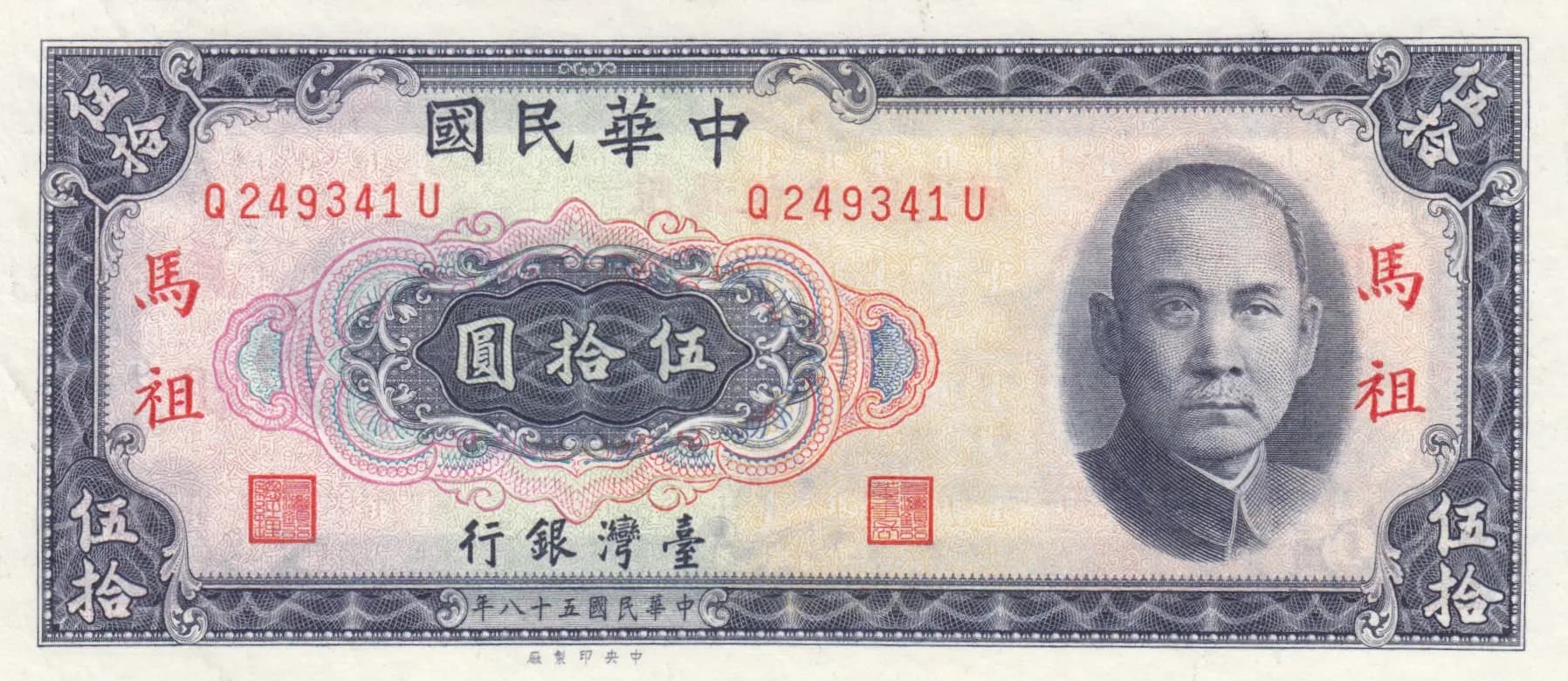
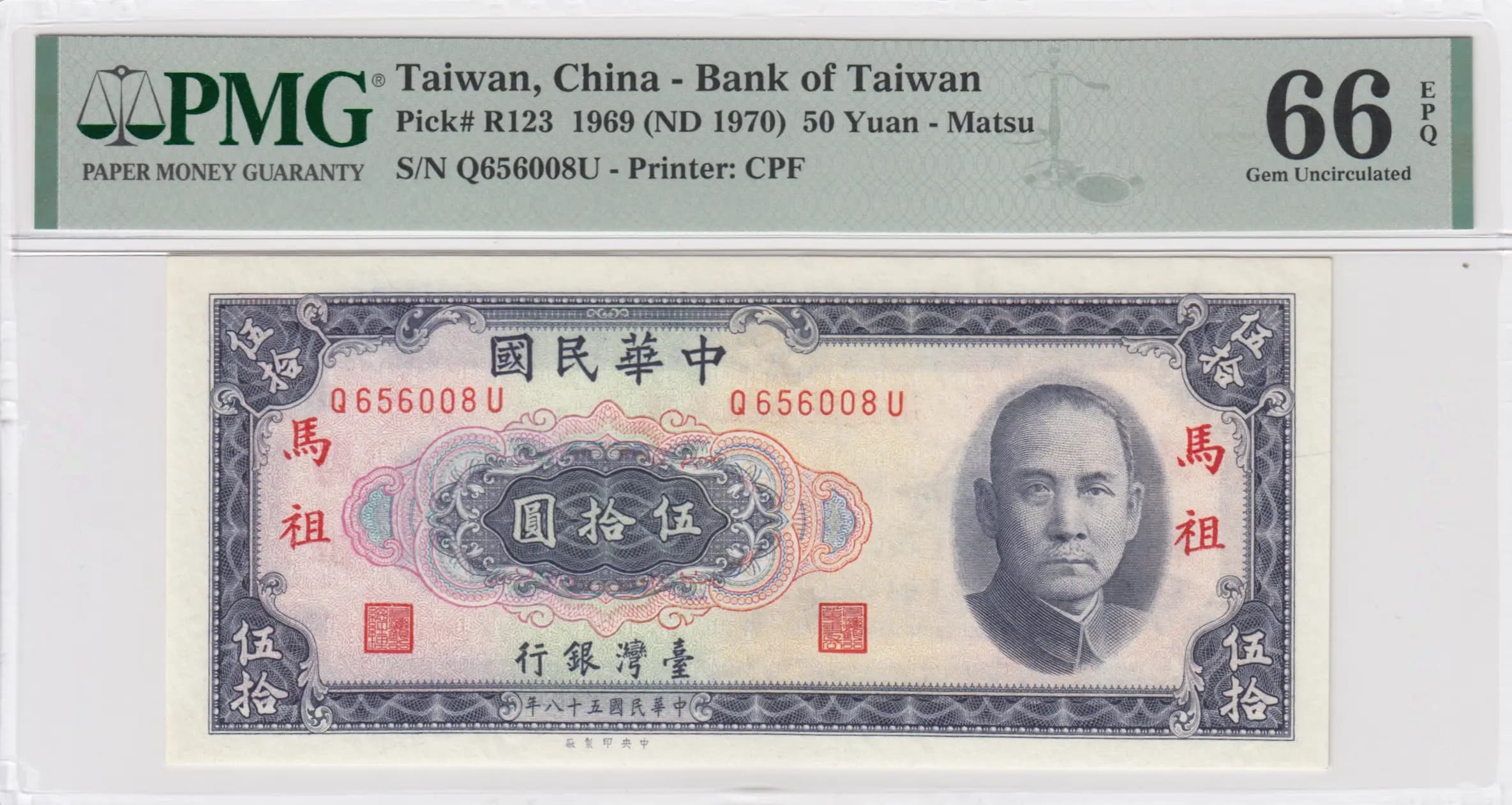
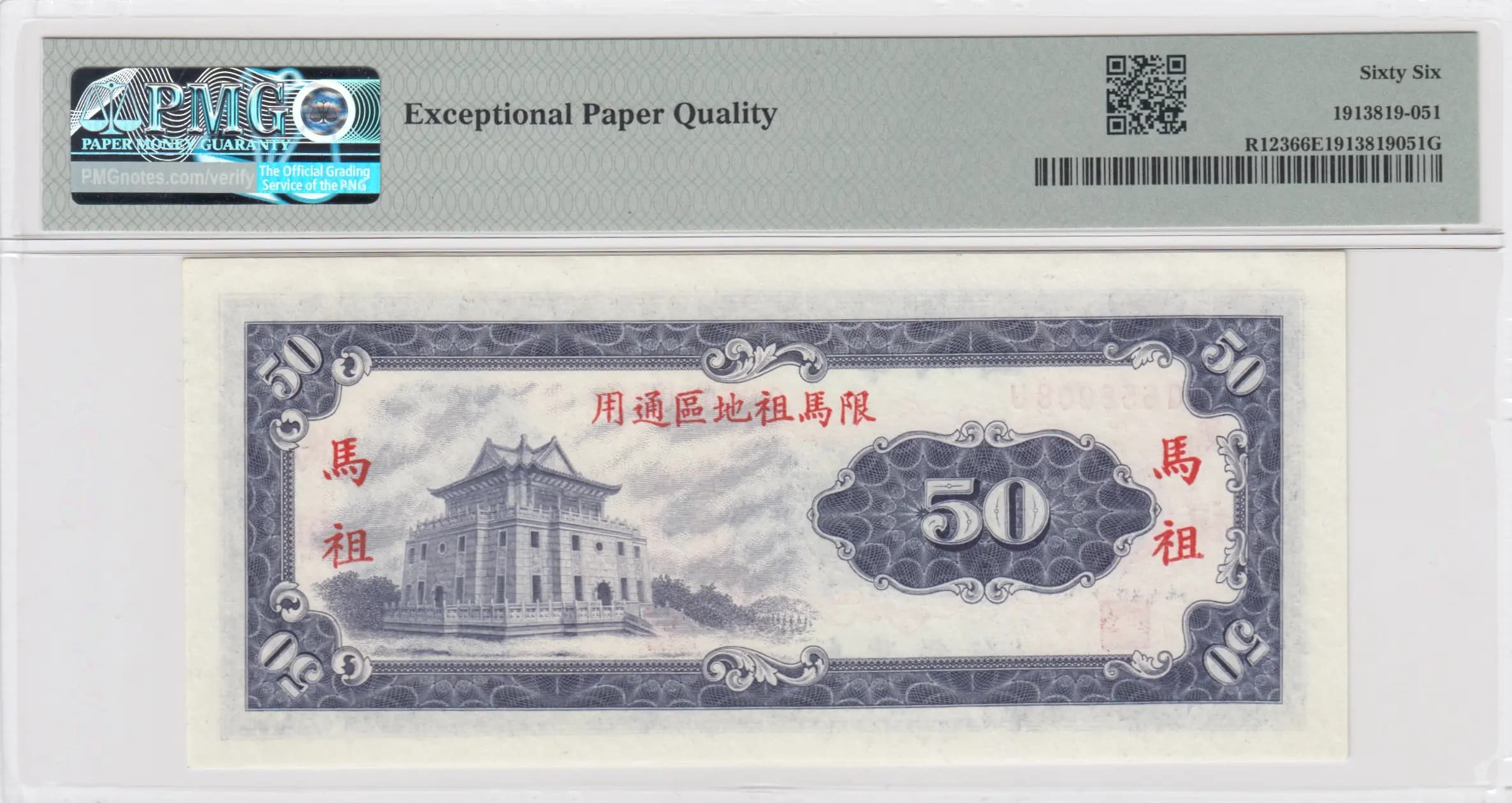
This is a PMG 66 EPQ example of the 1970 Taiwan Bank of Taiwan 50 Yuan Matsu regional note, featuring a striking violet and multicolored design with Dr. Sun Yat-sen's portrait on the obverse and a traditional Chinese pagoda on the reverse. The note exhibits exceptional paper quality and sharp printing characteristic of uncirculated specimens, with crisp serial numbers (Q656008U) and well-preserved security elements including ornate guilloche work and red security seals. As a regional currency issue for the Matsu area, this note represents an interesting chapter in ROC monetary history and commands solid collector interest, particularly in premium grades.
Common. While this is a regional issue for Matsu (a specialized collector interest), the eBay price data strongly indicates common status: PMG 66 examples sold for $130.50 in 2022, which is modest for a 50+ year old note in premium certified condition. Lower grades (EF and UNC uncertified) realized $24.50 and $39 respectively in earlier sales, and the 2019 catalog values ($4 VF, $30 UNC) confirm this is a readily available note in the secondary market. The print run for this denomination and issue was evidently sufficient to ensure circulation in the collector market today.
Issued in 1969-1970 by the Bank of Taiwan, this 50 Yuan note was part of a special regional currency series designed specifically for circulation in Matsu (Mazu), the ROC-controlled islands in the Taiwan Strait. The inclusion of Dr. Sun Yat-sen's portrait underscores the ROC's political identity during the Cold War period, while the architectural landmark on the reverse—likely a significant Matsu structure—reflects the note's specific geographic purpose and the ROC's administrative presence in the territory.
The obverse features a formal portrait of Dr. Sun Yat-sen (Sun Yixian), founder of the ROC, positioned on the right side in traditional Chinese formal attire, a standard iconographic element on ROC banknotes of this era. The reverse displays a significant traditional Chinese architectural structure—likely a pagoda or temple building specific to Matsu—rendered in fine detail on the left side. Both sides employ an ornate border with elaborate guilloche patterning, decorative cartouches (particularly the prominent numeral '50' on the reverse), and red security seals/stamps. The color scheme of violet, blue, red, and beige creates visual hierarchy while maintaining the formal dignity appropriate to official currency.
OBVERSE: 中華民國 (Republic of China) | 五十圓 (Fifty Yuan) | 馬祖 (Matsu) | 臺灣銀行 (Bank of Taiwan) | Q656008U (Serial Number). REVERSE: 50 (Denomination numeral) | 馬祖 (Matsu) | 用通區地租馬限 (Regional currency designation for Matsu area—approximate translation indicating limited regional use).
Intaglio (engraved) printing with offset color layers, as evidenced by the crisp line work, fine guilloche patterns, and precise registration of the multicolored design observed throughout the note. The note was produced by CPF (China Printing Factory), as indicated in the catalog reference. The sharp definition of ornamental elements and the uniform color saturation visible in the images are characteristic of high-quality intaglio production standards used for official government currency.
This example carries the serial number prefix 'Q' with the specific number Q656008U. The 1970 date on the specimen corresponds to the 1969 issue date noted in catalog references (a common practice of dating the year of design/authorization versus printing). No major varieties (such as signature variants or significant overprints) are apparent from the visual analysis, though collectors of Matsu notes should verify serial number ranges and any minor printing variations that may exist within this Pick number. The Pick catalog designation P-R123 suggests this is a regional issue with its own distinct cataloging designation separate from mainland ROC currency.