5 yuan 1955
“Matsu”
Market Prices
9 salesAbout This Note
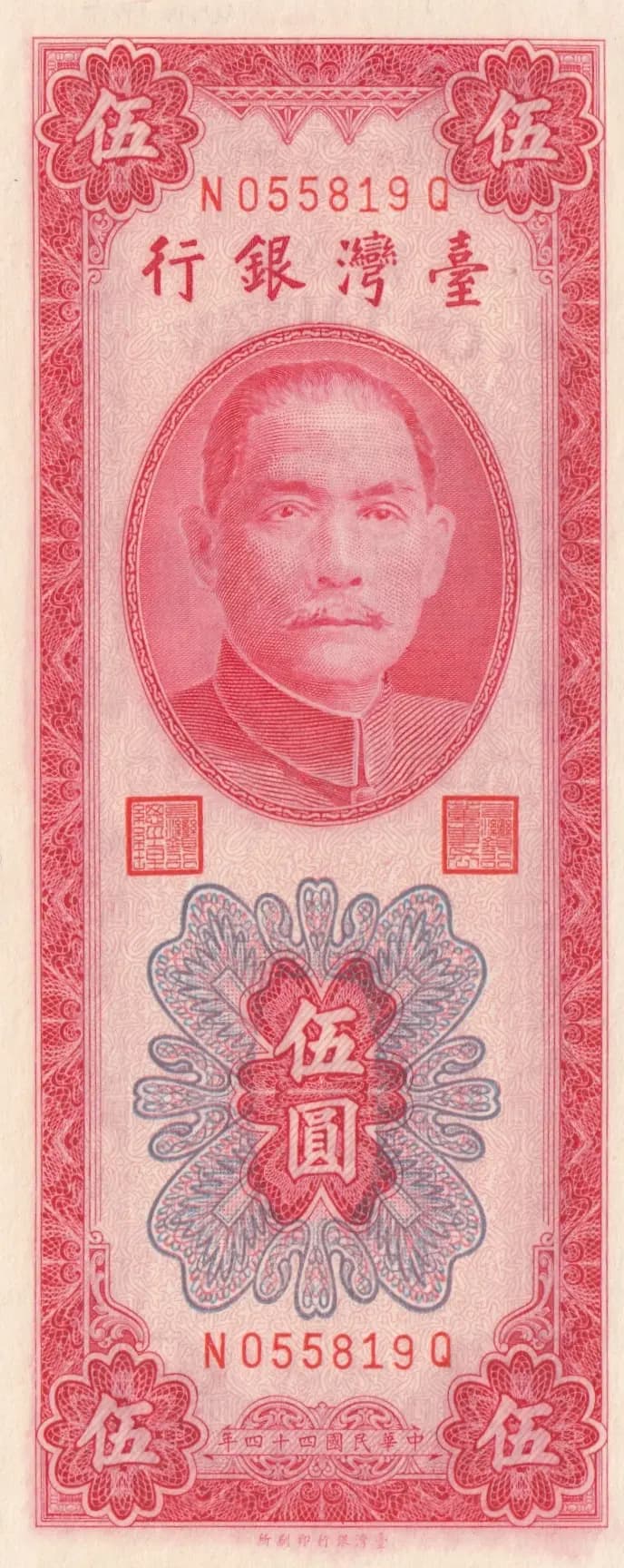
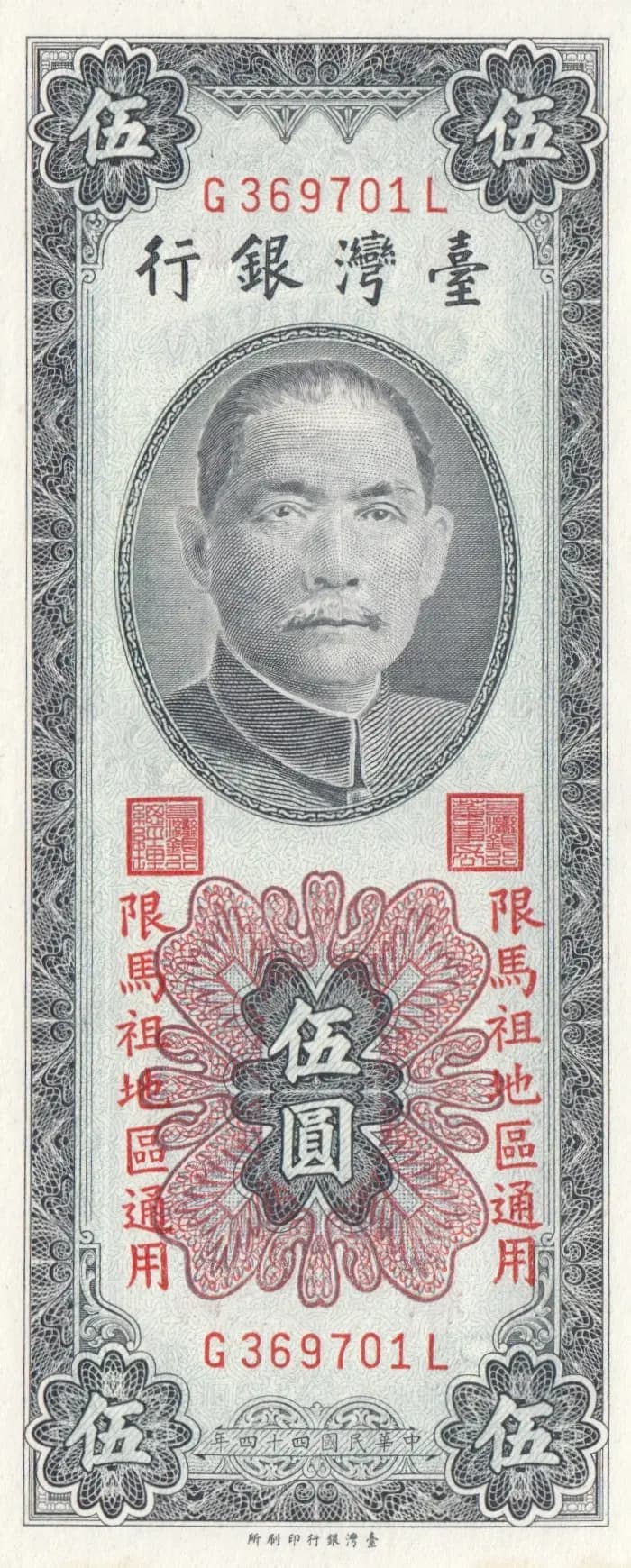
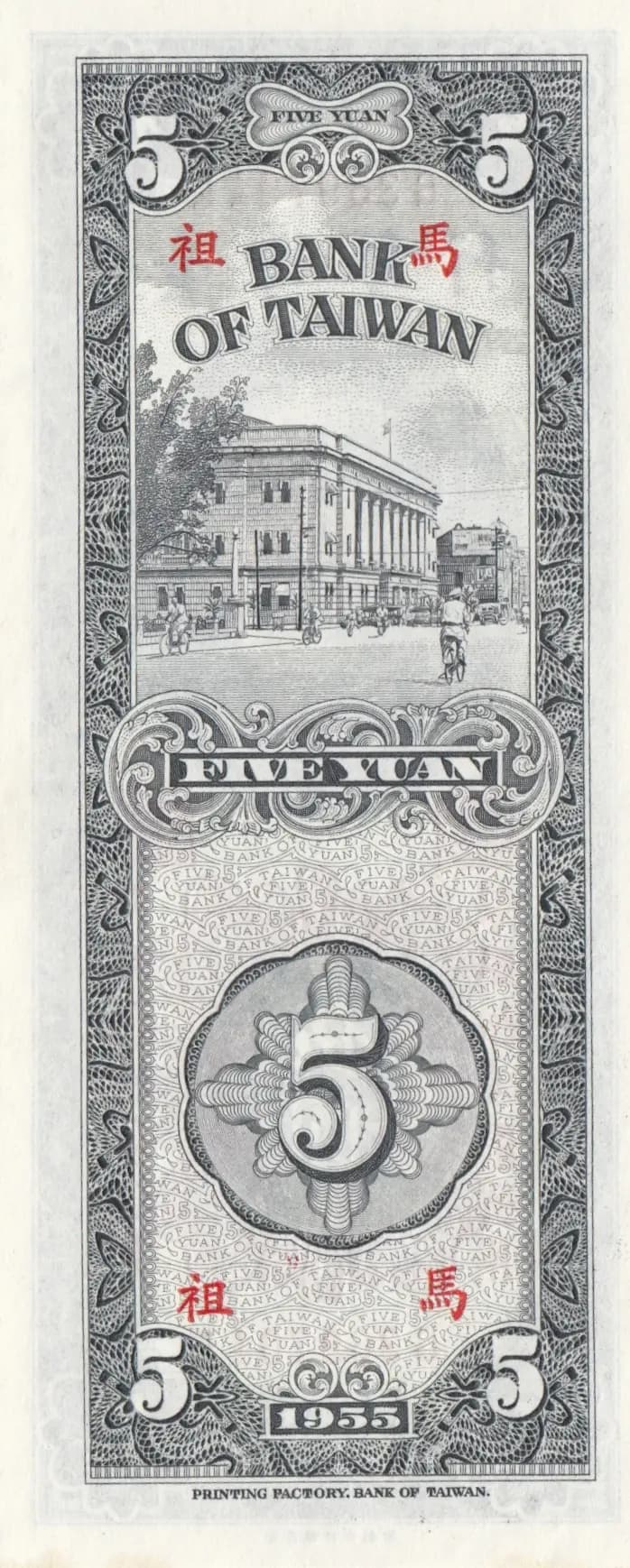
This is an uncirculated 1955 Bank of Taiwan 5 Yuan note (Pick R121), a specialized regional currency issued specifically for use in the Matsu islands, as clearly indicated by the inscription '限馬祖地品通用' on the front. The note displays exceptional preservation with crisp printing, vibrant red and black coloration, and no visible wear, consistent with its UNC grade. The dual-language design (Chinese and English) and architectural imagery of the Bank of Taiwan building reflect the post-war modernization efforts of Taiwan during this period.
Common. While this is a regional/specialized issue limited to Matsu circulation, eBay auction data shows consistent sales activity with multiple UNC examples selling between $27.50 and $44 USD over the past decade, with PMG-graded examples (64-66) commanding $30-$49.99. The volume and frequency of sales, combined with the 2008 catalogue value of $15 UNC and the note's stable pricing trajectory, indicate adequate supply in the collector market. Regional issues of this type were produced in sufficient quantities for their designated markets.
This 5 Yuan note represents a unique chapter in Taiwan's monetary history, issued during the 1950s when the Bank of Taiwan issued specialized currency for the Matsu archipelago, which had strategic military importance during the early Cold War period. The classical architectural rendering of the Bank of Taiwan building on the reverse symbolizes the institution's role in stabilizing Taiwan's post-1949 economy. The restriction to Matsu-only circulation reflects the geopolitical divisions and controlled monetary systems characteristic of 1950s East Asia.
The obverse features a formal portrait of a distinguished male figure with a prominent mustache, wearing military-style formal attire with a high collar, positioned within an ornate oval frame. The portrait is flanked by elaborate floral rosette patterns in red and black, with decorative corner medallions in all four corners. The reverse depicts the Bank of Taiwan's headquarters building, a multi-story classical or colonial-style structure with columned facade, windows, and entrance vestibule with figures. A large ornamental circular medallion containing the numeral '5' anchors the lower center. The entire note employs intricate engraved background patterns for security and aesthetic purposes, with bilingual text (Chinese and English) throughout.
Front side: '伍' (Five), '行銀灣臺' (Bank of Taiwan), Serial number 'G3697011', '伍圓' (Five Yuan), '限馬祖地品通用' (For use in limited areas/For Matsu islands use only). Back side: 'FIVE YUAN' (English denomination), 'BANK OF TAIWAN' (English issuer name), '祖馬' (Matsu/Mazu - the geographic designation), '1955' (year of issue), 'PRINTING FACTORY, BANK OF TAIWAN' (production attribution).
Intaglio (engraved) printing on high-quality banknote paper. The note exhibits fine line work characteristic of security printing of the era, with detailed engraving visible in the architectural rendering, portrait work, decorative borders, and background security patterns. The crisp registration of black and red colors, combined with the precision of fine lines in the floral and geometric ornaments, indicates professional security printing, consistent with the Bank of Taiwan's printing capabilities in the 1950s.
This specimen features serial number G3697011 in red, consistent with the standard issue format for this Pick number. The note is specifically identified as a Matsu-restricted currency variant of the 5 Yuan denomination. No overprints, color variations, or printing errors are evident in this example. The dual-language design (Chinese/English) is standard for this issue type, reflecting international financial practices of the 1950s.