5 yuan 1963
“Quemoy”
Market Prices
23 salesAbout This Note
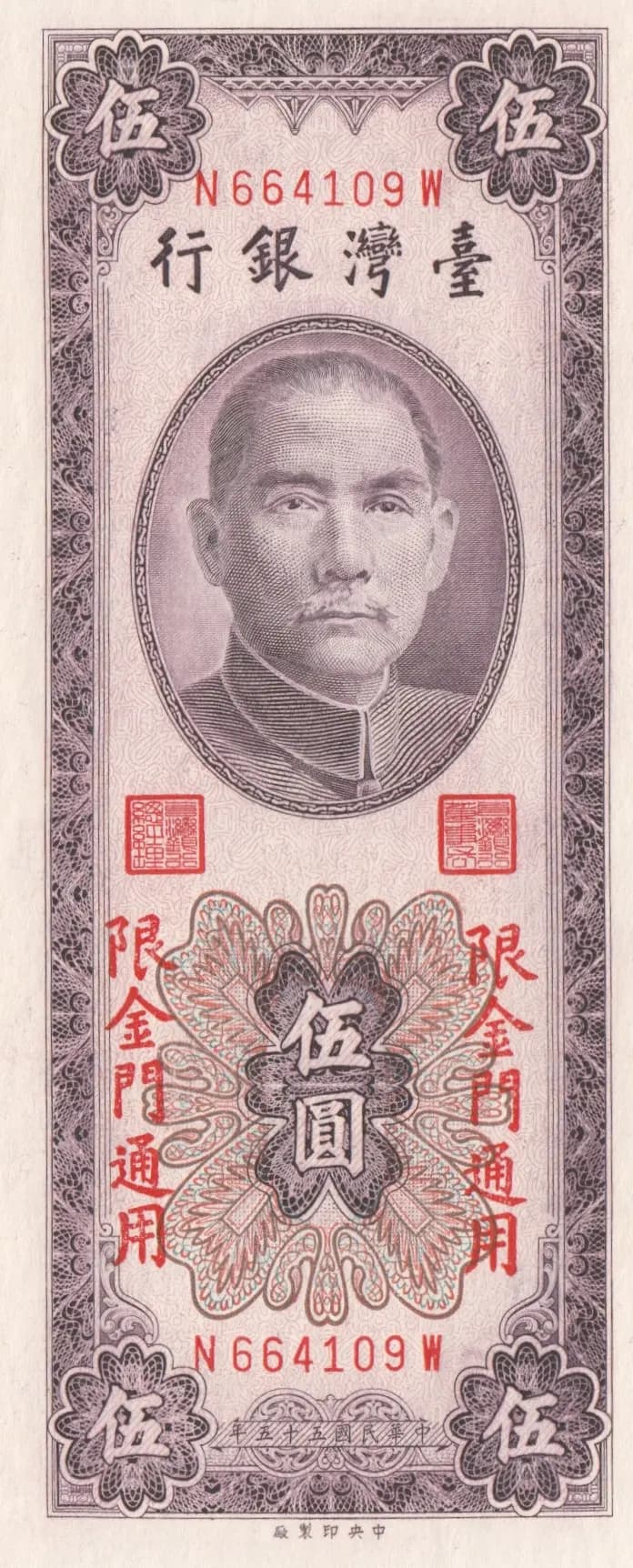
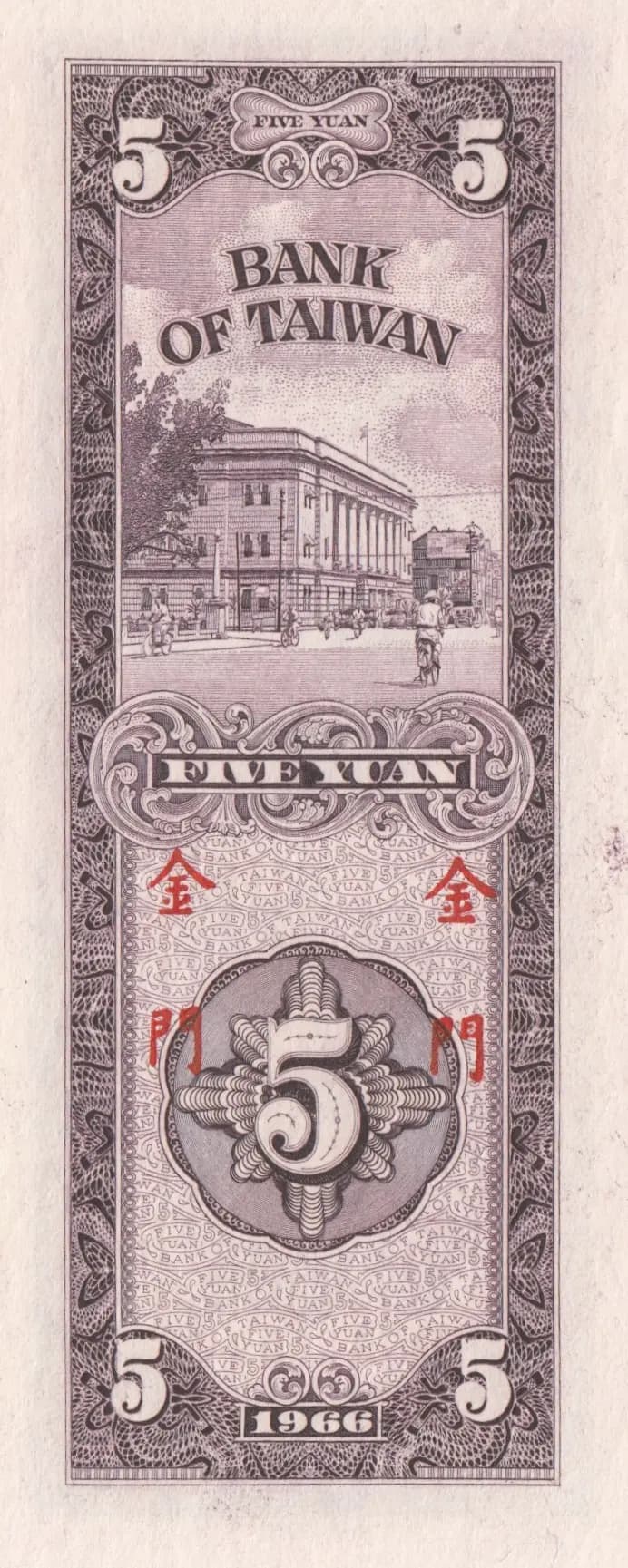
This is a 5 Yuan note from the Bank of Taiwan, issued in 1966 and presented in uncirculated condition. The note features a striking violet-brown color scheme with Dr. Sun Yat-sen's portrait in an oval frame on the obverse, complemented by ornate floral medallion designs in all four corners and an elaborate central decorative emblem. The reverse displays a classical architectural building representing a bank or government structure, rendered in fine engraving detail with street-level activity, making this a visually compelling example of mid-20th century Taiwanese currency design.
Common. The eBay price tracking data shows consistent sales in the $17-$39 range for PMG 65-67 grades, with UNC examples selling for approximately $17.50-$26 as far back as 2013-2014. The 2019 catalogue value for UNC is listed at only $20. This price history and the frequency of sales on the secondary market indicate this is a readily available note with no significant scarcity premium. The note was produced in sufficient quantities to remain common in the numismatic market today.
Issued by the Bank of Taiwan in 1966 during a period of economic development and institutional stability in Taiwan, this note reflects the formal aesthetic standards of the era through its classical architectural imagery and traditional Chinese ornamental design elements. The prominence of Dr. Sun Yat-sen's portrait underscores his continued symbolic importance to the Republic of China government based in Taiwan. The architectural building depicted on the reverse likely represents an important financial or governmental institution of the period, connecting the currency to Taiwan's modernizing infrastructure.
The obverse features Dr. Sun Yat-sen, founder of the Republic of China, depicted in formal attire with mandarin collar in a classical engraving style within a centered oval frame. His portrait is surrounded by ornate floral medallion designs positioned in all four corners and a large elaborate central decorative emblem featuring Chinese numerals and ornamental scrollwork beneath the portrait. The reverse presents a multi-story classical architectural building with prominent columns and formal design, depicted with street-level activity including early 20th century vehicles and pedestrians, symbolizing Taiwan's institutional authority and modernity. The denomination '5' appears in circular ornamental frames with elaborate scrollwork on both sides. The entire note is framed with intricate border designs incorporating traditional geometric and floral patterns typical of high-security banknote design of this period.
Obverse: '臺灣銀行' (Bank of Taiwan), '中央印製廠' (Central Printing Works/Central Printing Factory). Reverse: 'FIVE YUAN' (English denomination, repeated), 'BANK OF TAIWAN' (English issuer), '五圓' (Chinese for Five Yuan), '1966' (Issue year). Serial number visible: N664109W (printed in red at top and bottom of obverse).
Intaglio/engraving process (note-specific printing method standard for banknotes of this era). Printed by CPF (Central Printing Works/中央印製廠), as indicated on the obverse. The visual analysis reveals fine line work, detailed portrait engraving, intricate border designs, and multi-colored printing with precise registration—all characteristic of traditional intaglio banknote production. The crisp, clear print quality and ornamental complexity indicate professional security printing techniques employed during the 1960s.
Serial number N664109W observed on this specimen. The note carries the notation '1966' as the issue date on the reverse, consistent with catalog data and RealBanknotes.com reference identifying this as the 1966 issue (not the 1963 catalog year designation in the provided data—the visual evidence and secondary market sources confirm 1966 as the actual issue year). The use of red ink for serial numbering and the CPF printer attribution (Central Printing Works) are standard features for this Pick number P-R109. No overprints or known major varieties are evident from the visual analysis.