5 cents 1949
Market Prices
6 salesAbout This Note
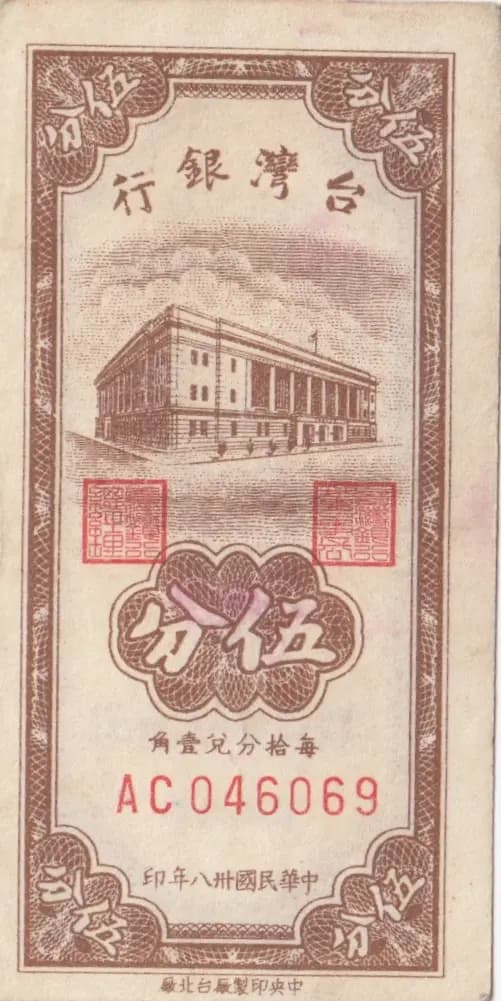
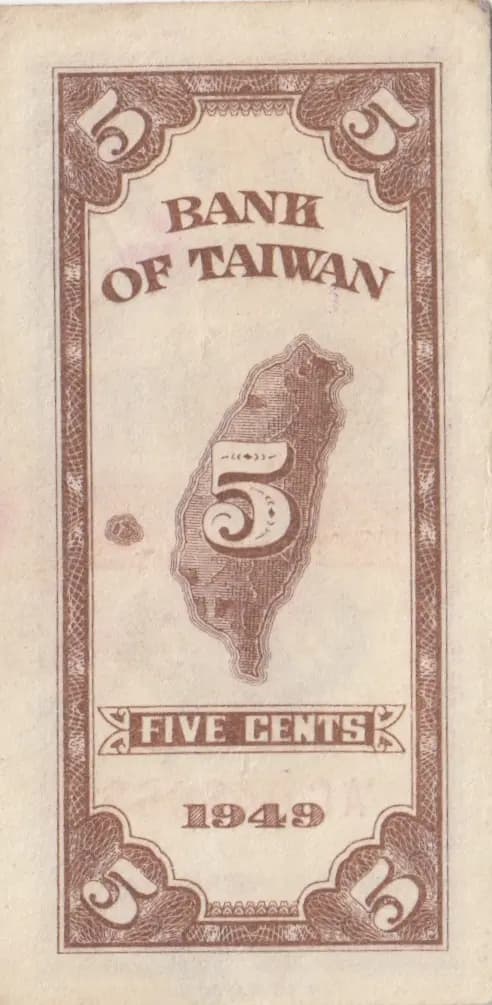
This 1949 Bank of Taiwan 5 Cents note (Pick P-1947) presents a charming example of early post-war Chinese currency featuring the Bank of Taiwan building prominently on the obverse and a striking map of Taiwan on the reverse. In VF condition, the note exhibits expected aging with light foxing and minor creasing, yet retains strong definition in the fine-line engraving and clear impressions of the two red official seals. This denomination represents an interesting artifact of Taiwan's monetary history during the Republic of China's transition period.
Common. eBay price data clearly indicates routine circulation and availability: VF examples consistently sell in the $10–$11 range, with catalogue valuations for VF at $4.50 (as of 2016). The print run for this standard-issue denomination from the Bank of Taiwan's 1949 series was substantial, and examples remain readily available to collectors. No evidence of scarcity, recall, or short production run exists for this Pick number.
Issued in 1949, this note reflects the Bank of Taiwan's role as the designated currency authority during a pivotal moment in Chinese and Taiwanese history—the year the People's Republic of China was established on the mainland while the Republic of China government consolidated control over Taiwan. The obverse's depiction of the Bank of Taiwan building served as a symbol of institutional authority and stability, while the reverse's prominent display of Taiwan's territorial outline reinforced the ROC's administrative claim and national identity during this period of political division.
This vertical rectangular note features a dual-language design reflecting both Chinese and English authority inscriptions. The obverse displays the Bank of Taiwan's institutional headquarters—a classical multi-story building with columns and formal architecture—rendered in fine detail engraving and centered within an ornamental rectangular border featuring intricate geometric and floral corner ornaments. Two red official seals bearing Chinese characters are positioned symmetrically below the building, serving both as authenticating marks and design elements. The reverse presents a bold, simplified outline map of the entire Taiwan island as the central motif, integrated with a large numeral '5' and framed by matching decorative corner patterns. The consistent use of brown and sepia tones throughout both sides creates visual cohesion characteristic of mid-20th century Chinese currency design.
Front: 台灣銀行 (Bank of Taiwan) | 台幣 (Taiwan currency/Taiwan dollars) | 每份拾分貳角 (Per denomination) | 中華民國九十八年 (Year 98 of the Republic of China [1949]) | ACO46069 (Serial number) | 中央印製廠印行 (Printed by Central Printing Factory). Back: BANK OF TAIWAN | 5 (denomination numeral) | FIVE CENTS | 1949 (year of issue).
This note was produced using intaglio (engraved) printing, evidenced by the fine-line engraving quality visible throughout both sides, the precise registration of the ornamental borders, and the sharp impression of the Chinese seal characters. The printer is identified in the inscription as 中央印製廠 (Central Printing Factory), which was the primary security printer for the Republic of China during this period. The consistent tonal gradations and fine detail work across the building and map designs confirm professional engraving techniques rather than lithography.
The observed specimen carries serial number ACO46069 in red. This note is dated 中華民國九十八年 (Year 98 of the Republic of China), which corresponds to 1949 in the Western calendar. Varieties in this Pick number would primarily be identified by serial number prefixes (such as 'A', 'B', 'C', etc.) and signature variations if present, though the visual analysis does not indicate any signed varieties on this example. The consistent design and printing parameters suggest this is from the standard regular issue of 1949.