10 yuan 1969
“Quemoy”
Market Prices
3 salesAbout This Note
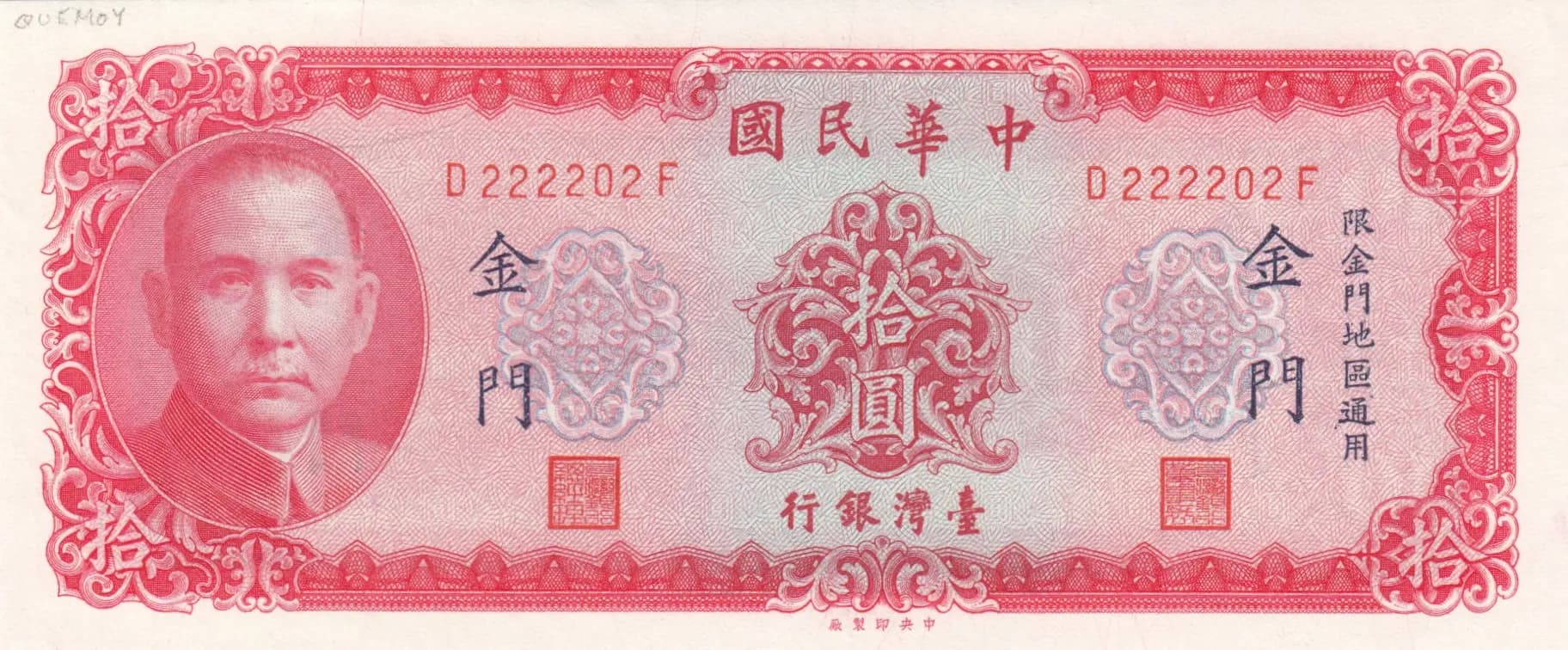
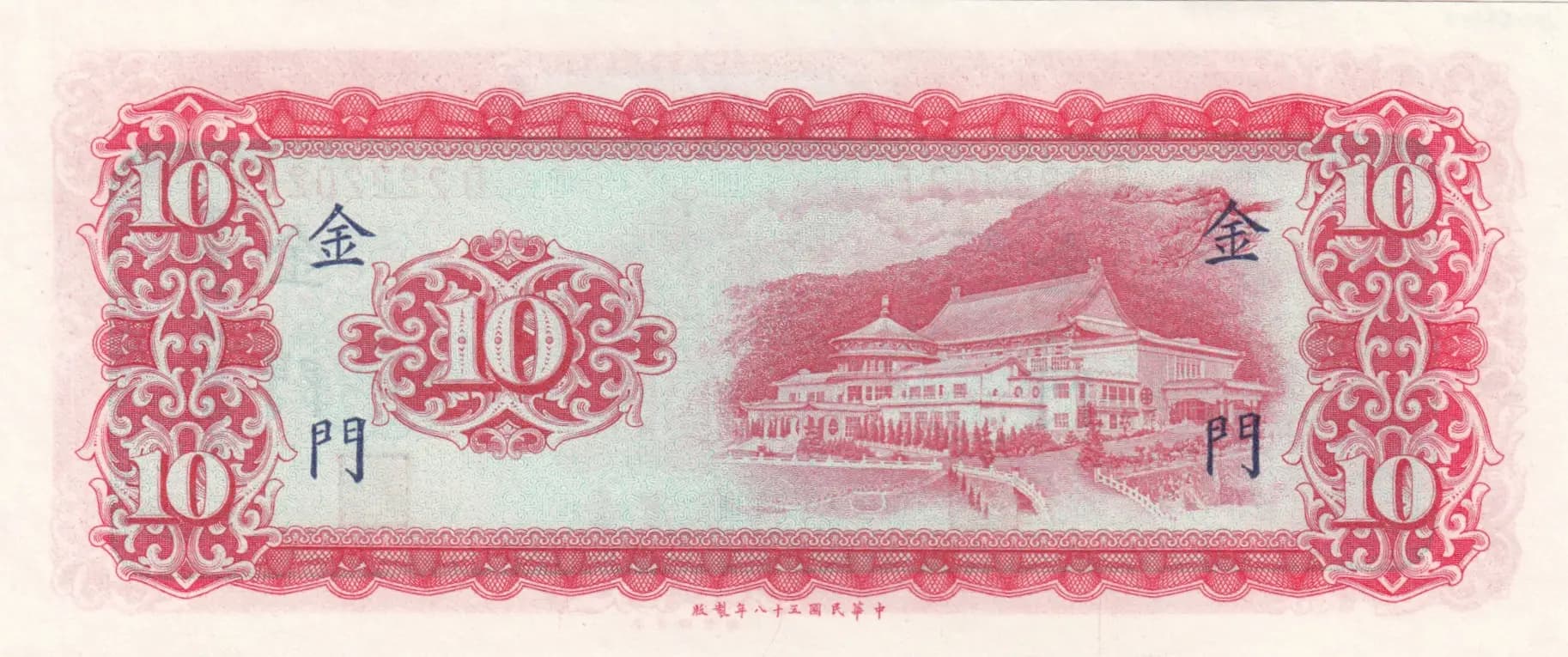
This is an uncirculated 1969 Taiwan 10 yuan note issued by the Bank of Taiwan, specifically overprinted for use in Kinmen (Quemoy). The note features a portrait of Dr. Sun Yat-sen on the obverse in red and multicolor, with ornate baroque-style decorative borders and fine line engraving throughout. The reverse displays a traditional Asian architectural complex with mountainous background, rendered in the same elegant red and cream color scheme. The bright, crisp appearance and absence of wear confirm its uncirculated state.
Common. While this is a Kinmen-specific overprint with limited geographic circulation, market evidence strongly supports a common rating: catalog value is listed at $10 UNC (2019), and recent eBay sales show specimens selling between $6-$35 even in higher grades (PMG 63), with typical AUNC examples fetching $20 or less. No evidence of rarity, short print runs, or recall status exists for this Pick number. The Kinmen overprint adds regional interest but does not substantially restrict supply in the collector market.
This note represents a significant period in cross-strait monetary history, issued during the height of the Cold War when Kinmen Island remained under Republic of China control just miles from mainland China. The overprint specifically designating this for 'Kinmen area use' reflects the unique monetary arrangements necessitated by the political division of China. The continued issuance of notes bearing Dr. Sun Yat-sen's portrait underscores the ROC government's historical legitimacy claims and its role as custodian of the Three Principles of the People that Sun established.
The obverse features a formal portrait of Dr. Sun Yat-sen (1866-1925), founder of the Republic of China, positioned at the left in three-quarter pose wearing contemporary formal dress. The portrait is rendered in the classical banknote engraving style with meticulous attention to facial features and clothing detail. The design incorporates symmetrical ornamental medallions with traditional Chinese motifs flanking the central text area, and elaborate baroque-style scrollwork in pink and red tones frames the entire composition. The reverse depicts the Kinmen Garrison headquarters or similar significant ROC military installation on the island, rendered as a detailed architectural landscape scene with mountain backdrop, symbolizing the administrative and military importance of the territory. The denomination '10' appears prominently in ornate corner medallions on all four corners of the reverse.
FRONT: 中華民國 (Republic of China) | D2222202F (Serial Number) | 金門 (Kinmen/Quemoy) | 清華銀行 (Qinghua Bank) | 門地區通用 (For use in this area). BACK: 10 (Denomination) | 金門 (Kinmen/Quemoy) | 中華民國十元 (Republic of China 10 Yuan).
Intaglio (engraved) printing on multicolor underprint, a standard technique for banknote production. The fine line engraving visible throughout the design—particularly in the portrait shading, border scrollwork, and architectural details—is characteristic of high-security currency printing of the era. The precision of the decorative elements and the clarity of the multicolor separation indicates professional currency printing by the Bank of Taiwan's approved security printer, likely the Taiwan Currency Printing Plant.
This specimen is identified as a Kinmen area overprint variety with the serial number prefix 'D2222202F'. The 1969 issue date with 1975 printing notation (per REALBANKNOTES reference) indicates a later production run of this denomination. Kinmen overprint varieties are distinguished by the specific text '金門' and regional use designation '門地區通用' visible on both sides. Collectors should note that Kinmen overprints of this period exist with varying serial number prefixes and printing dates, representing different batches of currency prepared for island use.