10 000 yuan 1948
Market Prices
About This Note
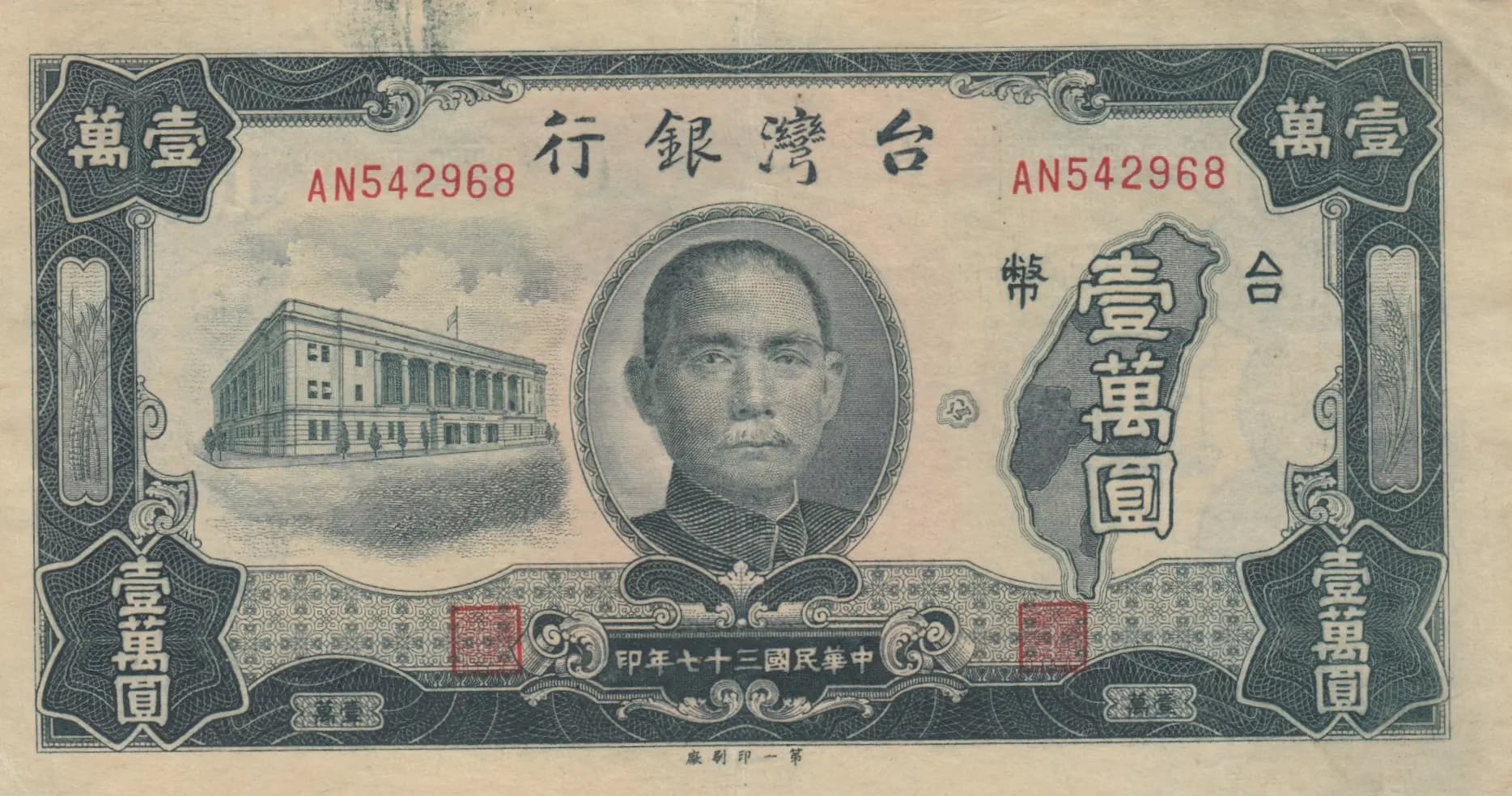
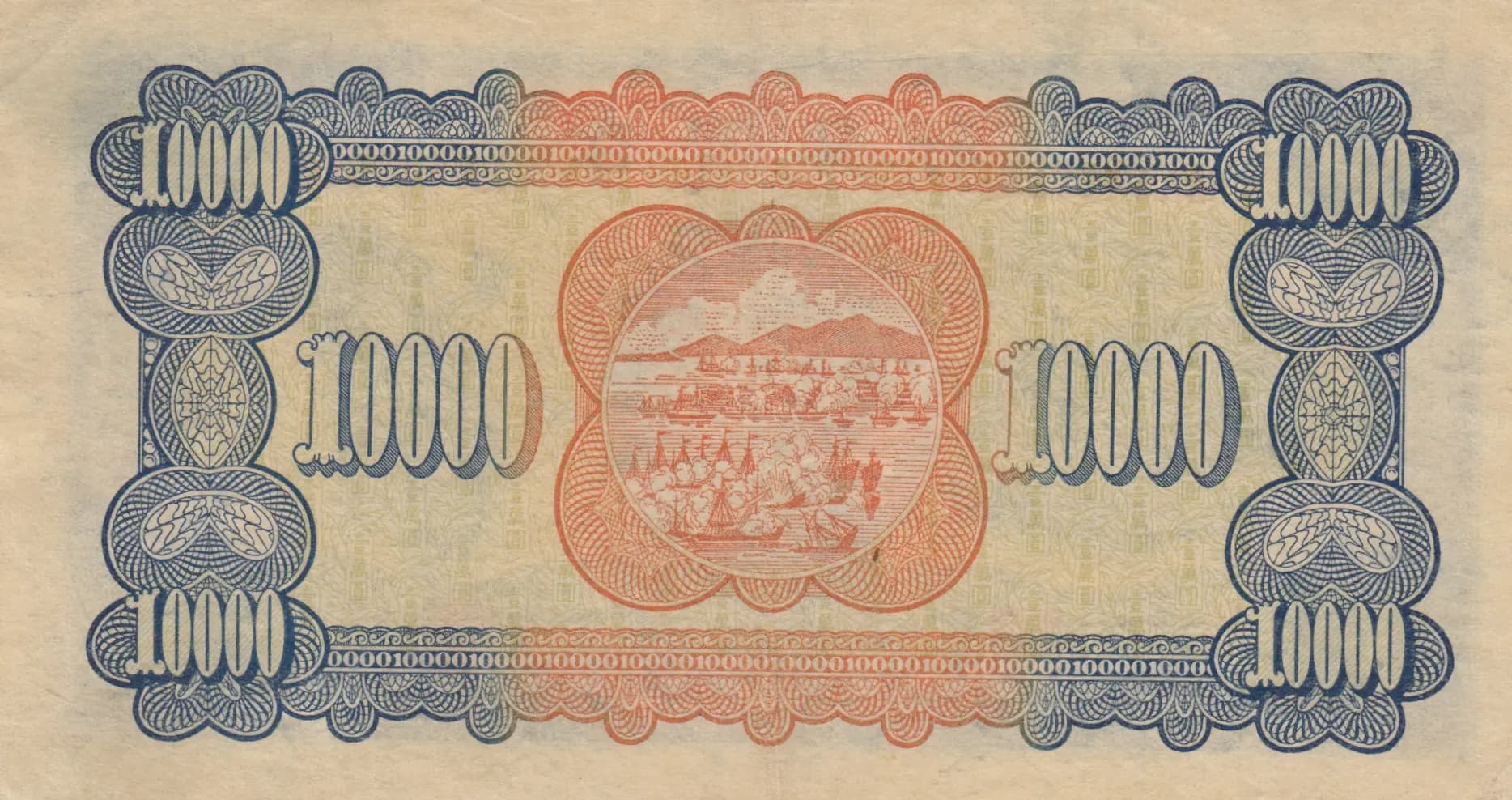
This 1948 Bank of Taiwan 10,000 Yuan note (Pick P-1944) presents an impressive example of early post-war Chinese currency design with ornate two-color printing in dark teal-green and red. The obverse features Dr. Sun Yat-sen in military dress centered between the Bank of Taiwan building (left) and decorative cartouche (right), while the reverse displays an elaborate landscape scene within a scalloped cartouche surrounded by intricate geometric corner medallions. In AU condition, the note shows expected age-related patina including foxing and yellowing, yet maintains excellent clarity in printing with no tears or major damage—a notable preservation for this 75+ year old note.
Common. The eBay market data shows a wide range of listed prices with numerous sales in the $5–$50 USD range, indicating reasonable supply and accessibility to collectors. While 2016 catalogue values suggested $100–$200 for VF/UNC specimens, the actual eBay market liquidity and repetitive listings at significantly lower prices ($15–$25 range) confirm this is not a scarce issue. The Bank of Taiwan issued these notes in substantial quantities during 1948, and survivors exist in moderate numbers despite the historical period.
Issued in the 37th year of the Republic of China (1948), this banknote represents the Bank of Taiwan's currency during the turbulent period following Japan's WWII defeat and the subsequent Chinese Civil War. The reverse depicts a naval battle against the Danes in 1633, referencing Taiwan's pre-modern history as a contested colonial territory, while the prominent inclusion of Dr. Sun Yat-sen reinforced the legitimacy of the Republic of China government during this politically fragmented era. The note's issuance predates the KMT's retreat to Taiwan by one year, making it historically significant to the transition period.
The obverse features a formal military portrait of Dr. Sun Yat-sen (founder of the Republic of China) in the central oval frame, flanked by the neoclassical Bank of Taiwan building with regular window patterns and columned facade on the left. The right side displays a decorative cartouche with Chinese characters. An elaborate geometric border with ornate corner medallions and scrollwork frames the entire design in two-color lithography (dark teal/blue-green with red accents and seals). The reverse showcases a landscape scene—likely depicting Taiwan's 1633 naval engagement against Danish colonial forces—rendered in reddish-orange tones within an ornamental scalloped cartouche. Four matching corner medallions with star and floral geometric patterns in blue and cream surround the central vignette, with large denomination numerals '10000' integrated throughout the border design.
Front: '台灣銀行' (Bank of Taiwan); '台灣壹萬圓' (Taiwan Ten Thousand Yuan); '中華民國三十七年印' (Printed in the 37th year of the Republic of China [1948]); Serial number 'AN542968' (appears twice). Back: '10000' (denomination numerals in Arabic, appearing in multiple locations across the ornamental border).
Multi-color lithography (two-color process on front, three-color on reverse) employing fine line engraving techniques. The printer is identified as FPFT (Foo Pang Foo Tong or similar Chinese security printer designation). The note demonstrates sophisticated use of geometric line patterns, color separation, and ornamental engraving typical of high-security banknote production from this era. Red seal stamps (chops) are integrated as part of the design rather than applied separately.
Serial number prefix 'AN' with S/M catalog number T72-23 identifies this as a standard regular issue from the primary printing. No overprints, signature variations, or special markings are evident from the visual analysis. The note appears to be a straightforward regular circulation issue without known major varieties. Specific printer information (FPFT) and the T72-23 designation aid in cataloging but do not indicate a rare variety—this represents the standard production variety for Pick P-1944.