50 piastres 1942
Market Prices
4 salesAbout This Note
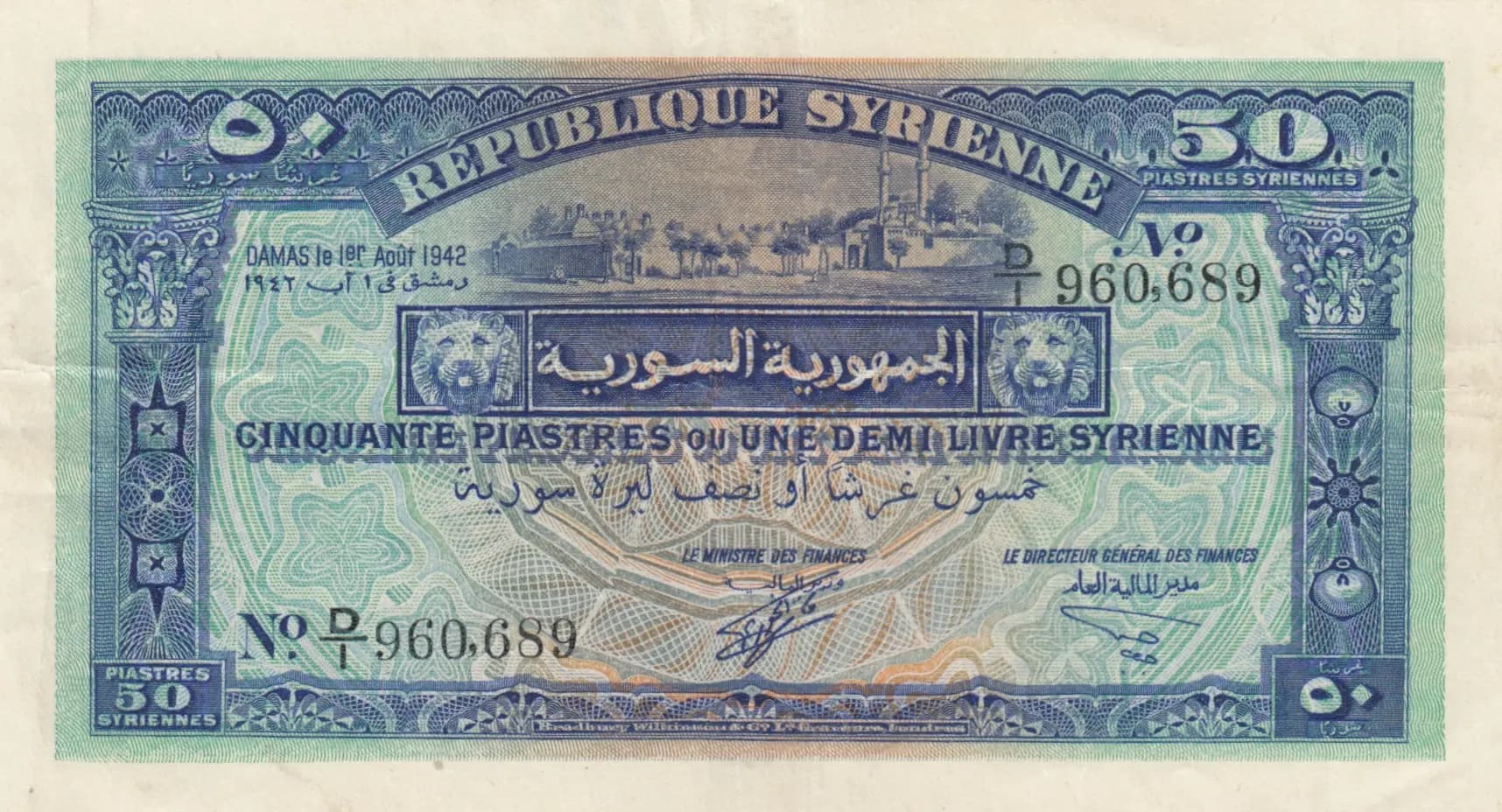
This Syrian 50 Piastres note from 1942 is a well-executed example of Republique Syrienne currency featuring a beautiful Damascus cityscape on the obverse with Islamic architectural elements rendered in blue and green. In VF condition, the note displays age-appropriate creasing and yellowing but maintains excellent legibility and clear detail in the intricate engraved borders and dual serial numbers. This piece represents an important early post-mandate Syrian issue during a transitional period in the nation's history.
Common. The eBay market data provided indicates consistent sales in the $20-81 range for similar conditions over multiple years, with 2016 catalogue values placing VF examples at $50—typical pricing for widely circulated mandate-period Syrian currency. Print runs for this issue were substantial, and examples remain available in the collector market without difficulty.
Issued on 1 August 1942 during Syria's period under French Mandate administration (which ended in 1946), this note reflects the bilingual French-Arabic currency conventions of the era. The depicted Damascus cityscape with its prominent mosques and minarets symbolized Syrian national identity, while the later architectural elements on the reverse suggest the Citadel of Aleppo, another iconic symbol of Syrian heritage. The denomination system (piastres/demi-livre) and issuer designation maintain the Ottoman-influenced monetary structure that persisted through the mandate period.
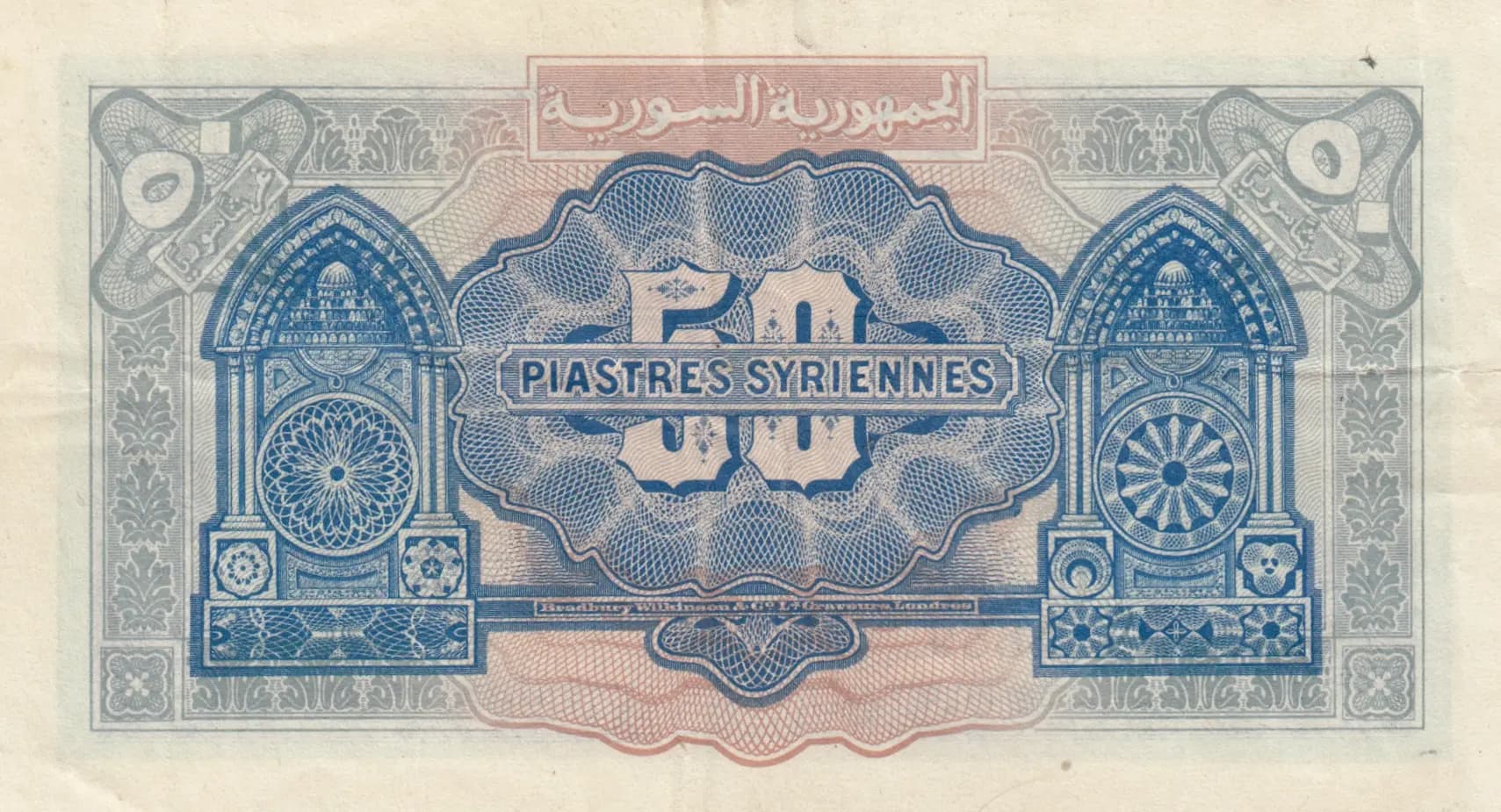
The obverse features a panoramic view of Damascus with its characteristic mosques and minarets rendered in blue and green tones, occupying the central composition. The cityscape is framed by ornate Islamic-inspired geometric and floral decorative borders incorporating stars, crescent moon motifs, and sunburst designs typical of Islamic artistic tradition. Two serial numbers appear in different positions (top right and bottom left), and both French and Arabic text is prominently displayed reflecting the bilingual administration of the mandate period. The reverse side showcases Islamic architectural ornamentation with symmetrical arched doorways, rose windows with radiating geometric patterns, and elaborate ornamental borders. The denomination cartouche is centrally positioned within an ornamental shield. The overall aesthetic emphasizes Syrian cultural and religious heritage through architectural symbolism.
Front side: 'REPUBLIQUE SYRIENNE' (Syrian Republic), '50 PIASTRES SYRIENNES' (50 Syrian Piastres), 'DAMAS le 1er Aout 1942' (Damascus 1st August 1942), 'الجمهورية السورية' (Syrian Republic in Arabic), 'CINQUANTE PIASTRES OU UNE DEMILIVRE SYRIENNE' (Fifty Piastres or One Half Syrian Pound), 'خمسين قرش أو نصف ليرة سورية' (Fifty Piastres or Half Syrian Pound in Arabic), 'LE MINISTRE DES FINANCES' (Minister of Finance), 'LE DIRECTEUR GÉNÉRAL DES FINANCES' (Director General of Finances), 'وزير المالية' (Minister of Finance in Arabic), Serial numbers 'N° 960,689' and 'N° D 960,689'. Reverse side: 'الجمهورية السورية' (Syrian Republic in Arabic), 'PIASTRES SYRIENNES' (Syrian Piastres), '50' (denomination).
Engraved intaglio printing as evidenced by the fine line work, intricate background patterns, and sharp detail in the ornamental borders. The note was produced by Bradbury Wilkinson of New Malden, a premiere security printer known for high-quality banknote engraving. The dual serial numbers and complex geometric security patterns reflect the sophisticated anti-counterfeiting measures of the era.
The observed serial number format 'N° 960,689' and 'N° D 960,689' (with prefix letter 'D') represents the standard variety for this Pick number. The date inscription 'DAMAS le 1er Aout 1942' is consistent with the first and primary issuance of this denomination. No overprints, commemorative markings, or other distinguishing varieties are evident in this example.