5 piastres 1919
Market Prices
10 salesAbout This Note
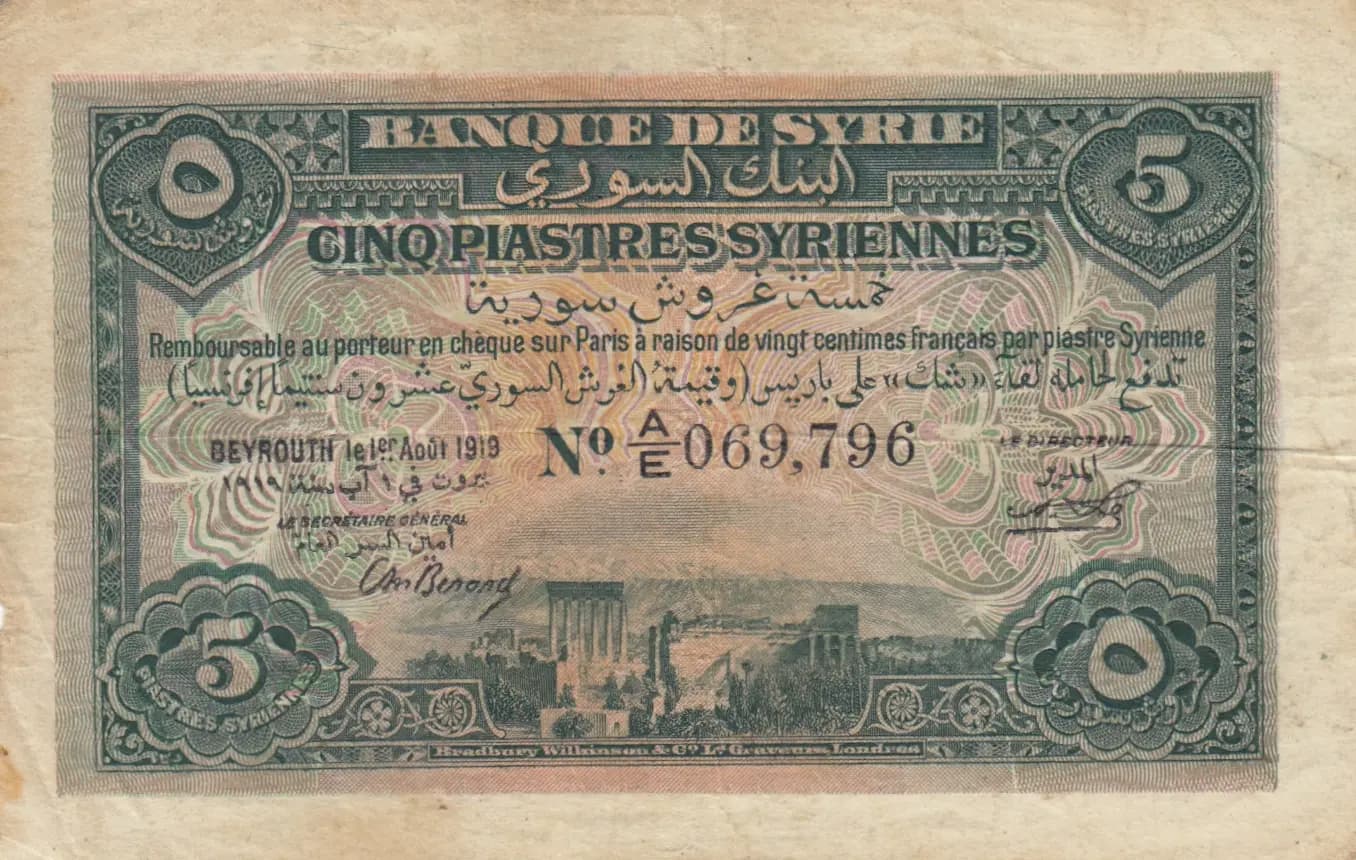
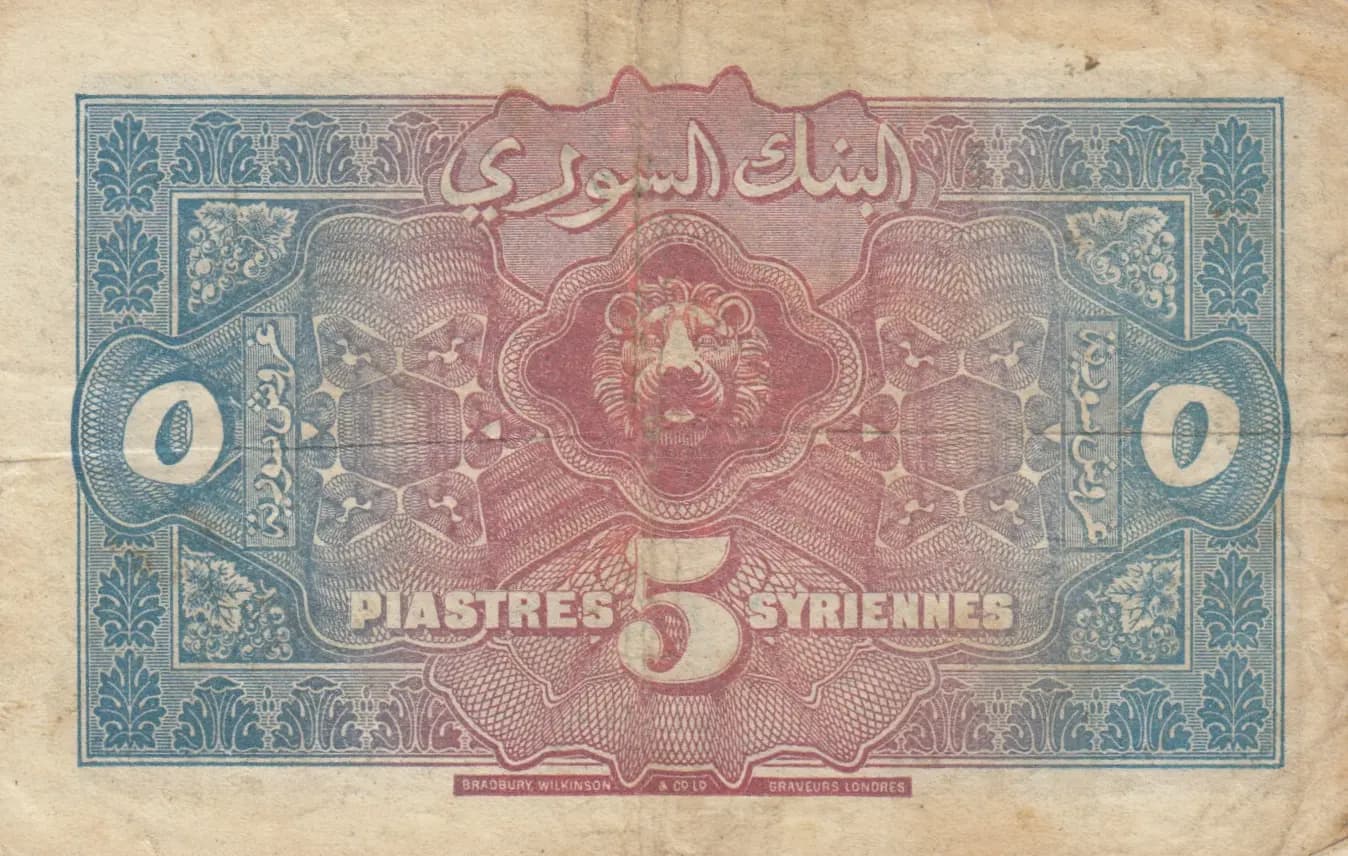
This is a 5 Piastres Syriennes banknote from the inaugural 1919 issue of the Banque de Syrie, Pick P-1a, in Fine condition. The front features the celebrated Columns of Baalbek rendered in green and multicolor tones, while the reverse displays an ornate portrait medallion in blue and mauve. Despite visible creasing, staining, and color fading consistent with its age and circulation, the note retains excellent clarity of the fine engraving work, making it a historically significant example of early Syrian monetary authority.
Common. The eBay price history demonstrates steady circulation and availability in the secondary market, with F-grade examples selling for $68–$204 across a span of 14 years (2009–2024), indicating regular supply. Recent sales of F-grade notes (2024) at $71 with 21 bids, combined with 2016 catalog values placing F-grade at only $35, confirm this is a widely held and accessible note. The 1919 first issue was likely printed in substantial quantities to establish the new central bank's credibility, and surviving examples remain common enough to support steady collector demand without commanding premiums.
This note was issued on August 1, 1919, just months after the Ottoman collapse and during the establishment of French mandate governance in Syria—a pivotal moment when the newly formed Banque de Syrie asserted monetary sovereignty. The choice to feature the Columns of Baalbek, one of the Levant's most iconic Greco-Roman monuments, symbolized Syria's ancient cultural heritage and legitimacy as a modern nation-state. The bilingual French-Arabic inscriptions and redemption clause tied to Paris reflect the transitional political reality of the French mandate period.
The obverse (front) features a classical landscape engraving of the Columns of Baalbek—the iconic Greco-Roman ruins located in the Bekaa Valley of Lebanon—positioned at the lower center in dark green and multicolor underprint. The composition is framed by ornate bilingual borders incorporating elaborate floral and geometric patterns in green and pink/mauve, with corner denomination medallions displaying the numeral '5'. The reverse (back) presents a formal portrait of a male figure with facial hair depicted in profile or three-quarter view within an intricate medal-like circular frame, surrounded by symmetrical winged ornamental scrollwork and geometric patterns in blue and pink/mauve. Both sides showcase the high-quality fine-line engraving characteristic of Bradbury Wilkinson security printing, with bilingual French-Arabic text establishing this as an official instrument of the newly constituted Banque de Syrie.
{"front":{"issuer":"BANQUE DE SYRIE / البنك السوري (Bank of Syria)","denomination":"CINQ PIASTRES SYRIENNES / خمسة قروش سورية (Five Syrian Piastres)","redemption":"Remboursable au porteur en chèque sur Paris à raison de vingt centimes français par piastre Syrienne (Redeemable to bearer by check on Paris at the rate of twenty French centimes per Syrian piastre)","date_location":"BEYROUTH le 1er Août 1919 (Beirut, August 1, 1919)","serial":"N° A E069,796 (Serial Number A E069,796)","officer_title":"LE SECRETAIRE GENERAL (The Secretary General)","signature":"A.M. Barraud","printer":"Bradbury, Wilkinson & Co Ltd London"},"back":{"issuer":"البنك السوري (Bank of Syria)","denomination":"PIASTRES 5 SYRIENNES (5 Syrian Piastres)","printer":"Bradbury, Wilkinson & Co Ltd / GRAVEURS LONDRES (Engravers London)"}}
Intaglio engraving (line engraving) executed by Bradbury, Wilkinson & Co Ltd of London, a leading British security printer. The visual evidence of intricate fine-line work, detailed border patterns, multiple color registration, and the sophisticated security features typical of BWC production confirm this is a high-quality intaglio banknote. The multi-color printing was achieved through successive runs of engraved plates, a standard security printing method of the era.
This note is identified as Pick P-1a based on the catalog data and PMG records. The serial number prefix 'A E' and signature of A.M. Barraud are characteristic of the P-1a variety. Bradbury Wilkinson printing is confirmed. The PMG Population Report notes that Pick P-1 exists in at least two major varieties (P-1a and P-1b) with additional currency test specimen variants (P-1cts), though the differences between these are likely signature, printer block, or subtle design variations not clearly distinguished in standard references. The observed example shows no overprints, stamps, or special markings indicating it is a regular-issue note rather than a specimen or special variant.