25 pounds 1958
Market Prices
5 salesAbout This Note
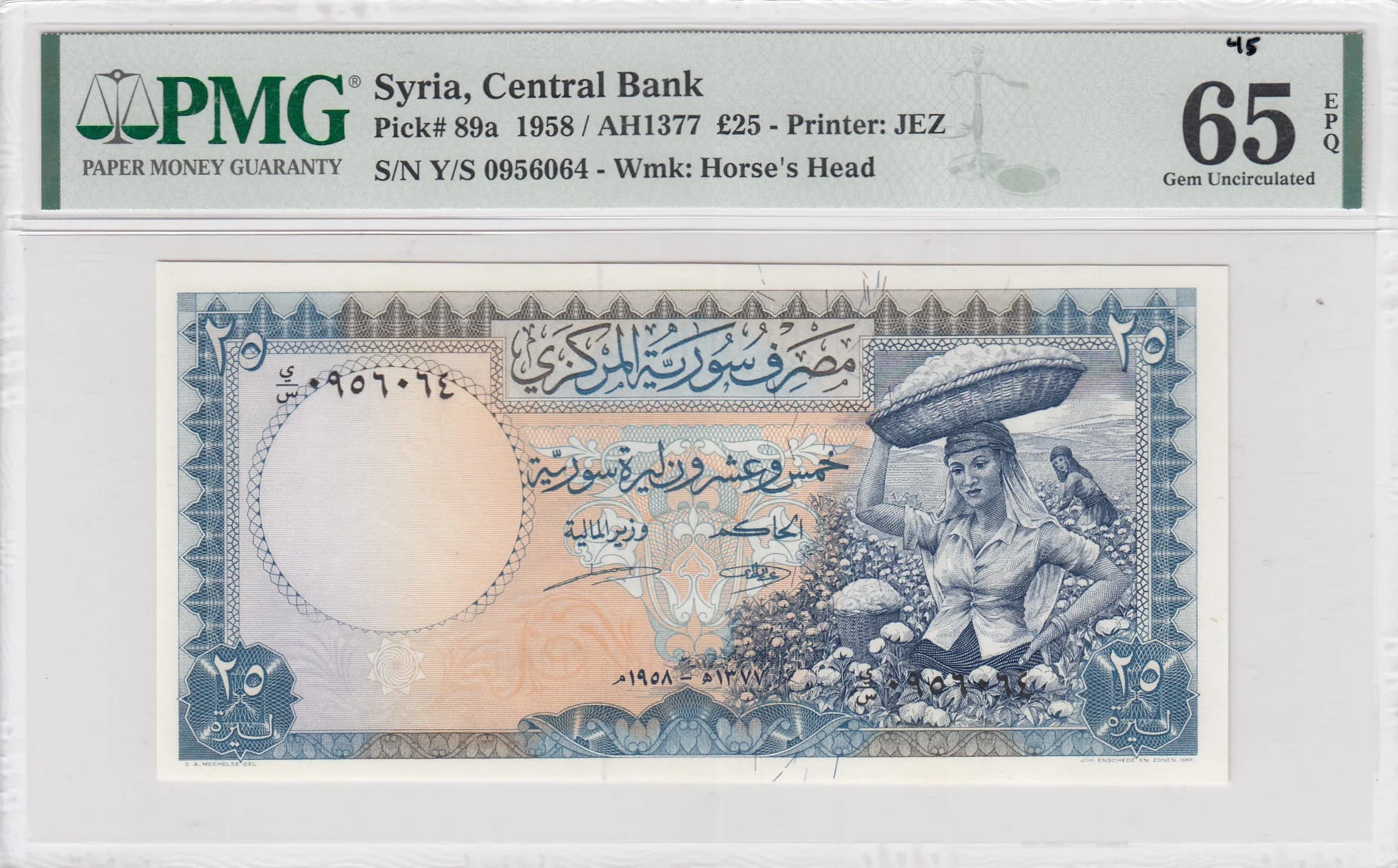
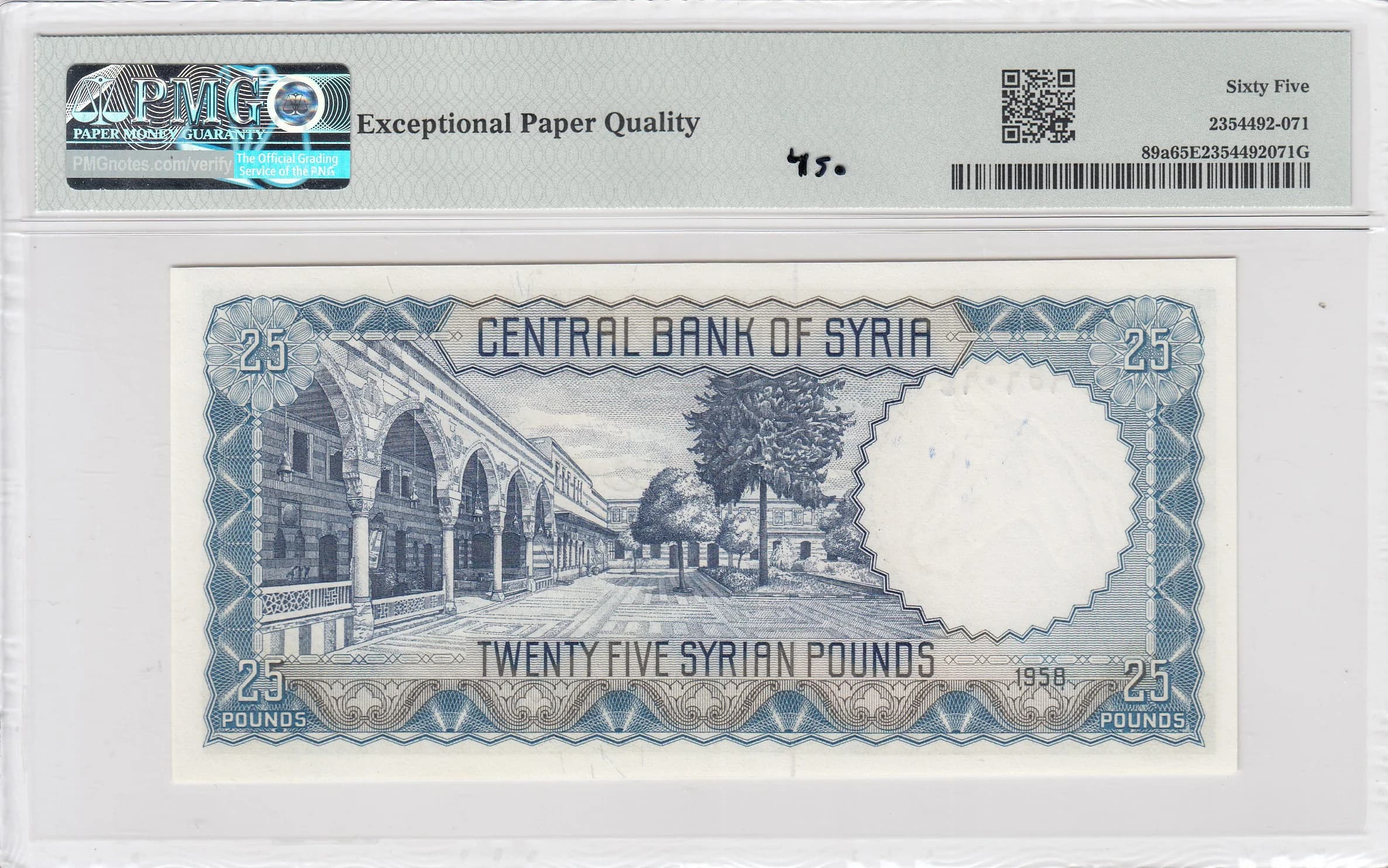
A stunning example of Syria's 1958 25 pound note in PMG 65 EPQ condition, representing a pivotal moment in Syrian monetary history following independence. The obverse features an elegant engraved portrayal of a woman in traditional Syrian dress harvesting cotton—a key economic symbol of the era—while the reverse showcases the classical Azem Palace in Damascus, exemplifying Syrian cultural heritage. This gem uncirculated specimen displays exceptional eye appeal with pristine surfaces, vibrant blue and multicolor printing, and no visible circulation wear, making it a highly desirable example for collectors of Middle Eastern currency.
Common. While this is a historically significant issue from Syria's early independence period, the 1958 25 pound denomination was part of a regular circulation series issued in substantial quantities by the Central Bank of Syria. eBay market data confirms common-grade examples (VG) sell for $30-35, with even UNC specimens from 2015 realizing under $660. The PMG population report shows this is a straightforward cataloged Pick number with established variants. Only exceptional high-grade examples (PMG 65 and above) command premium prices ($500+), reflecting condition rarity rather than inherent scarcity of the issue itself.
Issued in 1958 by the newly independent Central Bank of Syria, this banknote reflects Syria's post-colonial identity and economic priorities during a period of significant political transformation. The cotton harvest imagery celebrates the nation's agricultural foundation and rural economy, while the Azem Palace—a masterpiece of 18th-century Ottoman-era Damascus architecture—symbolizes Syria's rich historical and cultural continuity. The bilingual English-Arabic inscriptions demonstrate the modernizing Central Bank's commitment to international financial standards during this formative period of Syrian statehood.
The obverse depicts a scene of cotton harvesting, with a woman wearing traditional Syrian dress and head covering prominently featured in the right portion of the note, holding a large woven basket filled with cotton. A secondary figure is visible in the background among cotton plants, emphasizing the agricultural labor involved in this crucial economic sector. The left side features an elaborate circular guilloche design, a security feature typical of high-value banknotes of this era. The reverse displays the Azem Palace (Qasr al-Azem) in Damascus, rendered as a classical colonnade with multiple arched openings creating a distinctive arcade effect, with a tree-lined street perspective suggesting the palace's urban setting in the Old City of Damascus. Both sides incorporate ornamental geometric border patterns and corner rosettes characteristic of mid-20th century Central Bank design standards.
Front side: 'مصرف سوريا المركزي' (Central Bank of Syria), '٢٥' (25), '١٩٥٨' (1958), 'Y/S 0956064' (Serial number). Back side: 'CENTRAL BANK OF SYRIA' (Central Bank of Syria), 'TWENTY FIVE SYRIAN POUNDS' (Twenty Five Syrian Pounds), '25' (denomination numeral), 'POUNDS' (denomination name), '1958' (year of issue).
Intaglio engraving (copperplate) executed by Joh. Enschede of the Netherlands (identified as JEZ on the note), one of the world's premier security printers. The fine line engraving visible throughout the note—particularly evident in the guilloche patterns, architectural details, and decorative borders—is characteristic of high-security intaglio production. The multicolor underprint combined with blue as the dominant color was achieved through sophisticated multi-pass printing techniques standard for Central Bank currency production.
This example is cataloged as Pick-89a, with the 'a' designation indicating the primary variety of the 1958 issue. The serial number format 'Y/S 0956064' is typical of this issue. The note exhibits bilingual inscription layout (Arabic obverse with English reverse text), which is characteristic of the P-89a variety. No overprints or significant printer's marks are observed. The watermark area on the left side would contain an Arabian horse's head design, consistent with documented features for this Pick number. This represents the standard-issue circulation note rather than a specimen or special printing variant.