25 piastres 1942
Market Prices
10 salesAbout This Note
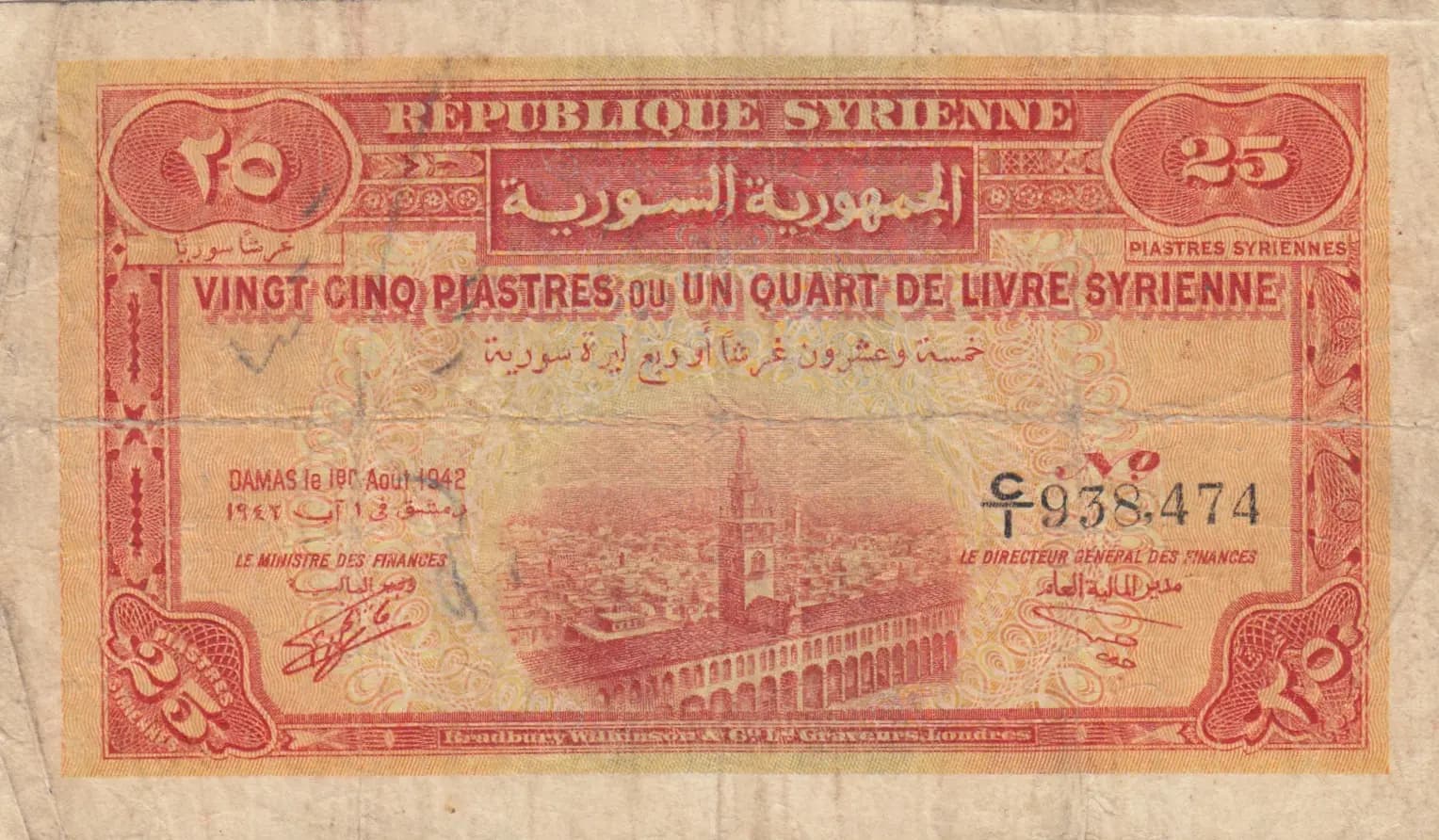
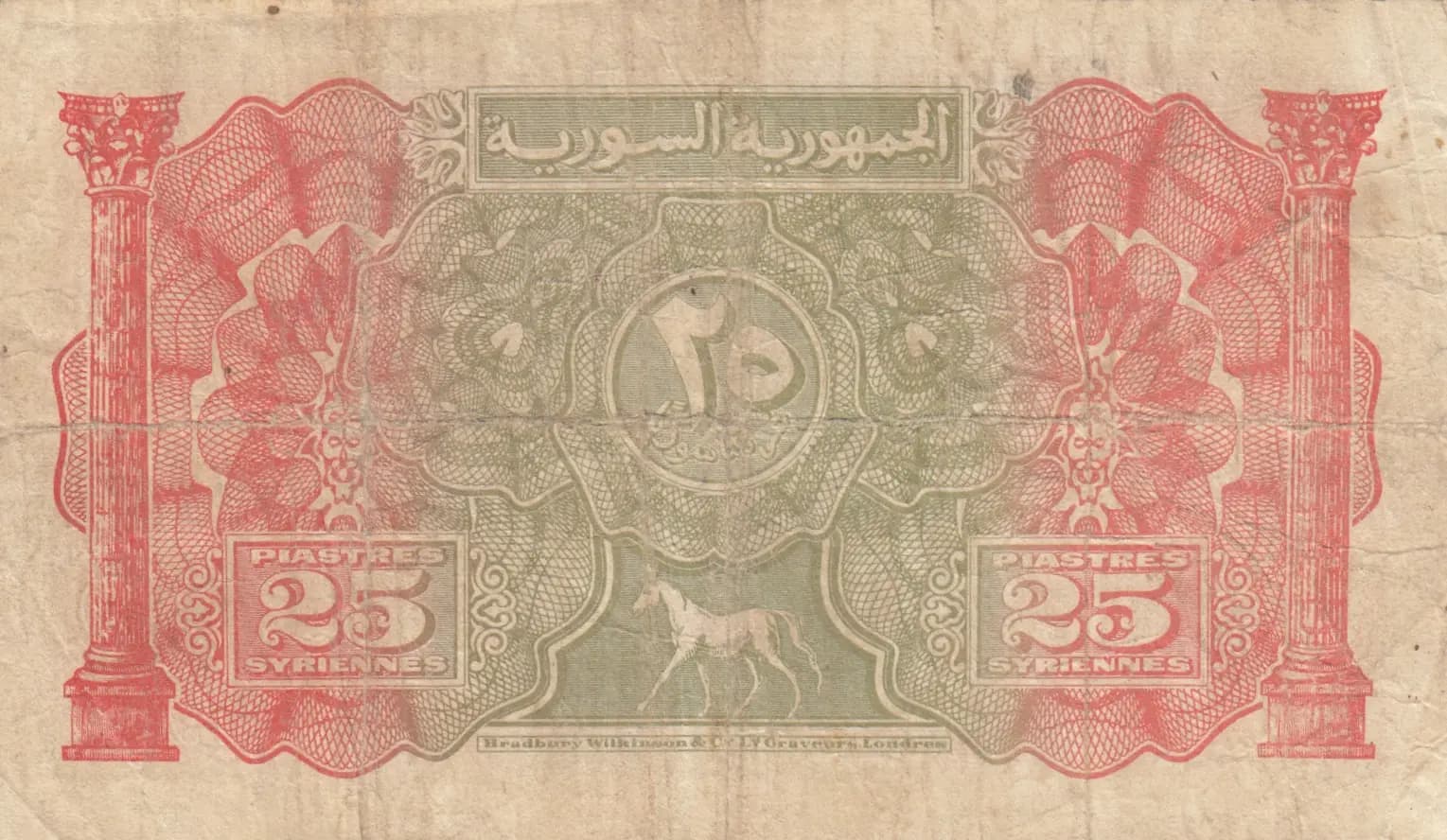
This is a Syrian 25 Piastres banknote issued on August 1, 1942 by the République Syrienne, printed by the renowned security printer Bradbury Wilkinson. The note displays characteristic early 20th-century engraved design work featuring the Omayyad Mosque of Damascus on the obverse, rendered in warm red and tan tones with intricate arabesque patterns and ornamental borders. Despite showing significant age-related wear including foxing, creasing, and paper yellowing consistent with 80+ years of circulation, the engraving quality remains clearly visible, with the reverse displaying heraldic lions and the large central denomination numeral within an ornate frame.
Common. Market evidence from realbanknotes.com shows consistent eBay sales of this note in Fine condition ranging from $15.99 to $37.50 across multiple transactions from 2013-2017, with a 2016 catalog value of $30 for VF condition. The repeated availability across multiple sales over an extended period indicates adequate supply in the collector market. While the note is now historically significant at 80+ years old, the print run and survival rate suggest this is a standard circulating issue from the period rather than a scarce or rare variety.
This banknote was issued during Syria's critical wartime period when the nation was under French Mandate governance following the collapse of Ottoman rule. The bilingual French-Arabic inscriptions and design elements reflect the transitional political status of the period, with the note dated just months before Syria's path toward greater independence. The prominent inclusion of the Omayyad Mosque—one of the world's oldest and most significant Islamic monuments located in Damascus—underscores the cultural and religious identity central to Syrian national coinage during this formative era.
The obverse features an engraved cityscape depicting the Omayyad Mosque of Damascus with its characteristic architectural elements including the central minaret and surrounding buildings rendered in fine line work. The composition is framed by ornamental circular designs in the corners and repeating geometric border patterns in arabesque style, typical of Islamic decorative traditions. The reverse displays heraldic symbolism with two rampant lions in formal heraldic pose positioned as flanking supporters, ornamental columns with classical capitals framing the composition, and elaborate floral and leaf designs in the corners. The large central numeral '25' is prominently displayed within an ornate circular cartouche. The color palette on both sides employs red as the dominant color with tan/beige and yellow-orange accents on the obverse, and red with green/olive tones on the reverse.
FRONT SIDE: 'République Syrienne' / 'جمهورية السورية' (Syrian Republic); '25' (denomination); 'Vingt Cinq Piastres ou Un Quart de Livre Syrienne' (Twenty-Five Piastres or One Quarter Syrian Pound); 'Damas le 1er Août 1942' / 'دمشق ١ آب ١٩٤٢' (Damascus, 1st August 1942); 'Le Ministre des Finances' / 'وزير المالية' (Minister of Finance); 'Le Directeur Général des Finances' / 'مدير المالية العام' (Director General of Finance); 'Piastres Syriennes' (Syrian Piastres); Serial: 'C938.474'. REVERSE SIDE: 'جمهورية السورية' (Syrian Republic); '25' (denomination); 'Piastres Syriennes' (Syrian Piastres); 'Bradbury Wilkinson & Co. Engravers, Londres' (Bradbury Wilkinson & Co. Engravers, London).
Steel plate engraving, executed by the London-based security printer Bradbury Wilkinson & Co., as documented in the engraver's mark on the reverse. The fine line engraving throughout, intricate border patterns, detailed heraldic lion figures, and complex ornamental designs are characteristic of high-security banknote production techniques of the 1940s era. The serial number 'C938.474' appears to be separately applied, likely through letterpress printing in dark ink.
The PMG population report indicates two catalogued variants for Pick number P-51: the standard P-51 and P-51cts. The observed specimen exhibits the standard variety with serial number C938.474, French-Arabic bilingual inscriptions, and the Bradbury Wilkinson printer attribution. No overprints, error features, or other distinguishing variety markers are evident in the visual analysis. The condition grade of F (Fine) is consistent with the circulated wear patterns visible in both images.