100 pounds 1962
Market Prices
10 salesAbout This Note
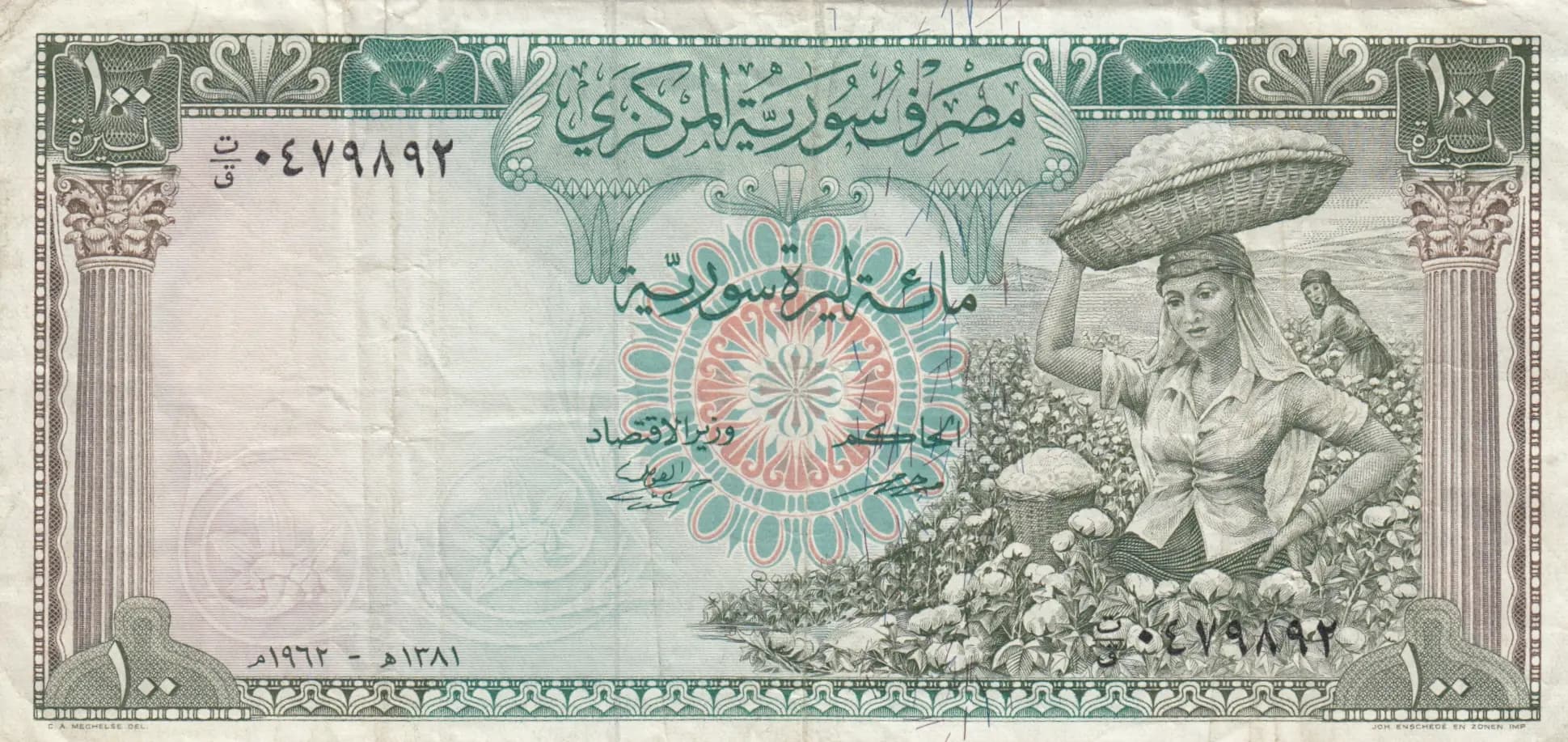
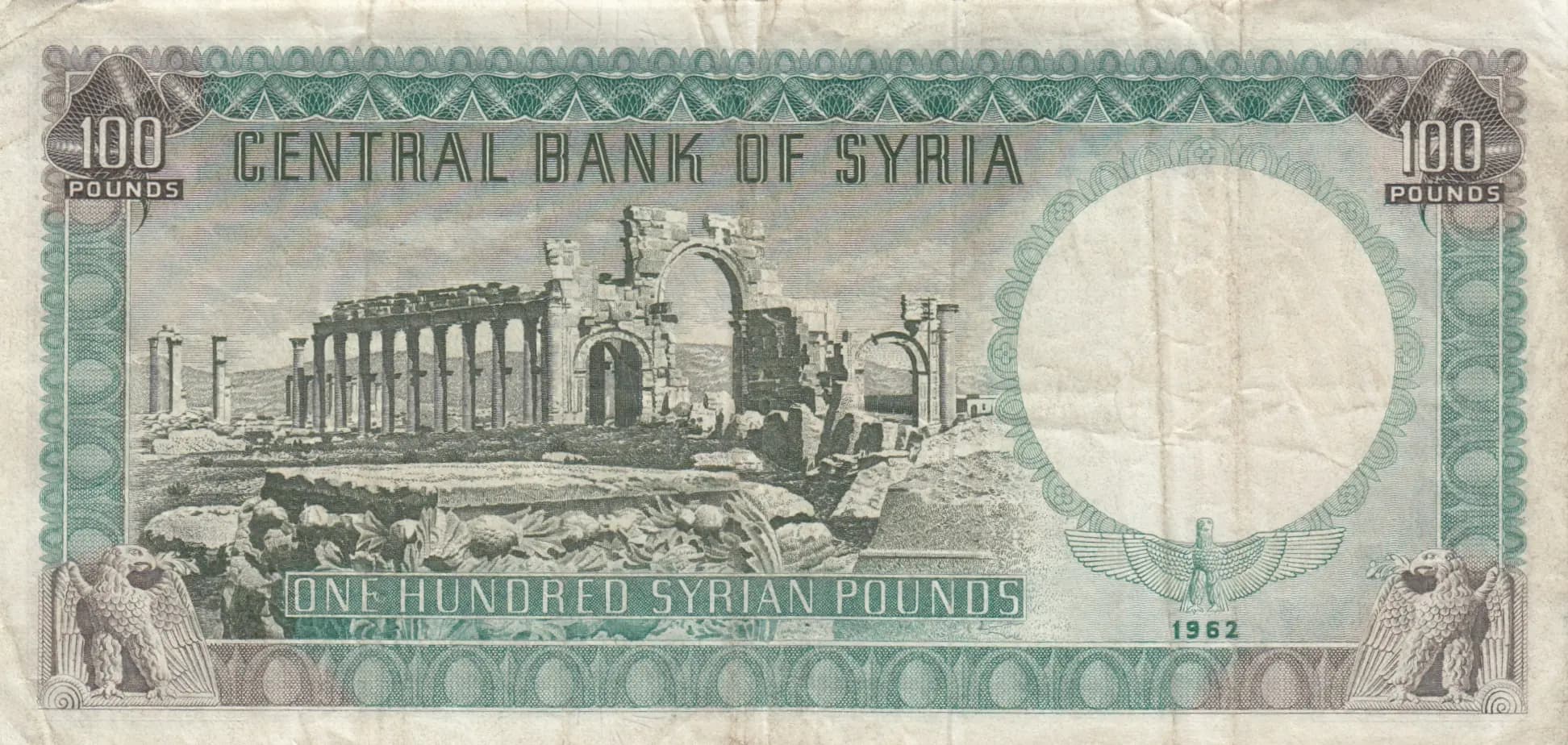
This 1962 Syrian 100 Pounds note (Pick P-91b) presents a well-preserved example of mid-20th century Levantine currency design, featuring a striking composition with a woman in traditional dress harvesting cotton on the obverse and Palmyra's classical Roman architecture on the reverse. The note displays moderate circulation wear consistent with its Fair grade, including visible creasing across the center and some foxing, yet retains the crisp engraved details and vibrant color palette of its original design. The dual-language presentation (Arabic and English) and intricate security engraving reflect the professional standards of the Netherlands-based Joh. Enschede printing house.
Common. This is a regular-issue note from a substantial print run by a major international security printer. The eBay price data shows consistent market trading in the $14-48 range for Fair grade examples across multiple sales spanning over a decade (2012-2021), with Fair-graded specimens typically realizing $15-30. The median Fair-grade selling price falls around $20, well within the standard range for common mid-20th century Middle Eastern banknotes. No evidence of scarcity or recall exists for this Pick number variant.
Issued in 1962 during the early years of the Syrian Arab Republic (following the 1958-1961 United Arab Republic merger), this banknote celebrates Syria's agricultural heritage through its depiction of cotton harvesting—a cornerstone of the Syrian economy. The reverse features Palmyra's Hadrian's Gate and columns, connecting modern Syria to its Roman imperial past and emphasizing the nation's historical significance as a crossroads of civilizations. The dual-language design reflects Syria's position in the post-independence Arab world while maintaining English for international commercial use.
The obverse features an engraved pastoral composition depicting a woman in traditional Syrian dress with a head covering, positioned prominently on the right side holding a basket above her head in a cotton field, with a second harvester visible in the background and mountains beyond—symbolizing Syria's agricultural foundation. Flanking columns with Corinthian capitals occupy the left and right margins, establishing classical architectural framing. The center displays elaborate Arabic calligraphy in a circular mandala-like arrangement rendered in green and red, serving as the primary denomination text. Ornate floral and geometric border patterns frame the entire composition. The reverse presents a professionally engraved photograph of Palmyra's most iconic Roman monument—Hadrian's Gate (or the Temple of Bel gateway)—featuring multiple arches and Corinthian columns set against a rocky landscape. Eagle symbols appear in the bottom corners of the reverse, functioning as heraldic emblems of the Syrian state. Ornamental geometric borders with repeating patterns frame both sides.
Front side: 'مصرف سورية المركزي' (Central Bank of Syria), 'مئة جنيه' (One Hundred Pounds), '١٣٨١ - ١٩٦٢' (1962 - 1381 Hijri calendar), plus Arabic serial number. Back side: 'CENTRAL BANK OF SYRIA' (English heading), 'ONE HUNDRED SYRIAN POUNDS' (English denomination text), '100 POUNDS' (corner denominations), '1962' (issue year). The dual-script presentation reflects the bilingual currency standards of post-independence Syria.
Intaglio (steel engraving) on the primary design elements, combined with offset lithography for the color underprint. The note was printed by Joh. Enschede en Zonen (JEZ) of Haarlem, Netherlands, one of the world's premier security printers. The fine line engraving visible throughout—particularly in the facial features, textile patterns, architectural details, and border ornaments—is characteristic of high-security currency production. The multi-layered color application and precise registration visible in the images demonstrate professional offset lithography techniques layered beneath the engraved elements.
This specimen is cataloged as Pick P-91b (1962 issue), with the catalog notation indicating a 1962 variant distinct from the earlier P-91a. The visual analysis confirms the 1962 date on both obverse (Arabic calendar: '١٣٨١ - ١٩٦٢') and reverse. The printer mark 'JEZ' (Joh. Enschede Zonen) is confirmed in the specialist references. Serial number visible in the image reads 'ق ٩٤٧٩٨٩٢' in Arabic numerals, consistent with Central Bank of Syria's numbering conventions. No overprints or signature varieties are evident from the visual analysis. The watermark noted in references (Arabian horse's head) would require physical inspection to confirm but is the standard security feature for this issue.