1 livre 1939
Market Prices
6 salesAbout This Note
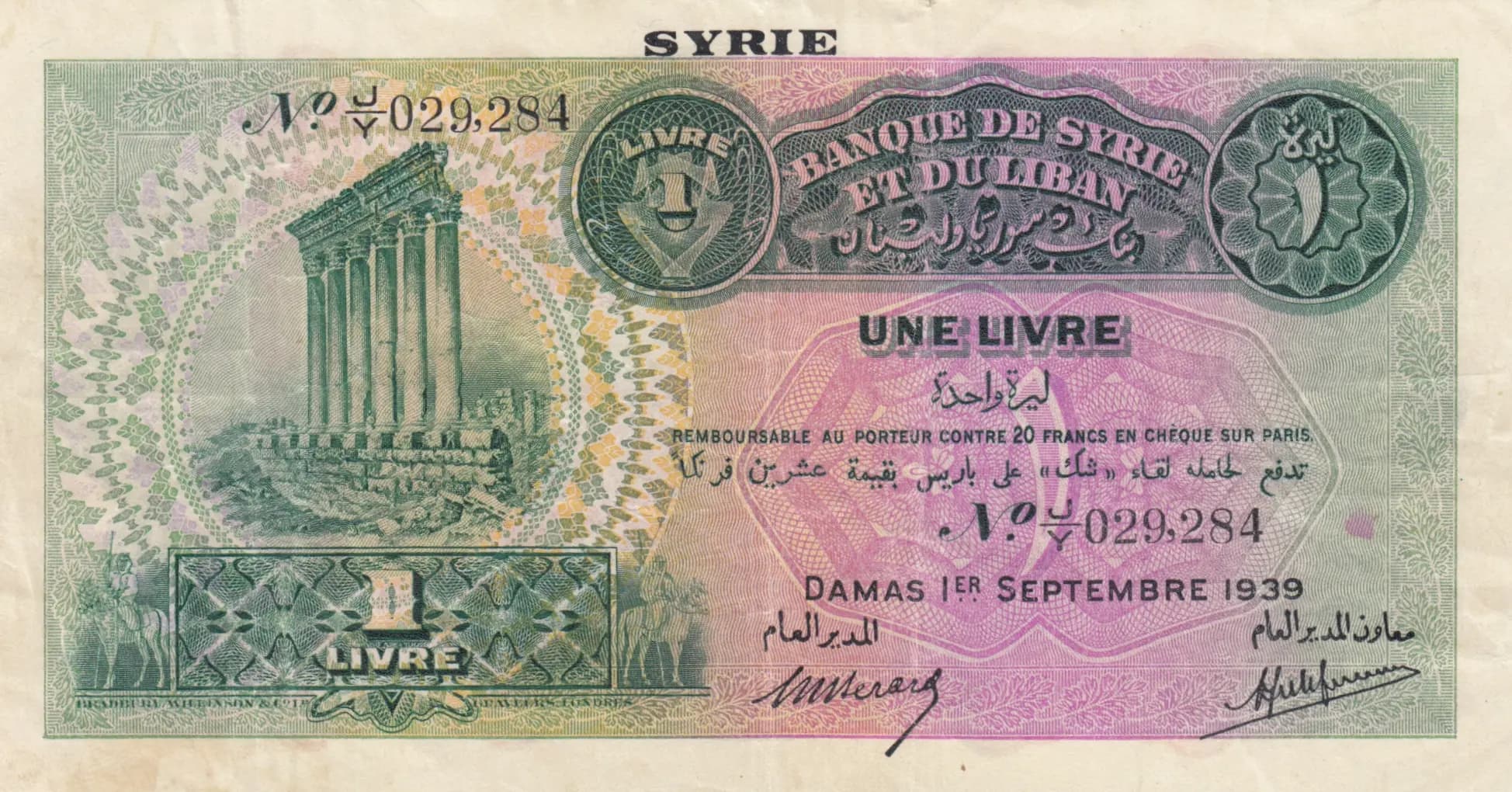
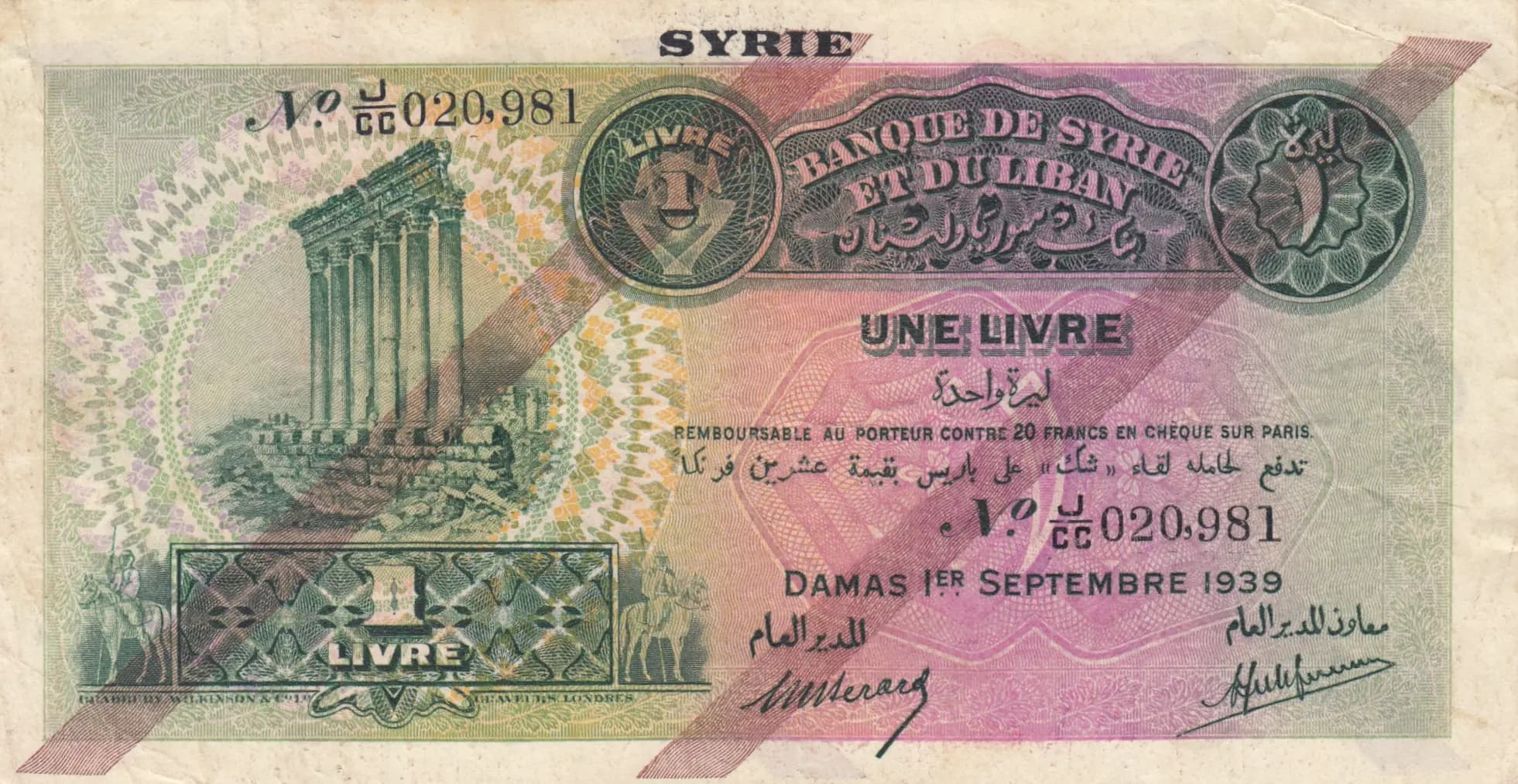
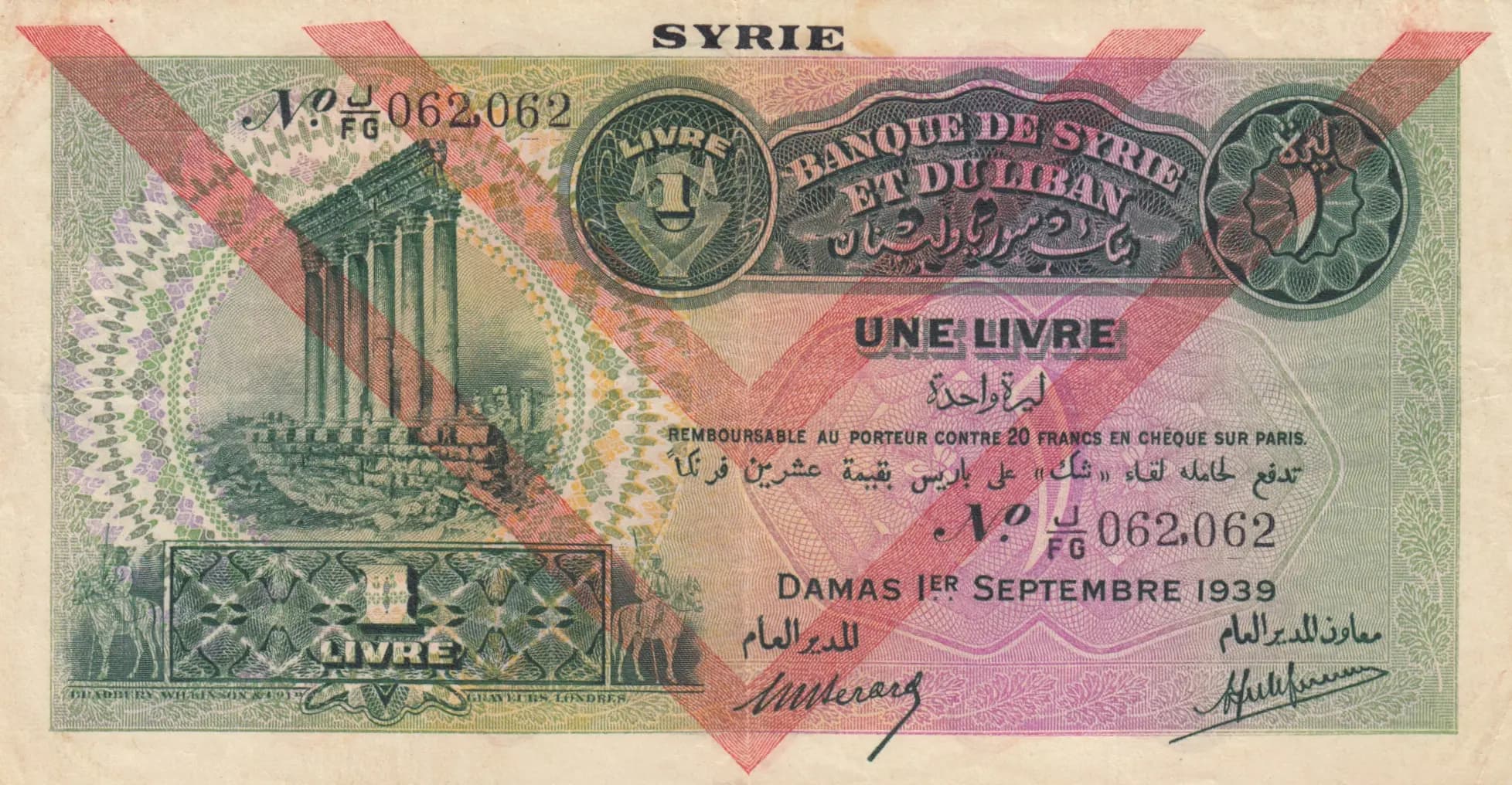
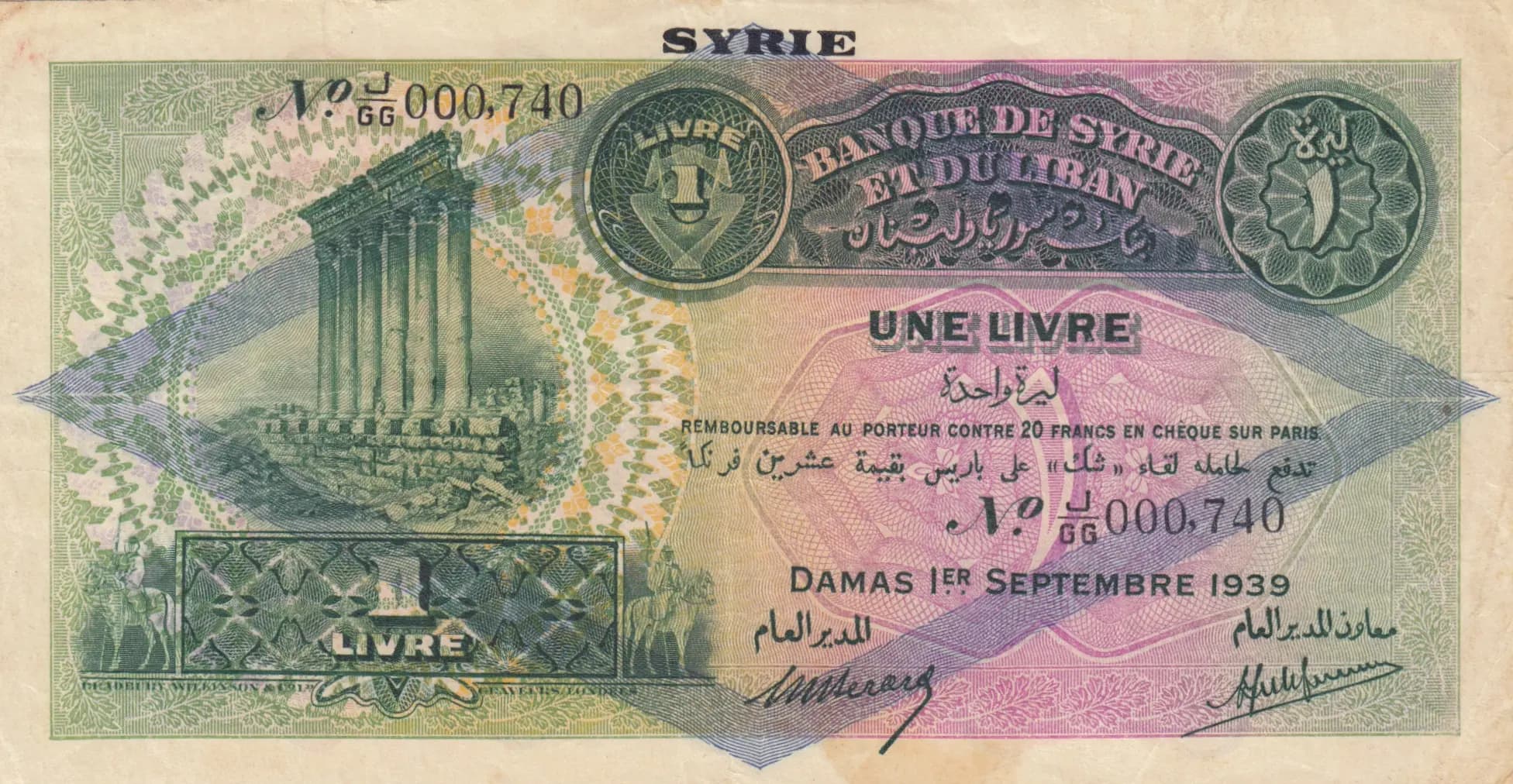
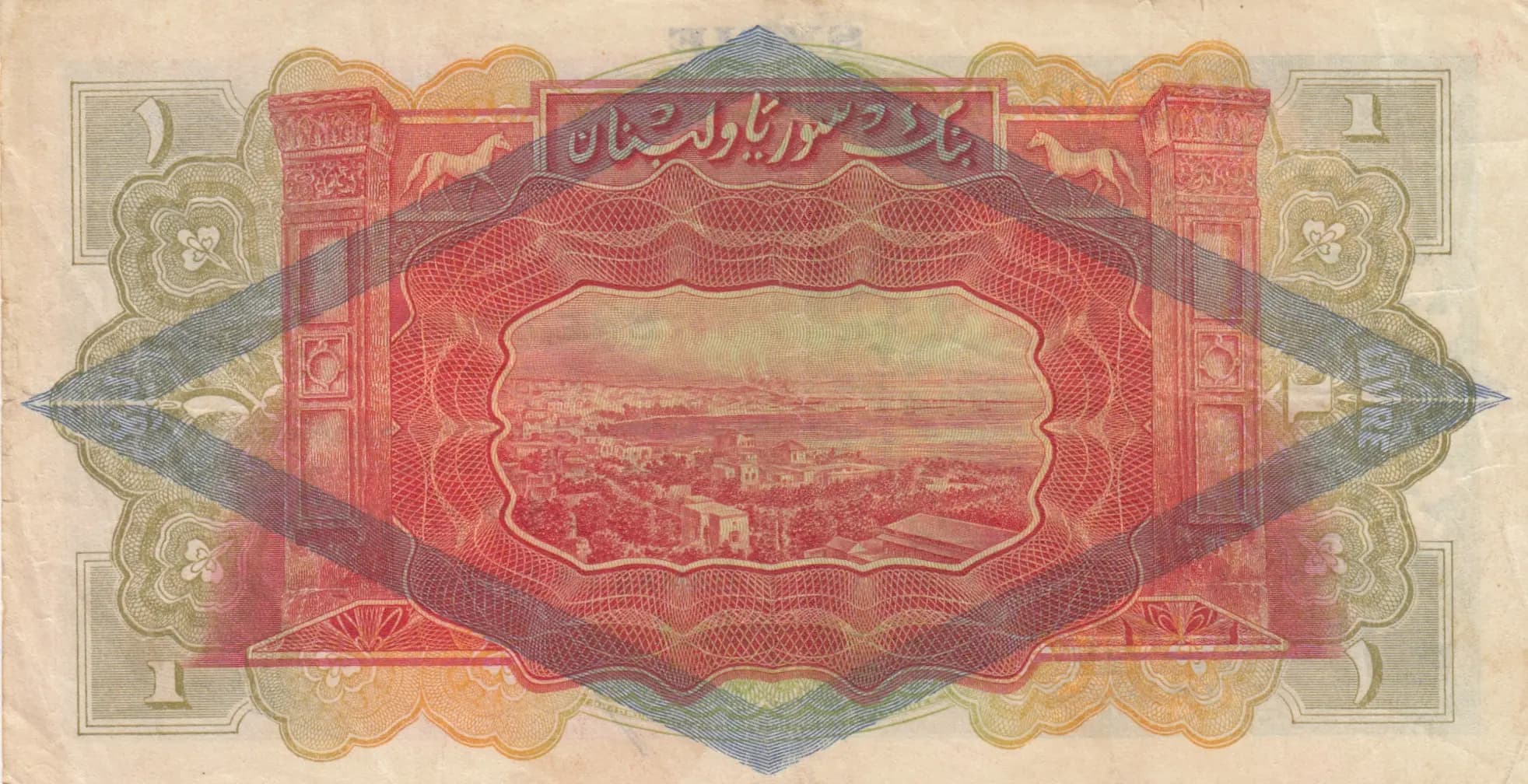
A historically significant Syrian 1 Livre banknote from September 1, 1939, issued by the Banque de Syrie et du Liban during the transitional French Mandate period. The note displays excellent classical design work featuring the iconic Columns of Baalbek in green and multicolor tones on the obverse, with a panoramic cityscape (likely Beirut) on the reverse in red and tan hues. In VF condition, this note exhibits age-appropriate patina with light foxing and creasing, but maintains crisp legibility of all text and clear definition of the engraved architectural imagery.
Common. The eBay market data provided shows consistent sales in the $20–$50 range across multiple condition grades (F, VF) from 2015–2022, with catalog values at $45 for VF condition. Typical auction prices and trading volumes indicate this is a well-represented issue in the secondary market. The Banque de Syrie et du Liban issued multiple variants (P-40a through P-40f per PMG records), suggesting healthy original print runs. No evidence of scarcity or premium demand justifies a rarity designation above common.
Issued on the eve of World War II, this banknote represents Syria and Lebanon under French Mandate administration, a period lasting from 1920 to 1943. The deliberate choice of Baalbek—one of the Roman Empire's most magnificent temple complexes in the Bekaa Valley—as the primary obverse design reflects the cultural and historical heritage of the region, while the cityscape on the reverse likely depicts Beirut, the major commercial center. The bilingual French-Arabic inscriptions and the redemption clause against Parisian francs underscore the colonial economic relationship of the era.
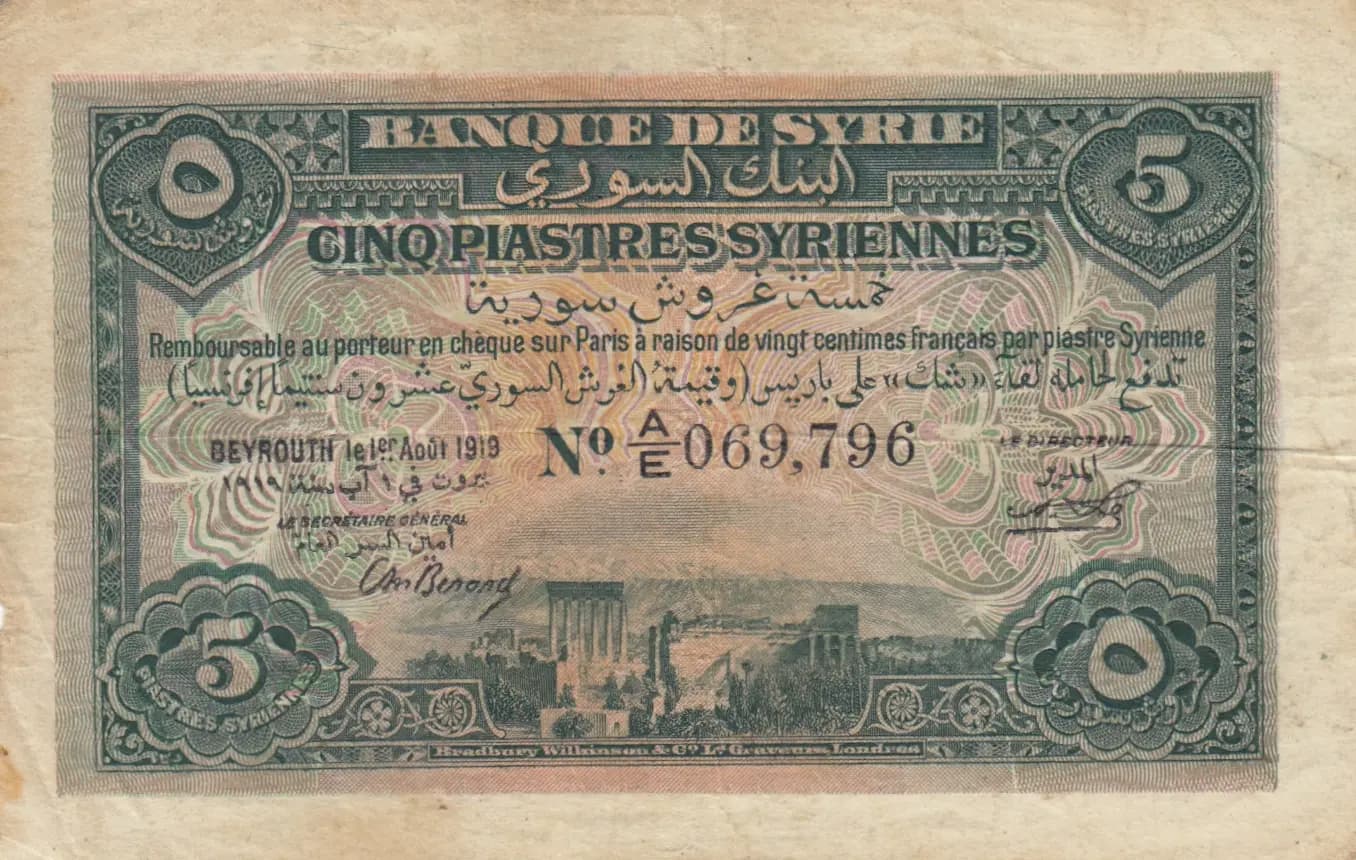
The obverse features the renowned Columns of Baalbek positioned prominently at left, rendered in fine engraved detail showing the classical Corinthian capitals and architectural precision of this UNESCO World Heritage site. The note employs a harmonious color palette of green, pink, tan, and cream with blue accents throughout. Ornamental corner designs incorporate floral and geometric patterns typical of Belle Époque security printing. Twin circular seals/emblems frame the upper portion (left and right), with the right featuring what appears to be heraldic symbolry (possibly a double-headed eagle representing the Franco-Levantine administration). The reverse presents a panoramic landscape or cityscape in red and pink tones, likely depicting Beirut as the financial capital, with mountains visible in the background and urban structures rendered in middle distance. Fine line engraving creates textural depth throughout both sides.
FRONT: 'SYRIE' (Syria); 'BANQUE DE SYRIE ET DU LIBAN' (Bank of Syria and Lebanon); 'UNE LIVRE' (One Pound/Livre); 'REMBOURSABLE AU PORTEUR CONTRE 20 FRANCS EN CHEQUE SUR PARIS' (Redeemable to Bearer Against 20 Francs in Check on Paris); 'DAMAS 1ER SEPTEMBRE 1939' (Damascus 1st September 1939); 'N.° GG 000,740' (Serial Number); 'LIVRE' (Pound). Arabic text throughout corresponds to these French inscriptions. BACK: Arabic text at top corresponding to denomination; panoramic view caption (specific text not fully legible in description but represents a geographical or civic view).
Intaglio engraving (recess printing) executed by Bradbury Wilkinson & Co. (BWC), New Malden, Surrey—a premier British security printer of the era. The note exhibits characteristic features of high-quality early 20th-century intaglio work including crisp line definition, complex color registration across multiple plates, fine hatching and cross-hatching in ornamental zones, and precise serial number application. The 'SYRIE' overprint appears in blue Type E format, indicating this is a later printing variant of the series with the Syria overprint added to distinguish it from Lebanese-only circulation notes.
This note is catalogued as P-40f, representing one of six known variants of the 1 Livre 1939 issue (P-40a through P-40f per PMG population data). The distinction likely relates to signature combinations, printing dates within the 1939 series, or subtle overprint variants. The observed 'SYRIE' overprint in blue Type E format is consistent with P-40f identification. The serial number prefix 'GG' and the specific date of issue (1 September 1939) help establish this as the standard 1939 variant rather than earlier or later reissues. Collectors should verify signature block placement and overprint positioning against catalog descriptions to confirm the precise variety.