5 kronor 1970
Market Prices
8 salesAbout This Note
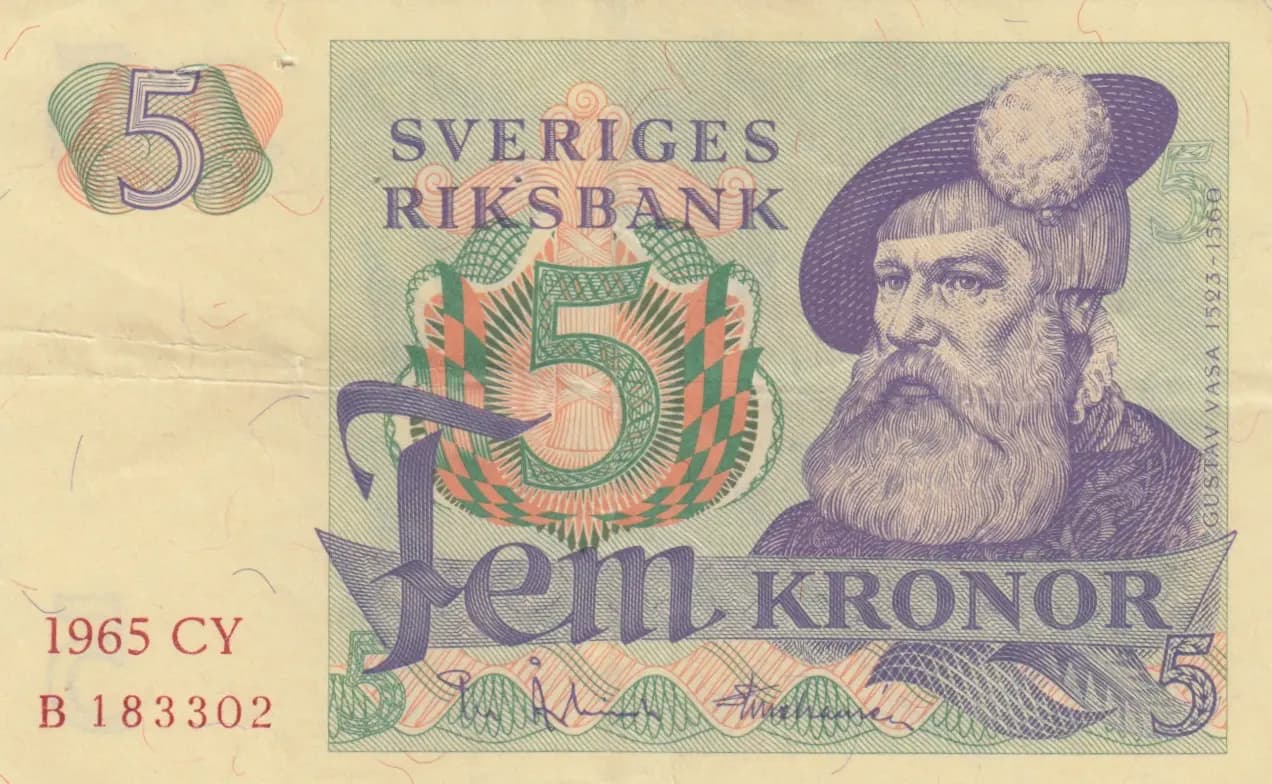
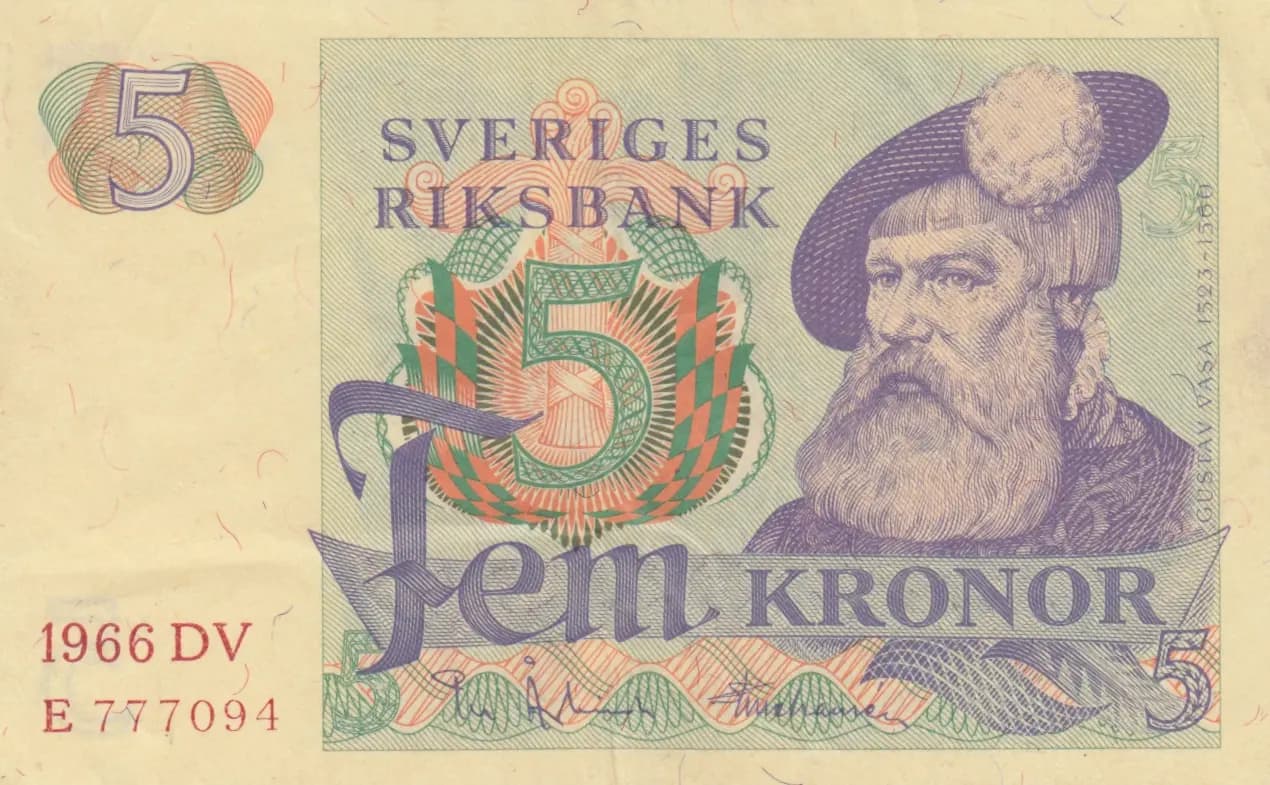
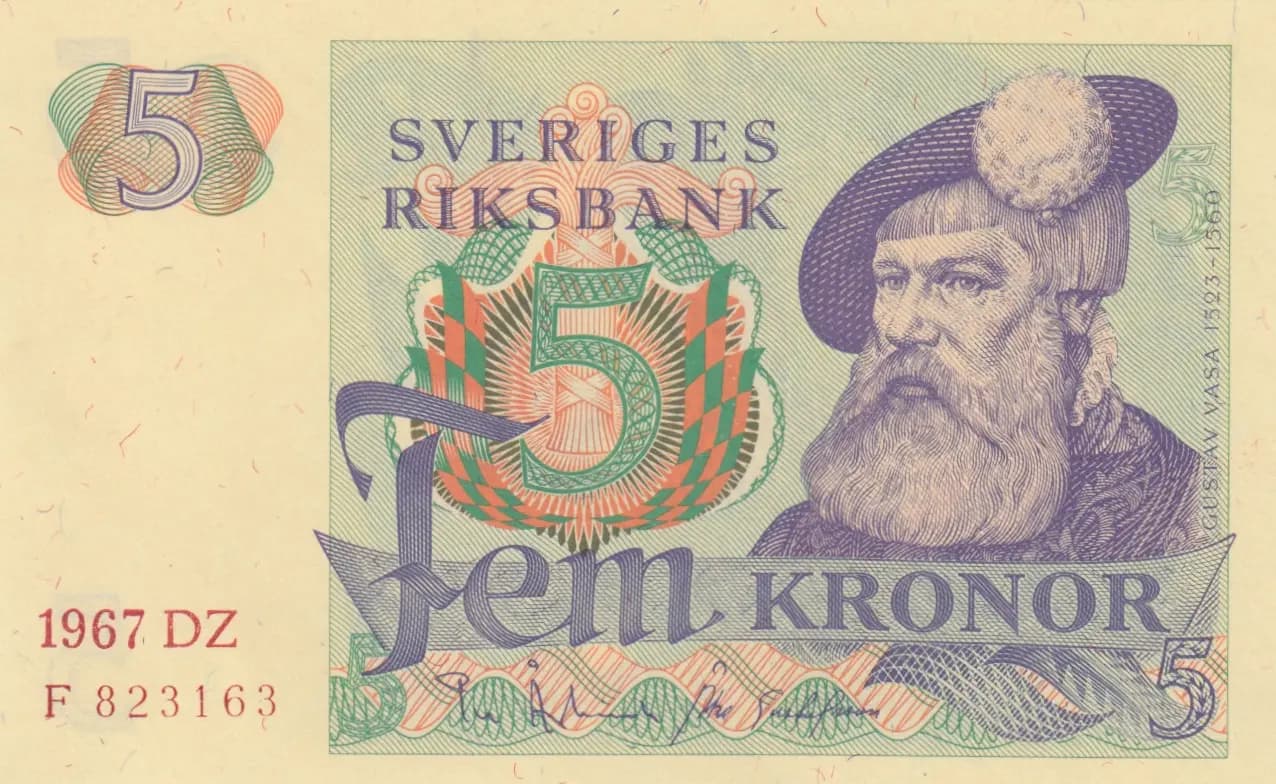
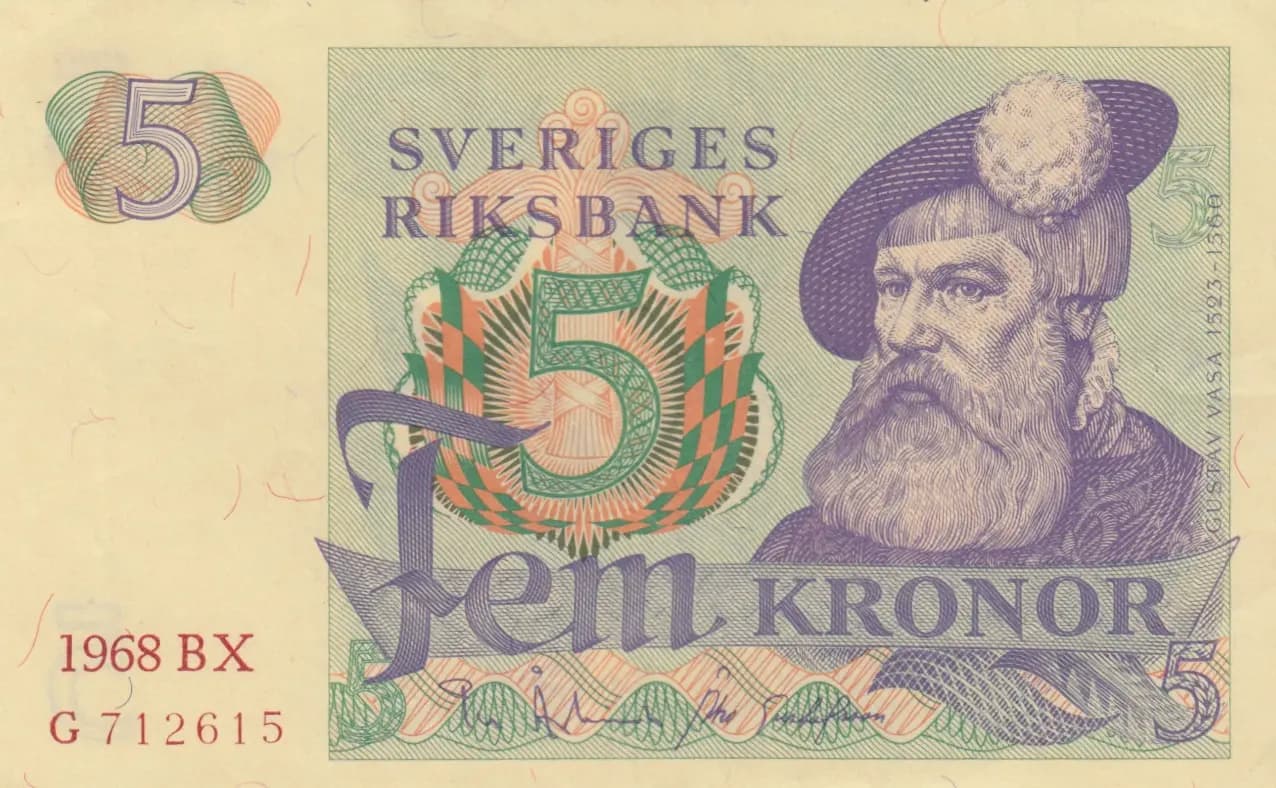
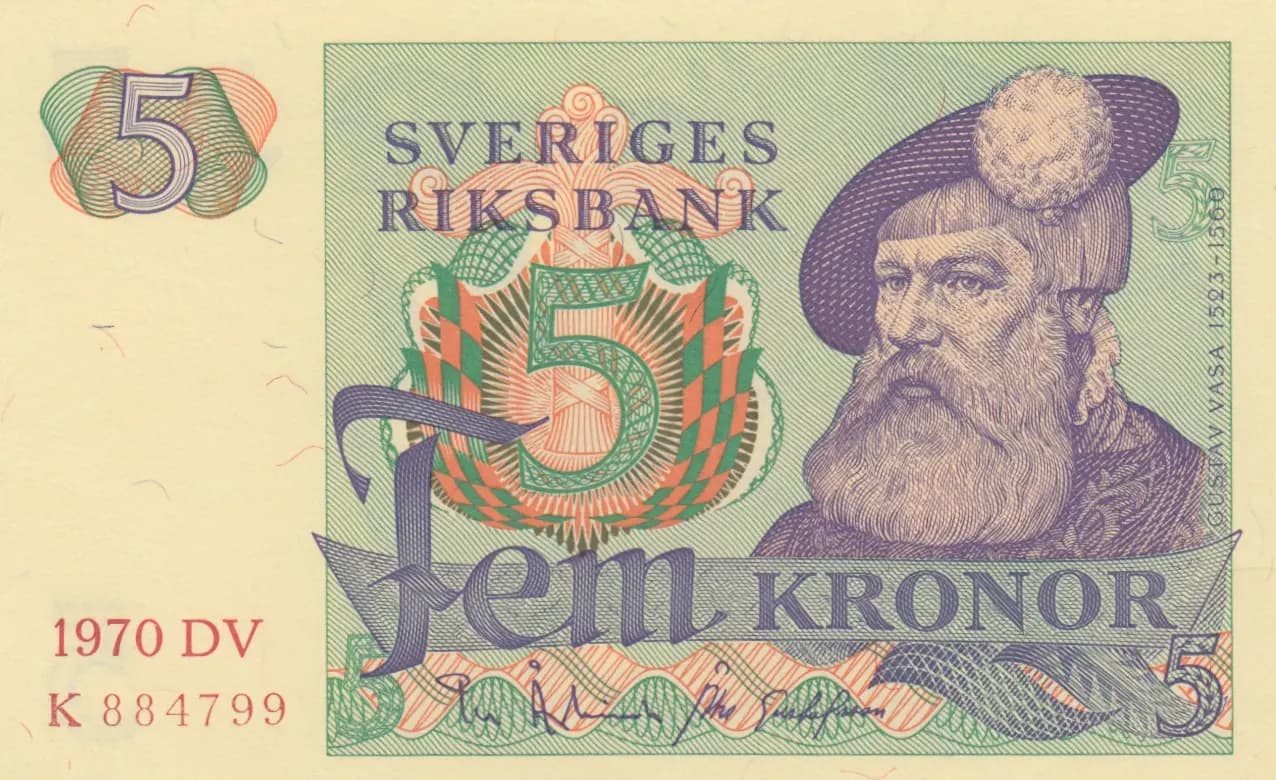
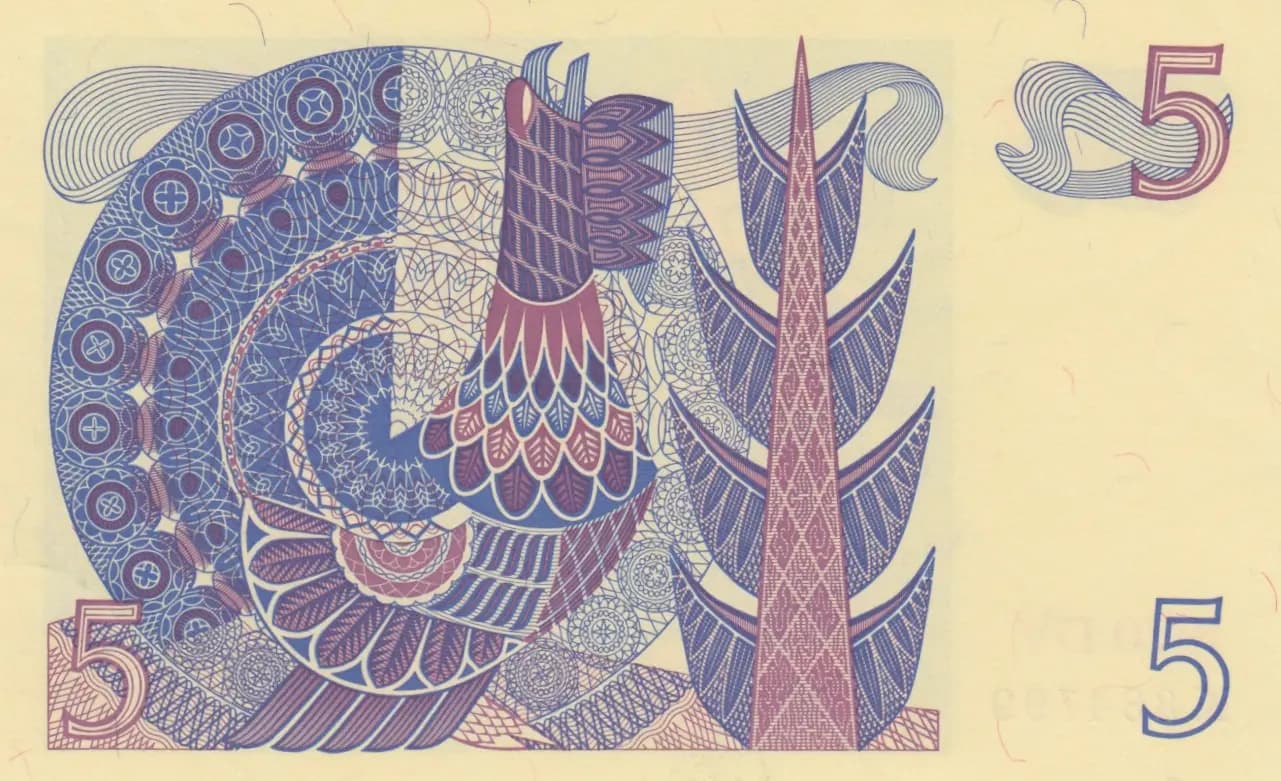
This Sweden 5 kronor banknote from 1970 (Pick P-51b) features a striking portrait of King Gustav Vasa in distinctive period headwear on the obverse, rendered in purple, green, and orange tones characteristic of this series. The reverse displays an ornate abstract design in blue and maroon with fine engraving work typical of Swedish Riksbank currency. While this example shows moderate wear consistent with circulation use—including visible creasing, foxing, and aging of the cream-colored paper—the intricate security features and detailed line work remain clearly visible, making it an educational example of early 1970s Swedish currency design.
Common. This is a regular issue note from a long production run (1965-1981) with substantial circulation. eBay market data shows consistent sales across multiple condition grades, with UNC examples selling for $2.69 in 2017 and catalogue values (2019) listing UNC at only $3. The note shows clear circulation wear, and even higher-graded PMG examples command modest prices ($12.50-$38 for PMG 65-66), which is typical for common modern-era banknotes rather than scarce or rare pieces. The large volume of this series in existence combined with modest collector valuations indicates this is a standard banknote for Swedish collections.
Issued during the reign of King Gustav VI Adolf (1950-1973), this note commemorates Gustav Vasa (1496-1560), the founder of the modern Swedish state and first elected king of Sweden, whose bearded portrait and distinctive Renaissance-era headpiece dominate the obverse. The 1965-1981 series of which this 1970 example is part represents a mid-century redesign by Sveriges Riksbank reflecting Sweden's cultural heritage while incorporating contemporary security printing techniques. The choice of Gustav Vasa as the primary portrait underscores the historical continuity and national identity that Swedish currency sought to convey during this period.
The obverse features a three-quarter profile portrait of King Gustav Vasa positioned to the right, depicted as a bearded man wearing a distinctive purple-colored feathered hat characteristic of 16th-century Swedish royal attire. The central design incorporates an ornate shield containing the numeral '5' in red and green with radiating decorative elements, flanked by large numerals '5' in the upper left (rendered in multicolor teal, purple, orange, and pink) and upper right corners. The reverse abandons portraiture in favor of a symmetrical, highly ornamental abstract design featuring elaborate floral or feather-like motifs executed in fine engraving, rendered predominantly in blue, purple/maroon, and cream, with large denominal numerals '5' positioned in both upper and lower right corners. The entire design is executed with fine cross-hatching and geometric patterns throughout, reflecting high-security intaglio printing standards.
Front: 'SVERIGES RIKSBANK' (Sweden's National Bank), '5 Kronor' (denomination), '1970 DV' (year and printer/series designation), 'K 884799' (serial number). Back: '5' (denomination numeral only). All inscriptions are in Swedish or numerical designations standard to currency of the period.
Intaglio engraving (recess printing), the standard security printing method for Swedish Riksbank notes of this era. The extremely fine line work, detailed cross-hatching, complex geometric patterns, and three-color printing visible throughout—particularly evident in the security features on both obverse and reverse—are characteristic of intaglio production. This Pick number was produced by Enskilda Banken's printing works or the Riksbank's designated security printer, utilizing traditional Swedish engraving techniques that were state-of-the-art for the 1970 production period.
Pick P-51b designation indicates this is a specific variety within the 1970 Gustav Vasa series. The serial number observed (K 884799) with prefix letter 'K' suggests this note falls within a particular print batch or series variant; different prefix letters can indicate separate printing runs or signature variations. The '1970 DV' date marking indicates the specific year and printer code. To definitively identify the precise variety, signature blocks on the note would need examination, as signature changes typically define the 'a', 'b', 'c' designations within Pick catalog numbers for this Swedish series. The visual analysis does not provide sufficient resolution of signature areas to specify the exact signatory variant, but the P-51b designation has been confirmed from catalog data.