5 kronor 1968
Market Prices
24 salesAbout This Note
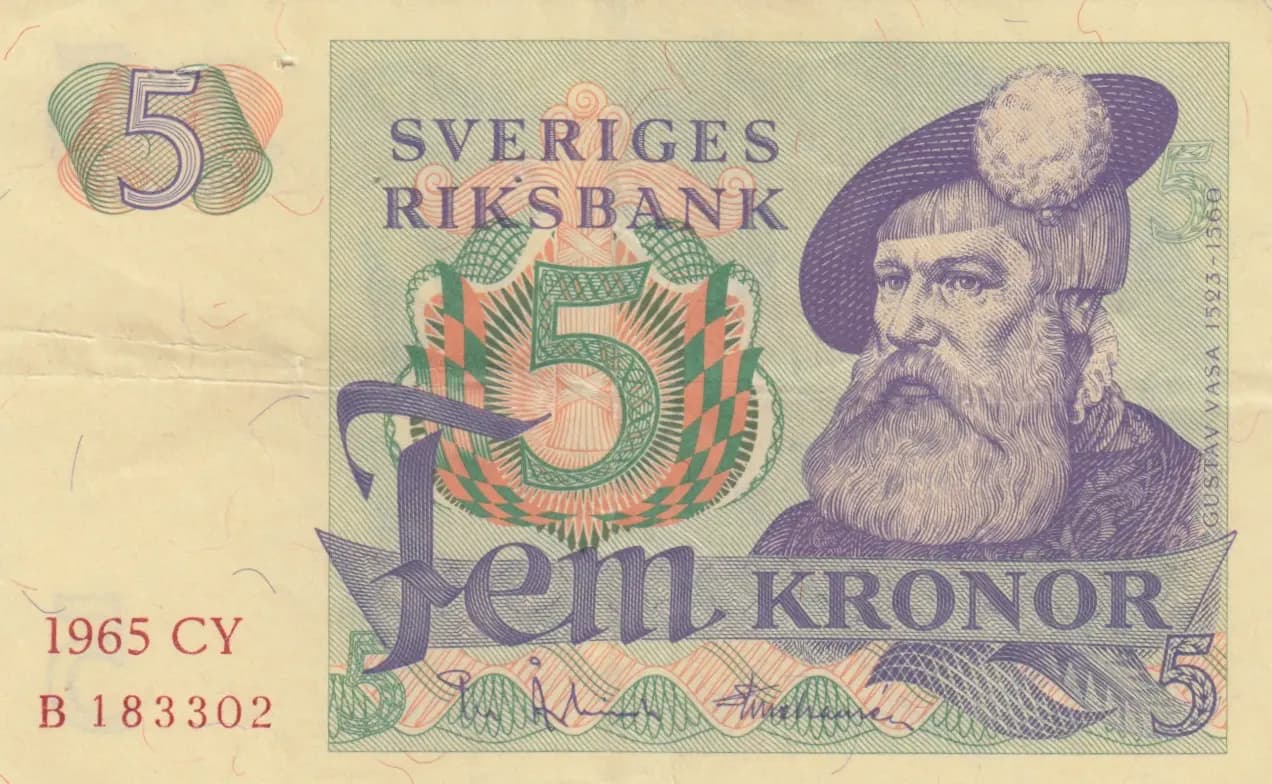
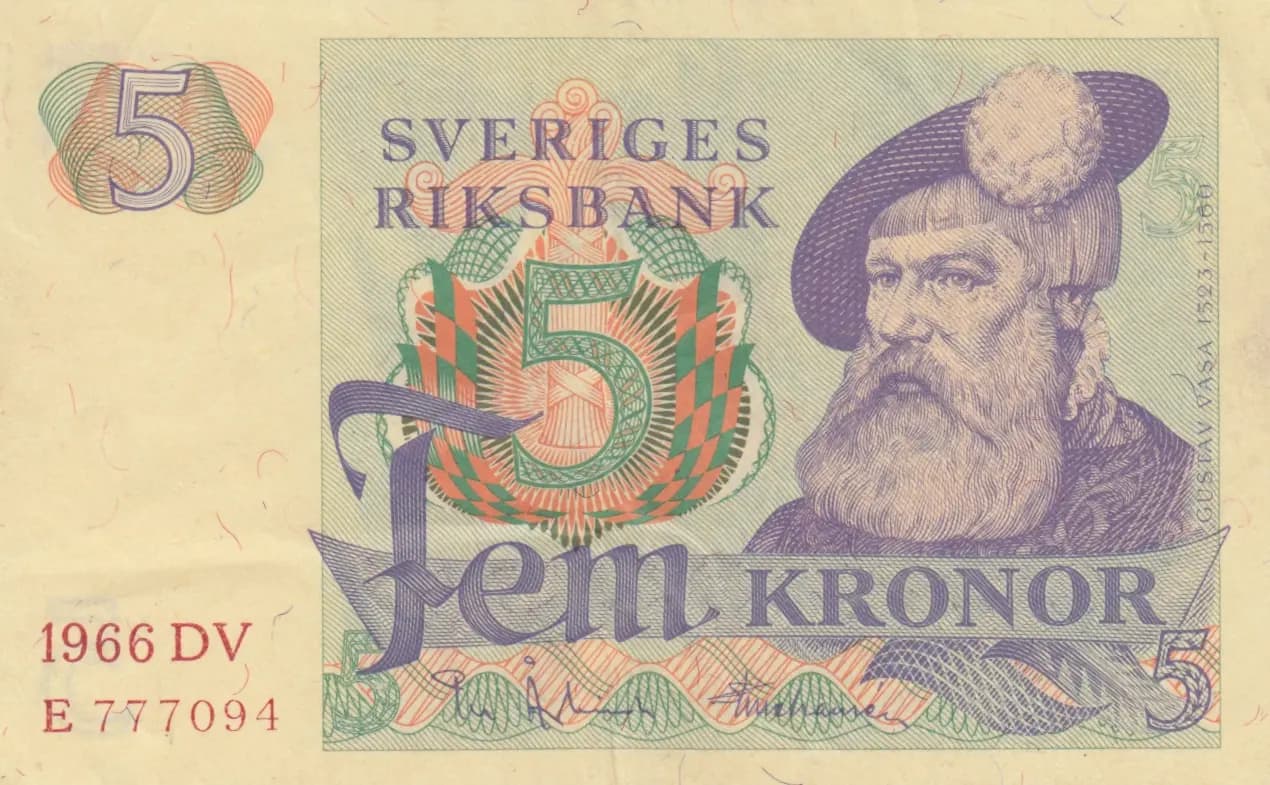
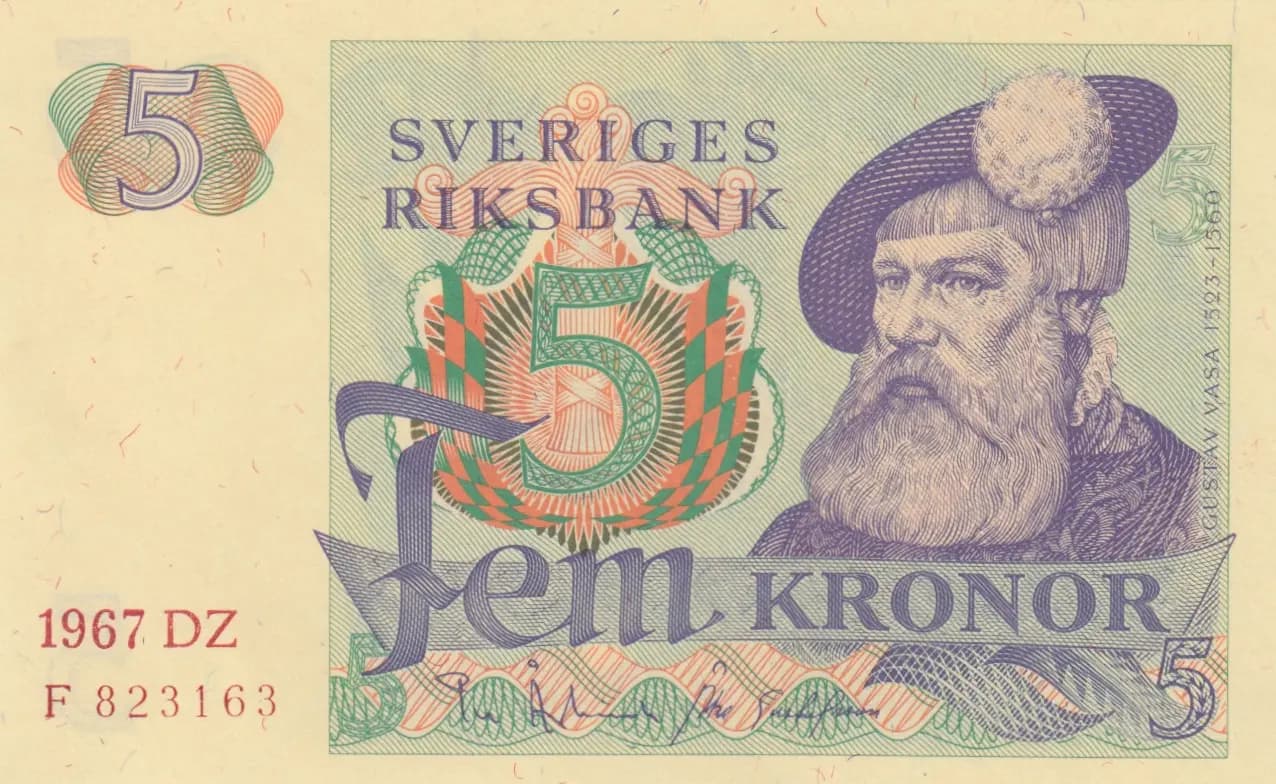
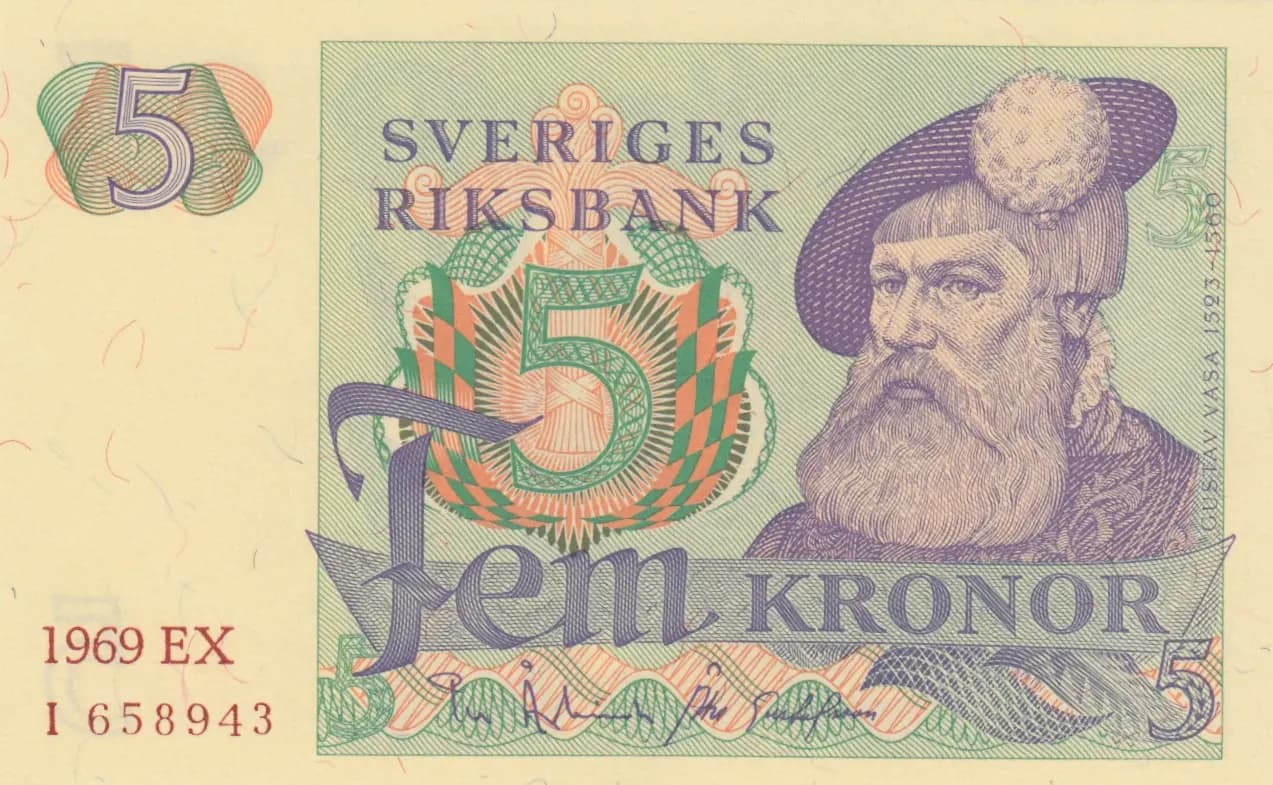
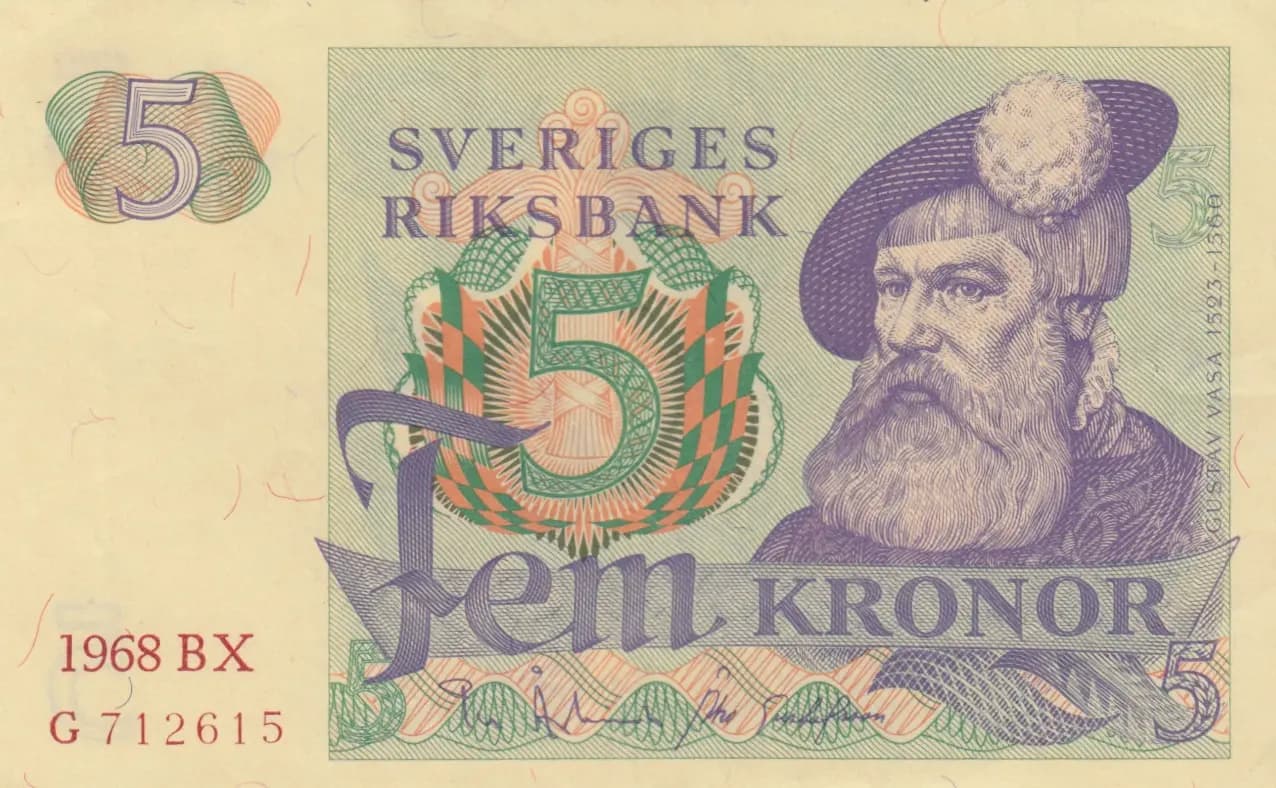
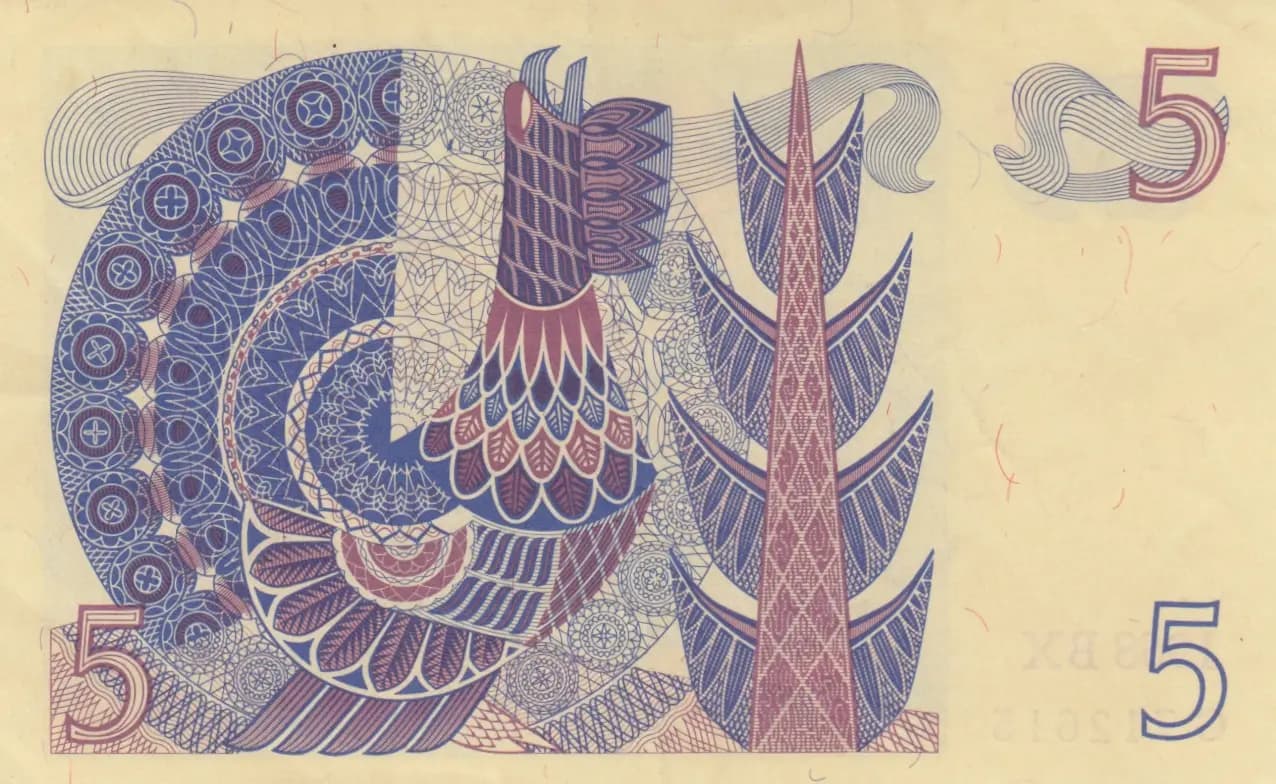
This Swedish 5 kronor note from 1968 (Pick P-51a) presents a well-preserved example of mid-20th century Scandinavian currency design, featuring King Gustav Vasa's portrait on the obverse alongside an ornate shield bearing Sweden's heraldic arms. The reverse displays an intricate abstract rooster design rendered in blue and burgundy, exemplifying the sophisticated intaglio printing techniques employed by Sveriges Riksbank. In VF condition with visible creasing and minor foxing consistent with circulation, this note represents a solid example of the 1965-1981 series.
Common. This note is from a 14-year circulation issue (1965-1981) with substantial print runs typical of regular denomination currency in a stable industrialized nation. eBay market data confirms common status with consistent sales in the $2-$5 range for VF-UNC examples; even professionally graded examples (PMG 66) typically sell for $15-$50, well within the range for common modern banknotes. The VF condition grade in particular shows regular pricing at $2-$4.75, indicating abundant supply relative to demand.
Issued during Sweden's period of economic stability in the 1960s, this banknote honors King Gustav Vasa (1496-1560), the founding father of the Swedish nation who broke free from the Kalmar Union and established Sweden as an independent kingdom. The heraldic shield featuring the red and yellow checked pattern reflects the traditional coat of arms that Vasa himself would have used, connecting the modern 1968 currency to Sweden's 16th-century independence movement. The abstract rooster motif on the reverse, while stylistically modernist, likely carries symbolic significance related to Swedish national identity and agricultural heritage.
The obverse features a formal portrait of King Gustav Vasa positioned at center-right, depicted as a bearded man wearing 16th-century period costume with a white plumed hat, rendered with fine detail characteristic of intaglio portraiture. A large ornamental numeral '5' with radiating sunburst design dominates the upper left, framing the Swedish royal coat of arms—a shield with the characteristic red and yellow (gold) checked pattern typical of Vasa heraldry, surrounded by a green wreath-like heraldic ornament. The palette of purple, green, coral, and cream creates visual hierarchy across the design. The reverse eschews figurative imagery in favor of elaborate abstract ornamentation: a stylized rooster rendered in geometric patterns occupies the center-left, while a wheat sheaf design appears on the right, both composed of intricate cross-hatching, circles, and geometric motifs in blue and burgundy on cream background, with large decorative numerals '5' positioned in opposite corners.
Front side: '5' (numeral), 'SVERIGES RIKSBANK' (Sweden's Central Bank), 'fem KRONOR' (five kronor), '1968 BX' (date and series identifier), 'G712615' (serial number). Back side: '5' (numeral, appears in upper right and lower left corners). All text is in Swedish, the official language of Sweden.
This note was produced using intaglio (engraved) printing with multiple color passes, a premium security printing method employed by Sveriges Riksbank. The fine line work, complex geometric patterns, intricate cross-hatching throughout both sides, and precise color separation visible in the images are characteristic of high-security intaglio production. The detailed portraiture of Gustav Vasa and the elaborate decorative elements would have required master engraved plates. While the specific printer is not documented in the provided references, Swedish banknotes of this era were typically produced by Tumba Bruk or similar Scandinavian security printers under Riksbank supervision.
This specific note bears the date '1968' and series identifier 'BX' with serial number 'G712615'. Within the 1965-1981 issue period for Pick P-51a, notes can vary by year of issue and series letter combinations. The 'BX' designation and 1968 date mark this as from the mid-series period. No major varieties (such as signature changes, significant overprints, or printing errors) are apparent in the visual analysis, though Swedish banknotes of this series are known to have multiple printing variations across their 16-year circulation. The note would be cataloged as a standard P-51a without special variety designation unless additional diagnostic features (such as rare series combinations or documented printing errors) were present.