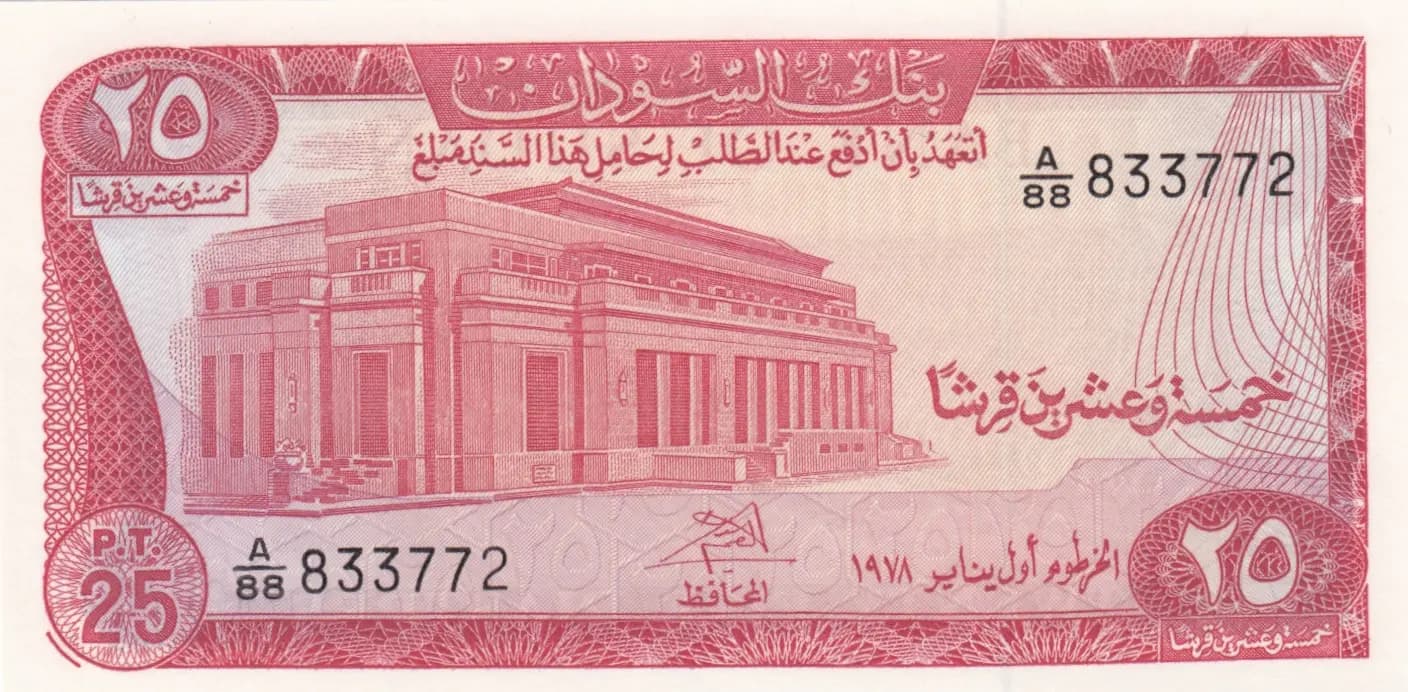
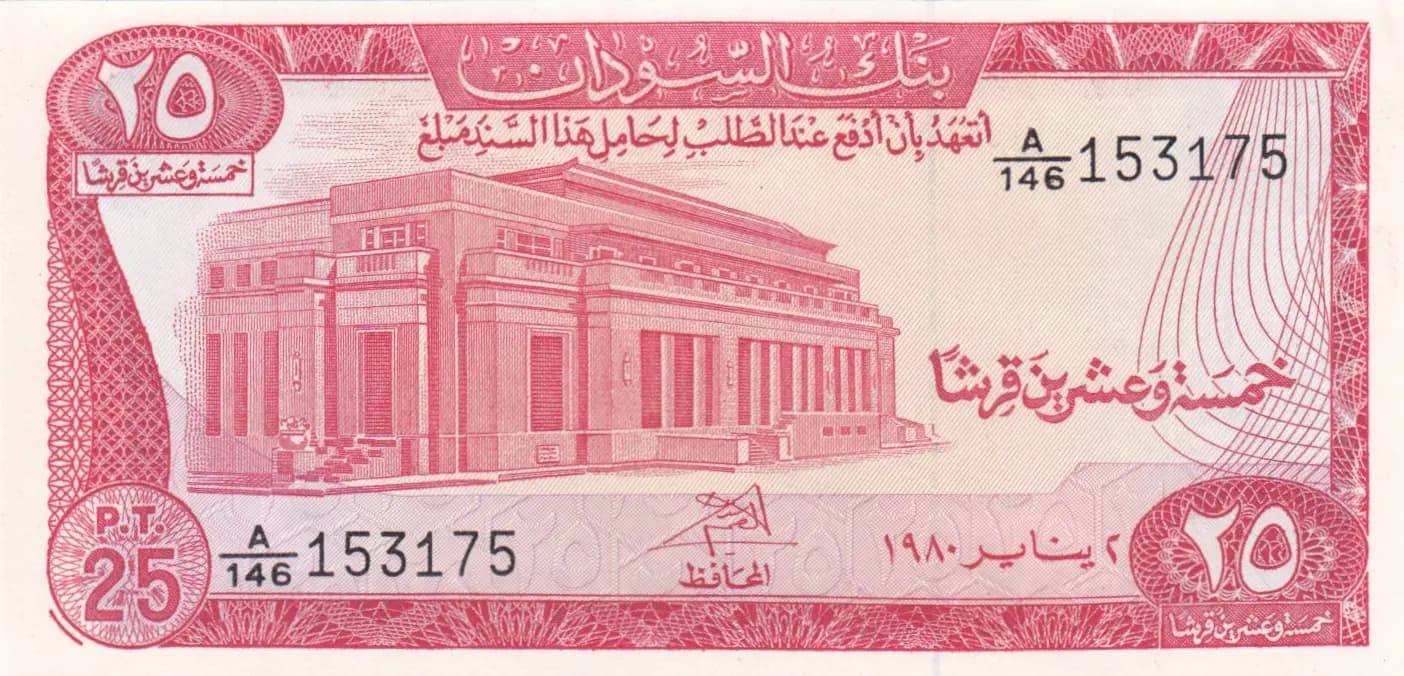
25 piastres 1956
Market Prices
6 salesAbout This Note
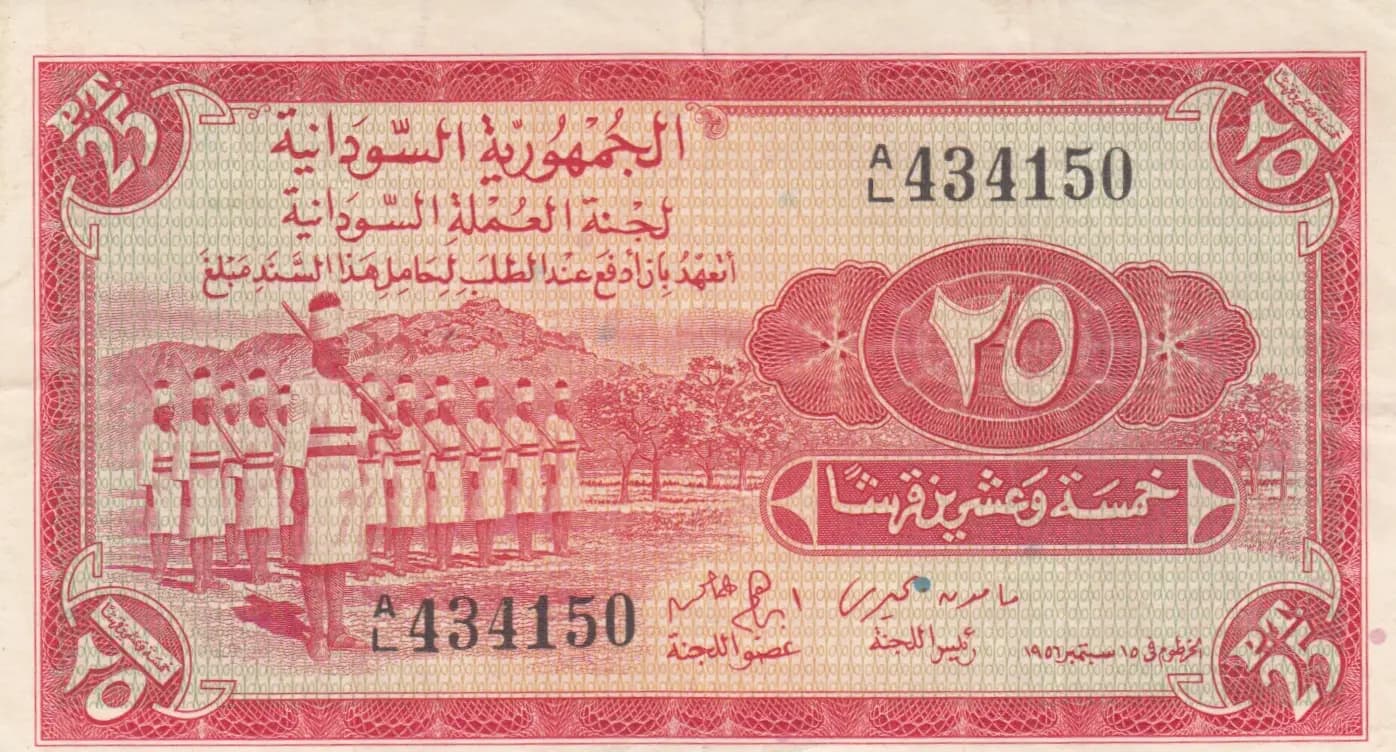
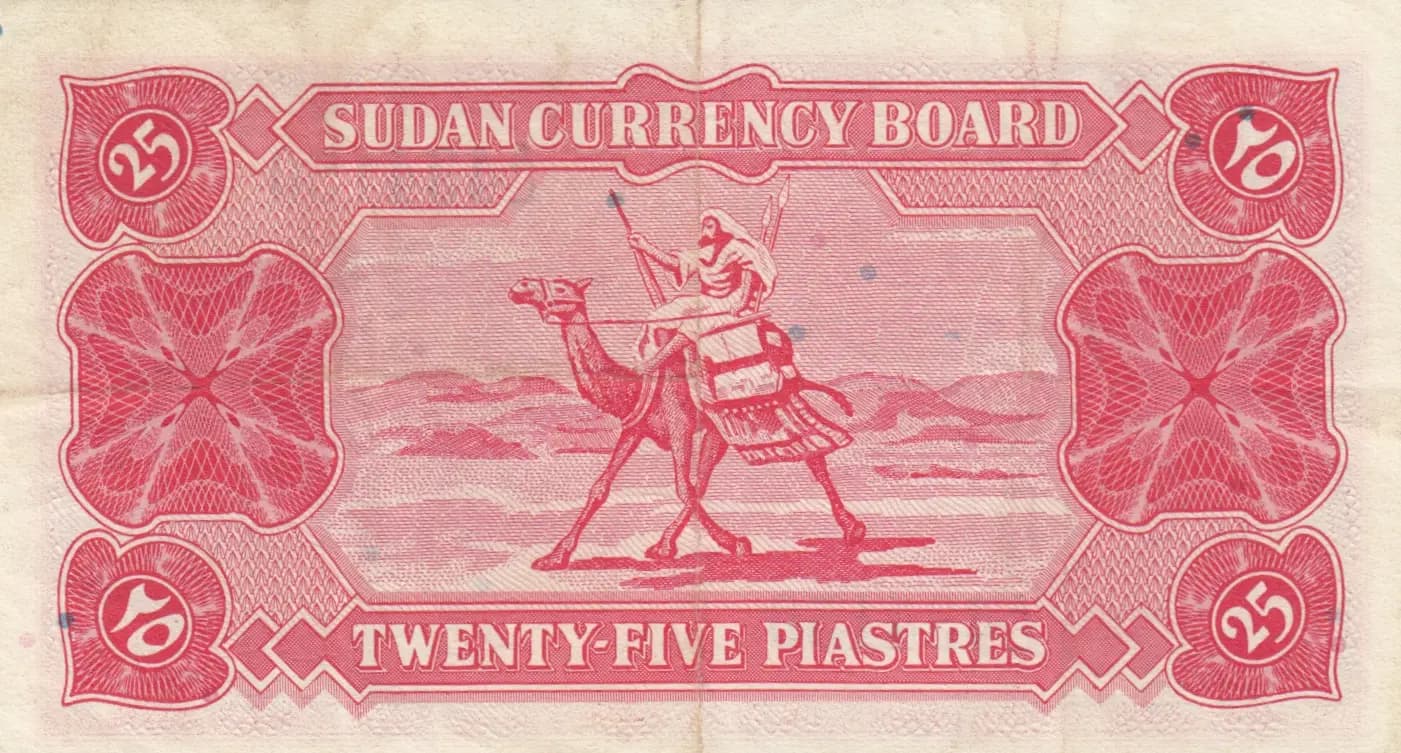
This Sudan Currency Board 25 piastres note from 1956 (Pick P-1B) presents a historically significant early post-independence banknote in VF condition. The obverse features uniformed soldiers in formation against a mountainous landscape, while the reverse depicts the iconic desert camel soldier—Sudan's national emblem. Although showing expected wear from circulation with creases and age-related discoloration, the note retains clear impressions and strong color saturation consistent with VF grading.
Common. eBay market data shows VF specimens consistently selling in the $24-32 range (2020 sales), with 2016 catalog values listing VF at $20. These price points indicate robust collector demand but abundant supply. The note was part of Sudan Currency Board's regular circulation issue from 1956, with no recorded print run restrictions or recall. The PMG population report shows multiple cataloged variants (P-1As, P-1B) indicating substantial numbers entered the graded market. Early circulation examples in VF condition represent standard collector-grade material with no premium scarcity factors.
Issued by the Sudan Currency Board in 1956, this note commemorates Sudan's transition to independence, with the camel soldier on the reverse symbolizing the desert warrior heritage central to Sudanese national identity and the country's break from colonial rule. The bilingual inscriptions (Arabic and English) reflect Sudan's dual linguistic heritage during this formative period. The soldiers depicted on the obverse represent the nation's military and institutional identity in the newly independent state.
The obverse depicts a formal procession or formation of uniformed military or government officials standing at attention, set against a landscape with mountains and scattered vegetation in the background—symbolizing Sudan's newly established military and administrative authority. The reverse features the celebrated motif of a mounted camel soldier (meharist) in traditional Sudanese dress traversing desert terrain, representing both Sudan's nomadic heritage and its martial traditions. Both sides feature ornate coral-pink decorative borders with fine geometric patterns characteristic of mid-20th-century Commonwealth currency production. Corner ornaments display the denomination '25' in ornamental cartouches. The overall design employs classical engraved vignettes typical of British-influenced Commonwealth currency design of the era.
OBVERSE - Arabic: الجمهورية السودانية (Republic of Sudan), لجنة العملة السودانية (Sudan Currency Commission), مشروقة الشرق (East Light/Dawn of the East), نائب الرئيس (Vice President), عضو اللجنة (Committee Member). Latin numerals: 25 (denomination), Serial number E434150. REVERSE - English: SUDAN CURRENCY BOARD, TWENTY-FIVE PIASTRES, 25 (denomination).
Intaglio engraving (line engraving) executed with fine detail and complex geometric border patterns, as evidenced by the intricate line work visible throughout both sides. The dominant colors (coral/rose pink on pale green and pale orange underprint) were applied through multi-color letterpress or offset lithography in conjunction with the engraved base design. This note was produced by Thomas De La Rue and Company (TDLR), the primary security printer for British Commonwealth nations during this period, though the specific variant printing codes are not externally visible on this specimen.
Cataloged as Pick P-1B (second variety of the 25 piastres denomination). The visual analysis shows Arabic date at lower right and confirms the soldiers/camel soldier design described in reference catalogs. Serial number prefix 'E' is visible; variants may exist with different prefixes. PMG records indicate P-1As and P-1B as distinct varieties, suggesting variations exist in signatures, dates, or security features. The specific signature block combinations and any overprints would require examination of both signature panels to definitively establish the precise variety, though the basic design conforms to P-1B specifications.