50 piastres 1973
Market Prices
7 salesAbout This Note
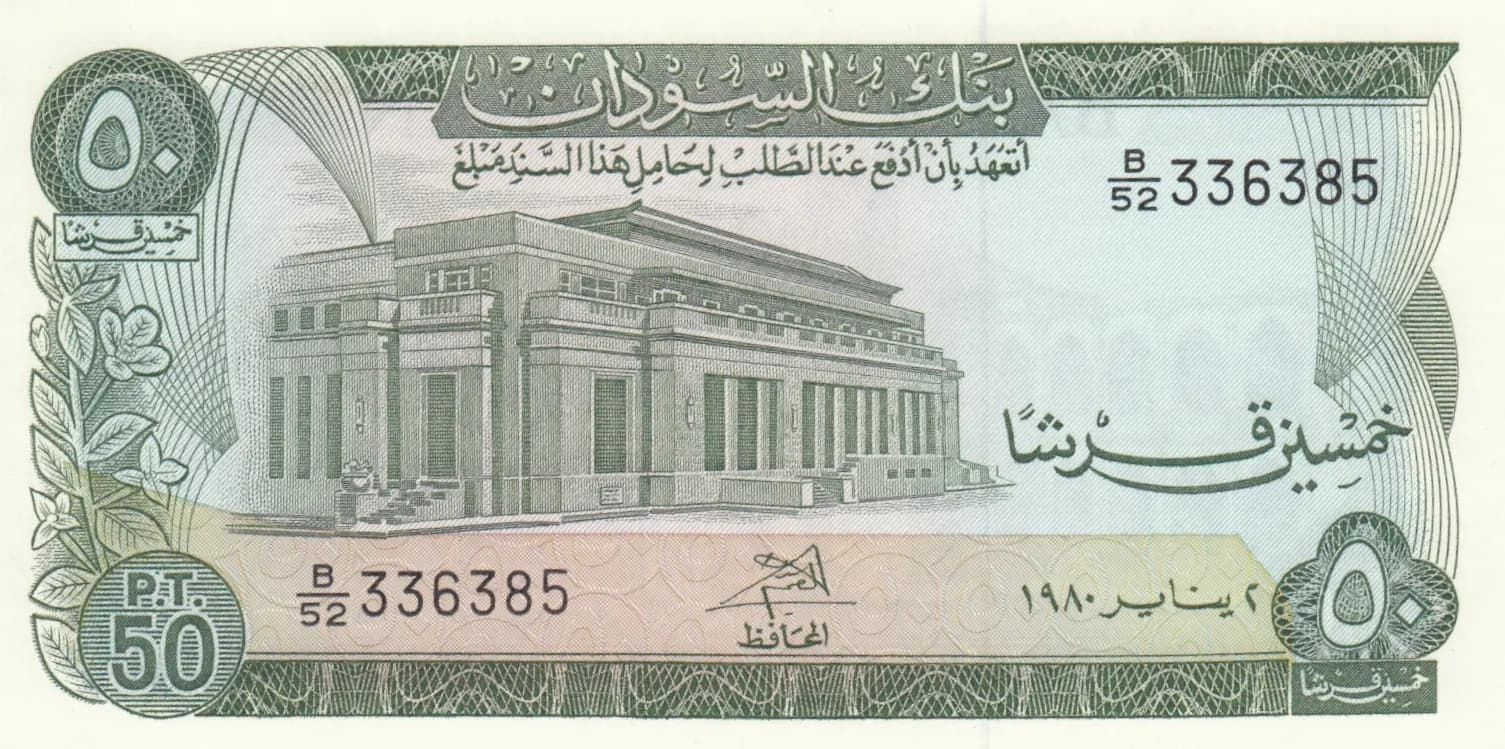
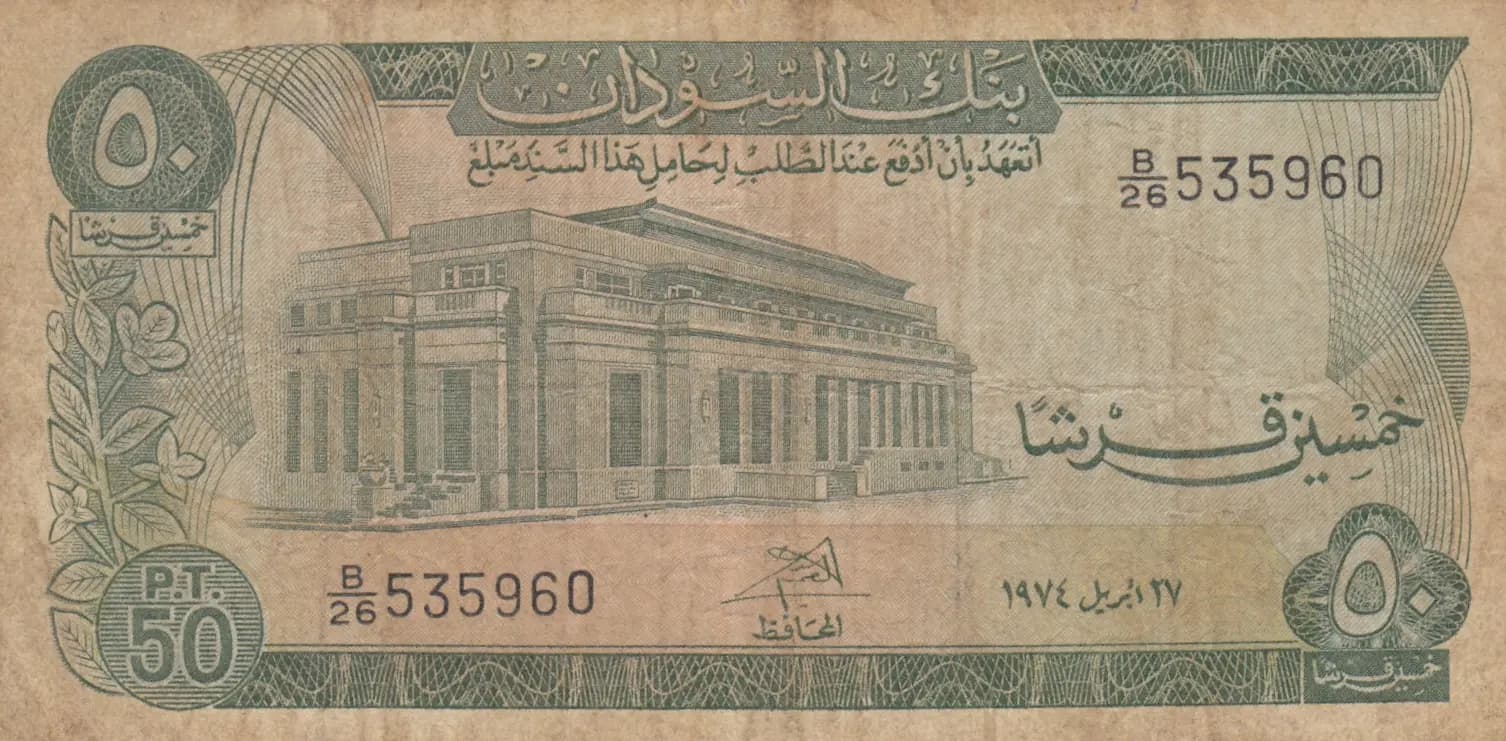
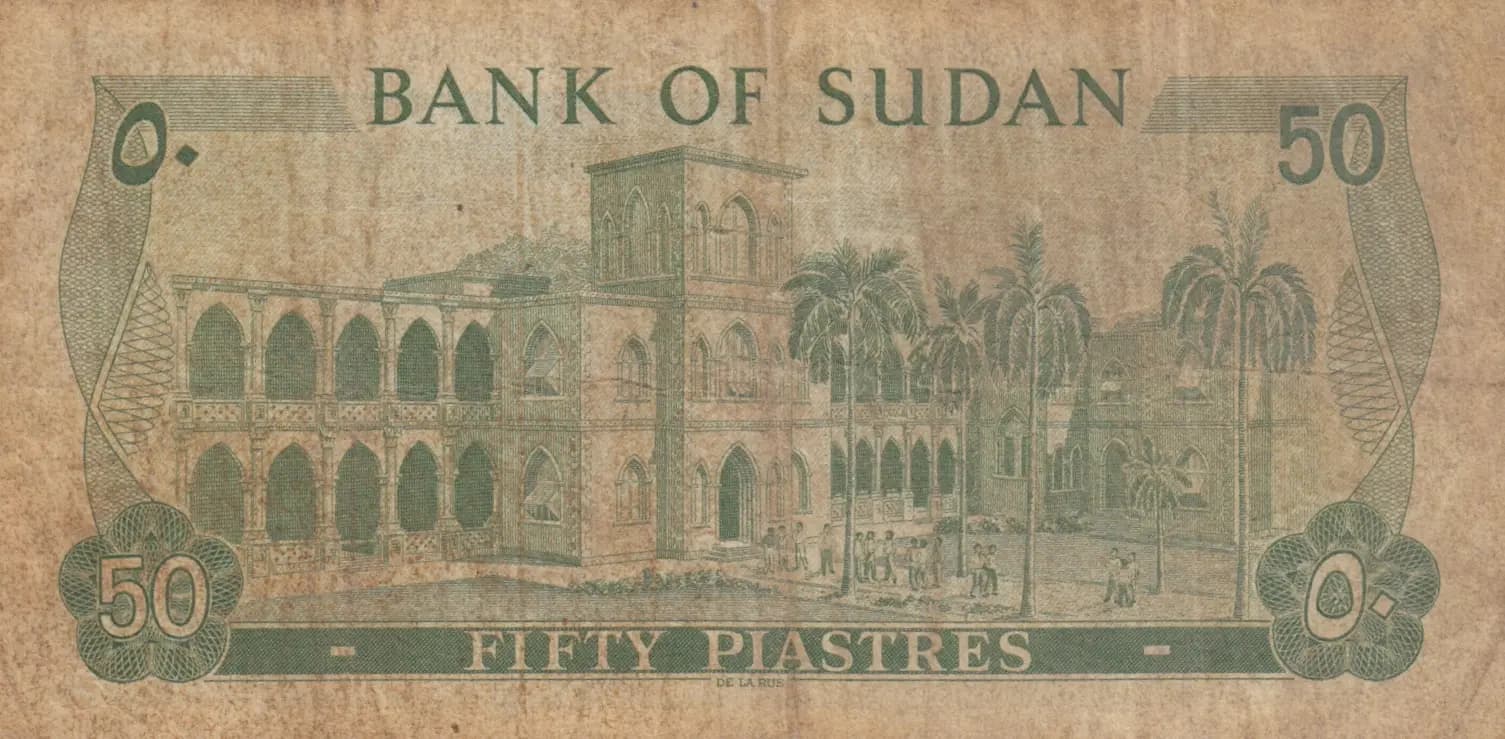
This 50 Piastres note from Sudan (1973) presents a well-preserved example of Bank of Sudan's mid-1970s currency, featuring the iconic neoclassical Bank of Sudan building on the obverse and the University of Khartoum on the reverse. The note exhibits the characteristic green-on-multicolor printing typical of De la Rue's production, with visible aging patina and light creasing consistent with VG condition. The intricate line work and ornamental designs remain crisp and legible, making it an attractive specimen of Sudanese monetary history.
Common. eBay market data shows consistent sales in the $6–$26 range for VF specimens, with catalog values from 2019 listing VF at $4 and UNC at $18. Regular issue status with production by major security printer De la Rue and a relatively wide circulation period (1973–1978) indicate substantial print runs. The note is readily available in numismatic markets, typical of mid-20th-century African banknotes.
Issued during Sudan's post-independence era under the government of Jaafar Nimeiry, this banknote celebrates two institutions central to the nation's modernization: the Bank of Sudan (depicted on the obverse as a symbol of financial authority) and the University of Khartoum (shown on the reverse as a center of learning and national development). The 1973 date marks a period of economic activity following Sudan's 1969 revolution, with the note's bilingual (Arabic/English) design reflecting the country's position as a bridge between the Arab world and international commerce.
The obverse features the neoclassical Bank of Sudan building in Khartoum—a symmetrical structure with multiple columns, balustrades, and a formal institutional facade occupying the center of the composition. Large circular denomination seals displaying '50' and 'P.T.' flank the left side, while ornamental leaf and botanical designs form a decorative left border. All four corners contain denomination markers. The reverse depicts the University of Khartoum, an Islamic/Oriental architectural structure with characteristic arched openings arranged in two tiers, flanked by palm trees, a central tower element, and human figures at ground level—representing the nation's commitment to higher education. Both sides employ fine line cross-hatching and intricate ornamental borders as security features typical of De la Rue's banknote production.
FRONT: 'بنك السودان' (Bank of Sudan); 'خمسون' (Fifty); 'P.T.' (Piastres); '50' (denomination numeral); Serial number 'B 2653960'; Date marking '17 الديل 1976' (17th of Dhu al-Hijjah, 1976, Islamic calendar); Banking terms in Arabic regarding credit conditions. BACK: 'BANK OF SUDAN' (English); 'FIFTY PIASTRES' (denomination in English); '50' (denomination numeral); 'DE LA RUE' (printer attribution).
Intaglio (engraved) printing on banknote paper, executed by De la Rue, London (TDLR abbreviation noted on reverse). The fine line patterns, precise cross-hatching throughout the design, ornamental borders, and sharp definition of architectural details are characteristic of intaglio security printing. Multiple denomination markers and repetitive security patterns serve anti-counterfeiting purposes.
This specimen displays serial number 'B 2653960' with prefix 'B', indicating one of the known serial number varieties documented for this Pick number. The Islamic calendar date of 1976 ('17 الديل 1976') appears on the obverse, consistent with notes issued during the mid-to-late portion of the circulation period. The catalog reference notes 'various date and signature varieties' for this issue (1973–1978), and this note represents the 1976 dated variety. No special overprints or commemorative markings are visible.