25 piastres 1980
Market Prices
8 salesAbout This Note
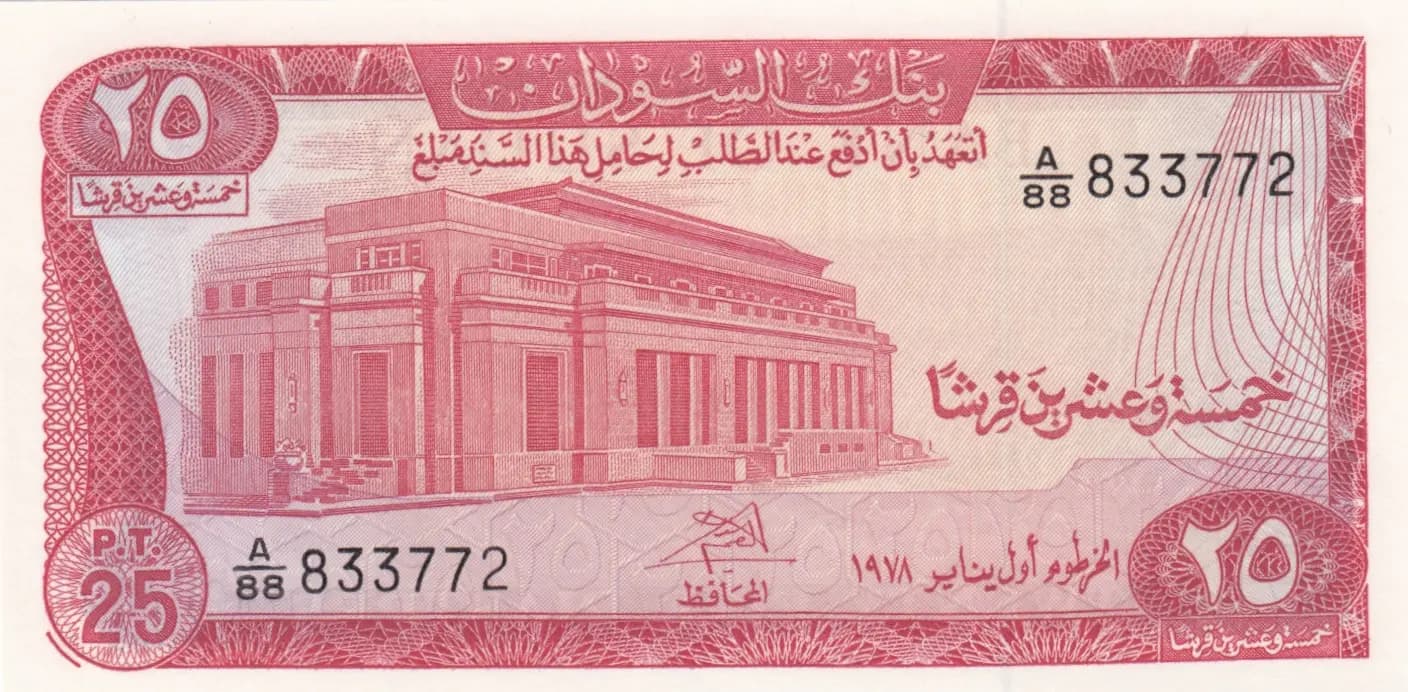
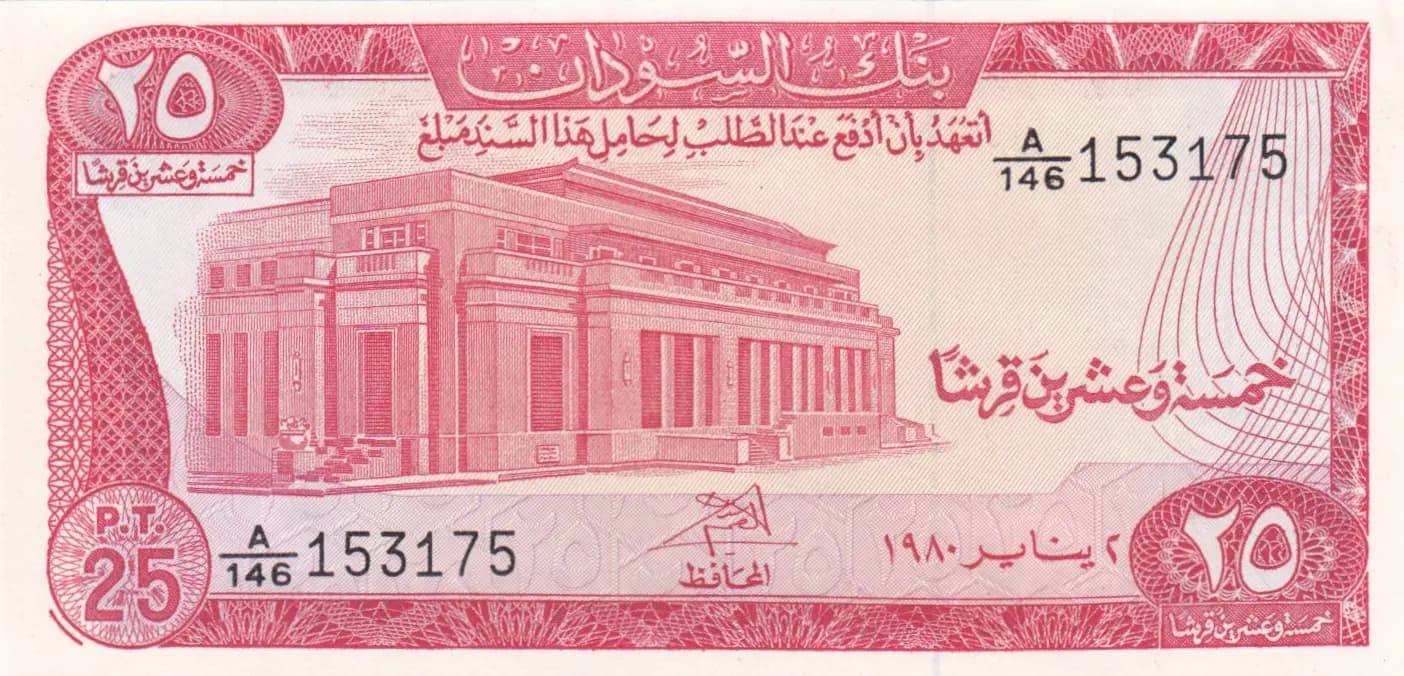
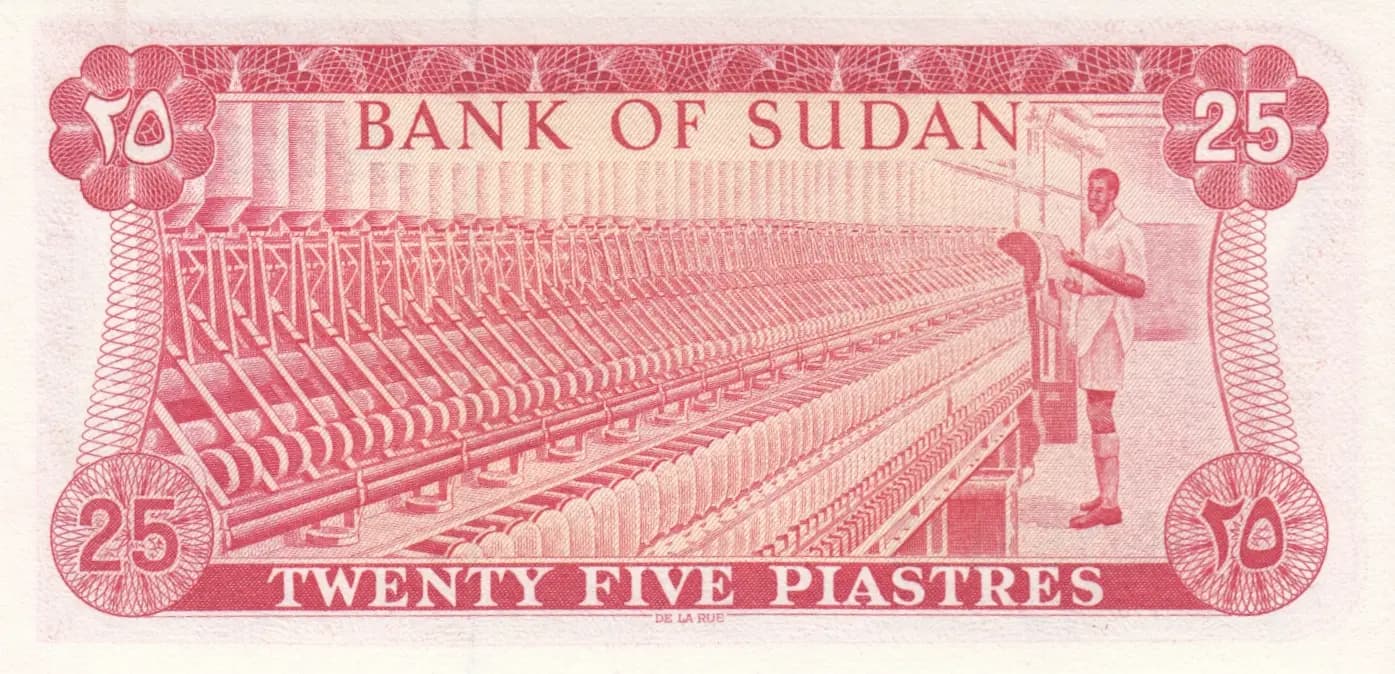
This is a striking 1980 Sudan 25 Piastres note in uncirculated condition, featuring the iconic Bank of Sudan building rendered in vibrant pink and magenta tones on the obverse. The reverse depicts industrial/textile machinery with a worker, reflecting Sudan's economic focus during this period. The note exhibits excellent preservation with crisp printing, sharp borders, and no signs of circulation, making it a desirable example for collectors of African currency.
Common. This note was regularly issued from 1970-1980 in substantial quantities and remains readily available in the collector market. Secondary market data from eBay shows consistent sales in the $3-$15 range across various grades, with UNC examples averaging $9-$10, indicating healthy supply and steady collector demand rather than scarcity. The 2019 catalog value of $10 for UNC confirms this is a standard, commonly encountered issue.
Issued in 1980 during a period of Sudan's economic development, this note commemorates the nation's industrial and textile sectors through its reverse design showing mechanized production. The Bank of Sudan building depicted on the obverse represents the central financial authority established post-independence, while the textile industry imagery reflects Sudan's significant cotton and manufacturing economy of the era.
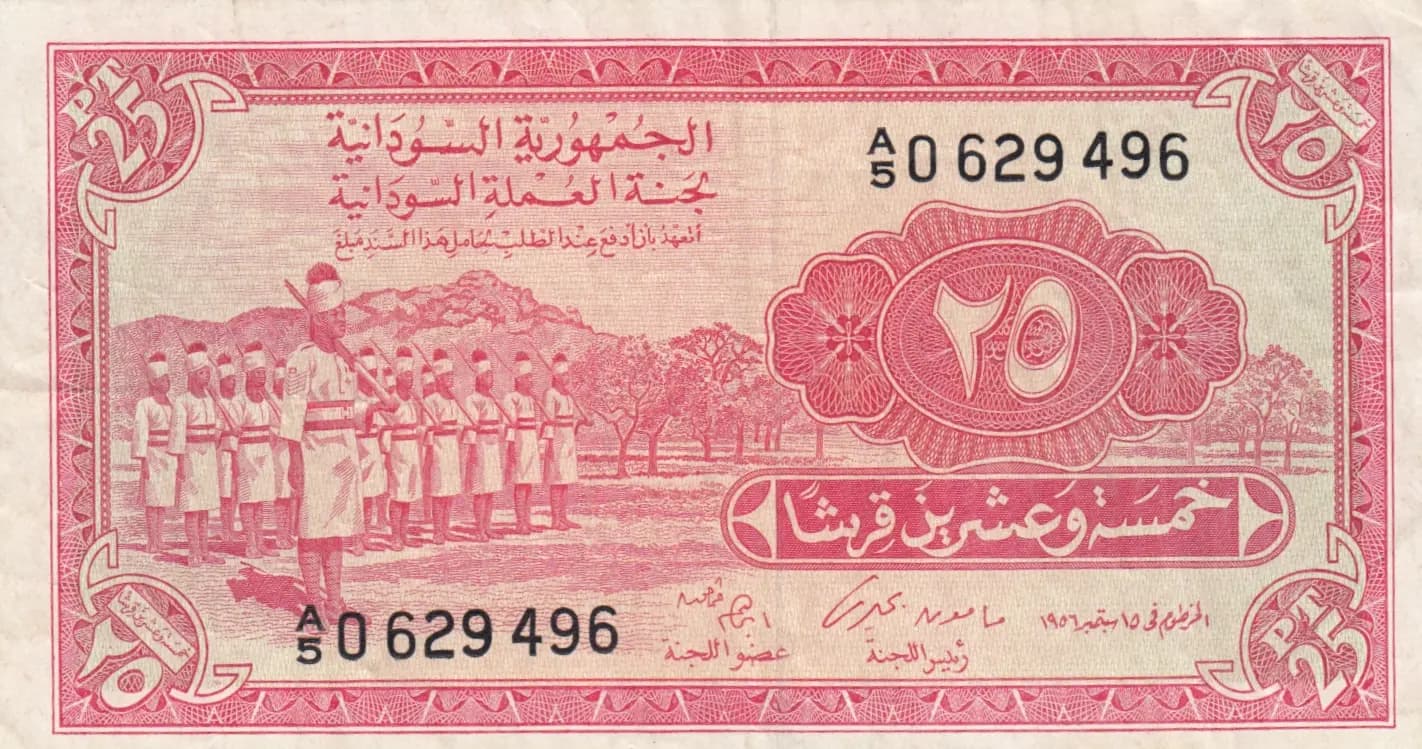
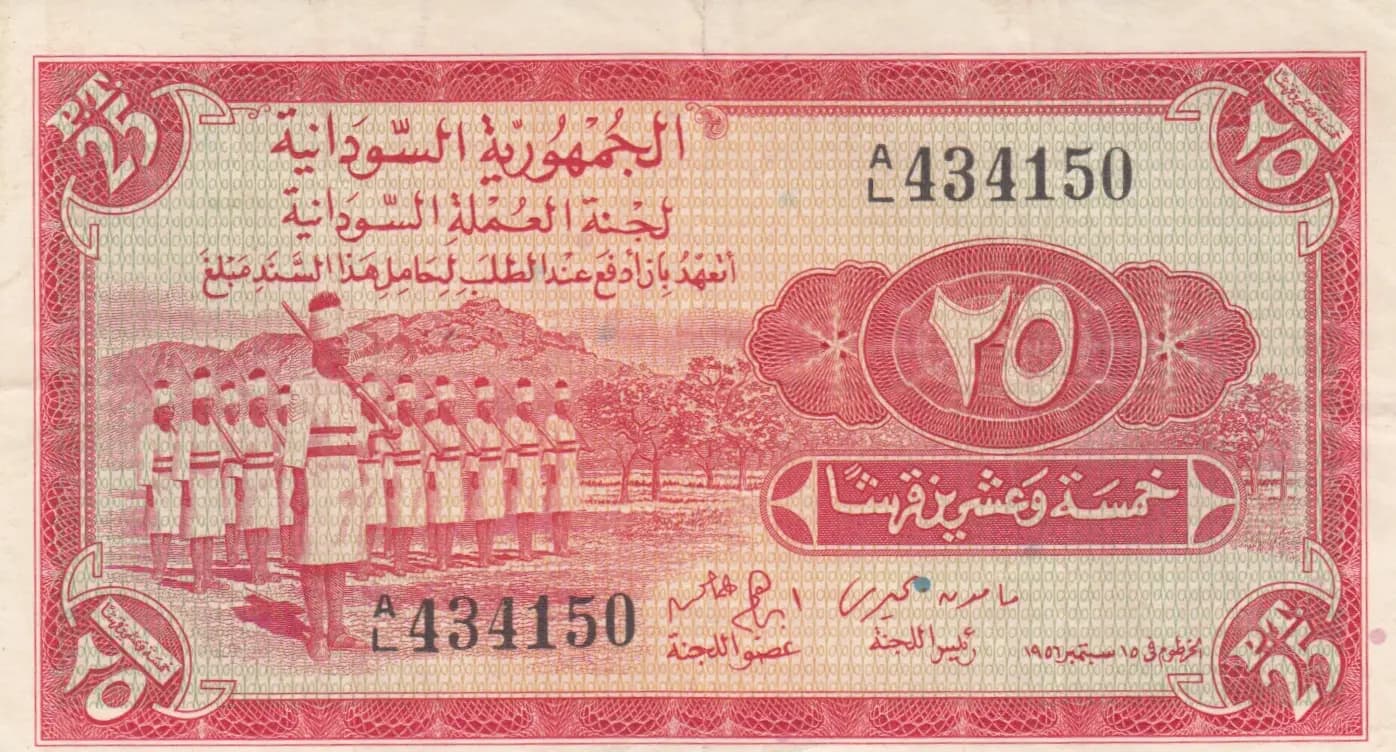
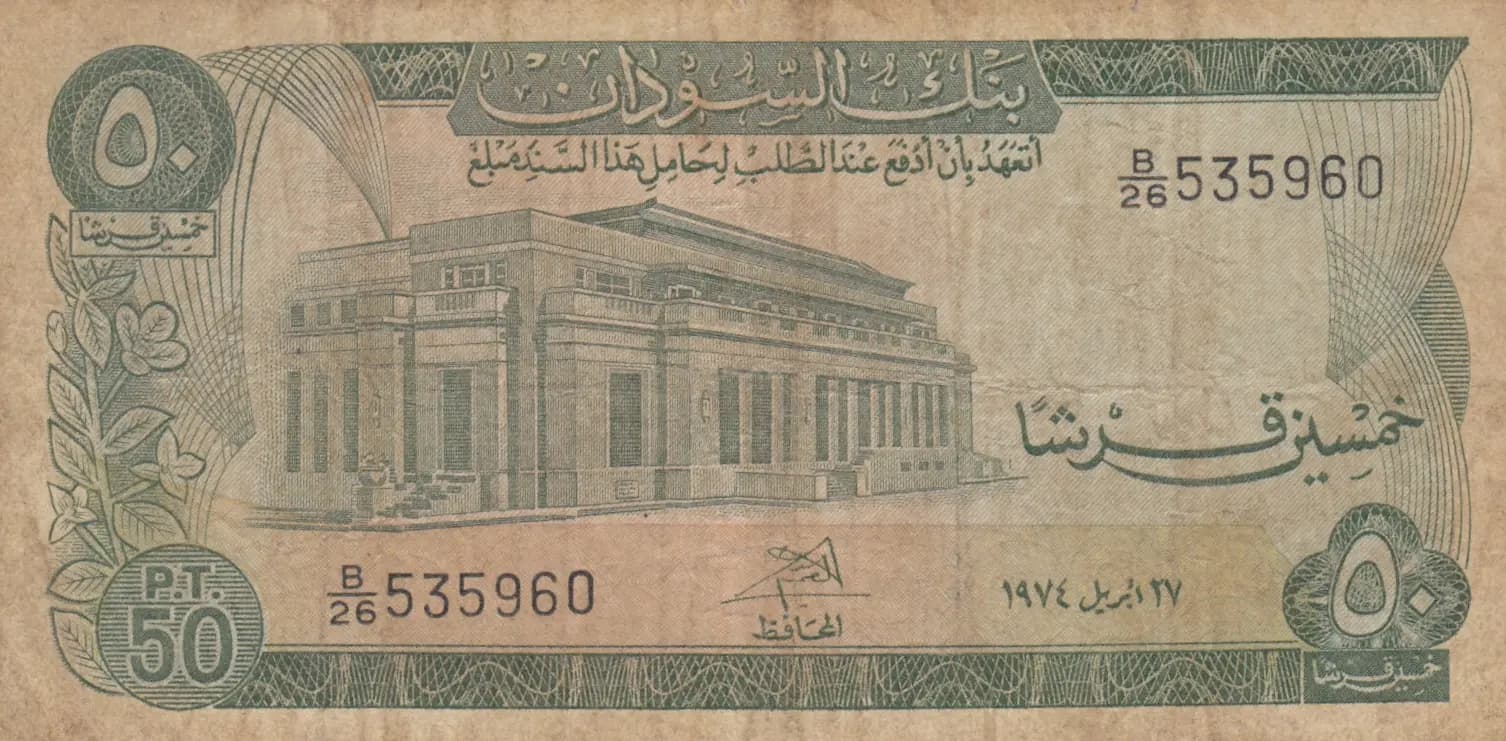
The obverse features the Bank of Sudan headquarters building in Khartoum, depicted in classical architectural style with columned facade, multiple stories, and a stepped entrance. The building is rendered in fine detail with intricate engraving typical of De La Rue's work. The reverse showcases Sudan's textile and industrial sector with a worker operating machinery in rows of cotton or textile equipment, demonstrating the nation's industrial capacity. Both sides employ distinctive ornamental circular frames containing the '25' denomination in all corners, connected by geometric and floral border patterns characteristic of 1970s-1980s banknote design. The color scheme of pink, magenta, and red dominates throughout, creating a visually cohesive and distinctive appearance.
FRONT (Obverse): 'بنك السودان' (Bank of Sudan) appears prominently. Arabic inscriptions include references to the promise and guarantee to the bearer for continuous circulation and references to projects and dates. The year '1980' (كيشاب ١٩٨٠) is clearly marked. Serial number 'A 146 1531/75' appears in upper right and lower left. Denomination '25' in Arabic numerals appears in ornamental circles. BACK (Reverse): 'BANK OF SUDAN' and 'TWENTY FIVE PIASTRES' appear in English text. The printer's mark 'DE LA RUE' identifies De La Rue London as the security printer. Denomination '25' appears in ornamental circles at all four corners.
Intaglio engraving and multicolor offset printing, executed by De La Rue London, a leading British security printer. The fine line work visible throughout, intricate geometric patterns, and detailed architectural and industrial scenes are consistent with high-quality intaglio engraving combined with sophisticated multicolor offset printing techniques. Security features include fine-line border work and the dual serial number placement.
Pick catalog number P-11c identifies this as a variant of the 25 Piastres series. Related varieties include P-11b and P-11s in PMG population records, indicating multiple signature and date combinations exist for this denomination. The serial number prefix 'A 146' and the specific printing date of 1980 help identify the precise variety. Collectors should note potential variations in signatures, serial number prefixes, and precise printing dates within the P-11 series.