50 rupees 1979
Market Prices
53 salesAbout This Note
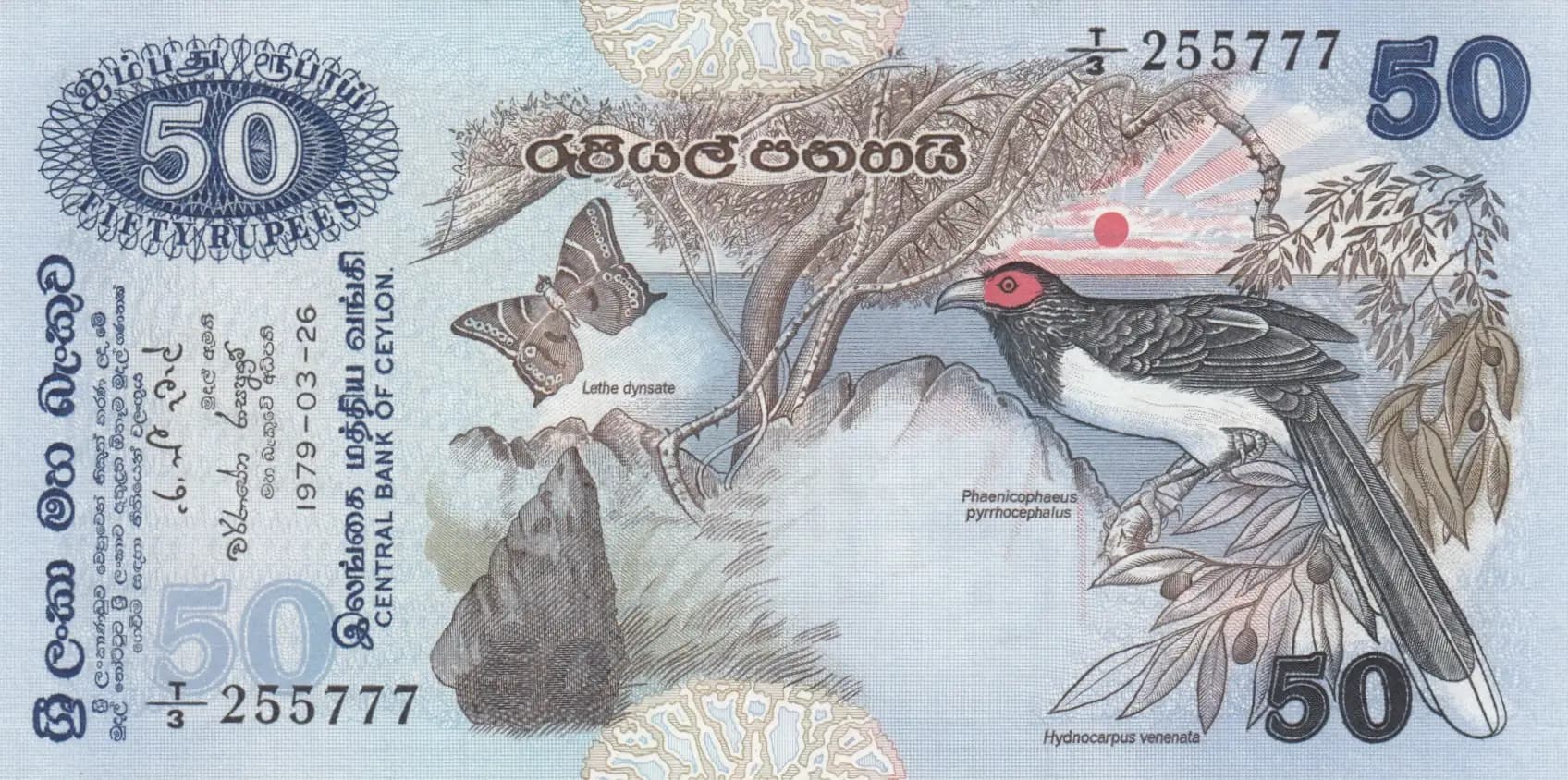
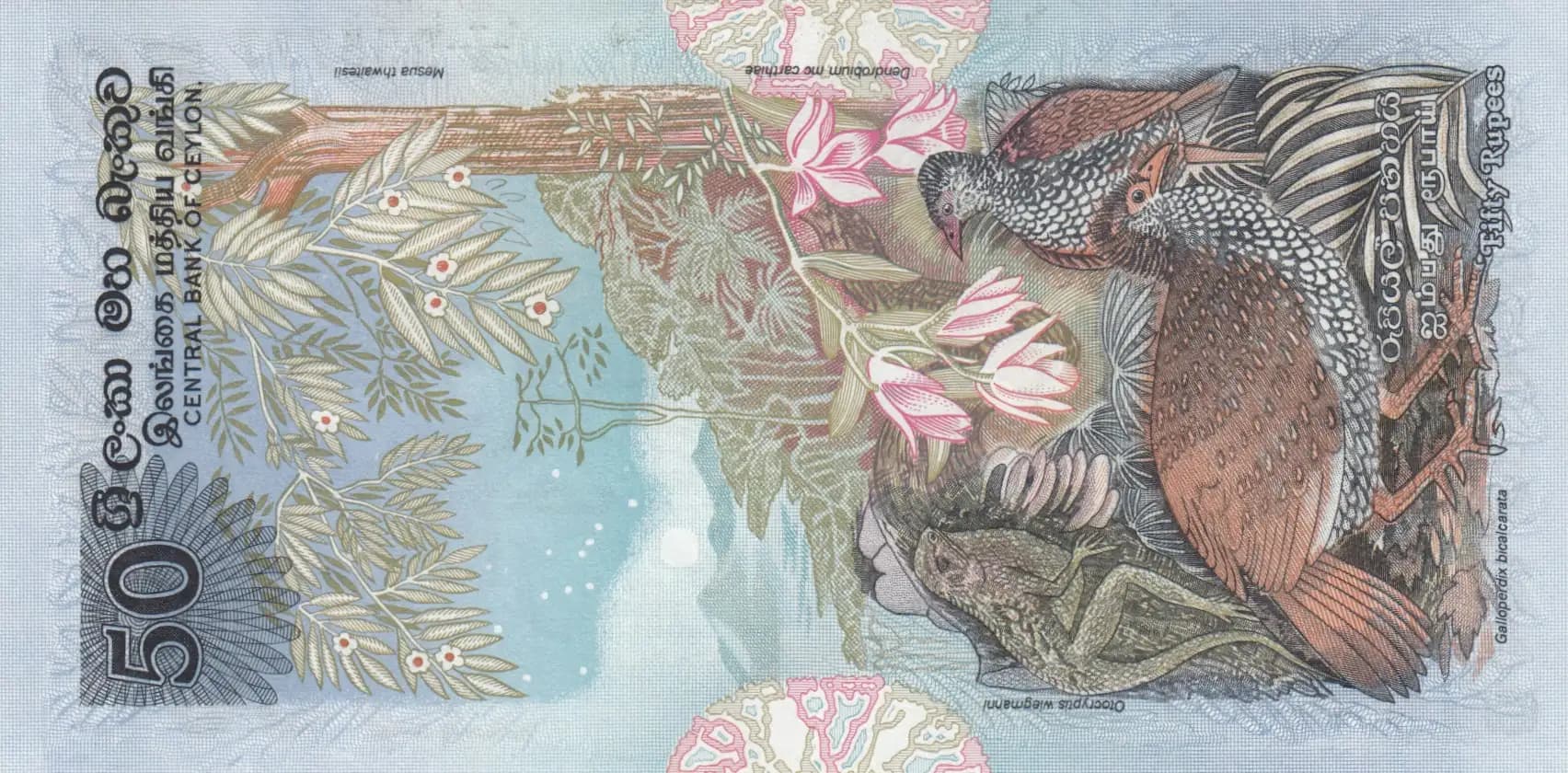
This is an exceptional UNC example of the 1979 Central Bank of Ceylon 50 rupee note (Pick P-87), displaying pristine condition with vibrant, undisturbed colors throughout. The note showcases Sri Lanka's endemic wildlife in stunning detail—a red-faced malcoha in profile on the obverse, Ceylon spurfowl and leguan on the reverse—alongside rare botanical specimens, all rendered through fine line engraving on multicolor underprint. At current market rates, UNC examples consistently achieve $50–$115 at auction, with this note representing an excellent example of Ceylon's wildlife-themed currency series from the post-independence period.
Common. While the 1979 50 rupee note is no longer in circulation in Sri Lanka, it was issued as a regular circulation note with substantial print runs appropriate for a mid-denomination banknote of a Commonwealth nation. eBay market data confirms consistent availability: ungraded UNC examples regularly sell in the $45–$115 range with 12–28 bids per listing, and even higher grades (PMG 66–67) regularly appear on the market at $90–$180. The abundance of sales data spanning over a decade with no evidence of supply constraint indicates this is a widely available note among collectors. It is not scarce.
Issued on March 26, 1979, this banknote was released during Sri Lanka's period of economic transition following independence, when the Central Bank of Ceylon (later renamed Central Bank of Sri Lanka in 1998) was emphasizing the nation's natural heritage and biodiversity. The deliberate choice to feature endemic species—the red-faced malcoha, Ceylon spurfowl, and leguan—reflected national pride in Sri Lanka's unique flora and fauna, while scientific nomenclature printed alongside illustrations underscored the country's commitment to conservation and education. This design philosophy made the 50 rupee note part of a broader wildlife series that celebrated Ceylon's ecological distinctiveness during a formative period of the young republic.
The obverse presents a panoramic natural scene dominated by the red-faced malcoha (Phoenicophaelus pyrrhocephalus), a striking Sri Lankan endemic bird rendered in profile with distinctive red facial markings and black-and-white plumage, perched prominently on a rocky outcrop in the composition's center-right. The Ceylon Forester butterfly (Lethe dynastae) is illustrated in delicate detail at center, with a sunset/sunrise landscape backdrop featuring rocky formations, flowering plants (identified as Hydrocarpus venenata), and natural vegetation. Ornate '50' denomination numerals frame the upper corners in elaborate decorative scripts. The reverse depicts additional endemic fauna and flora including the Ceylon spurfowl (Galloperdix bicalcarata), leguan lizard (Otocryptis wiegmanni), a delicate white orchid (Dendrobium mc carthiae), and botanical specimens including Mesua thwaitesii branches. Throughout, fine naturalistic engraving combines with bold color blocking in blues, browns, pinks, and tans to create a cohesive wildlife-focused design.
Front side: '50' (denomination numeral), 'ශ්රී ලංකා' (Sinhala: Sri Lanka), 'CENTRAL BANK OF CEYLON' (English), 'Phoenicophaelus pyrrhocephalus' (Latin scientific name: Red-faced Malcoha), 'Lethe dynastae' (Latin: Ceylon Forester butterfly), 'Hydrocarpus venenata' (Latin: plant species), '26.03.1979' (issue date), 'T 255777' (serial number). Back side: '50' (denomination numeral), 'ශ්රී ලංකා' (Sinhala: Sri Lanka), 'CENTRAL BANK OF CEYLON' (English), 'Galloperdix bicalcarata' (implied; Ceylon Spurfowl), 'Otocryptis wiegmanni' (implied; leguan/lizard species), 'Dendrobium mc carthiae' (implied; orchid species), 'Mesua thwaitesii' (implied; flowering branch/tree species). The reverse includes 'Osteobrama neilli' as observed in the visual analysis.
This note employs multi-color intaglio printing (line engraving) combined with lithography, a hallmark of high-security banknote production from the 1970s. The fine line guilloche patterns visible in ornate borders, the precise naturalistic rendering of animals and plants, and the registration of multiple color layers indicate professional banknote security printing, likely produced by De La Rue or a similar British Commonwealth security printer that serviced Central Bank of Ceylon contracts during this period. The multicolor underprint base supports additional color separation work visible in the botanical and zoological illustrations.
The observed example carries serial number T 255777, placing it within the standard regular-issue production. According to the catalog reference, replacement notes for this Pick number use serial number prefix Z/1, which this example does not exhibit. No signature variations are evident in the visual analysis provided. The note is dated 26.03.1979 (March 26, 1979), consistent with the noted issue date for Pick P-87. Standard varieties for this issue relate to serial number prefixes and minor printing variations across different bank note printing batches, but the example shown represents a typical regular-issue specimen without notable variety status.