1 rupee 1925
About This Note
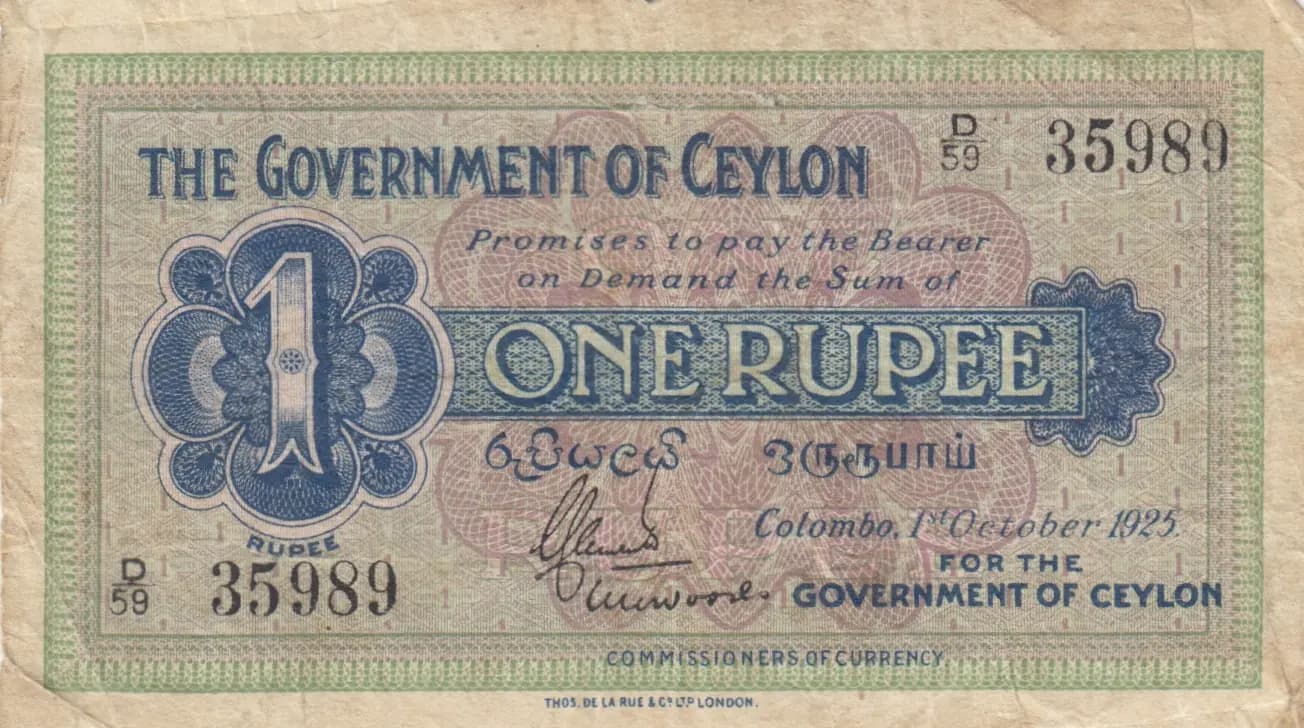
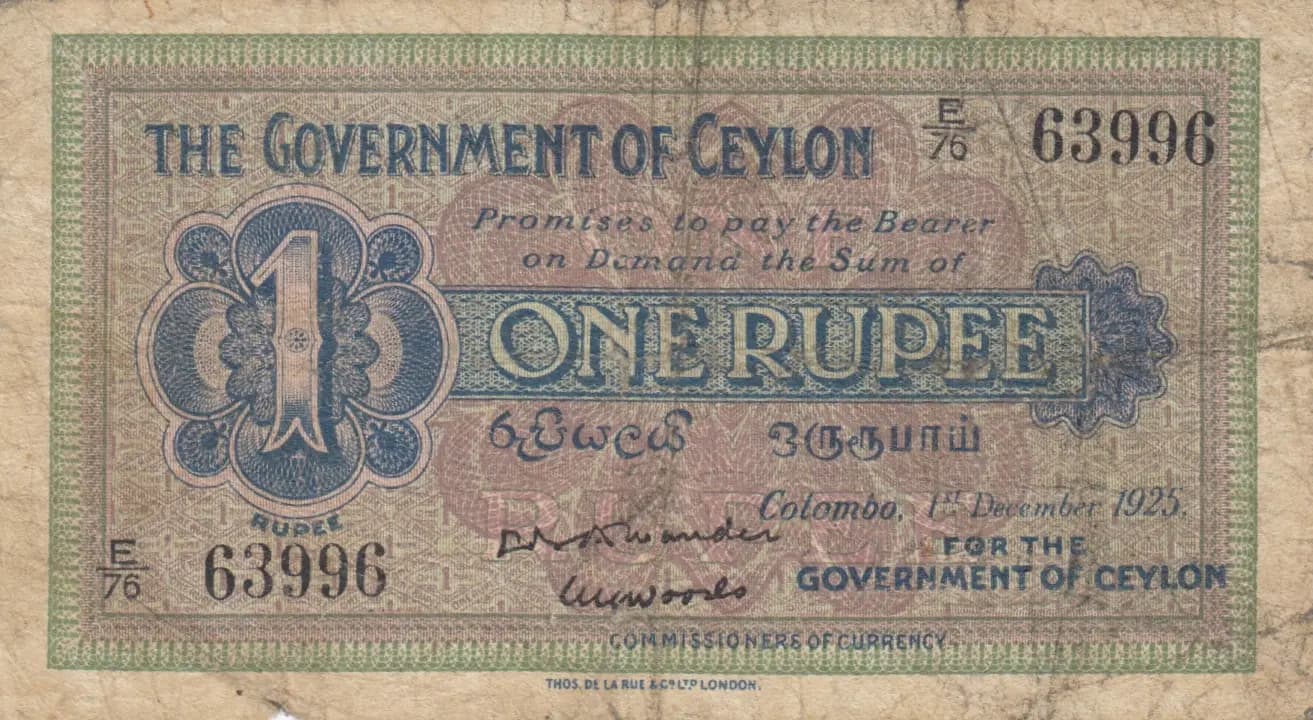
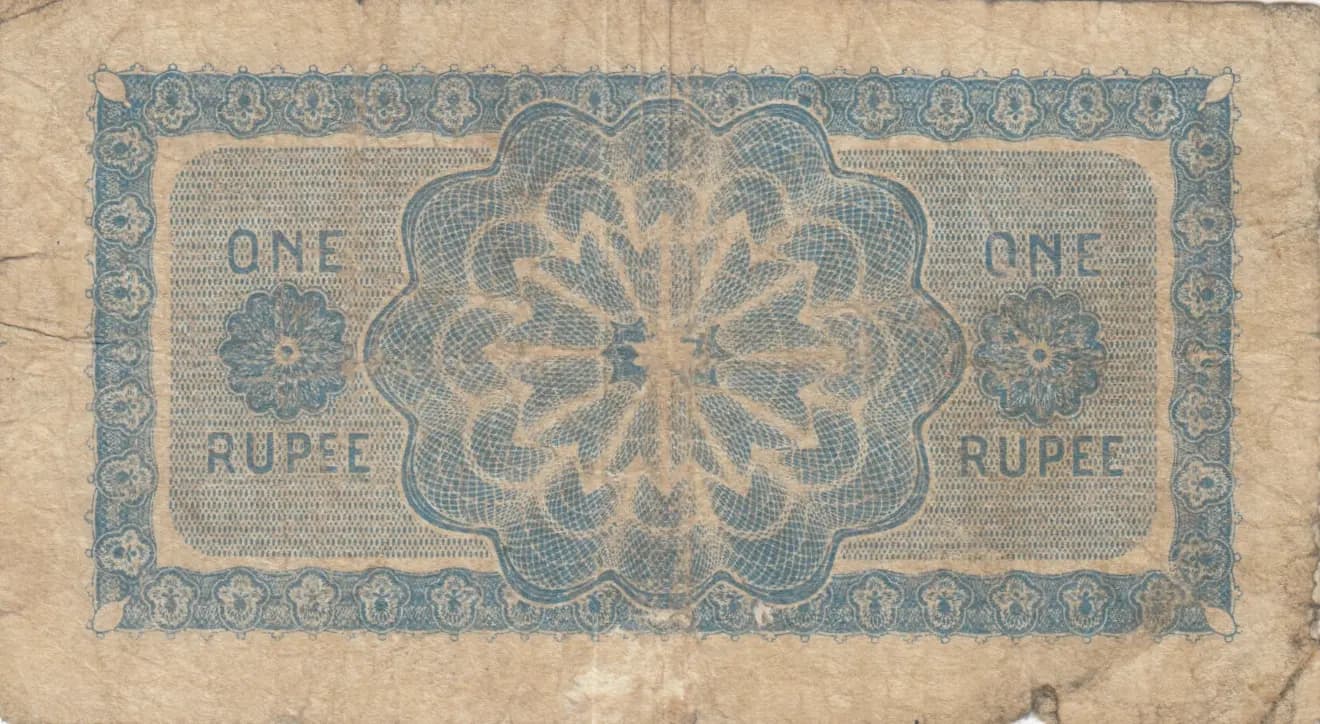
This is a 1925 Government of Ceylon one rupee note (Pick P-16b) issued on 1st December 1925 in Colombo, printed by the prestigious Thomas de la Rue & Co Ltd of London. The note exhibits the characteristic ornamental design of early 20th-century Commonwealth currency, featuring bilingual inscriptions in English and Sinhala script, with an intricate circular star/lotus motif on the reverse. In Grade G condition, the note shows significant aging with multiple creases, foxing, and fading consistent with circulation, making it a representative example of Ceylon's early independence-era currency.
Common. The 1925 Ceylon one rupee note (Pick P-16b) is a standard issue from a well-established denomination and printing series that ran from 1917-1939 under the Government of Ceylon. While banknotes of this age show wear and are less frequently encountered than modern currency, they were produced in substantial quantities for circulation and remain widely available to collectors in various condition grades. The Grade G condition specimen observed here is typical for circulated notes from this era and does not command premium pricing.
This banknote was issued during Ceylon's period under British colonial administration, approximately 8 years before Ceylon gained dominion status in 1931. The inclusion of Sinhala script alongside English reflects the colonial administration's acknowledgment of the island's indigenous population, while the "Commissioners of Currency" designation indicates governance through appointed British financial authorities. The 1925 date places this note in the interwar period when Ceylon's economy was heavily dependent on tea and rubber exports under the British economic system.
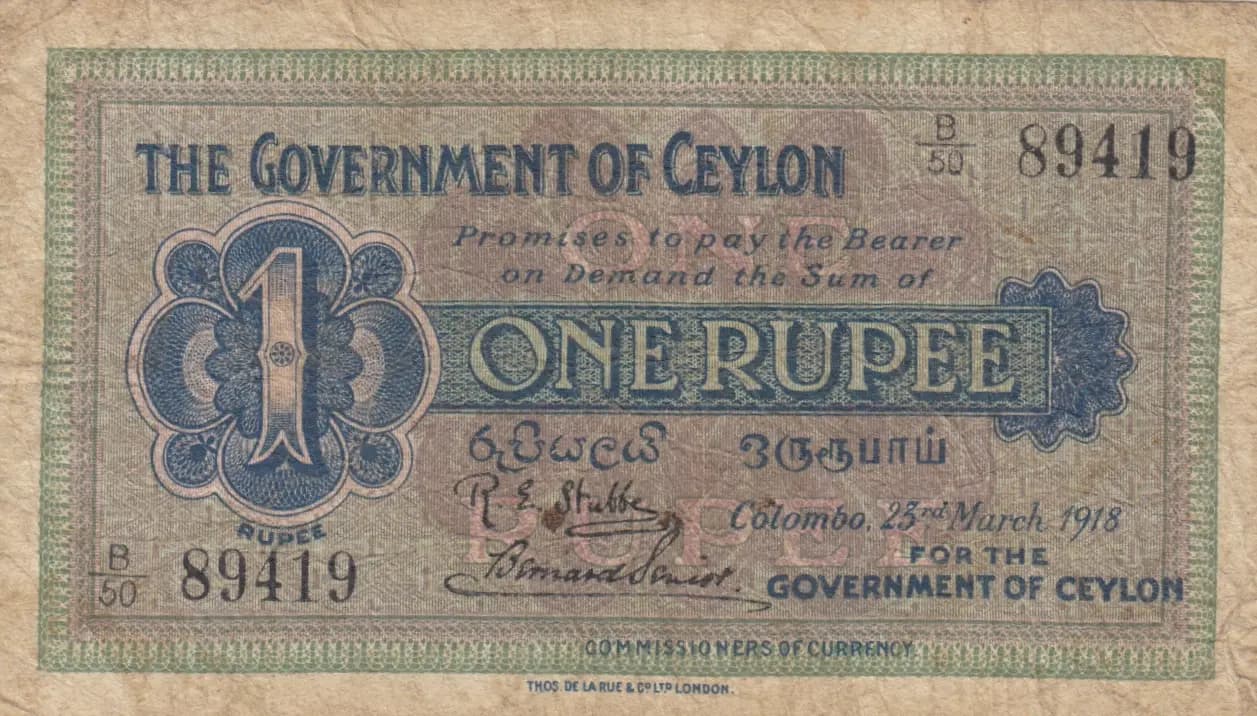
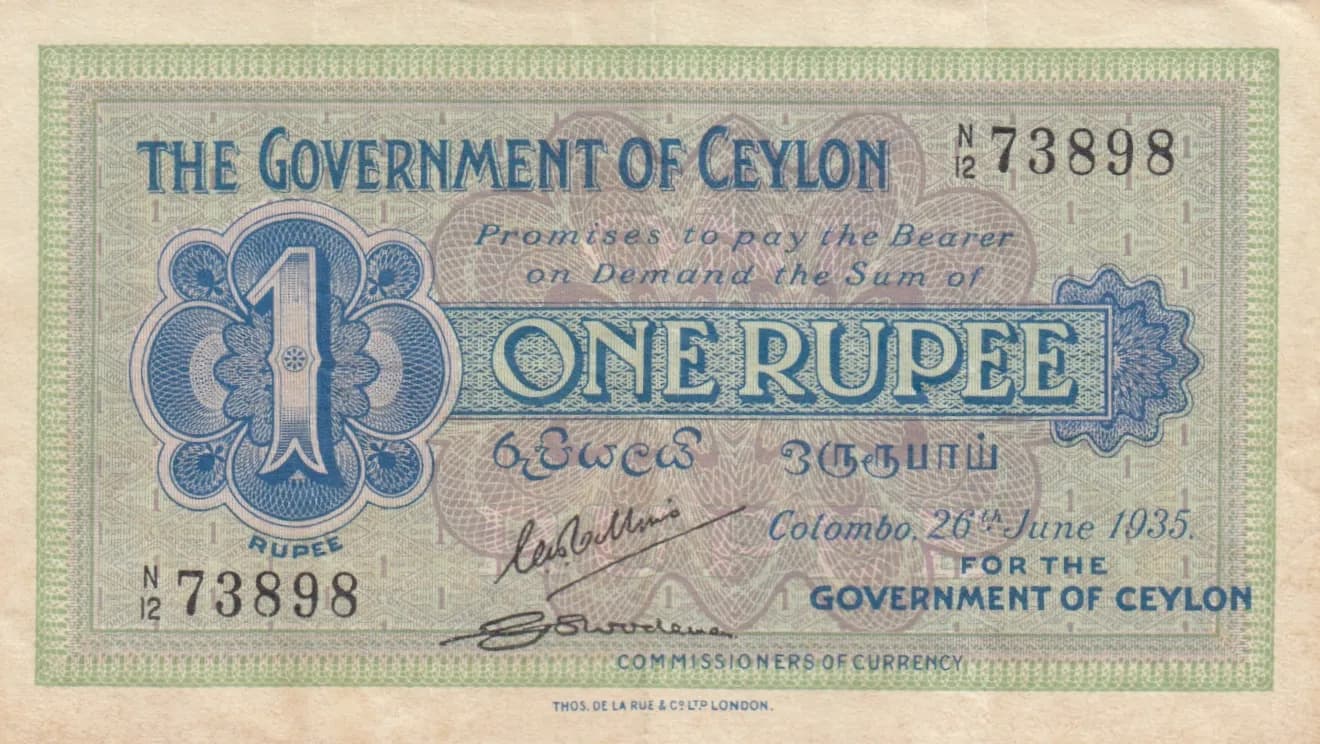
The obverse features a classical promise-to-pay design typical of British Commonwealth currency of the era, with the denomination 'ONE RUPEE' prominently centered within decorative rectangular frames executed in green and blue tones. The note incorporates bilingual text reflecting Ceylon's multicultural character, with Sinhala script complementing the English inscriptions. The reverse displays a highly ornamental central motif—a geometric star or lotus-like circular design with intricate radiating patterns—enclosed within a decorative scalloped border frame with repeating ornamental elements. The background of the reverse is filled with fine crosshatch or mesh patterns serving as anti-counterfeiting security measures. The dominant color scheme comprises green, blue, and tan/beige tones throughout, with subtle pink/mauve accents on the obverse.
FRONT SIDE: 'THE GOVERNMENT OF CEYLON' / 'Promises to pay the Bearer on Demand the Sum of' / 'ONE RUPEE' / 'Colombo, 1st December 1925' / 'FOR THE GOVERNMENT OF CEYLON' / 'COMMISSIONERS OF CURRENCY' / Serial number: E 76 63996 / 'THOS. DE LA RUE & CO LTD LONDON' (printer attribution) / Sinhala script: 'ඉක්රුප' (One Rupee) and 'රුපියල්' (Rupee). REVERSE SIDE: 'ONE RUPEE' (appears in four corners: top left, top right, bottom left, bottom right).
This note was produced using intaglio printing (engraved plate printing), the standard security printing method employed by Thomas de la Rue & Co Ltd for Commonwealth banknotes of this period. The fine line work, intricate geometric mesh patterns, decorative borders, and ornamental designs are characteristic of high-security intaglio production. The clarity and complexity of the central reverse motif and the text integration into the overall design reflect the precision capabilities of this premium printing technique, which creates distinctive tactile relief on the paper surface.
The specific variety observed is characterized by the date '1st December 1925' and serial number prefix 'E 76' with sequential number 63996. The signature block reads 'FOR THE GOVERNMENT OF CEYLON / COMMISSIONERS OF CURRENCY,' representing the standard administrative authority attribution for this series. Thomas de la Rue & Co Ltd is credited as the London-based printer, as indicated on the note itself. This constitutes the standard P-16b variety; no overprints, commemorative markings, or exceptional printing variants are evident in the visual analysis.