50 rupees 1958
About This Note
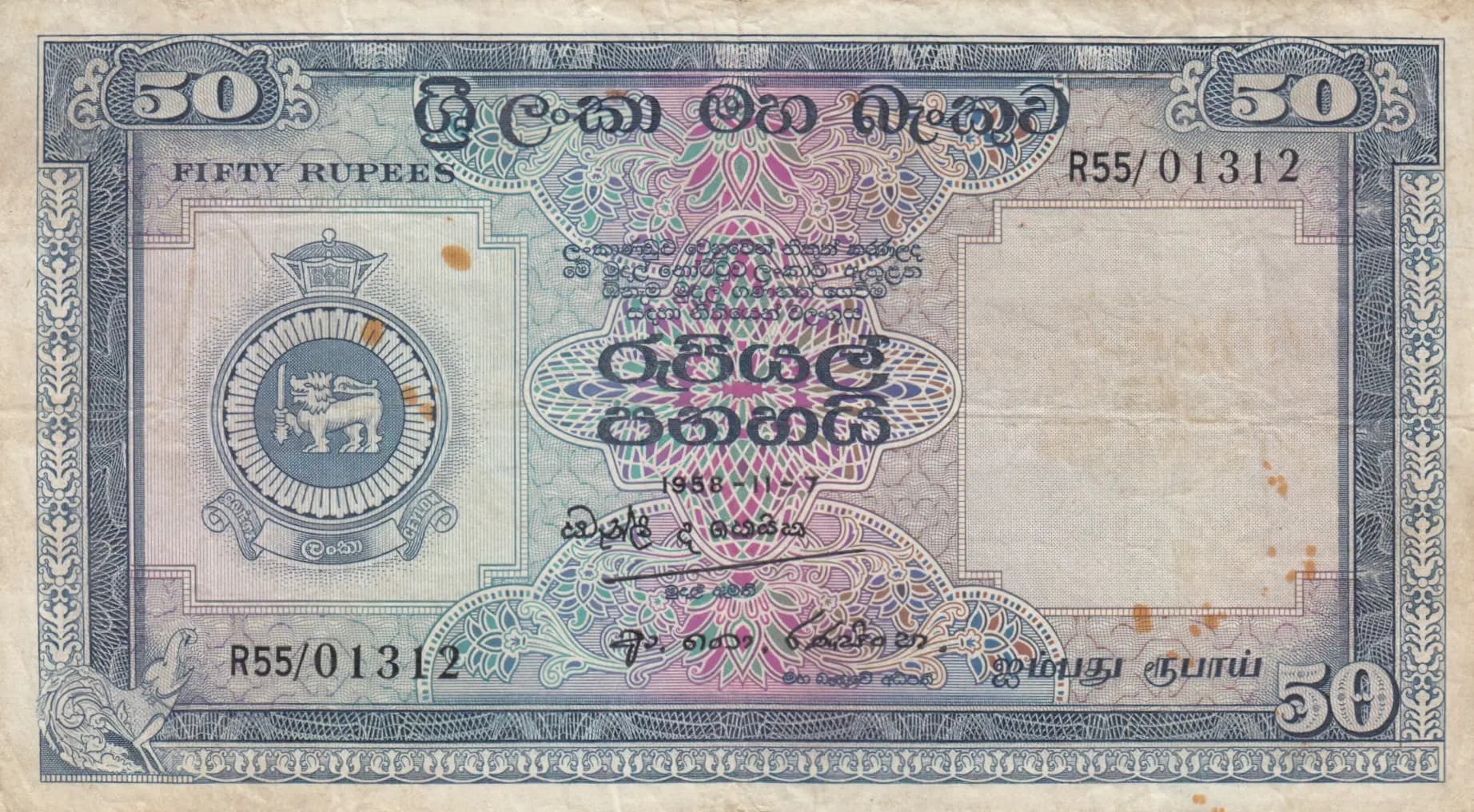
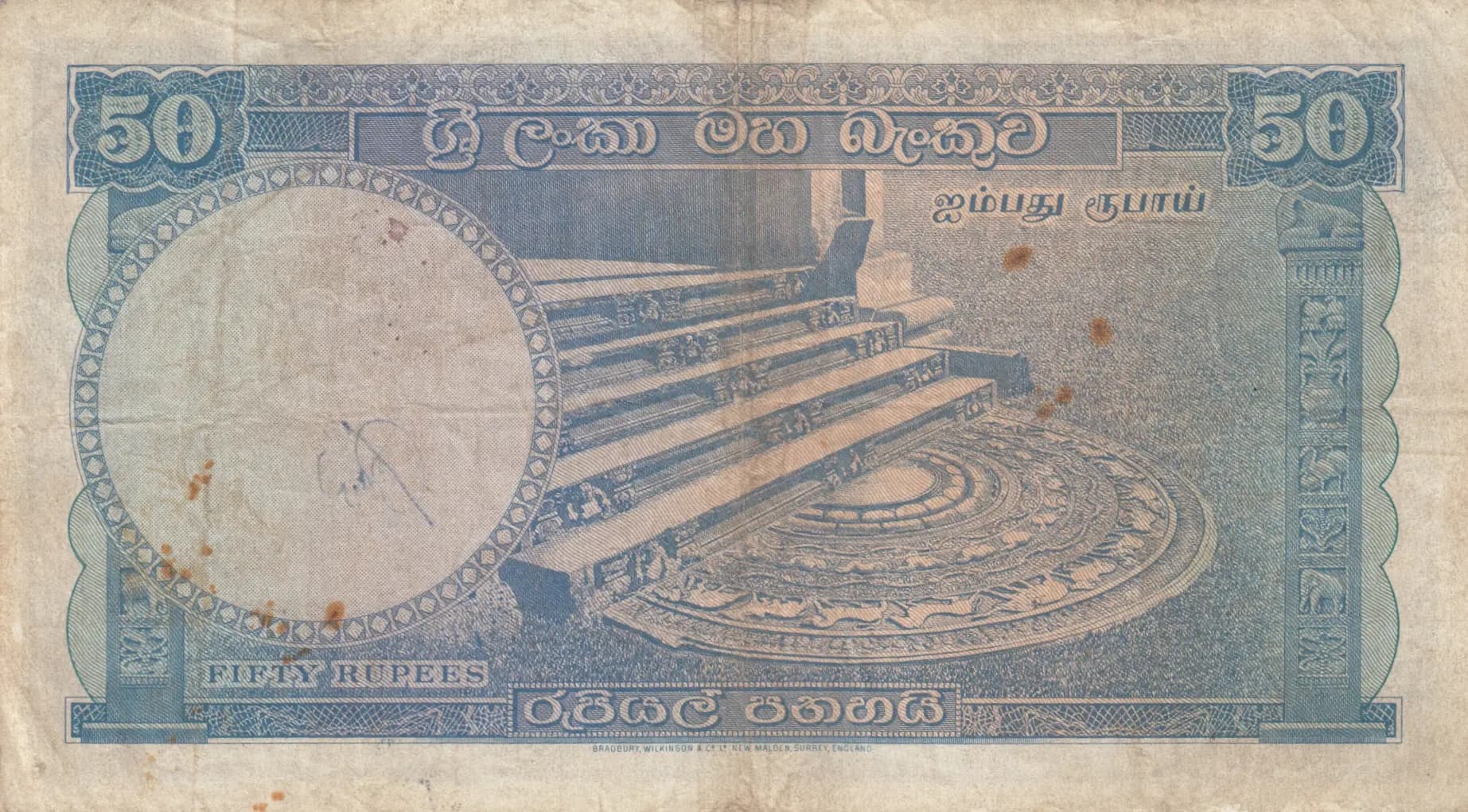
This 50 Rupees banknote from 1958 issued by the Central Bank of Ceylon represents an early post-independence Sri Lankan currency note featuring classical engraving techniques. The note exhibits visible signs of age and circulation with scattered foxing and rust-colored stains throughout both sides, consistent with Fair condition grading. Notable design elements include the prominent lion emblem (Sri Lankan coat of arms) on the obverse and architectural imagery depicting Buddhist heritage on the reverse, making this an culturally significant example of Ceylon's mid-20th century numismatic identity.
Common. This note is from a standard circulation series issued by the Central Bank of Ceylon between 1956-1959 with substantial print runs. The Pick catalog P-60a designation indicates it is a cataloged but standard variety, not a limited or recalled issue. Notes from this series remain readily available in the collector market, even in Fair condition, with typical valuations well under $20 USD.
This 1958 note was issued during Ceylon's early years as an independent nation (independence granted in 1948), when the Central Bank was actively establishing a distinctive national currency identity. The deliberate incorporation of Sri Lankan symbols—the lion coat of arms and Buddhist architectural elements including what appears to be the Ratnagiri Vatadage in Polonnaruwa—reflects the post-colonial nation's effort to emphasize indigenous cultural heritage and Buddhist heritage in its monetary design.
The obverse features the coat of arms of Sri Lanka (the lion passant guardant) in a circular frame on the left side, symbolizing national sovereignty and identity. The right side displays an ornate oval medallion with intricate geometric and floral patterns in multiple colors (pink, green, blue), typical of classical numismatic security design. The reverse showcases Sri Lankan architectural heritage, prominently featuring the Ratnagiri Vatadage (moon stone/sacred structure in front of the stairs of the ancient Buddhist temple complex at Polonnaruwa), a UNESCO World Heritage site, positioned with a large circular ornamental medallion on the left. Decorative floral borders frame the entire design, reflecting the Victorian-era engraving aesthetics popular at mid-century Commonwealth currency production.
FRONT SIDE: 'FIFTY RUPEES' (English), 'ශ්රී ලංකා' (Sinhala - 'Sri Lanka'), 'தமிழை நூபாய' (Tamil - 'Fifty Rupees'), Serial number 'R55/01312', Denomination numeral '50'. BACK SIDE: 'FIFTY RUPEES' (English), '50' (denomination numeral), 'ශ්රී ලංකා' (Sinhala - 'Sri Lanka'), 'தமிழை நூபாய' (Tamil - 'Fifty Rupees'), 'BRADBURY WILKINSON & CO LTD ENGRAVERS LONDON' (printer credit).
Intaglio/recess engraving by Bradbury Wilkinson & Co Ltd, a renowned security printer located in New Malden, London. The note exhibits fine line work, intricate decorative patterns, and multi-color printing characteristic of high-security currency production of the 1950s. The complexity of the ornamental designs, fine linework throughout, and the crisp detail visible despite age-related deterioration are consistent with professional engraved currency plates.
Pick catalog number P-60a indicates this is the standard variety of the 1956-1959 series. The observed serial number prefix 'R55' suggests this specific note may be from an early printing run within the series (prefix notation in Ceylonese currency often related to production batches). No significant overprints, signature variations, or security feature alterations are noted that would constitute a distinct variety from the standard P-60a type.