50 cents 1948
About This Note
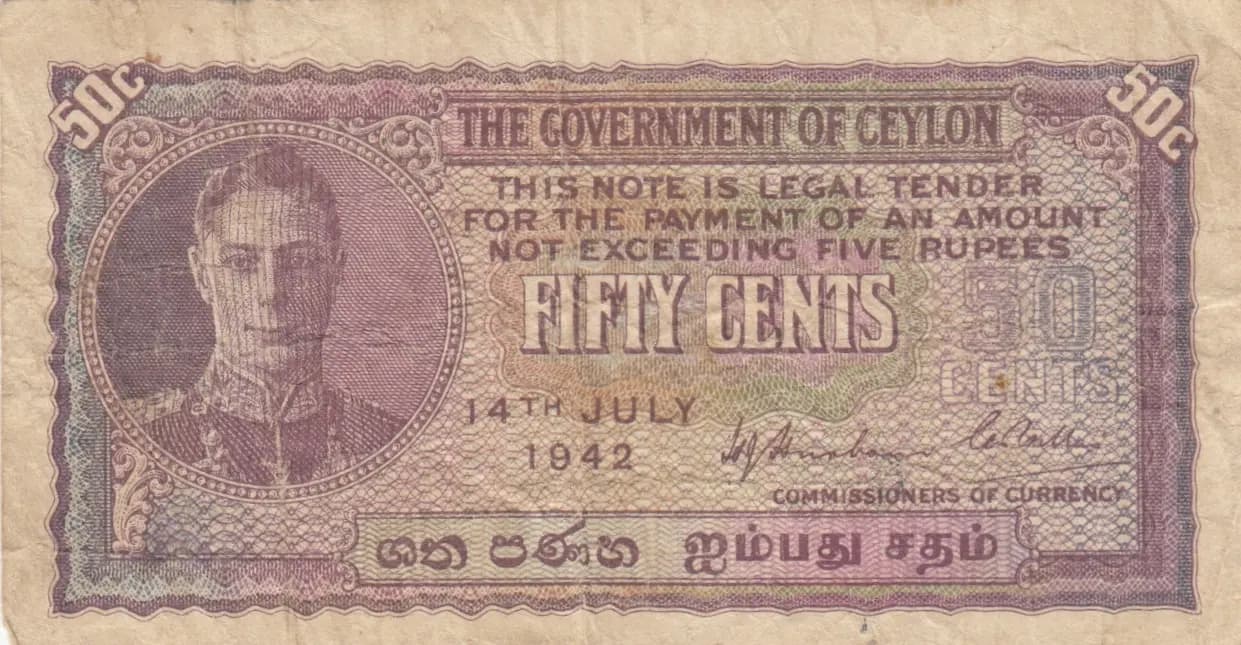
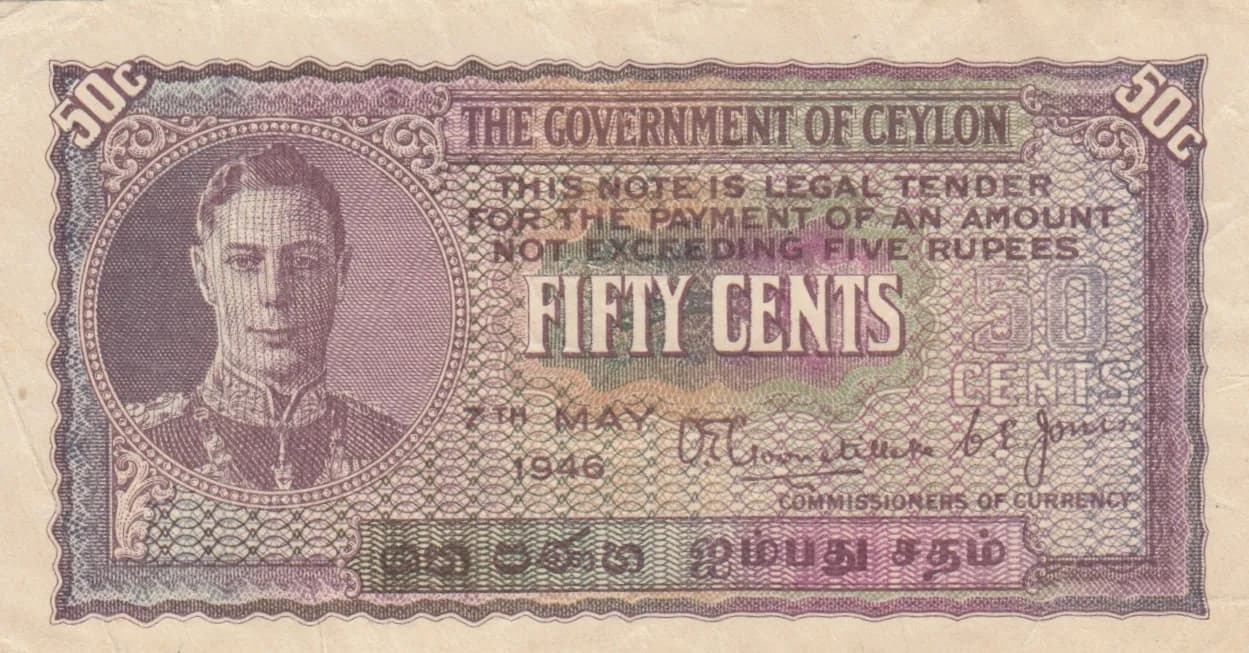
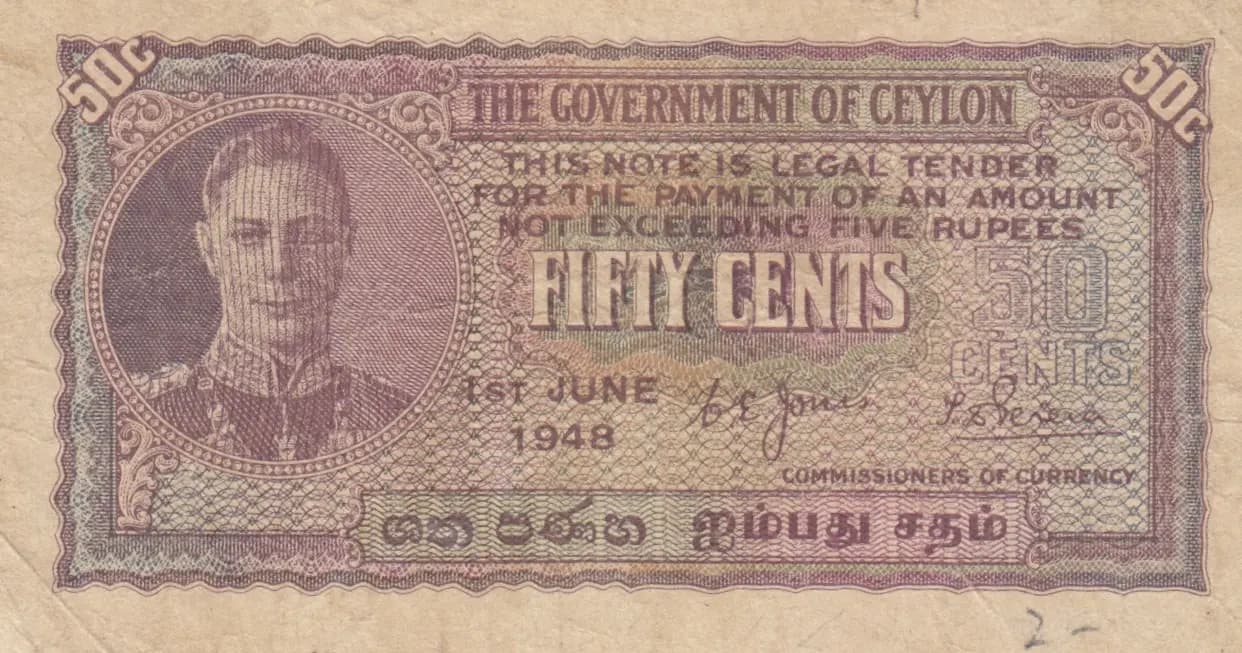
This is a Government of Ceylon 50 Cents banknote dated 1st June 1948, featuring a portrait of King George VI in an ornate circular frame on the obverse. The note exhibits Fair condition with visible creasing, foxing, and age-related discoloration consistent with its nearly 75-year history, while the intricate engraved security features and bilingual inscriptions (English and Sinhala/Tamil) remain clearly legible and represent an important early post-independence currency issue.
Common. The 50 Cents denomination from the 1942-1949 Government of Ceylon series (Pick P-45a) was issued in substantial quantities to meet everyday circulation demands. Fair condition examples are frequently encountered in the numismatic market at modest valuations, typically in the $5-15 range, confirming robust original print runs and regular survival rates. There is no evidence of limited mintage, recall, or short-lived status that would elevate this to scarce or rare classification.
Issued by the Government of Ceylon in 1948, this banknote represents a transitional period in Sri Lankan monetary history, just months after Ceylon's independence from British rule in February 1948. The portrait of King George VI reflects Ceylon's continued status as a Commonwealth dominion during this era, while the bilingual inscriptions in English and local scripts demonstrate the post-independence assertion of indigenous languages in official currency design. The Commissioners of Currency note text indicates the emerging local authority over monetary matters, marking the early years of Ceylon's independent central banking operations.
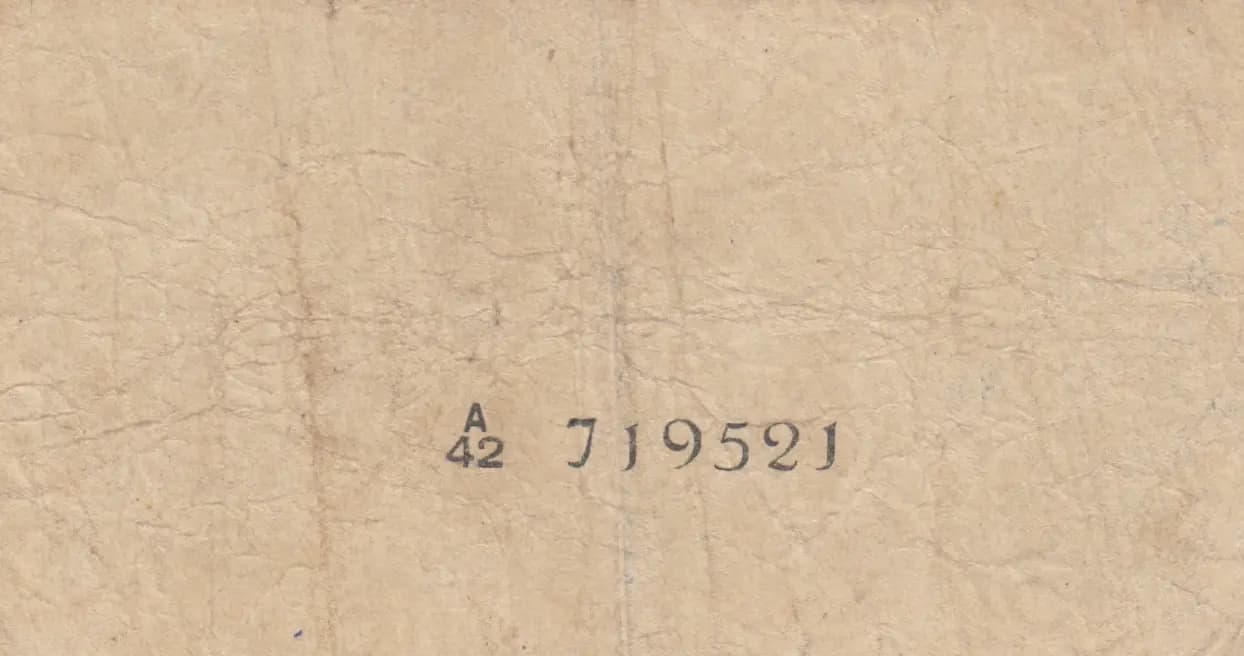
The obverse features a formal portrait of King George VI positioned in profile within an ornate circular decorative frame on the left portion of the note, rendered in fine engraved detail. The portrait is surrounded by elaborate corner ornaments and intricate border patterns characteristic of high-security banknote design. The note employs a predominantly brown and tan color palette with subtle mauve/purple tinting. The reverse is largely blank, displaying only the serial number. The denomination '50 Cents' is prominently displayed in English on the obverse, with corresponding text in local scripts. The overall design reflects classical Commonwealth banknote aesthetic conventions while incorporating Ceylon's emerging national identity through bilingual text.
Front side: 'THE GOVERNMENT OF CEYLON' (English); 'FIFTY CENTS' / 'CENTS' (English denomination); 'THIS NOTE IS LEGAL TENDER FOR THE PAYMENT OF AN AMOUNT NOT EXCEEDING FIVE RUPEES' (English legal tender declaration); '1ST JUNE 1948' (English issue date); 'COMMISSIONERS OF CURRENCY' (English issuing authority); text in Sinhala and/or Tamil scripts (unable to provide precise translation without specialized expertise, but represents equivalent denomination and issuer information in local languages). Back side: 'A 42 7J19521' (alphanumeric serial number identifier).
Intaglio (line engraving) printing, the standard security printing method for banknotes of this era. The fine line work, detailed portrait engraving, and intricate background patterns visible throughout the note are characteristic of intaglio processes. This note was likely produced by a British security printer, consistent with the practices of the Government of Ceylon at that time, though the specific printer attribution would require additional catalog research beyond the provided Pick number reference.
Serial number prefix 'A 42' with sequential numbering (7J19521) visible on reverse. The date of 1st June 1948 is consistent with the earliest issues of this series, representing a first-year-of-issue example. The note bears what appear to be handwritten signatures on the obverse, likely those of authorized signatories of the Commissioners of Currency, which may represent a specific signature variety. Without access to comprehensive Pick catalog signature variant documentation, the exact significance of these particular signatories cannot be confirmed, but collectors should note the specific signature combination present on this example as a potential variety marker.