5 rupees 1979
Market Prices
48 salesAbout This Note
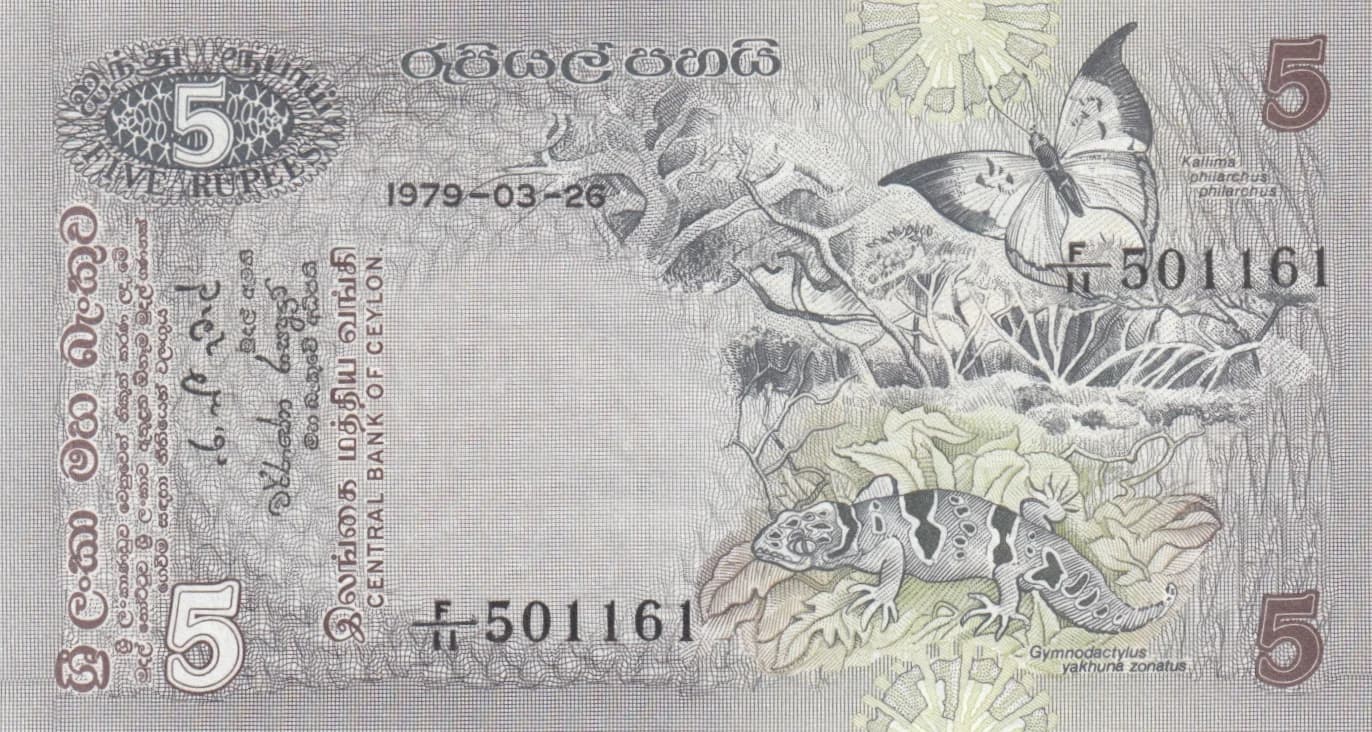
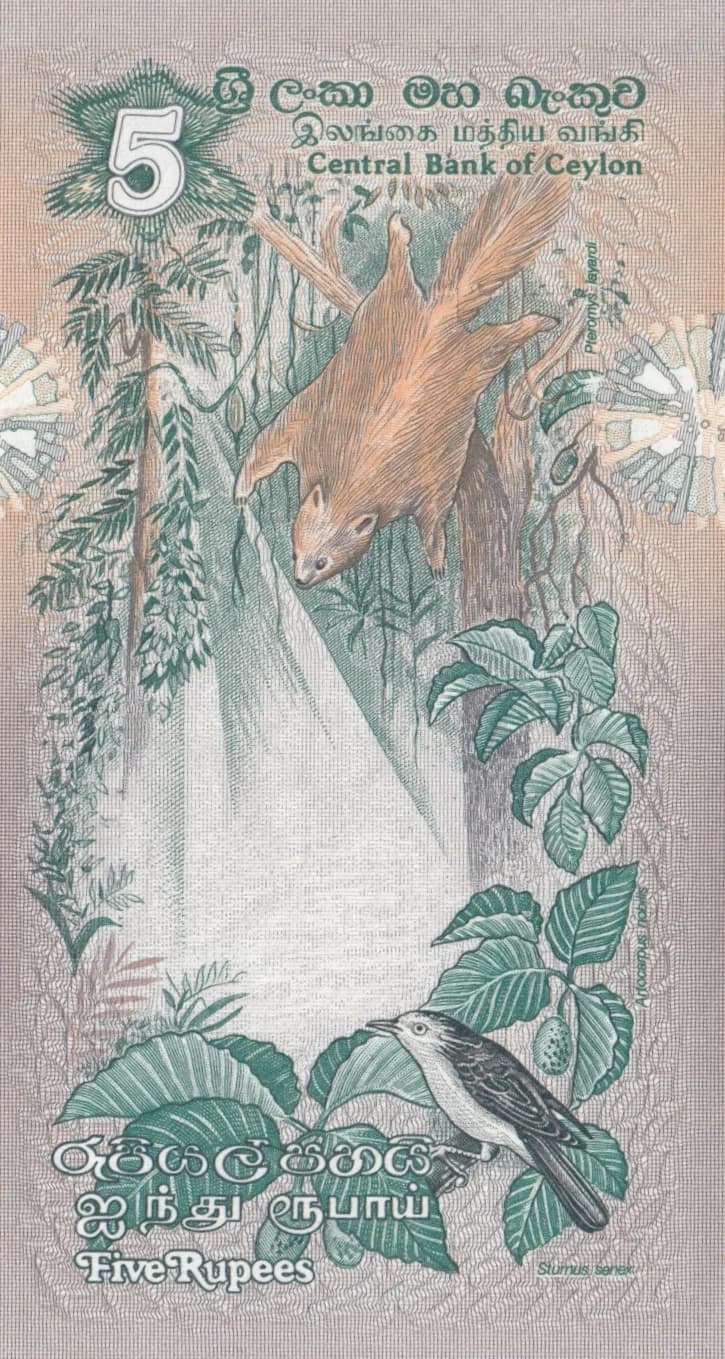
This is an uncirculated 1979 Central Bank of Ceylon 5 rupees note (Pick P-84) in pristine condition, featuring the distinctive wildlife design that characterizes Sri Lanka's fauna-themed banknote series. The obverse displays a detailed engraving of a flying squirrel (Pteromys layardi) among botanical elements, while the reverse showcases a Ceylon blue oakleaf butterfly (Kallima philarchus philarchus) and a leguan lizard (Gymnodactylus yakhuna zonatus), making it a visually engaging example of nature-themed currency from the post-independence period.
Common. This is a regular issue note from a modern circulation series (1979) by a major central bank. The eBay sales history provided shows consistent pricing in the $4-$20 range for uncirculated examples, with most UNC sales clustering around $6-$18, and even PMG-graded specimens (PMG 66-67) typically selling for $20-$60. These price points and transaction volume are consistent with common, readily available notes. While the fauna design is attractive and collectible, the note saw standard production volumes for a regular denomination in an established series. The presence of replacement notes (Z/1 prefix) further indicates substantial circulation and common availability.
Issued on March 26, 1979, by the Central Bank of Ceylon during Sri Lanka's transition period (the country would officially become the Democratic Socialist Republic of Sri Lanka in 1978), this note reflects the nation's commitment to highlighting its unique biodiversity on its currency. The selection of endemic and native wildlife species—including the flying squirrel, butterfly, and leguan—served both aesthetic and educational purposes, celebrating Sri Lanka's natural heritage during a period of economic and political restructuring. This fauna series represents an important numismatic tradition where developing nations used banknote design to assert cultural identity and environmental conservation awareness.
The obverse features a flying squirrel (Pteromys layardi) rendered in brown and white tones, depicted climbing or descending a tree trunk surrounded by detailed botanical foliage. The reverse displays two fauna specimens: the Ceylon blue oakleaf butterfly (Kallima philarchus philarchus) positioned in the upper right portion with its characteristic wing patterns, and the leguan/garden lizard (Gymnodactylus yakhuna zonatus) depicted among central foliage elements. Both sides employ ornamental decorative borders and circular denomination emblems featuring the numeral '5' in the upper left corner. The design represents Sri Lanka's tri-lingual currency tradition with English, Sinhala, and Tamil inscriptions, reflecting the nation's multicultural composition. The note incorporates fine line engraving security patterns throughout and uses a predominantly gray and cream color scheme on the obverse with green, brown, and mauve tones on the reverse.
FRONT SIDE: '5' (Arabic numeral, denomination), 'Central Bank of Ceylon' (English, issuing authority), 'Five Rupees' (English, denomination spelled out), 'ශ්රී ලංකා' (Sinhala, 'Sri Lanka'), 'ඉන්දි ශ්රී පාරි' (Sinhala, 'Five Rupees'), 'ஐந்து ரூபாய்' (Tamil, 'Five Rupees'), 'Sirnus sorex' (Latin scientific name). BACK SIDE: '5' (Arabic numeral in circular emblem), 'ශ්රී ලංකා' (Sinhala, 'Sri Lanka'), 'Central Bank of Ceylon' (English, issuing authority), '1979-03-26' (Gregorian calendar date), 'F N 501161' (serial number), 'Kallima philarchus philarchus' (Latin scientific name of butterfly), 'Gymnodactylus vakhurua zonatus' (Latin scientific name of leguan lizard).
Intaglio engraving (line engraving and multi-color lithography) producing fine detail work characteristic of Central Bank of Ceylon currency from this era. The combination of detailed engraved wildlife and botanical elements with security pattern backgrounds indicates professional bank note bureau printing standards. The multi-color overprinting visible in the color variations (gray/cream obverse with green/brown reverse) suggests a sophisticated multi-pass printing operation. While the specific printer is not definitively documented in the visual analysis, Central Bank of Ceylon notes from this period were typically produced by established international security printers meeting international banknote standards.
The serial number observed (F N 501161) does not appear to indicate a replacement note (Z/1 prefix). Replacement notes with the Z/1 prefix are documented for this Pick number but represent a known variety within the standard issue. No overprints, error varieties, or significant production variations are apparent in the examined specimen. The note exhibits standard characteristics consistent with the 1979 regular issue without distinguishing markers that would classify it as a rare variety or special printing.