5 rupees 1971
Market Prices
6 salesAbout This Note
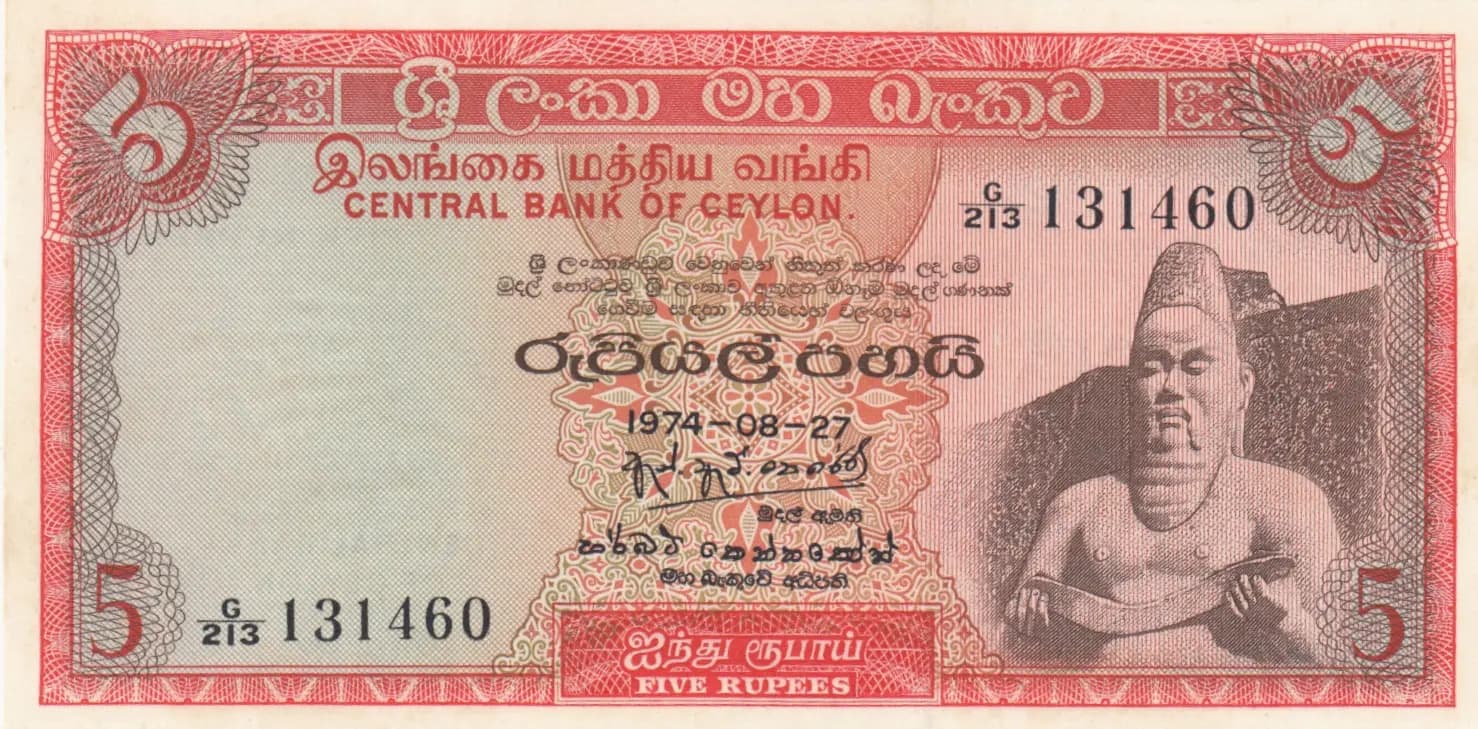
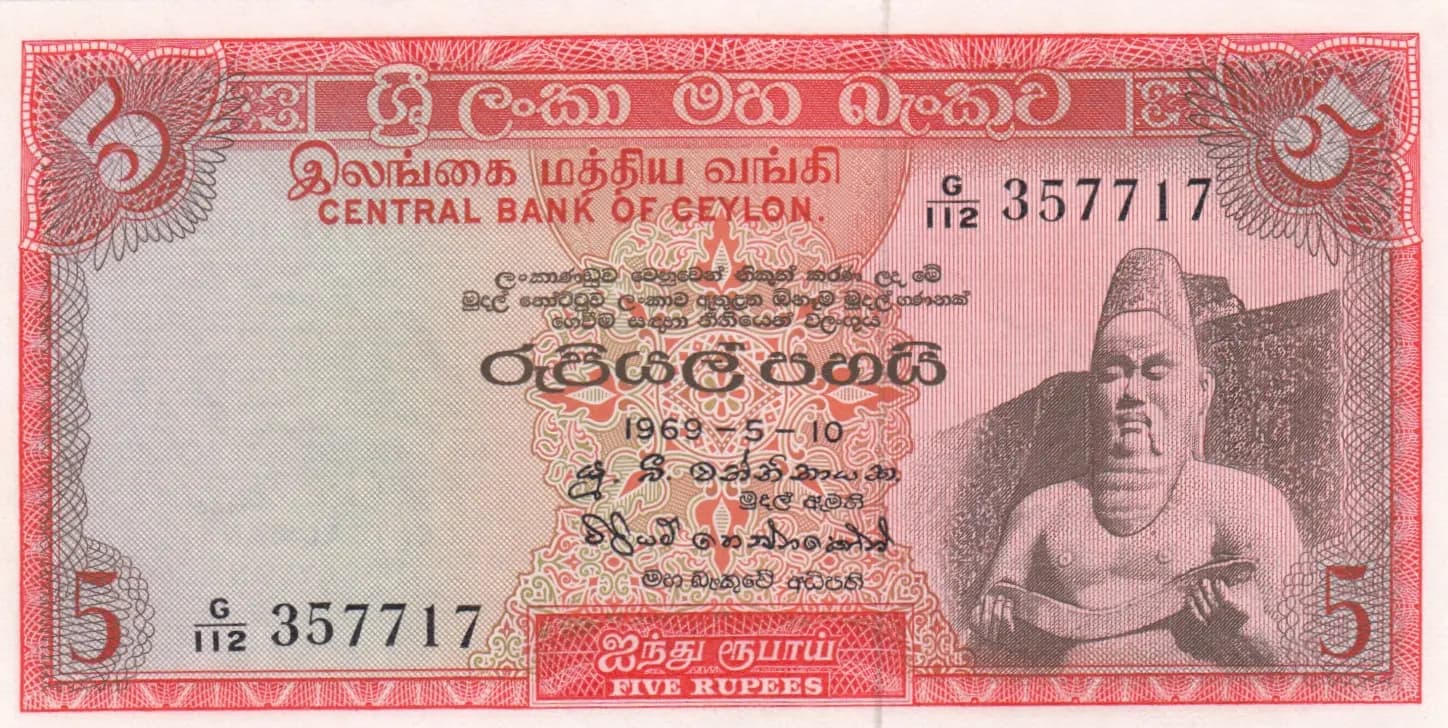
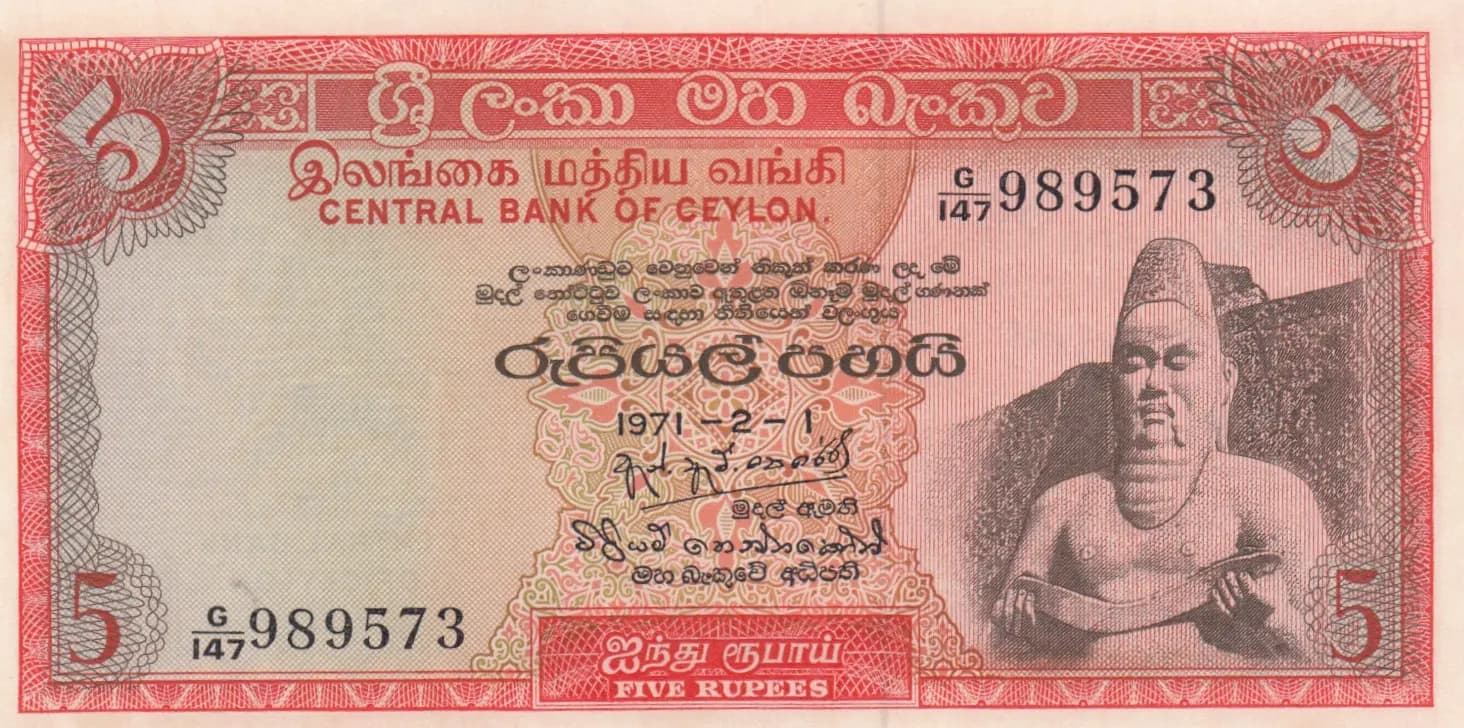
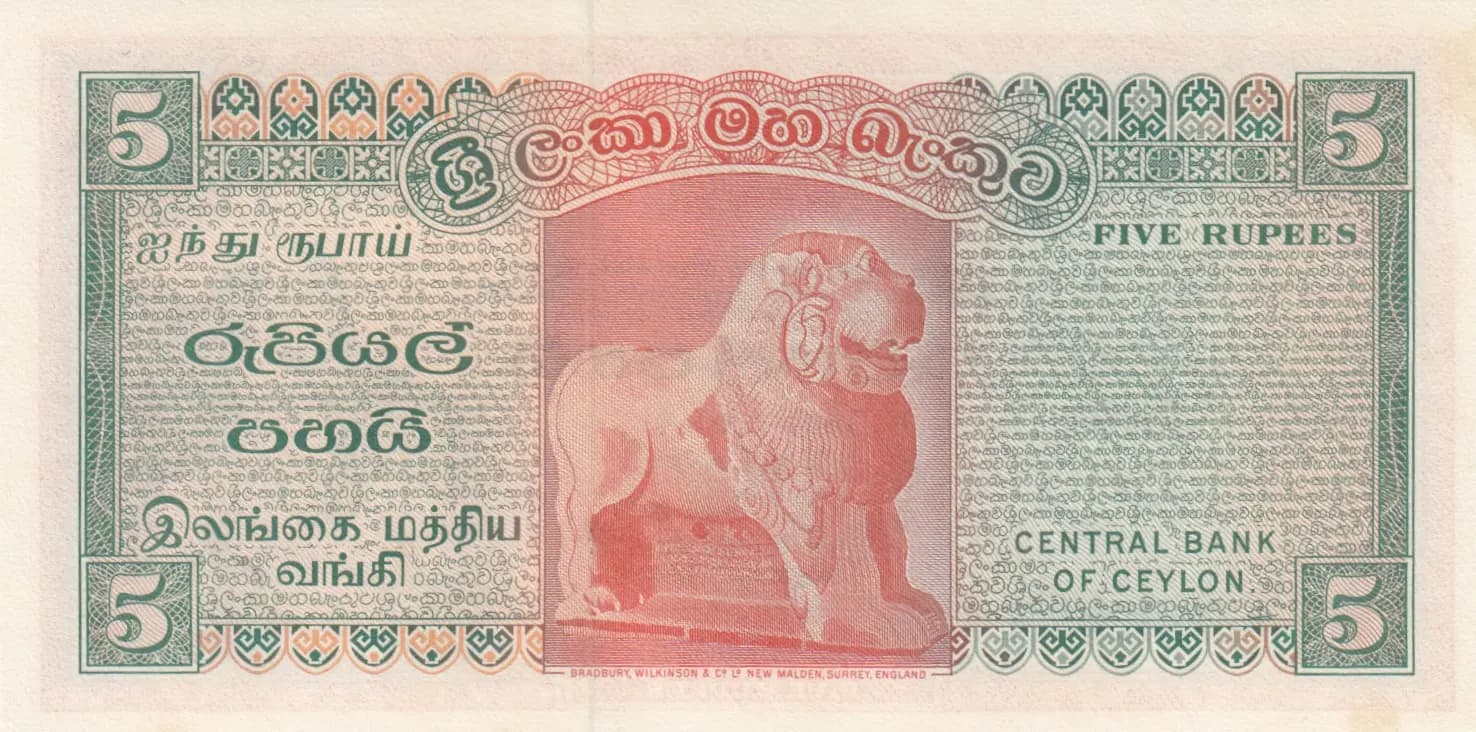
This is an exceptionally well-preserved 1971 Central Bank of Ceylon 5 Rupees note (Pick P-73b) in UNC condition, displaying crisp printing and vibrant color throughout. The note features a striking red/pink obverse with a portrait of King Parakkrama in traditional ceremonial dress on the right side, complemented by ornate geometric patterns and multilingual inscriptions in English, Sinhala, and Tamil. The reverse showcases the heraldic rampant lion within a green-bordered frame—a symbol deeply rooted in Ceylonese heritage—printed by the prestigious Bradbury Wilkinson security printer.
Common. eBay market data from realbanknotes.com shows multiple sales of this note in similar condition grades (PMG 65-66 selling for $15.50-$22.30) and catalogue valuations of $10 UNC (2019 pricing), indicating steady but modest collector interest. The Central Bank of Ceylon maintained consistent production of 5 Rupees denominations during 1969-1971, and Pick P-73b represents a standard regular-issue note without documented rarity factors such as limited print runs, early withdrawal, or significant overprints. The availability of comparable sales data and stable catalogue values confirm this is a commonly encountered note in the collector market.
Issued during the early 1970s by the Central Bank of Ceylon, this note reflects a period of national pride and cultural emphasis in Ceylon, then transitioning toward its eventual renaming to Sri Lanka in 1972. The prominent depiction of King Parakkrama, an ancient Sinhalese monarch famous for his architectural and administrative achievements, served to connect contemporary Ceylon to its illustrious Buddhist heritage. The heraldic lion on the reverse—a symbol integral to Ceylonese national identity—reinforces the postcolonial assertion of indigenous cultural authority on the nation's currency.
The obverse features a formal portrait of King Parakkrama positioned on the right side, depicted wearing traditional Sinhalese royal regalia including a distinctive tall headdress characteristic of ancient Lankan monarchs. The subject is rendered in fine intaglio detail against an ornately patterned background of geometric designs and scrollwork in red and cream tones. The left side is dominated by decorative rectangular and circular emblem patterns typical of mid-20th-century Central Bank of Ceylon currency design. The reverse displays the heraldic rampant lion—the national symbol of Ceylon—centered within a green-bordered frame, with the lion executed in deep red/pink against a complementary background. Both sides feature intricate geometric border frameworks and circular emblems in the corners, reflecting the sophisticated design standards of Bradbury Wilkinson's security printing work.
FRONT: 'CENTRAL BANK OF CEYLON' (English) / 'ශ්රී ලංකා මධ්යය බැංකුව' (Sinhala: Central Bank of Ceylon) / 'இலங்கை மத்திய வங்கி' (Tamil: Central Bank of Ceylon) / 'FIVE RUPEES' (English) / '1971-2-7' (Date: 7 February 1971) / Serial number: G 147 9889573 / Denomination: 5. BACK: 'FIVE RUPEES' (English) / Denomination: 5 / 'ශ්රී ලංකා මධ්යය බැංකුව' (Sinhala: Central Bank of Ceylon) / 'இலங்கை மத்திய வங்கி' (Tamil: Central Bank of Ceylon) / 'CENTRAL BANK OF CEYLON' (English) / 'BRADBURY, WILKINSON & CO LTD NEW MALDEN, SURREY, ENGLAND' (Printer: Bradbury Wilkinson & Co Ltd, New Malden, Surrey, England).
Intaglio (line-engraved) printing on multicolored stock, executed by Bradbury Wilkinson & Co Ltd of New Malden, Surrey, England. The note exhibits characteristic fine-line patterns, precise crosshatching, and multi-color layering visible throughout both obverse and reverse. The crisp detail in the portrait, ornamental work, and border designs are hallmarks of high-quality intaglio security printing. The security features include fine line work, geometric complexity, and the inherent difficulty of reproducing the precise color registration and depth achieved through the intaglio process.
This specimen is dated 1971-2-7 (7 February 1971) with serial number G 147 9889573, identifying it as part of the standard G-series production. Pick P-73b is distinguished from the earlier P-73a by the inclusion of 'CENTRAL BANK OF CEYLON' in English on the front alongside Sinhala text, whereas P-73a featured Sinhala text only. This note predates the 1972 country name change to Sri Lanka; later issues (P-73a continuation and subsequent denominations) would reflect the new national designation. No significant overprints or signature varieties are apparent on this example.