5 rupees 1969
Market Prices
6 salesAbout This Note
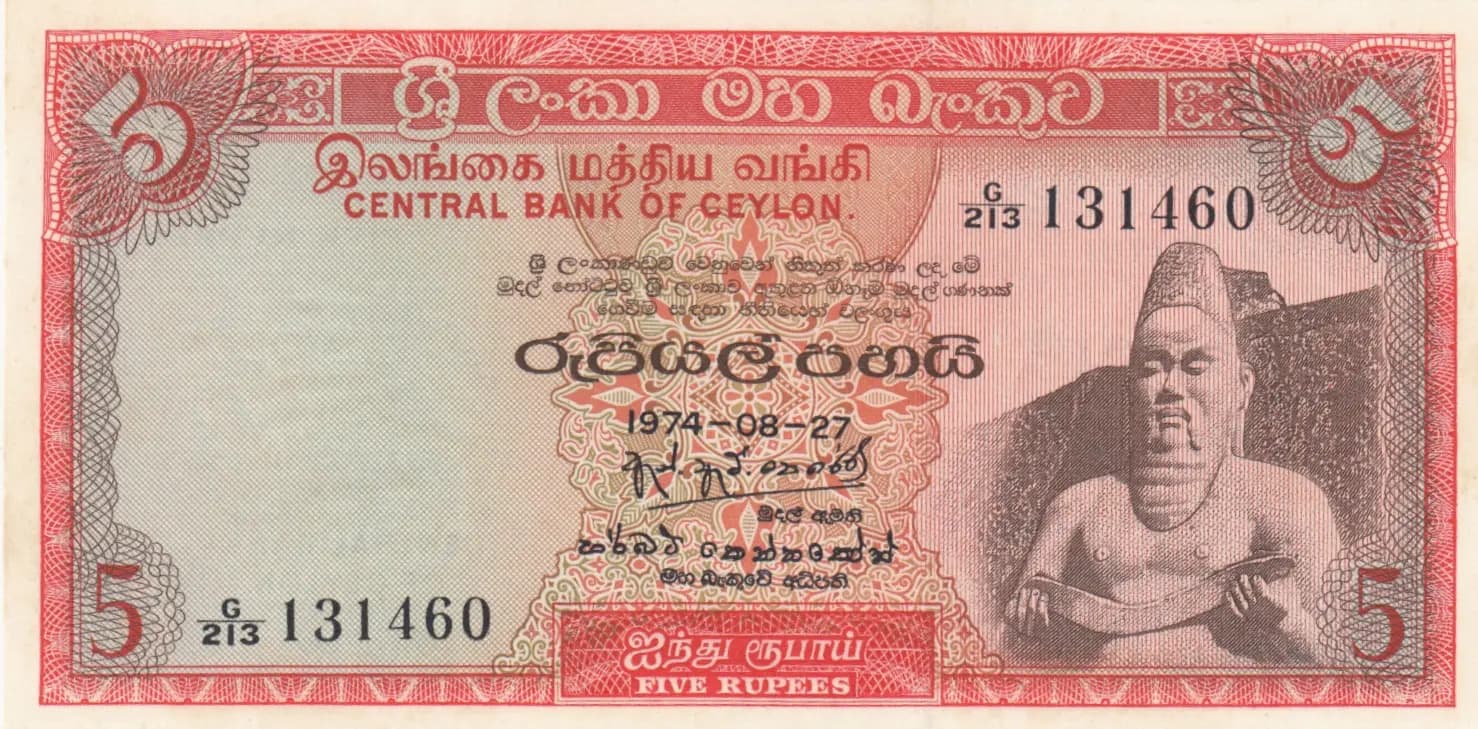
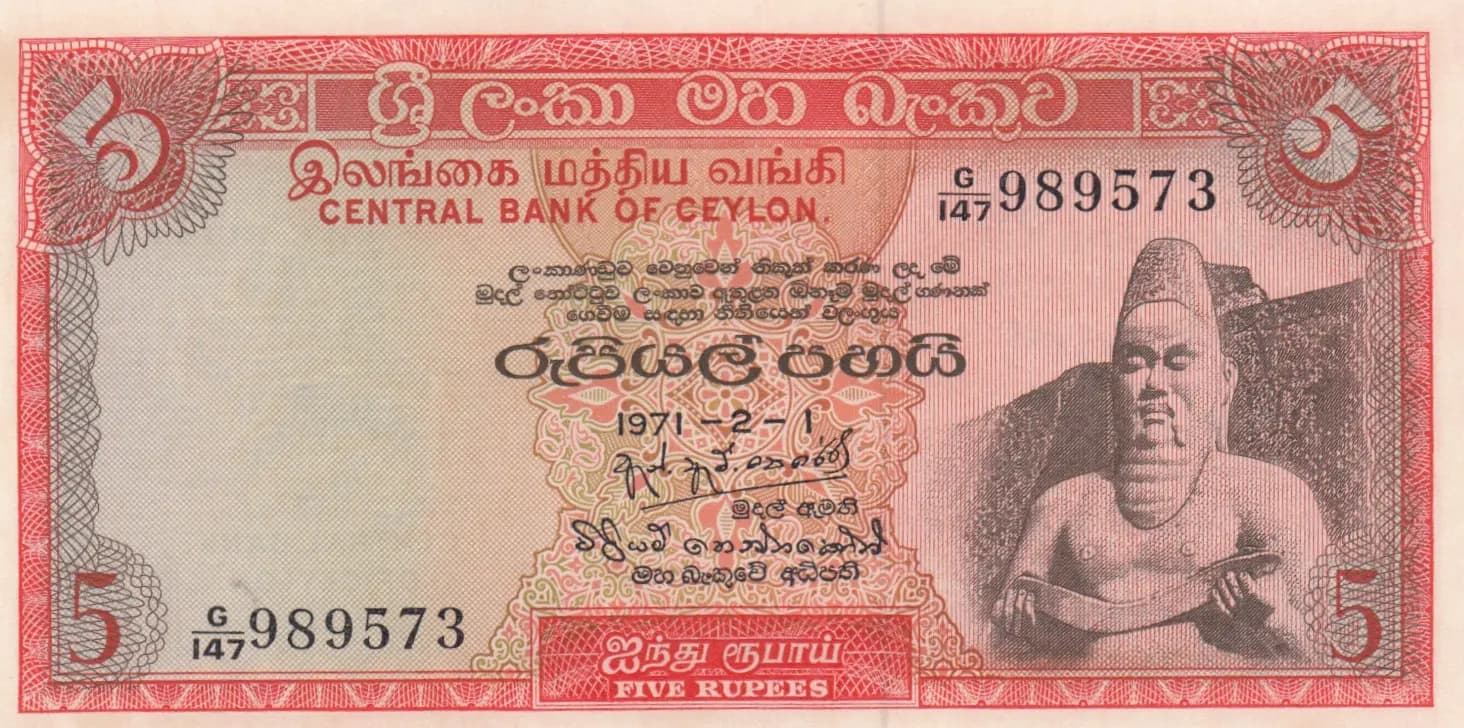
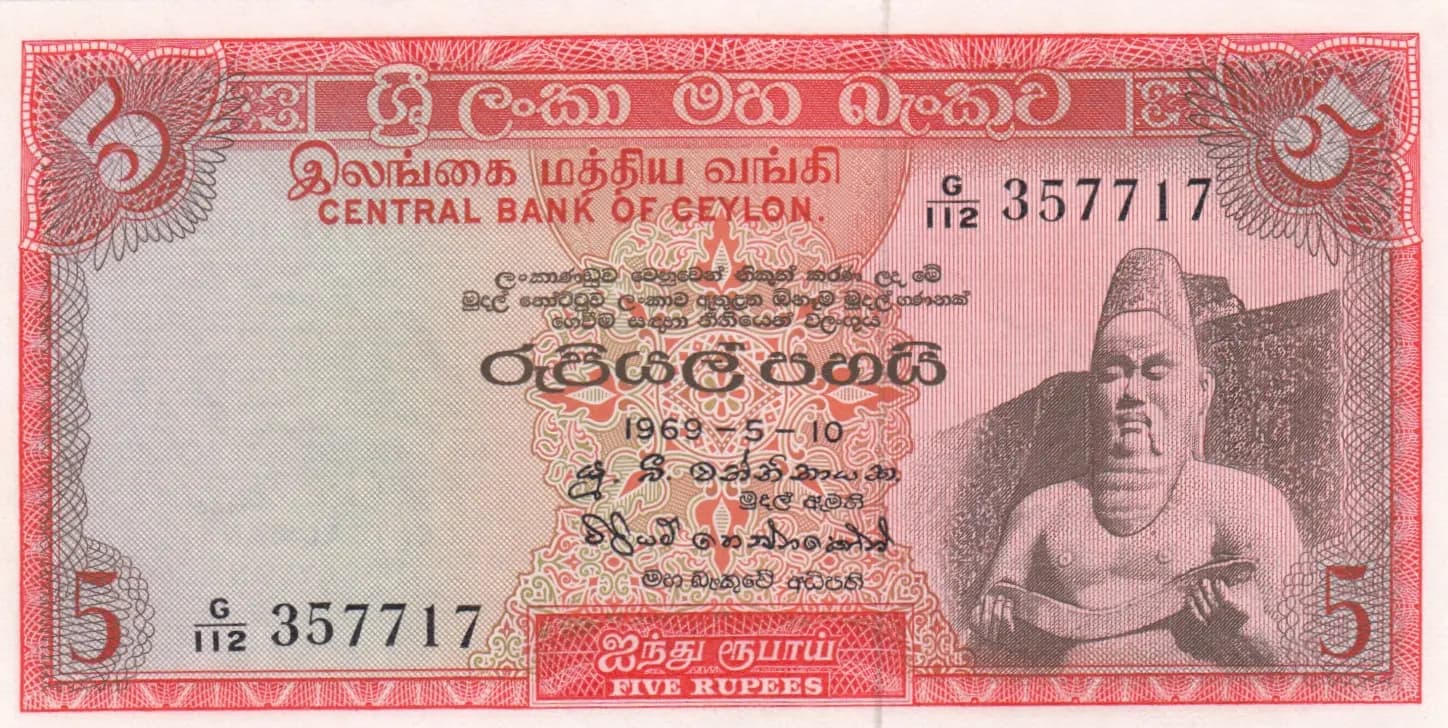
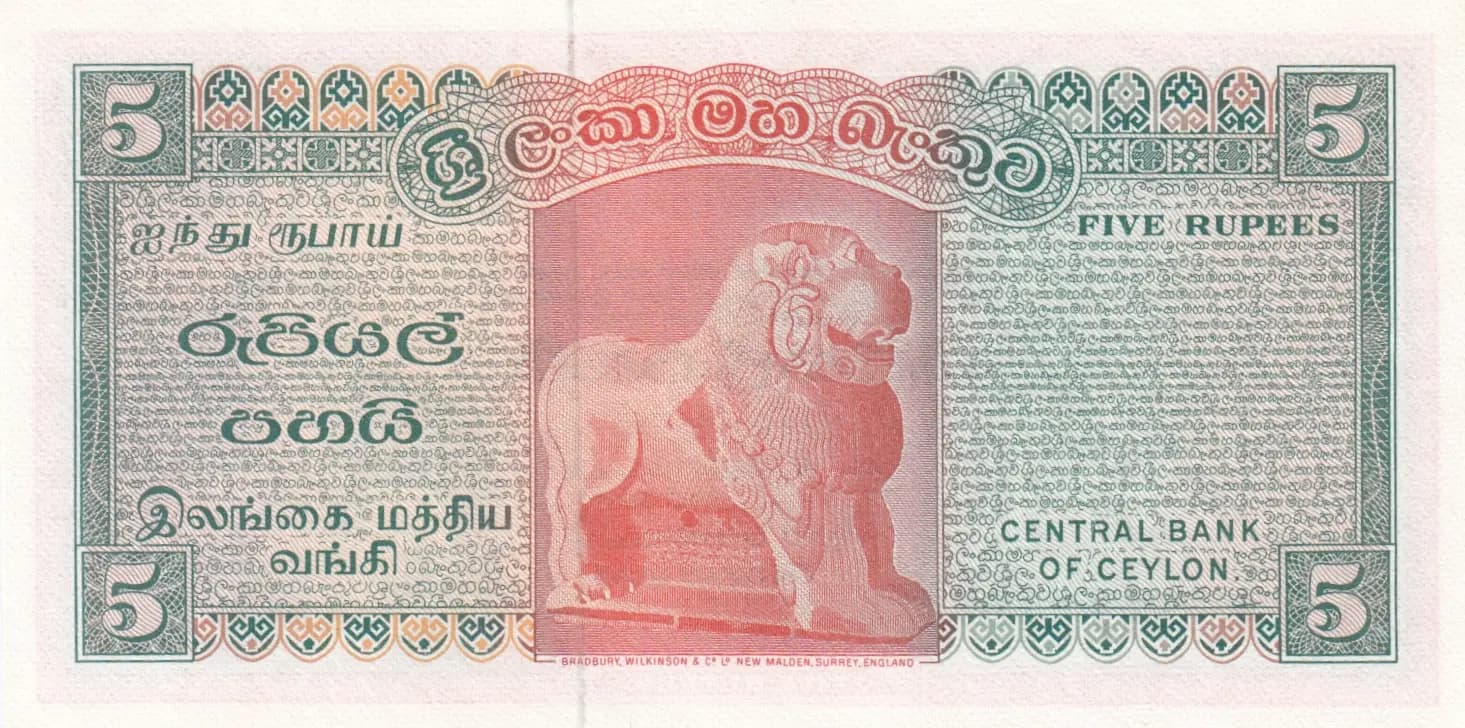
An exceptional example of the 1969 Central Bank of Ceylon 5 Rupees note (Pick 73a) in UNC condition, featuring the portrait of King Parakkrama on the obverse and the famous Lion Throne of King Nisankamalla on the reverse. The note displays pristine condition with no signs of circulation, crisp colors in pink/rose and multi-colored elements, and bears the date May 10, 1969 with serial number G/112 357717. This is a foundational piece of early modern Ceylon currency, printed by the renowned Bradbury Wilkinson security printer.
Common. While this is an early issue from 1969, the Ceylon 5 Rupees (Pick 73a) was produced in substantial quantities as a standard circulating denomination. eBay market data confirms modest valuations with UNC examples typically realizing $10-$15, and circulated grades selling for mere dollars. The print run was not restricted, this was not a commemorative issue, and the Central Bank of Ceylon had a stable 20+ year tenure, all factors supporting common status. No known major printing varieties, overprints, or recall information suggest scarcity.
This note was issued during a transitional period in Ceylon's history, with the Central Bank established as the independent monetary authority following Ceylon's independence in 1948. The portrait of King Parakkrama I, the 12th-century Sinhalese monarch known as 'Parakkrama the Great,' reflects the nation's cultural heritage and pride in its Buddhist-influenced historical legacy. The reverse features the iconic Lion Throne (Audience Hall) from Polonnaruwa's medieval palace complex, further emphasizing Ceylon's connection to its pre-colonial glory and consolidated national identity.
The obverse features a right-facing portrait of King Parakkrama I in traditional royal dress with an ornate headdress, rendered in fine engraved detail against a predominantly pink and rose-colored background. Ornate decorative medallions with intricate geometric patterns occupy the center, flanked by denomination numerals (5) in all corners and multi-script text identifying the issuer. The reverse presents the seated Lion Throne (Simhasana) of King Nisankamalla's audience hall from the 12th-century Polonnaruwa palace complex, depicted as a classical sculptural element within a central oval frame. The border is characterized by ornate geometric and floral patterns in green, teal, orange, and yellow tones, with denomination numerals repeating in each corner. The background incorporates a security microtext pattern in Sinhala script for anti-counterfeiting purposes.
FRONT SIDE: 'CENTRAL BANK OF CEYLON' (English); 'ශ්රී ලංකාවේ මධ්යය බැංකුව' (Sinhala: Central Bank of Sri Lanka); 'தலைநகர மத்திய வாங்கி' (Tamil: Central Bank); Date: 1969-5-10 (May 10, 1969); 'FIVE RUPEES' (English); 'ෙරුපියල් පහ' (Sinhala: Five Rupees); 'ஐந்து ரூபாய்' (Tamil: Five Rupees); Serial number: G/112 357717. BACK SIDE: 'FIVE RUPEES' (English); 'ෙරුපියල් පහ' (Sinhala: Five Rupees); 'ஐந்து ரූපாய්' (Tamil: Five Rupees); 'CENTRAL BANK OF CEYLON' (English); 'ශ්රී ලංකාවේ මධ්යය බැංකුව' (Sinhala); 'BRADBURY WILKINSON & CO LTD NEW MALDEN SURREY ENGLAND' (printer attribution); Background security text in repetitive Sinhala script pattern.
This note was produced using intaglio (engraved) printing by Bradbury Wilkinson & Co Ltd of New Malden, Surrey, England—one of the world's premier security printers of the era. The distinctive fine line work visible throughout, the detailed portrait engraving of King Parakkrama, and the intricate border designs are hallmarks of high-quality intaglio production. Multi-color printing was employed to create the pink/rose obverse and the multi-colored reverse with green, orange, and yellow border elements. The background security microtext pattern demonstrates the advanced anti-counterfeiting measures incorporated by the printer.
This specific example bears the date 1-5-1969 (May 10, 1969) and serial number prefix 'G/112' with number 357717. Pick 73a encompasses notes issued from 1969-1971 by the Central Bank of Ceylon. The visual analysis confirms the English bank name on the front ('CENTRAL BANK OF CEYLON'), which differentiates this from earlier issues (Pick 68) that featured the bank name in Singhalese only. No signature varieties, overprints, or other distinguishing variety markers are visible on this example. The note represents a standard variety within the Pick 73a classification.