5 rupees 1960
About This Note
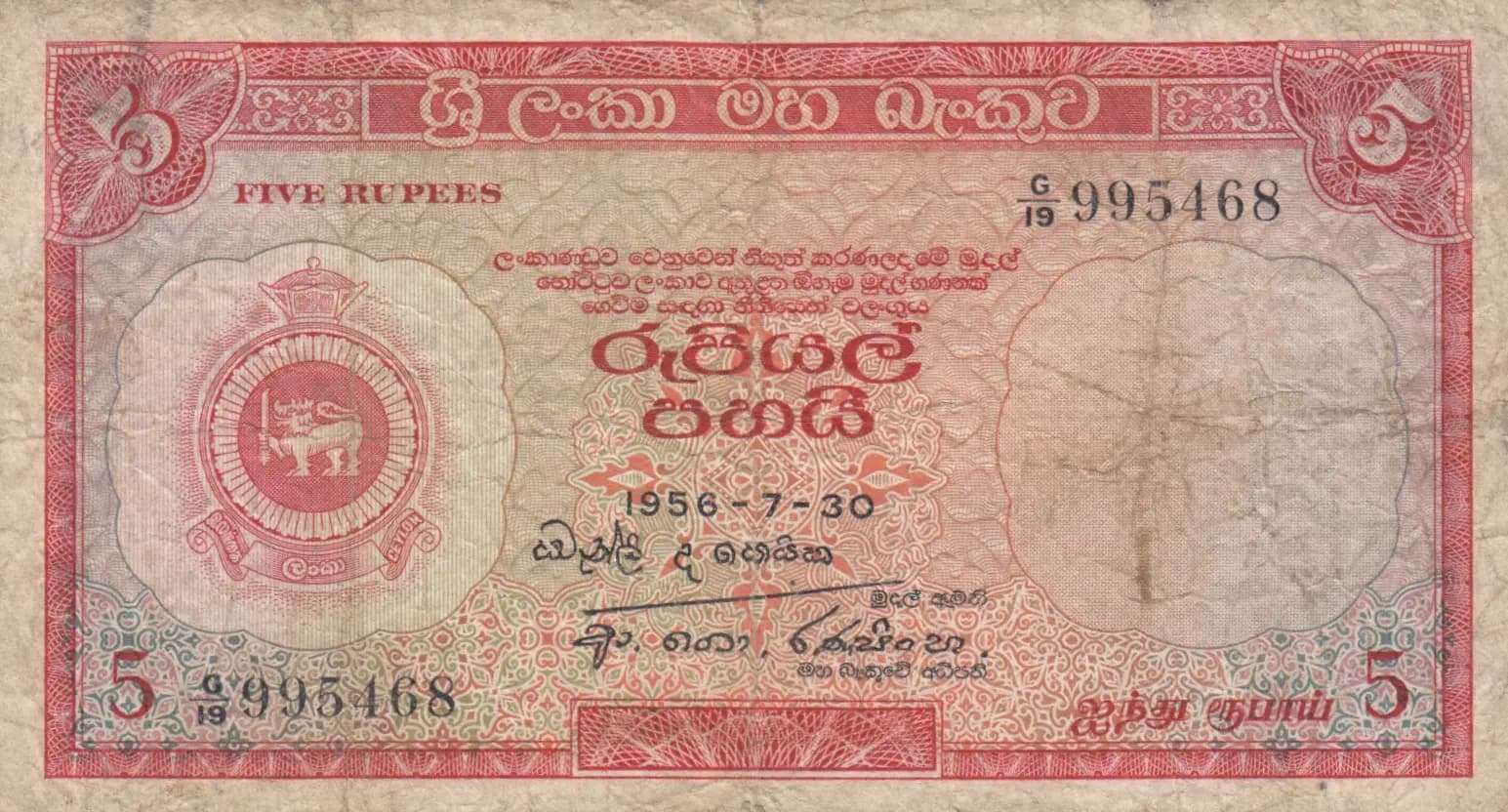
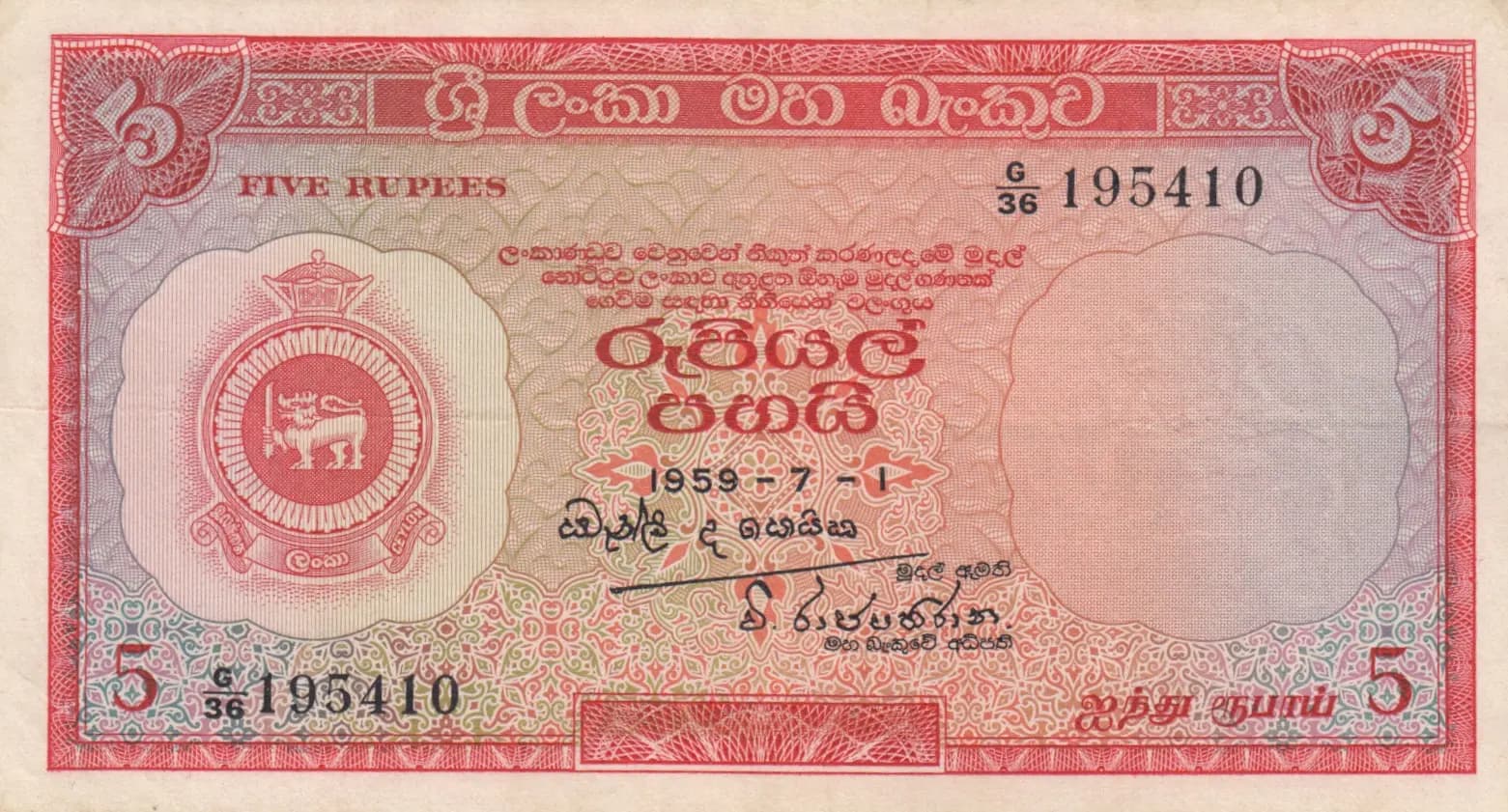
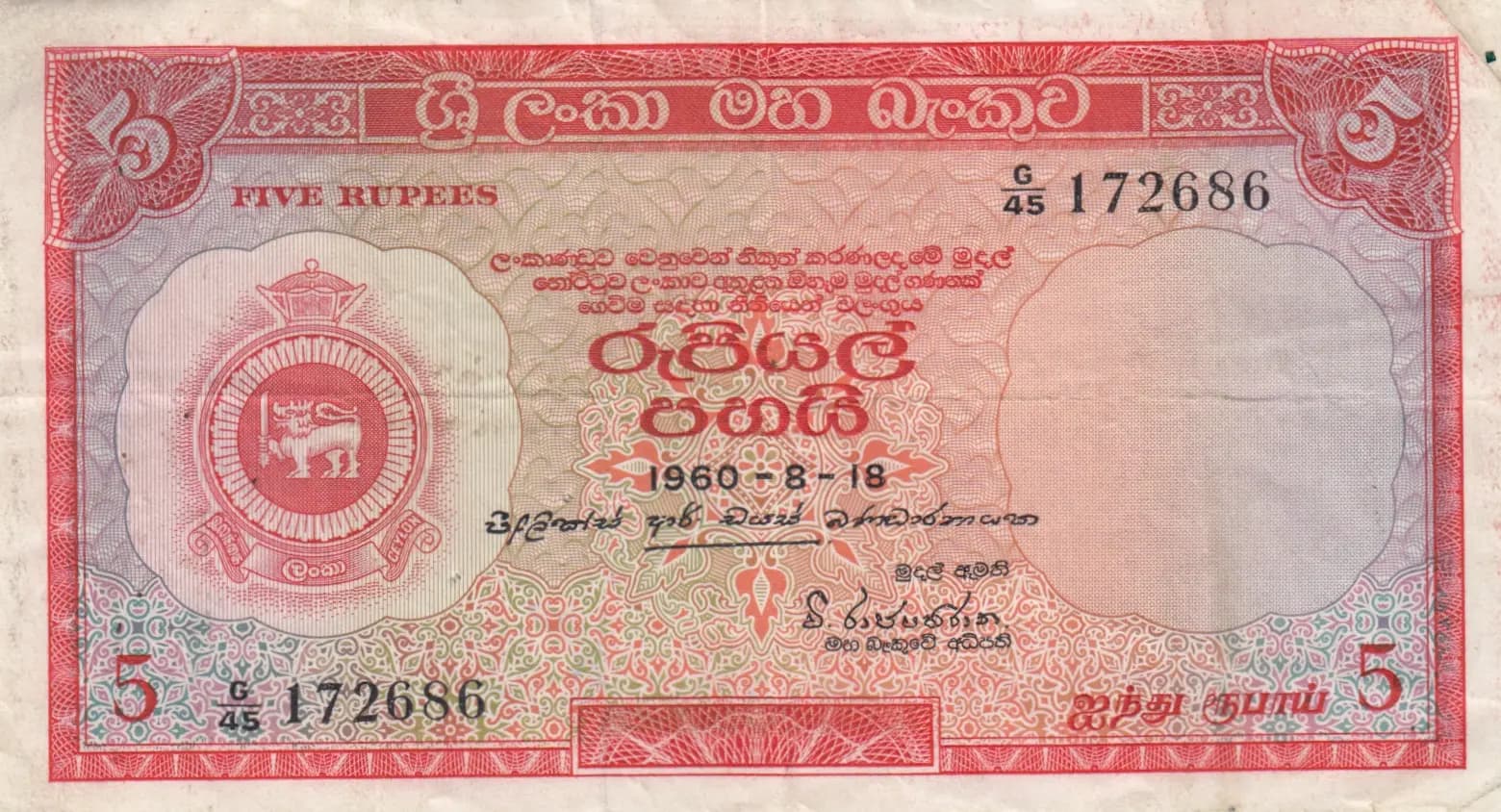
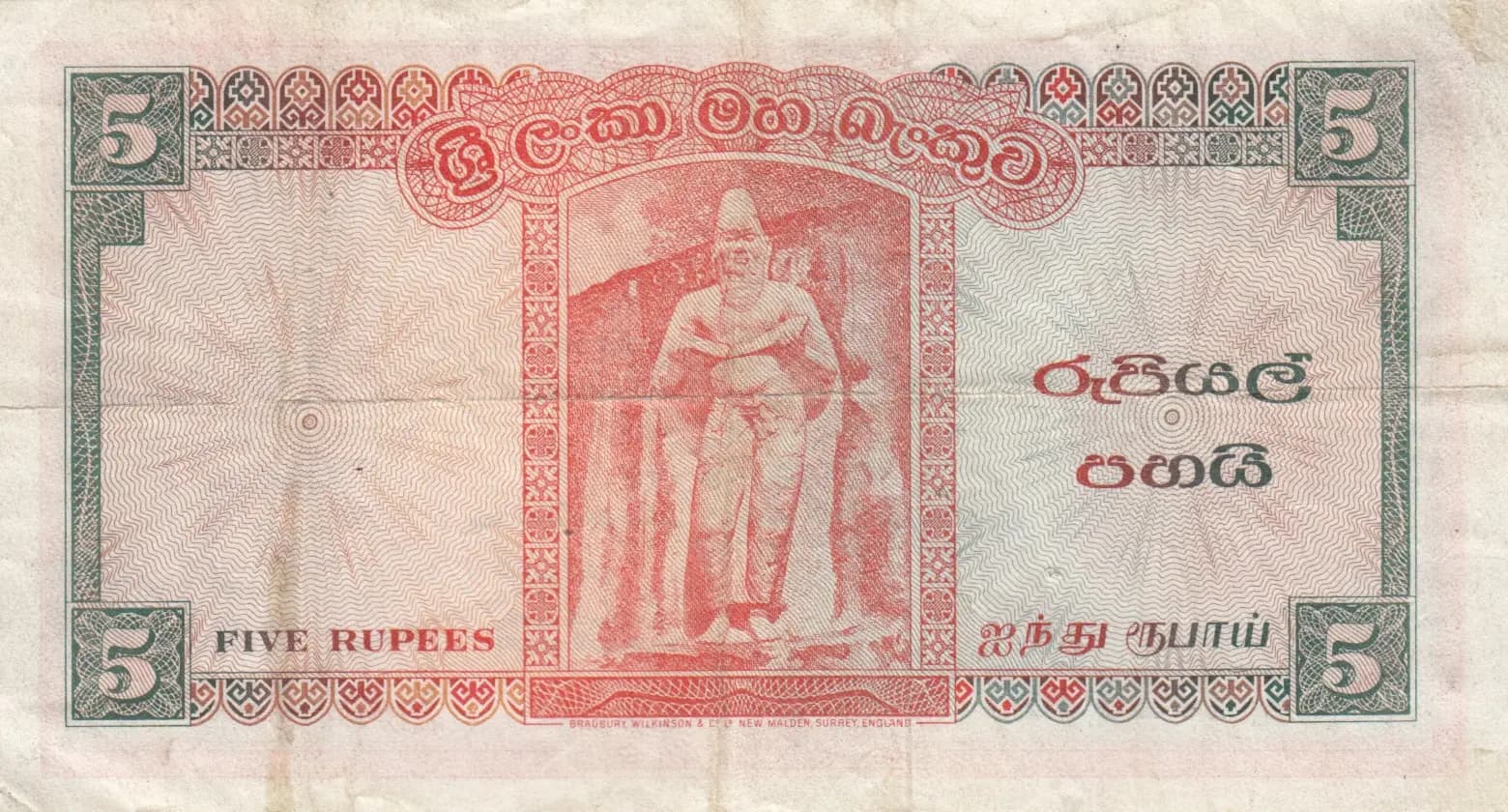
This is a Central Bank of Ceylon 5 rupees note from 1960 (Pick P-58c), featuring the distinctive red and green color scheme characteristic of early Ceylon currency. The front displays the heraldic lion emblem of Ceylon in an ornate circular frame with Sinhala and Tamil inscriptions, while the reverse presents a classical draped figure in the center with large green denomination numerals in all corners. The note exhibits typical aging for a 64-year-old banknote, with visible creasing, foxing, and patina consistent with its Fair grade, making it a representative example of Ceylon's post-independence monetary design.
Common. The 5 rupees denomination from the 1956-1962 series of the Central Bank of Ceylon was issued in substantial quantities during a seven-year production period. This Pick P-58c variant, while historically significant as part of Ceylon's early independence currency, represents standard circulation coinage from a well-established central bank issue. No evidence suggests limited print runs, special recall, or scarcity in Fair condition grade, which is the most frequently encountered condition for notes from this period.
Issued during Ceylon's early independence period (1956-1962), this 5 rupee note reflects the nation's transition to self-governance and the establishment of its own central banking authority. The heraldic lion emblem on the front symbolizes Ceylon's national identity, while the classical draped figure on the reverse likely represents a historical or cultural figure significant to the newly independent nation. The bilingual inscriptions in Sinhala and Tamil underscore the nation's linguistic and cultural diversity during this formative period of nation-building.
The front of the note features Ceylon's national heraldic lion emblem—a crowned lion passant guardant—positioned within an ornate circular decorative frame on the left side, symbolizing state authority and national identity. The design is surrounded by intricate geometric and floral border patterns in red, green, and cream tones. The reverse displays a classical figure in draped robes, rendered in fine engraving, positioned centrally and flanked by elaborate ornamental borders. Large green numeral '5' denominations are positioned in all four corners of the reverse. The overall design reflects the British security printing tradition combined with Ceylon's national symbolism, incorporating bilingual text in English, Sinhala, and Tamil to reflect the nation's multicultural composition.
FRONT SIDE: 'FIVE RUPEES' (English denomination); 'ශ්රී ලංකා ධනාධිකරණ අමාත්යාංශය' (Sinhala: Sri Lanka Finance Ministry); 'රුපියල් පස' (Sinhala: Five Rupees); Serial numbers 'G 45 1726686' and 'C 45 1726686'; Date '1960-8-18' (August 18, 1960); Tamil text present. BACK SIDE: 'FIVE RUPEES' (English); 'ෙරුපියල' / 'පස' (Sinhala: Rupees/Five); 'ஐந்து ரூபாய்' (Tamil: Five Rupees); Printer attribution 'BRADBURY WILKINSON & CO LTD NEW MALDEN SURREY ENGLAND'.
Intaglio (engraved) printing by Bradbury Wilkinson & Co Ltd, New Malden, Surrey, England, as indicated by the printer's mark visible on the reverse. The fine line engraving is evident throughout both sides in the detailed portrait work, intricate border patterns, and security-oriented geometric designs. The multi-color printing (red, green, cream base colors) was achieved through multiple passes of the intaglio printing process, a standard technique for high-security banknote production during this era.
The specific variety is identified by the serial number prefix letters (G and C denoting different series/print runs) and the date August 18, 1960. The note features prefix 'G 45' and 'C 45', with the numbering sequence 1726686. Multiple serial number iterations and color variations exist within the P-58c designation, with different prefixes indicating separate printings. The date of August 18, 1960 (1960-8-18) places this note within the mid-range of the seven-year issue period.