5 rupees 1956
About This Note
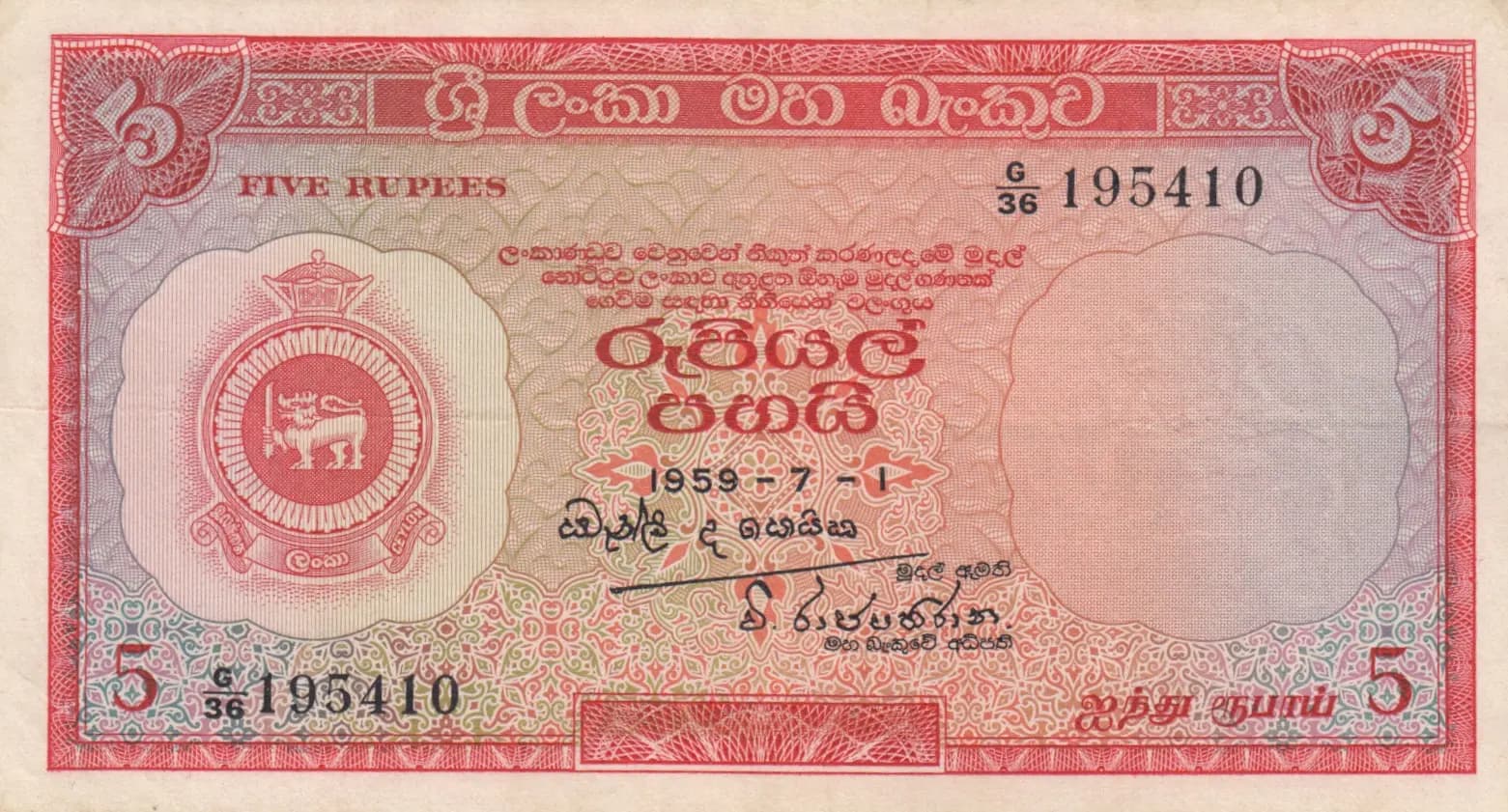
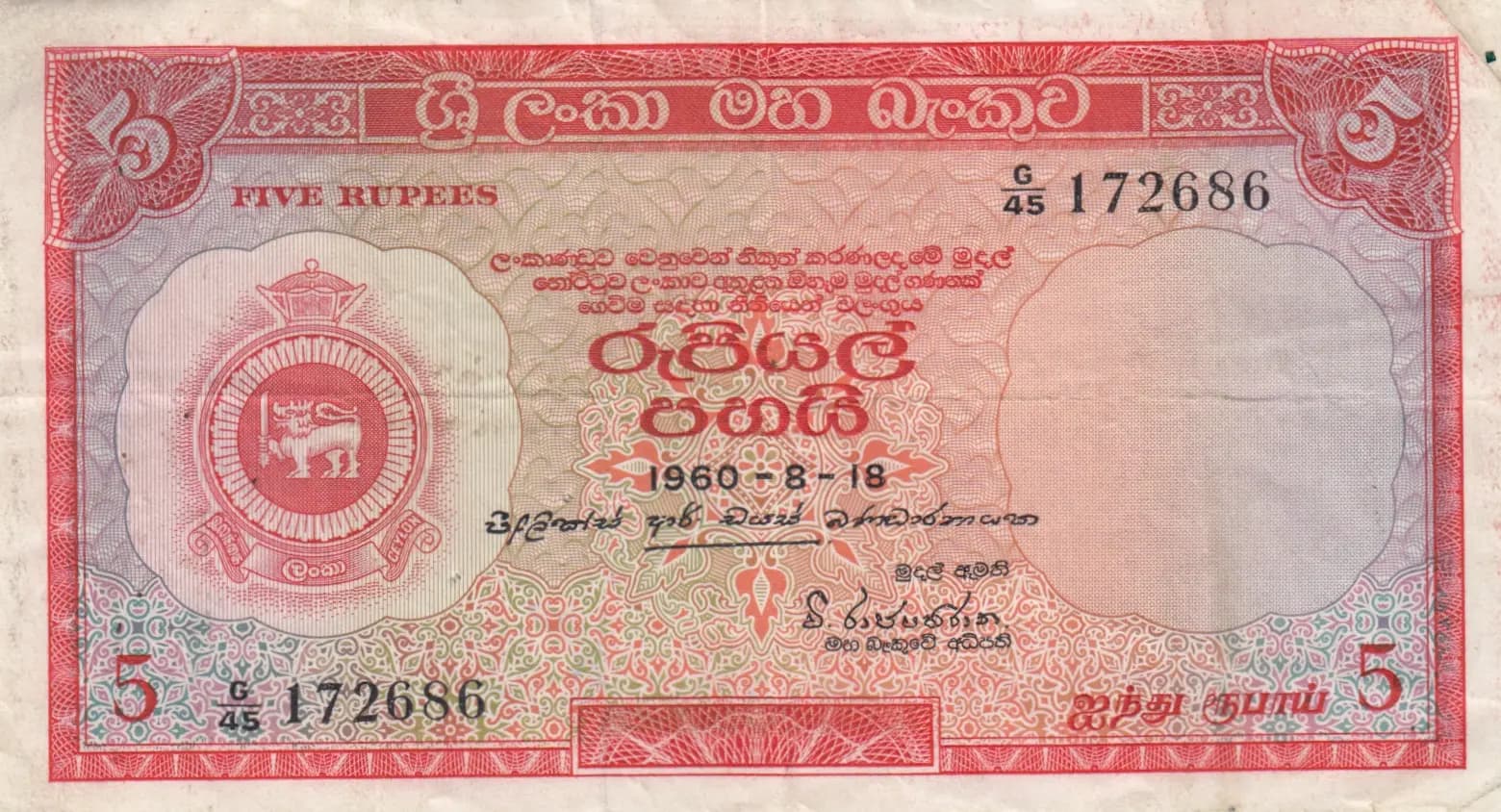
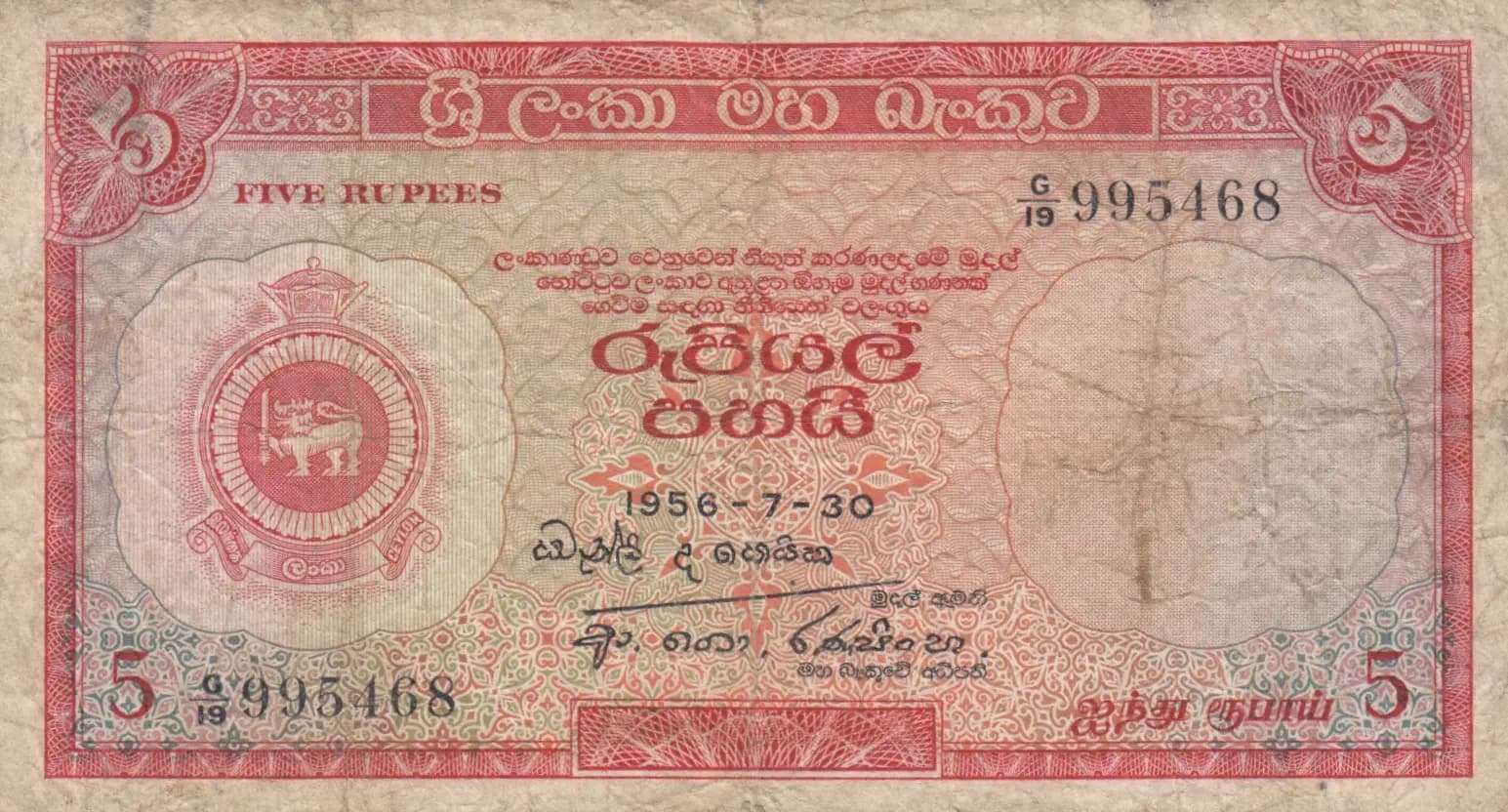
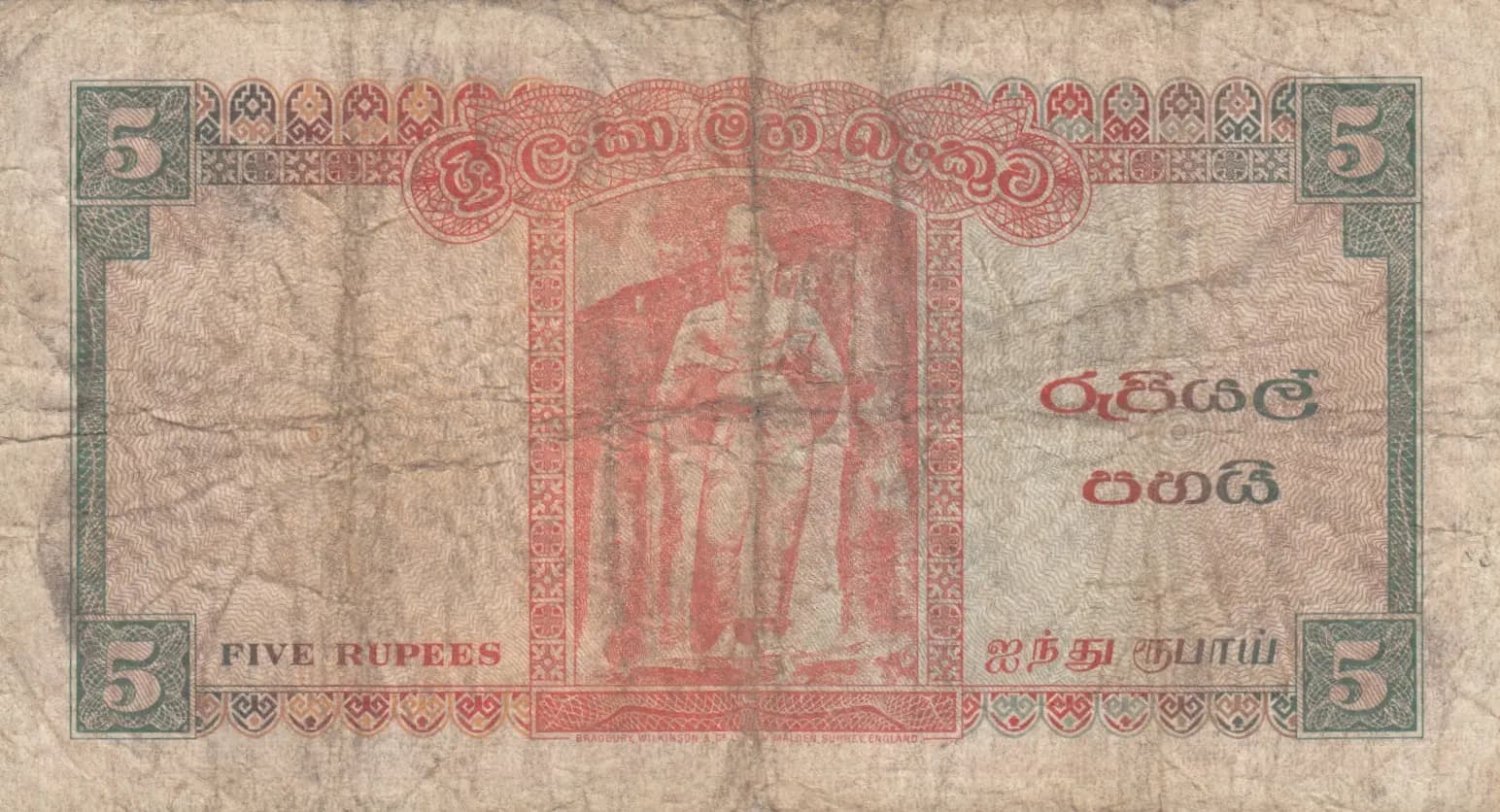
This is a VG-graded 5 Rupees banknote from the Central Bank of Ceylon dated 1956, representing an early post-independence Ceylon currency note. The note displays characteristic red and pink ornamental borders with a prominent lion coat of arms on the obverse and a standing figure in traditional dress on the reverse, both rendered in fine line engraving. The note shows moderate circulation wear with visible creasing and foxing consistent with its age, making it a collectible example of Ceylon's early numismatic heritage.
Common. The Central Bank of Ceylon's 1956-1962 series 5 Rupees notes (Pick P-58a) were issued in substantial quantities during a multi-year period and remain readily available in the collector market. The note's VG condition grade and standard serial number prefix indicate it represents typical circulation stock rather than a rare variety or low-numbered issue. No significant print run restrictions or early withdrawal patterns are known for this denomination and issuing authority during this period.
Issued in 1956, this note represents Ceylon's currency during the early years following independence from British colonial rule in 1948. The prominent lion coat of arms on the front symbolizes Ceylon's sovereignty and national identity, while the standing figure in ceremonial dress on the reverse likely represents a significant national or historical figure important to the newly independent nation. The trilingual inscriptions in English, Sinhala, and Tamil reflect the multi-ethnic character of Ceylon and the nation's commitment to linguistic pluralism during this formative post-colonial period.
The obverse features an ornate decorative border in red and pink with intricate geometric and floral patterns framing a central coat of arms depicting a lion within a circular medallion, identifying this as the heraldic symbol of Ceylon. The reverse displays a standing figure in formal ceremonial dress positioned centrally, flanked by ornamental architectural framing and decorative corner elements. Both sides employ fine line engraving throughout with the denomination '5' prominently displayed in green/teal numerals in the corners of the reverse. The trilingual text (English, Sinhala, and Tamil) is integrated throughout both sides, reflecting the official languages of Ceylon at the time of issue.
FRONT SIDE: 'FIVE RUPEES' (English denomination); 'ශ්රී ලංකා' (Sinhala: 'Sri Lanka'); 'ඔක්ස්ර' (Sinhala: 'Five'); Date marking '1956-7-30' (July 30, 1956); Serial number 'G 19995468'. BACK SIDE: 'FIVE RUPEES' (English denomination); '5' (Numeric denomination); 'ඔක්ස්ර' (Sinhala: 'Five'); 'ඔක්ස්ර පාඩු' (Sinhala: 'Five rupees'); 'ஐந்து ரூபாய்' (Tamil: 'Five rupees'); 'BRADDOUR WILKINSON & CO LTD LONDON BRIGHTON ENGRAVERS ENGLAND' (Printer attribution).
Intaglio engraving (line engraving), as confirmed by the fine detail work visible throughout the border designs, portrait, and denomination markers. The note was produced by Bradbury Wilkinson & Co Ltd, the renowned British security printer located in London, Brighton, and engraving facilities in England, as credited on the reverse. This printer was known for high-quality banknote production using traditional engraving methods with multiple color printing to achieve the red/pink and green/teal color separations visible on this note.
The observed specimen is dated 1956-7-30 (July 30, 1956) with serial number prefix 'G' and serial number 19995468. Pick P-58a encompasses the 1956-1962 date range for this design, with variations occurring across different printing dates within this span. The 'G' prefix suggests this note may belong to an early printing run, though without comprehensive serial number studies, the exact significance of this prefix relative to other varieties cannot be definitively established. The presence of both Sinhala and Tamil script alongside English confirms this as the standard trilingual variety of the series.