5 rupees 1952
About This Note
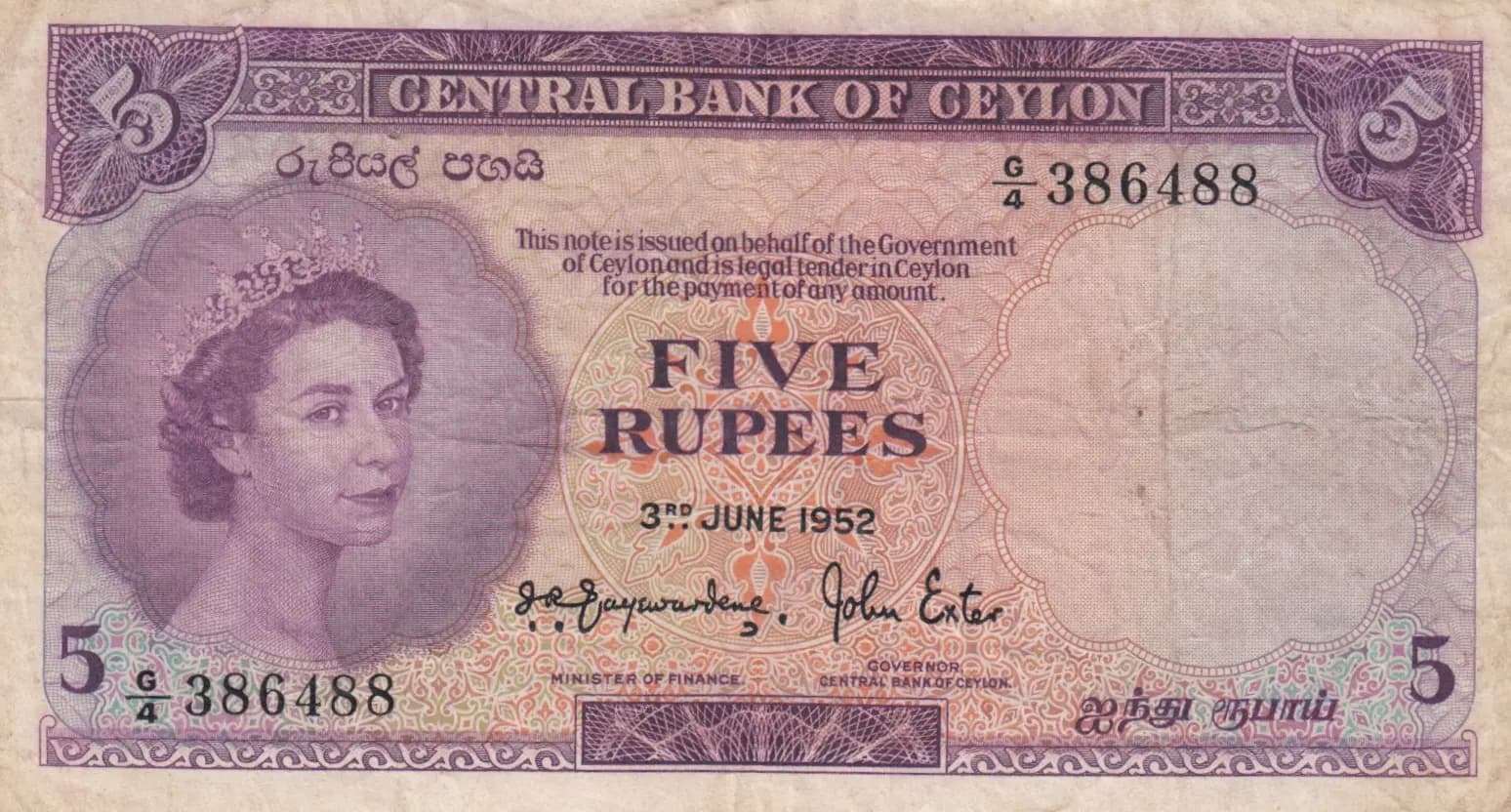
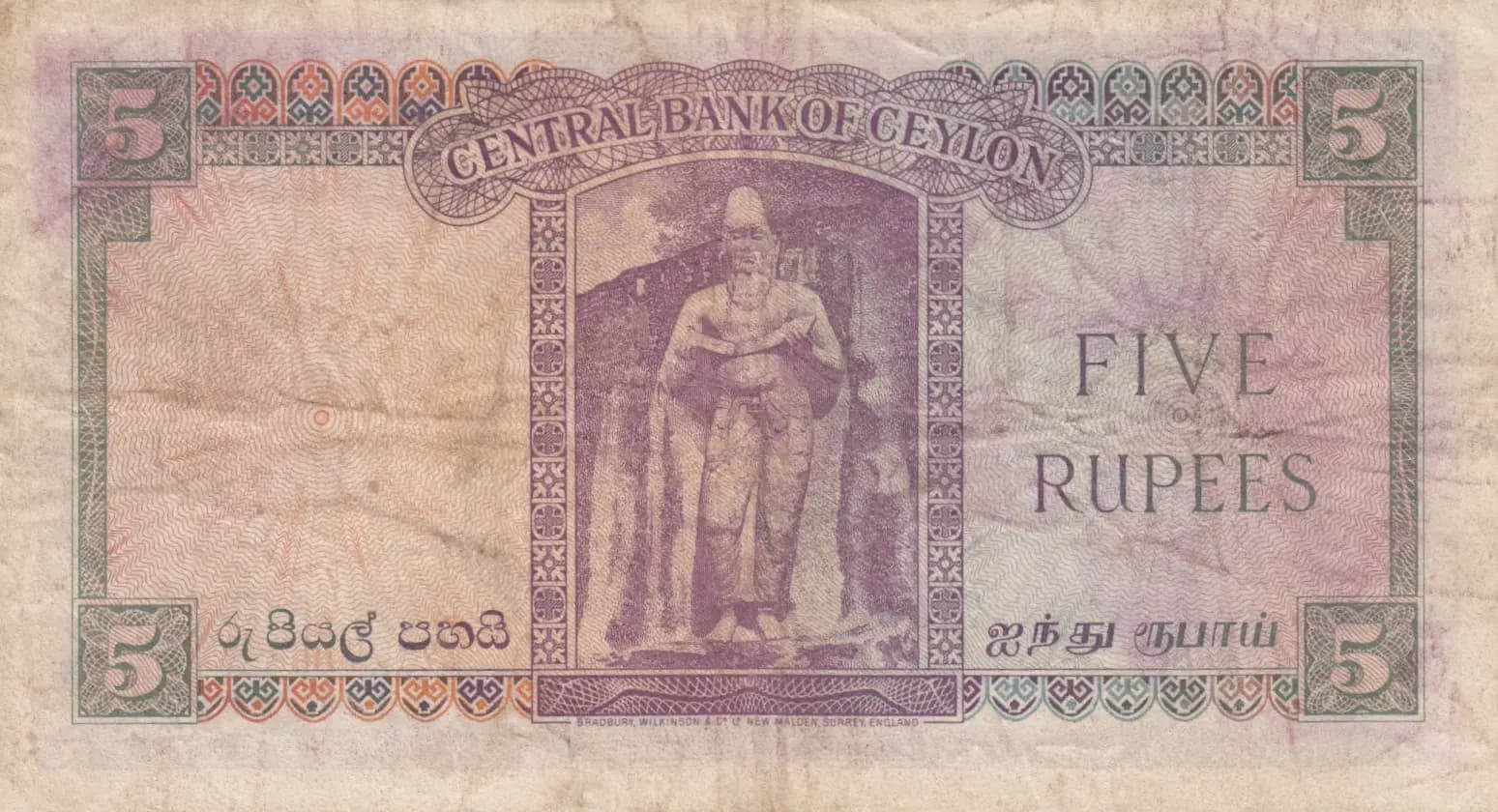
This Central Bank of Ceylon 5 Rupees note from June 3, 1952 (Pick P-51) features Queen Elizabeth II in profile on the obverse and a standing figure in traditional Ceylonese dress on the reverse, printed by Bradbury Wilkinson in their characteristic fine line engraving style. The note exhibits Fair condition with visible creasing, light discoloration, foxing on edges, and minor staining consistent with circulation wear, though structural integrity remains sound. As an early post-independence Ceylon issue during the monarchy period, this note represents an important transitional period in Sri Lankan numismatic history.
Common. This is a standard circulation issue of the Central Bank of Ceylon with no known print run restrictions, recall status, or short-lived issuing period. The serial number series (G/4 and 5/4 prefixes) suggests substantial production runs typical of regular currency denominations. The Fair condition grade is typical for notes of this age (72 years old) that saw circulation, and Fair-condition examples of this Pick number are readily encountered in the collector market.
This note was issued on June 3, 1952, during Ceylon's early years following independence from British rule in 1948, when the country retained the British monarch as head of state. The dual-language presentation in English and Sinhala reflects Ceylon's post-colonial identity, while the portrait of Queen Elizabeth II (whose reign began in 1952) demonstrates the Commonwealth connection maintained during this period. The figure in traditional dress on the reverse represents Ceylon's cultural heritage and sovereignty during this formative constitutional period.
The obverse features Queen Elizabeth II in right-facing profile within an ornate scalloped decorative frame positioned on the left side, with the denomination 'FIVE RUPEES' prominently displayed in the center surrounded by elaborate floral and geometric ornamental elements. The reverse depicts an unidentified standing male figure dressed in traditional Ceylonese robes or formal dress, centered within an ornate rectangular frame with architectural details. Both sides employ fine line engraving with complex geometric and decorative border patterns, utilizing a sophisticated color palette of purple, green, pink, orange/red accents on a cream/beige background. The bilingual design with English and Sinhala inscriptions reflects Ceylon's post-independence constitutional arrangement as a Commonwealth realm.
FRONT SIDE: Central Bank of Ceylon (English) / Central Bank of Ceylon (Sinhala: ශ්රී ලංකා රྒྱལ්ය බැංකුව) / 'This note is issued on behalf of the Government of Ceylon and is legal tender in Ceylon for the payment of any amount' / FIVE RUPEES / 3RD JUNE 1952 / MINISTER OF FINANCE / GOVERNOR CENTRAL BANK OF CEYLON / Serial Number: G/4 3886488 and 5/4 3886488. BACK SIDE: Central Bank of Ceylon (English) / Central Bank of Ceylon (Sinhala) / FIVE RUPEES / Five Rupees (Sinhala: ජනතා ෙරුපිය) / Denomination numeral: 5
Intaglio (line engraving) printing by Bradbury Wilkinson & Co., Ltd., New Malden, Surrey, UK. The note exhibits characteristic fine line engraving patterns, ornate decorative borders, and complex geometric background designs typical of Bradbury Wilkinson's high-security banknote production. The fine detail work visible in the portraits, ornamental frames, and overall composition confirms professional security printing standards of the period.
The observed specimen exhibits serial number prefix G/4 and 5/4, indicating a standard circulation printing. Varieties for this Pick P-51 are not well-documented in major catalogs, and this appears to be a standard production example without notable overprints, watermark variations, or signature varieties that would distinguish it as a recognized collecting variety. The June 3, 1952 date is consistent with the first issue of this denomination under the Central Bank of Ceylon.