5 cents 1942
About This Note
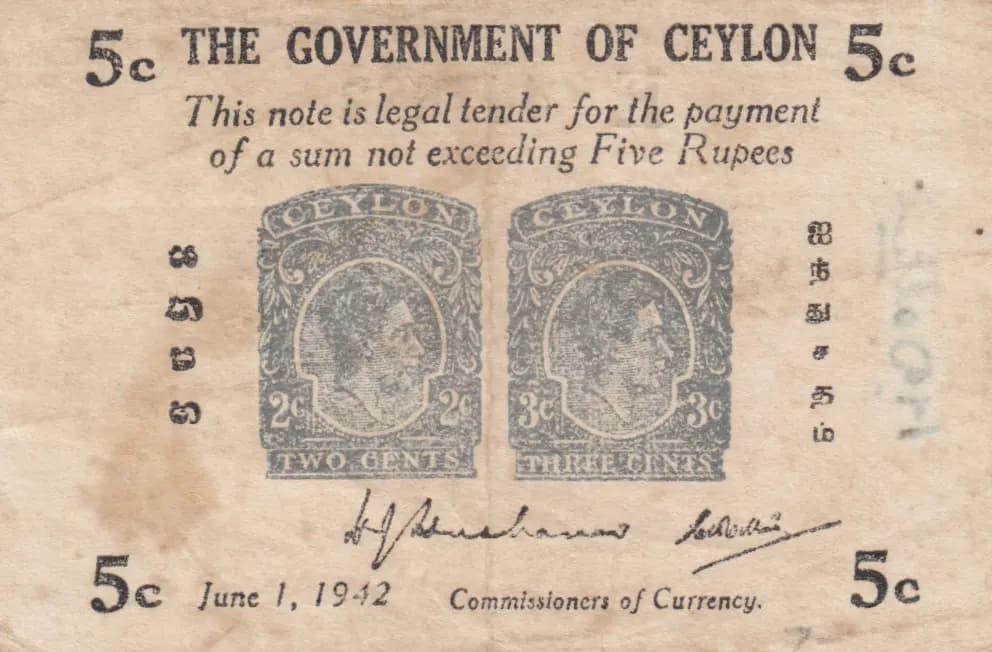
This is a scarce postal card issue of the 5 cents Government of Ceylon note from June 1, 1942, featuring an innovative dual-stamp design with two vignettes (2 cents and 3 cents) each displaying a profile portrait. The note exhibits typical age-related patina with foxing and staining throughout, consistent with its VF grade and 80+ year provenance. The serial number E 447682 and dual signatures add to its collectible appeal as an uncommon wartime emergency currency issue.
Uncommon. The postal card issue designation and specific Pick number (P-42a) indicates this was a limited emergency issue during wartime. The surviving population appears modest, with condition grades in VF and above being less frequently encountered than common circulation notes from larger wartime runs. However, it does not meet the threshold for 'scarce' or 'rare' based on documented circulation and collector availability.
Issued during World War II when Ceylon (modern-day Sri Lanka) was under British dominion, this postal card note represents an emergency currency measure by the Government of Ceylon's Commissioners of Currency. The incorporation of postage stamp imagery—specifically the 2 cents and 3 cents denominations—reflects the dual function these notes served as both currency and postal instruments during a period of wartime resource constraints and financial improvisation.
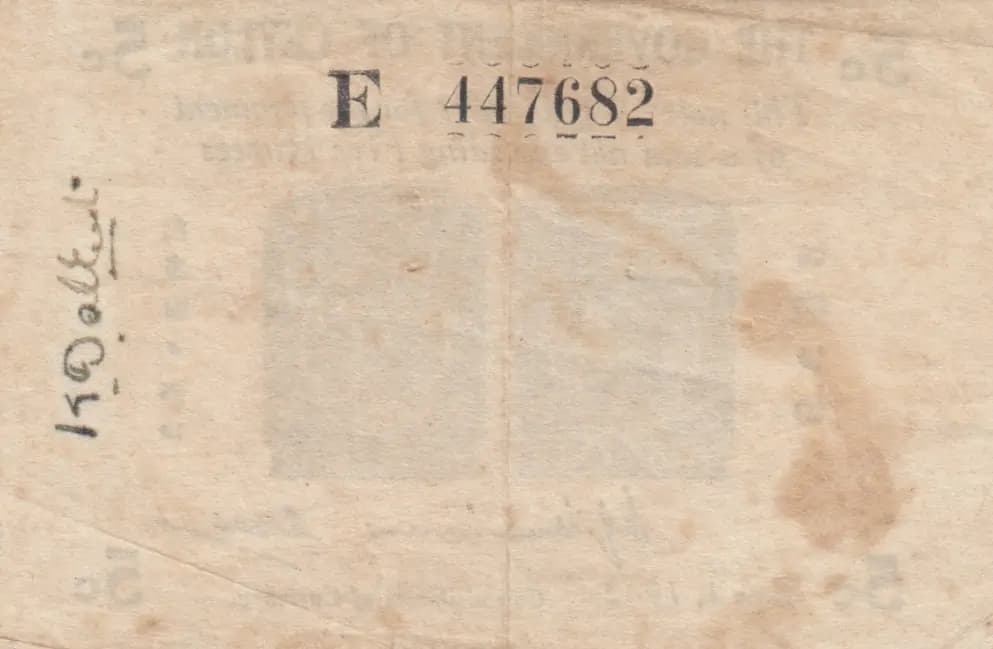
The obverse features a distinctive dual-stamp design central to its postal card function. The two vignettes display identical right-facing profile portraits—identified as King George VI based on catalog reference and the British dominion context of 1942 Ceylon. The 2 cents stamp occupies the left position while the 3 cents stamp occupies the right, each within decorative rectangular borders typical of postage stamp design. The denomination '5c' appears in all four corners in a sans-serif typeface. The reverse is largely plain, consistent with postal card convention, displaying only the serial number E 447682 and aged paper patina. The note employs a beige/tan colored paper stock with dark blue-gray printing throughout.
FRONT: '5c' (5 cents, appearing in all four corners); 'THE GOVERNMENT OF CEYLON' (issuing authority); 'CEYLON' (country identification); 'TWO CENTS' and 'THREE CENTS' (stamp denominations); 'This note is legal tender for the payment of a sum not exceeding Five Rupees' (legal tender declaration); 'June 1, 1942' (issue date); 'Commissioners of Currency' (issuing body); two handwritten official signatures. BACK: 'E 447682' (serial number); handwritten notation '1904' (archival or collector marking, predating the note's issue).
This note was produced using letterpress printing, the standard method for Government of Ceylon currency of the 1940s era. The technique is evident from the sharp, raised impression of the portrait vignettes and the crisp serif typography visible in the inscriptions. The two official signatures were added by hand after printing, as was customary for notes of this period and issuer.
This note is cataloged as P-42a, indicating it is the primary variety of the 5 cents postal card issue. The serial number prefix 'E' and the specific number 447682 are consistent with Government of Ceylon numbering practices of 1942. The dual signatures are characteristic of the issue and appear uniform. No notable overprints or secondary varieties are evident from the visual analysis. The handwritten '1904' notation on the reverse is an archival or collector mark and does not constitute an official variety.