2 rupees 1952
About This Note
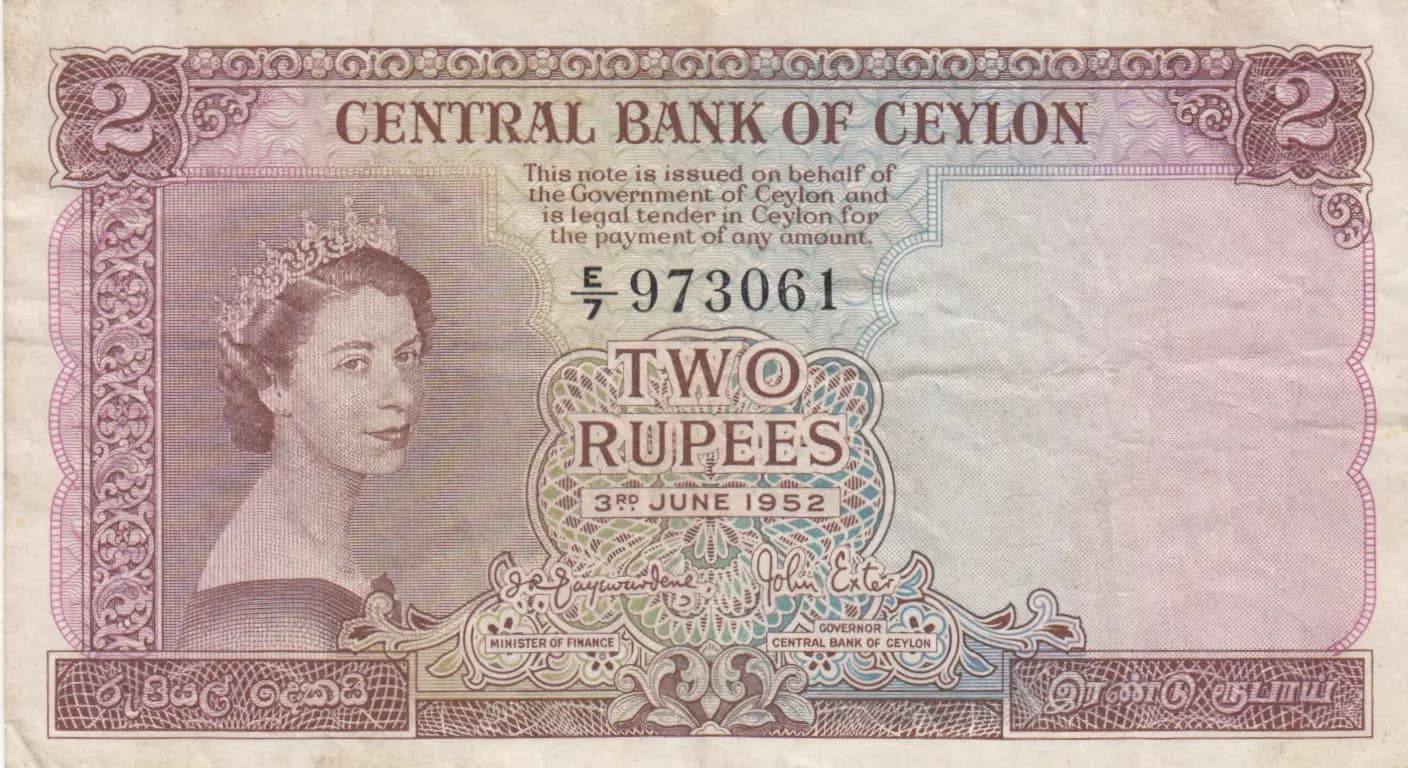
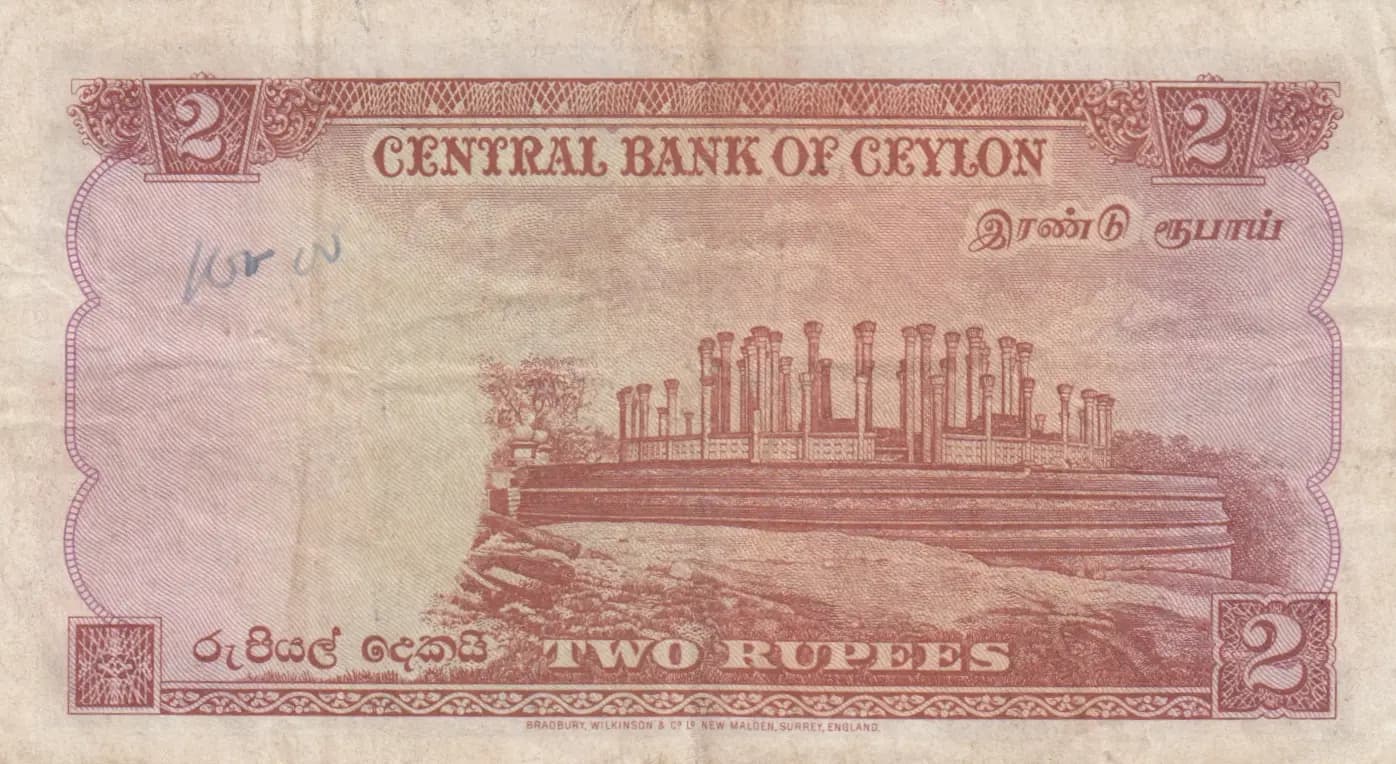
This is a VF-graded Central Bank of Ceylon 2 Rupees note from 1952, featuring an elegant portrait of Queen Elizabeth II on the obverse and the architectural landmark of Medirigiriya Vatadage on the reverse. The note displays the characteristic mauve and purple color scheme typical of early Ceylon currency, with intricate guilloche patterns and fine security printing by Bradbury Wilkinson. Despite light age-related discoloration and circulation wear consistent with its 70+ year history, the note retains strong detail and visual appeal, representing an important piece of post-independence Sri Lankan numismatic history.
Common. This 1952 2 Rupees note from the Central Bank of Ceylon (Pick P-50) is a widely circulated denomination from a substantial print run in the early years of Ceylon's independent monetary system. Early Commonwealth-era notes from Ceylon/Sri Lanka are frequently encountered in both numismatic and general collections, and no specific print run limitations or recall circumstances are known that would make this particular issue scarce. The VF condition grade is representative of notes that saw moderate circulation during the 1950s-1960s period.
Issued on 3rd June 1952, this note reflects Ceylon's early post-independence monetary sovereignty under the newly established Central Bank of Ceylon. The inclusion of Queen Elizabeth II on the obverse acknowledges Ceylon's status as a Commonwealth realm in the early 1950s, while the reverse features the Medirigiriya Vatadage, a magnificent ancient Buddhist temple complex in Polonnaruwa, emphasizing the nation's rich cultural heritage and Buddhist identity. The trilingual inscriptions in English, Tamil, and Sinhala represent the diverse linguistic communities of the island nation.
The obverse features a formal left-facing profile portrait of Queen Elizabeth II, rendered in fine detail within an ornamental circular medallion. The portrait is surrounded by elaborate decorative borders composed of intricate scrollwork, floral flourishes, and guilloche patterns in mauve and purple tones. The reverse depicts the Medirigiriya Vatadage (also known as the Circular Relic House), an outstanding example of ancient Buddhist architecture located in Polonnaruwa. The temple is rendered with careful attention to its distinctive circular design with multiple tiers of columns and architectural detail, set within a landscape suggesting the natural setting. The composition demonstrates exceptional engraving technique with fine line work throughout, creating depth and dimension in both the architectural rendering and the background.
FRONT SIDE: 'CENTRAL BANK OF CEYLON' (English header); 'TWO RUPEES' (denomination in English); '3RD JUNE 1952' (date of issue); 'This note is issued on behalf of the Government of Ceylon and is legal tender in Ceylon for the payment of any amount.' (legal tender statement); 'MINISTER OF FINANCE' and 'GOVERNOR CENTRAL BANK OF CEYLON' (signature authorities); 'E 973061' (serial number). BACK SIDE: 'CENTRAL BANK OF CEYLON' (English header); 'TWO RUPEES' (English denomination); 'ඉරාපත් දෙයි' (Sinhala: Two Rupees); 'இரண்டு ரூபாய்' (Tamil: Two Rupees); '2' (numeral denomination); 'BRADBURY, WILKINSON & CO LTD, NEW MALDEN, SURREY, ENGLAND.' (printer attribution).
Intaglio (engraved) printing on banknote stock, executed by Bradbury Wilkinson & Co Ltd, New Malden, Surrey—one of the world's premier security printers of the 20th century. The note exhibits characteristic high-security intaglio features including fine line guilloche borders, intricate background patterns, and detailed portraiture that would be difficult to counterfeit with contemporary technology. The color palette was achieved through traditional multi-color intaglio printing, layering mauve, purple, brown, and cream inks to create the sophisticated chromatic effect observed on both sides.
The serial number 'E 973061' and the signature lines for Minister of Finance and Governor represent standard authorization features for this 1952 issue. The date of 3rd June 1952 is the primary issue date for this variety. Varieties of this note may be distinguished by different signature authorities (different ministers and governors served during the period), though the primary catalog identification remains Pick P-50 for the entire 1952 emission. No major varieties such as overprints or error notes are noted in standard references for this denomination and date.