100 rupees 1956
About This Note
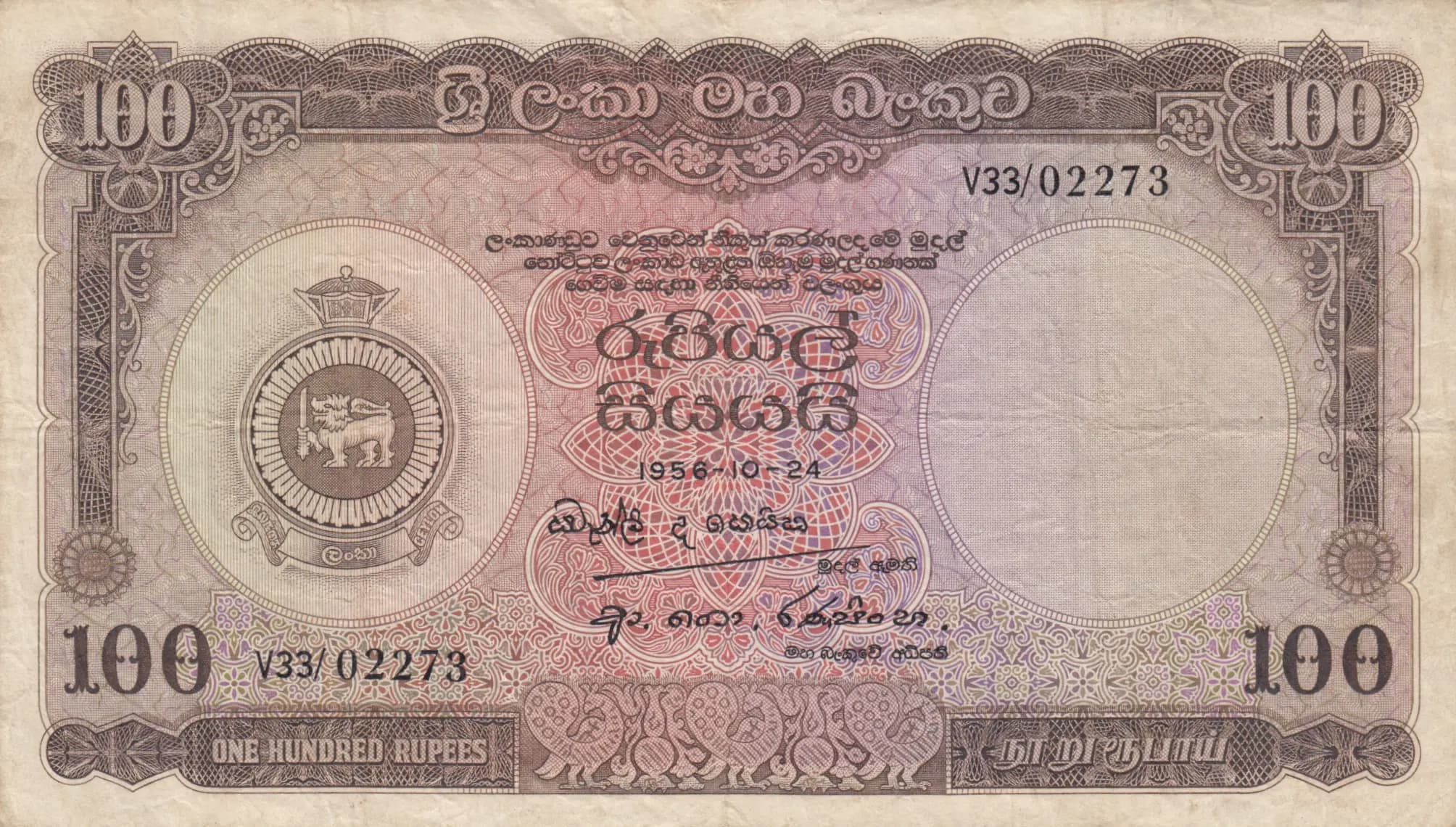
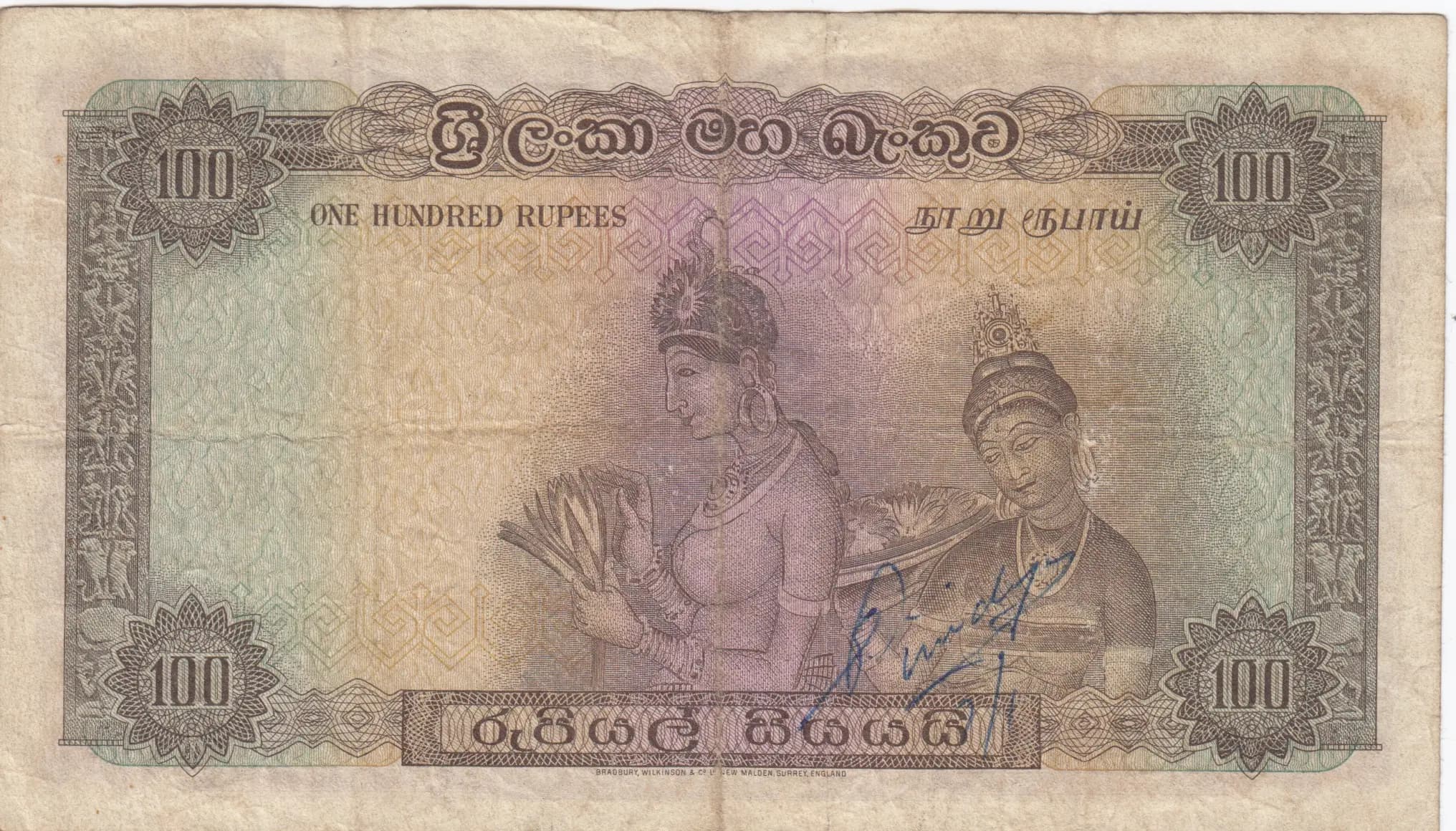
This is a 1956 Central Bank of Ceylon 100 rupee banknote (Pick P-61) in Fair condition, featuring the iconic lion emblem of Sri Lanka on the obverse and regal royal portraits on the reverse. The note exhibits typical circulation wear with creasing and foxing, but retains good structural integrity and clear impressions of its ornate decorative borders and fine line engraving. The dual-language inscriptions in English, Sinhala, and Tamil reflect Ceylon's multilingual heritage during the early post-independence period.
Common. The 1956 100 rupee note of Ceylon (Pick P-61) was issued as part of regular currency circulation by the Central Bank of Ceylon and maintains a substantial survival rate. While notes from this early post-independence period have numismatic interest, the print run was sufficient to support Ceylon's economy, and examples remain readily available to collectors. Notes in Fair condition like this example are particularly common in the market.
Issued on October 24, 1956, this banknote commemorates Ceylon's transition to independence and sovereignty, as evidenced by the prominent lion emblem (representing the Lion Flag of Ceylon) and the ceremonial royal portraits on the reverse. The Central Bank of Ceylon, established to manage the nation's monetary policy following independence from British rule in 1948, used this design to assert national identity while maintaining formal aesthetic traditions. The portraits depicted represent Ceylon's royal heritage and cultural significance during this formative period of nation-building.
The obverse features Ceylon's national lion emblem enclosed within a circular medallion on the left side, surrounded by concentric circles, symbolizing the newly independent nation's sovereignty. The reverse depicts two formal royal portraits in profile—a figure on the left facing left in traditional dress with ornate headdress, and a figure on the right facing right wearing an elaborate crown and ornate traditional garments with detailed jewelry, likely representing significant figures in Ceylon's royal or political hierarchy. Both sides are framed by intricate geometric and floral border patterns with ornate rosettes in all four corners, characteristic of high-security banknote design. The color scheme of pink, mauve, beige, cream, and brown creates an elegant, formal presentation appropriate for a high-denomination note. Fine line engraving and complex geometric diamond patterns in the central area provide anti-counterfeiting measures.
Front Side: Denomination '100' appears in all four corners in Arabic numerals. 'ONE HUNDRED RUPEES' in English text. Sinhala script text present in center decorative panel (precise transcription unclear from image). Tamil script text visible in right portion (precise transcription unclear from image). Serial number 'V33/02273' visible in upper right. Back Side: Denomination '100' in all four corners. 'ONE HUNDRED RUPEES' in English. Sinhala script in top center area (precise transcription unclear). Tamil script present (precise transcription unclear). Printer attribution: 'BRADBURY WILKINSON & CO. LTD WALDEN SURREY ENGLAND'. Two hand-written signatures in blue ink overlay the portraits.
This banknote was produced by Bradbury Wilkinson & Co. Ltd of Walden, Surrey, England, using traditional intaglio (engraved) printing techniques. The fine line engraving visible throughout the note—particularly evident in the portrait details, border patterns, and security features—is characteristic of high-security banknote production by this renowned security printer. The detailed geometric patterns and elaborate decorative elements showcase the precision engraving capabilities that made Bradbury Wilkinson a leading choice for Commonwealth currency production during this era.
This example features serial number V33/02273, with the 'V' prefix and two-digit variety code (33) typical of this issue. The handwritten signatures in blue ink on the reverse are consistent with Central Bank of Ceylon authorization signatures found on notes from this period. The specific signature varieties may indicate different issuing periods or signatories, which could be catalogued in specialized Ceylon banknote references, though the faded condition makes precise identification challenging. No overprints or unusual varieties are evident in this example.