10 rupees 1982
Market Prices
12 salesAbout This Note
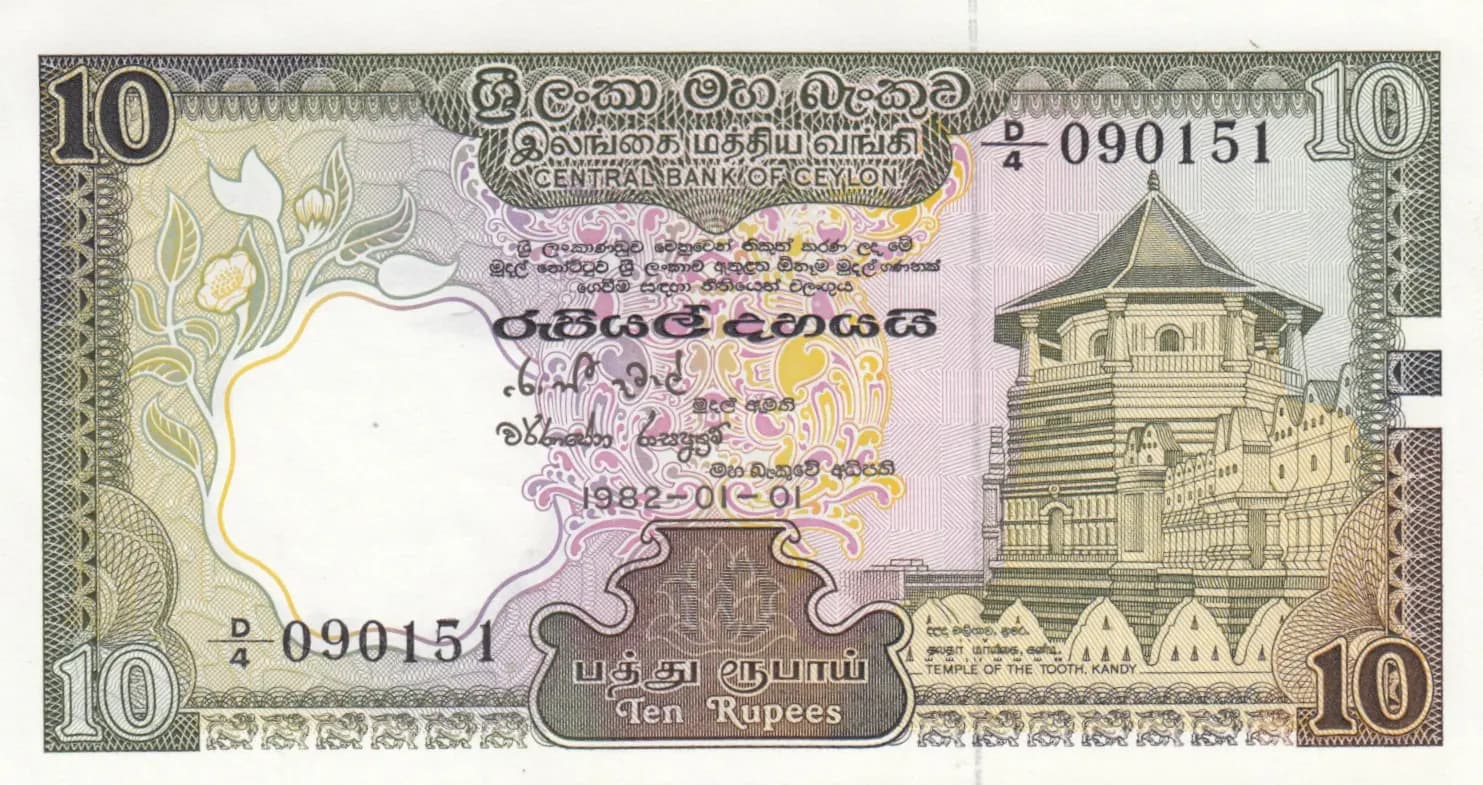
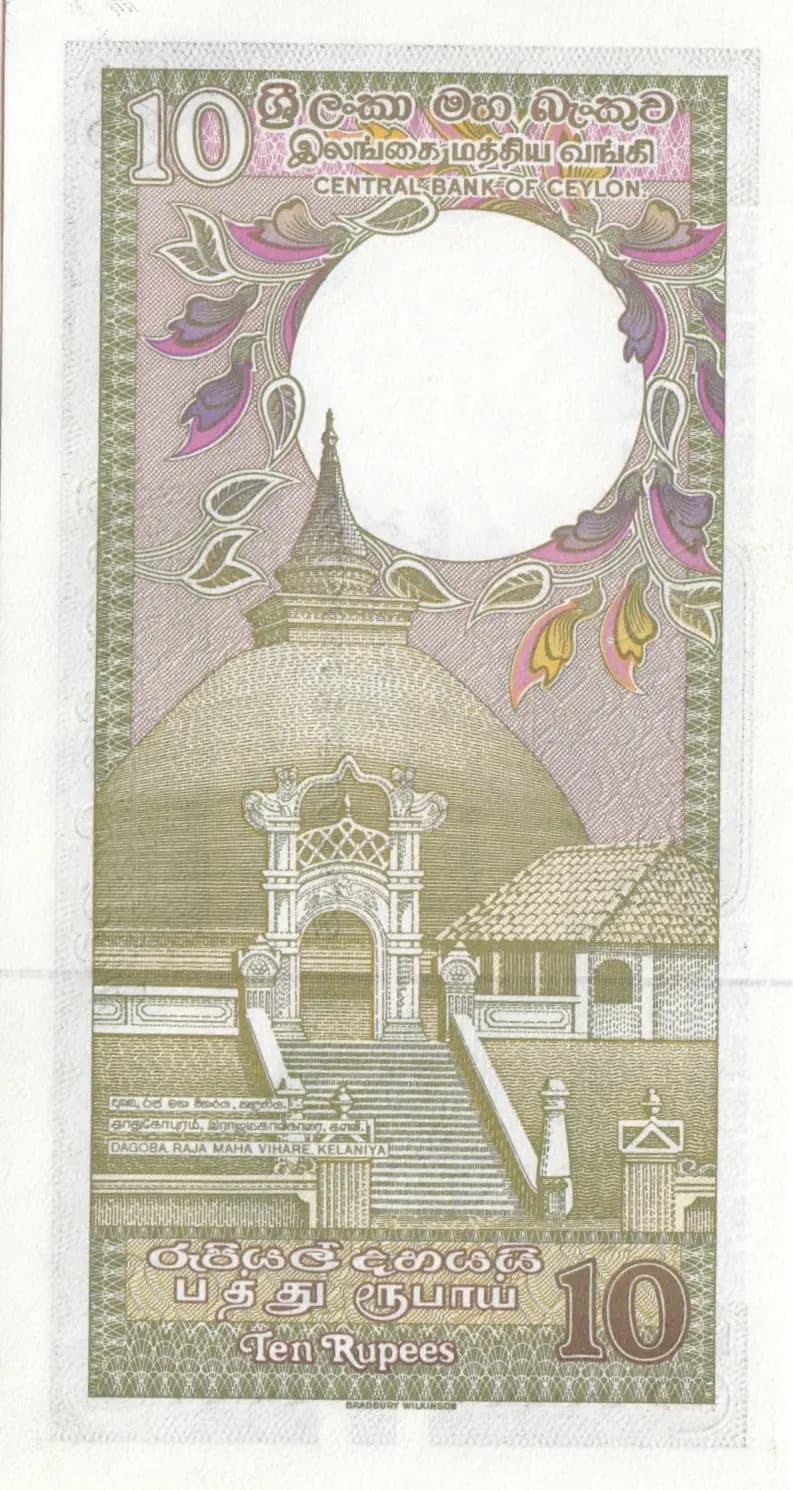
This is a 1982 Central Bank of Ceylon 10 Rupees note (Pick P-92) in UNC condition, featuring vibrant multicolor printing dominated by olive-green, purple, and yellow tones. The obverse showcases the ornate Temple of the Tooth in Kandy rendered as a detailed architectural illustration on the right side, while the reverse depicts the Dagoba Raja Maha Vihare Kelaniya temple entrance. The note displays excellent preservation with crisp, clear printing and only a minor vertical crease, making it a desirable specimen for collectors of Sri Lankan currency.
Common. This is a regular-issue note from a substantial print run during the Central Bank of Ceylon's active period. eBay market data consistently shows UNC examples selling for $2–$10, with most transactions in the $3–$5 range (based on historical sales from 2014–2026), and catalog valuation at $7.50 for UNC condition as of 2019. These modest prices across numerous sales indicate ready availability in the collector market. No print run restrictions, special recall status, or limited issuing period apply to this Pick number, all indicators of a common note.
Issued during the early 1980s by the Central Bank of Ceylon, this note reflects Sri Lanka's rich Buddhist heritage through its choice of religious landmarks. The Temple of the Tooth in Kandy and Raja Maha Vihare Kelaniya are among the island's most significant Buddhist shrines, with the former being one of the most sacred temples in Theravada Buddhism. This denomination and design series represents Ceylon's currency during a pivotal period in the nation's post-independence economic development.
The 10 Rupees note features a sophisticated bilateral design celebrating Sri Lankan Buddhist architecture. The obverse displays the Temple of the Tooth (Sri Dalada Maligawa) in Kandy, rendered as a multi-tiered structure with a distinctive pointed spire characteristic of Sri Lankan religious architecture, positioned on the right portion of the note. Ornamental floral and botanical patterns in yellow and white frame the left side, with the central bank identification text. The reverse presents an equally detailed architectural study of the Dagoba Raja Maha Vihare Kelaniya, shown as a temple entrance with gateway, ascending steps, and domed structures typical of Sri Lankan Buddhist temple complexes. A large white circular element dominates the reverse center, likely serving both aesthetic and security functions. Throughout both sides, intricate geometric and floral border designs in purple, olive-green, yellow, and tan create a cohesive, ornamental aesthetic reflecting traditional Sri Lankan artistic motifs.
FRONT SIDE: Central Bank designation appears in three languages — English: 'CENTRAL BANK OF CEYLON'; Sinhala: 'ශ්රී ලංකා මහ බැංකුව' (Central Bank of Sri Lanka); Tamil: 'இலங்கையின்ய வங்கி' (Central Bank of Ceylon). Denomination in three languages: English 'Ten Rupees', Sinhala 'පතිගණ රුපාය', Tamil 'பத்து ரூபாய'. Arabic numeral '10' appears in denomination positions. Temple identification: 'TEMPLE OF THE TOOTH, KANDY'. Serial number: 'D 4 090151'. BACK SIDE: Same trilingual institutional and denomination inscriptions appear. Temple identification: 'DAGOBA RAJA MAHA VIHARE KELANIYA'. Arabic numeral '10' in denomination areas.
This note was produced by Bradbury Wilkinson (BWC), New Malden, a renowned British security printer. The visual characteristics—including the fine geometric and floral line work, the registration of multiple color layers, and the precision of the architectural illustrations—indicate multicolor intaglio printing combined with offset lithography. The detailed botanical patterns and crisp denomination numerals are consistent with high-security intaglio techniques employed by Bradbury Wilkinson during this period. The watermark noted as 'Chinze' (likely referring to an artistic/decorative element rather than traditional paper watermarking) further reflects the sophisticated security printing standards of this era.
The observed serial number prefix 'D 4' suggests this specimen belongs to one of the standard serial number series for the 1982 emission. No significant varieties (such as signature variants, date overprints, or security feature modifications) are noted for Pick P-92 in numismatic literature. The 1982 and 1985 emissions of this 10 Rupees denomination are cataloged together in Pick references, but this specific specimen is identifiable as the 1982 issue by catalog record. Minor variations in serial number prefixes and ranges exist across the print run but do not constitute recognized collector varieties.