10 rupees 1979
Market Prices
51 salesAbout This Note
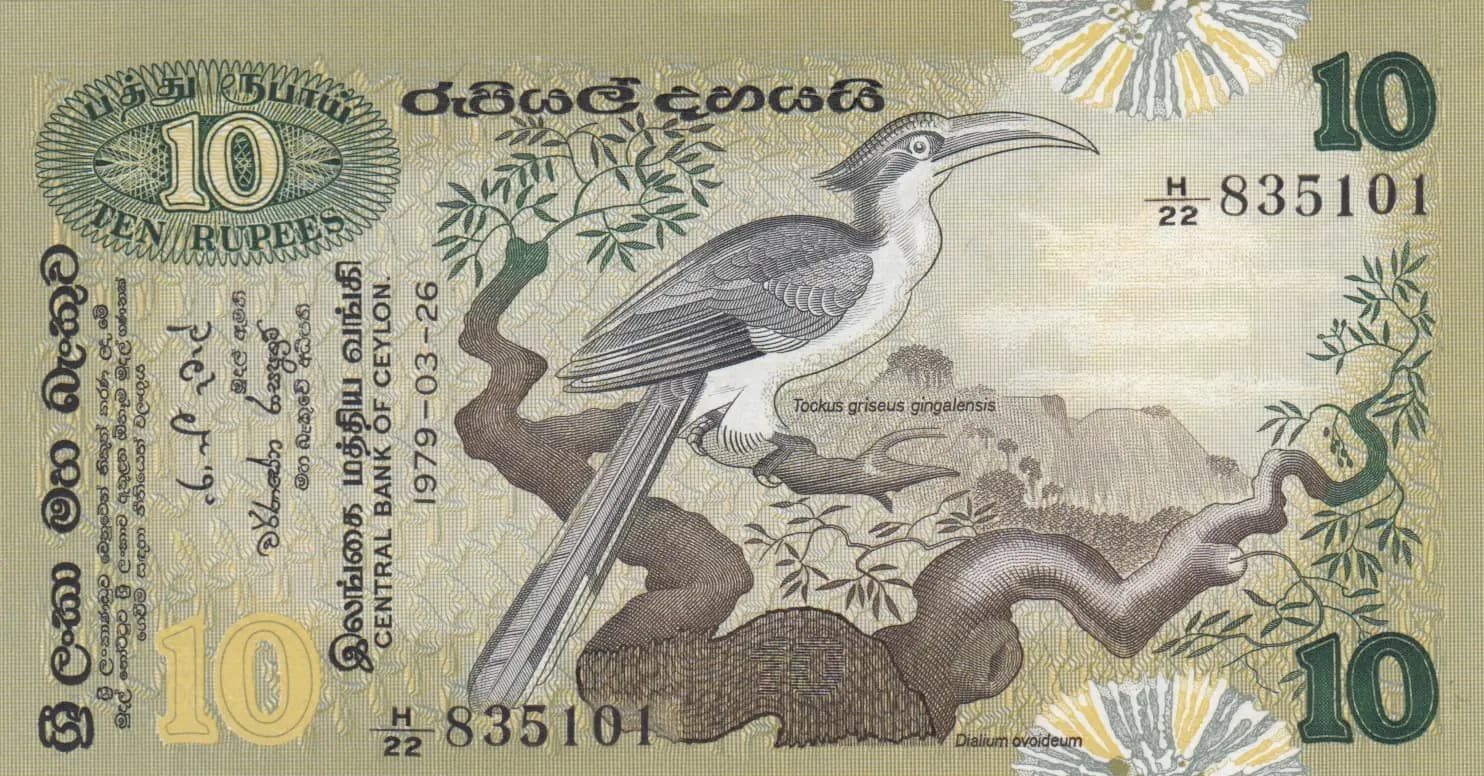
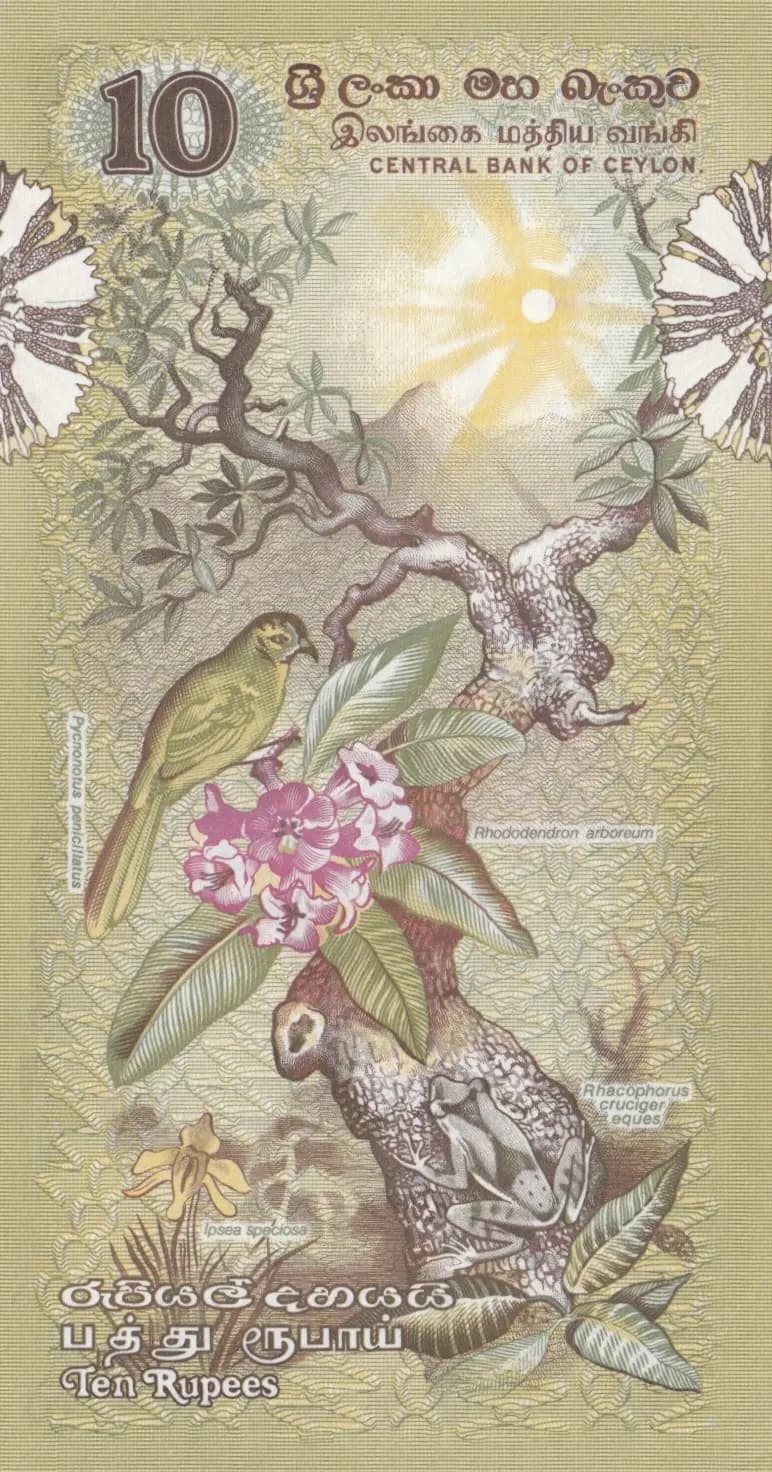
This is an exceptional UNC example of the 1979 Sri Lanka 10 Rupees (Pick P-85), showcasing pristine condition with sharp, crisp printing throughout. The note features a beautiful natural history theme with the Sri Lanka Grey Hornbill prominently depicted on the obverse, complemented by detailed botanical and zoological illustrations on the reverse, including a Yellow-eared Bulbul, tree frog, and Rhododendron flowers. As an uncirculated specimen with no visible wear or handling marks, this note represents the finest presentation of this environmentally-themed series from the Central Bank of Ceylon.
Common. Market data from realbanknotes.com shows consistent availability of this note across multiple condition grades, with UNC examples selling regularly between $16-$38 USD in recent years (2017-2024). The numerous eBay sales records spanning over a decade indicate steady supply and demand. While PMG-graded examples command premium prices ($54-$115 for grades 65-67), ungraded or modestly-graded examples remain affordable and accessible, typical of regular-issue banknotes from a major Central Bank with substantial print runs. The denomination (10 rupees) and broad circulation period suggest this was not a commemorative or limited issue.
Issued on March 26, 1979, this banknote reflects Sri Lanka's post-independence emphasis on national identity and natural heritage during a period of cultural consolidation. The deliberate choice to feature endemic Sri Lankan fauna and flora—particularly the Sri Lanka Grey Hornbill and Rhododendron arboreum—demonstrates the Central Bank's commitment to celebrating the nation's unique biodiversity on its currency. This thematic approach was characteristic of 1970s-80s Sri Lankan monetary design, which prioritized educational and nationalistic imagery over traditional portraiture.
The obverse features a naturalistic engraving of the Sri Lanka Grey Hornbill (Tockus griseus gingalensis) in profile, perched on a branch amid foliage, rendered in detailed line work against a multicolor underprint dominated by tan, green, and brown tones. The distinctive curved beak and feather detailing of the hornbill are rendered with fine precision, with Dialium ovoideum plant specimens depicted below. The reverse presents a complementary composition featuring the Yellow-eared Bulbul (Pycnonotus penicillatus) perched among Rhododendron arboreum flowers with pink-magenta blooms, and the tree frog (Rhacophorus cruciger eques) illustrated among intertwined branches. A radiating sun or moon motif appears in the upper center, with white floral corner ornaments. The denomination '10' appears in prominent positions with supporting text in English, Sinhala, and Tamil, emphasizing the multilingual character of Sri Lankan currency. All design elements are executed in fine-line engraving with complex guilloche patterns providing sophisticated security and aesthetic appeal.
{"front":{"english":["10 (in oval frames, top left and right)","TEN RUPEES (text)","CENTRAL BANK OF CEYLON (text)","1979 - 03 - 26 (date)","Tockus griseus gingalensis (scientific name of Sri Lanka Grey Hornbill)","Dialium ovoideum (scientific name of plant species)"],"sinhala":"රුපියල (Rupees)","tamil":"பதத் (Rupees)"},"back":{"english":["10 (denomination)","CENTRAL BANK OF CEYLON (issuing authority)","Rhododendron arboreum (scientific name of flowering plant)","Rhabdophorus cruciger eques (scientific name of tree frog)"],"sinhala":["ශ්රී ලංකා (Sri Lanka)","පතිසිංහ (Ten Rupees)"],"tamil":["இலங்கை (Sri Lanka)","பத்தரூபாய (Ten Rupees)"]}}
Intaglio (line engraving), utilizing multiple color printing passes to achieve the multicolor underprint and detailed naturalistic rendering of flora and fauna. The fine line engraving technique is evident from the intricate detail work in the bird plumage, botanical specimens, and background patterns. The complex guilloche patterns and security features visible throughout indicate production by a specialized security printer, consistent with Central Bank of Ceylon standards for the period. The crisp, sharp printing and excellent color registration in this UNC specimen demonstrate the high quality of the original print run.
Observed serial number prefix 'H' on the specimen (H 22 835101). According to catalog references, replacement notes carry the prefix 'Z/1'. This specimen appears to be from the regular issue series. The date of issue is 1979-03-26 as inscribed. No overprints, signatures, or other special markings are noted on this specimen that would indicate a distinct variety, though future notes may exist with different serial prefixes or date variations within the 1979 issue year.