10 rupees 1964
About This Note
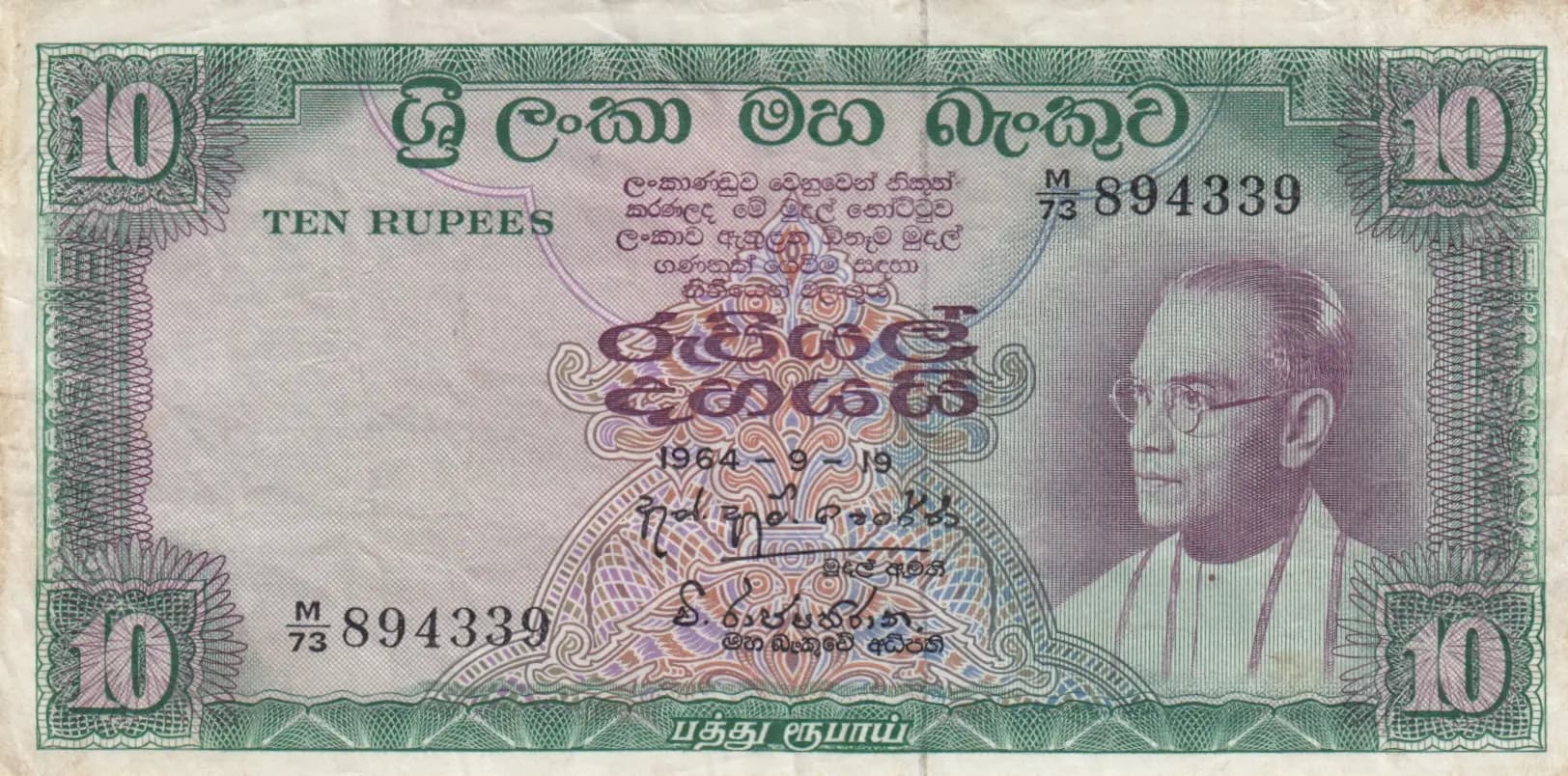
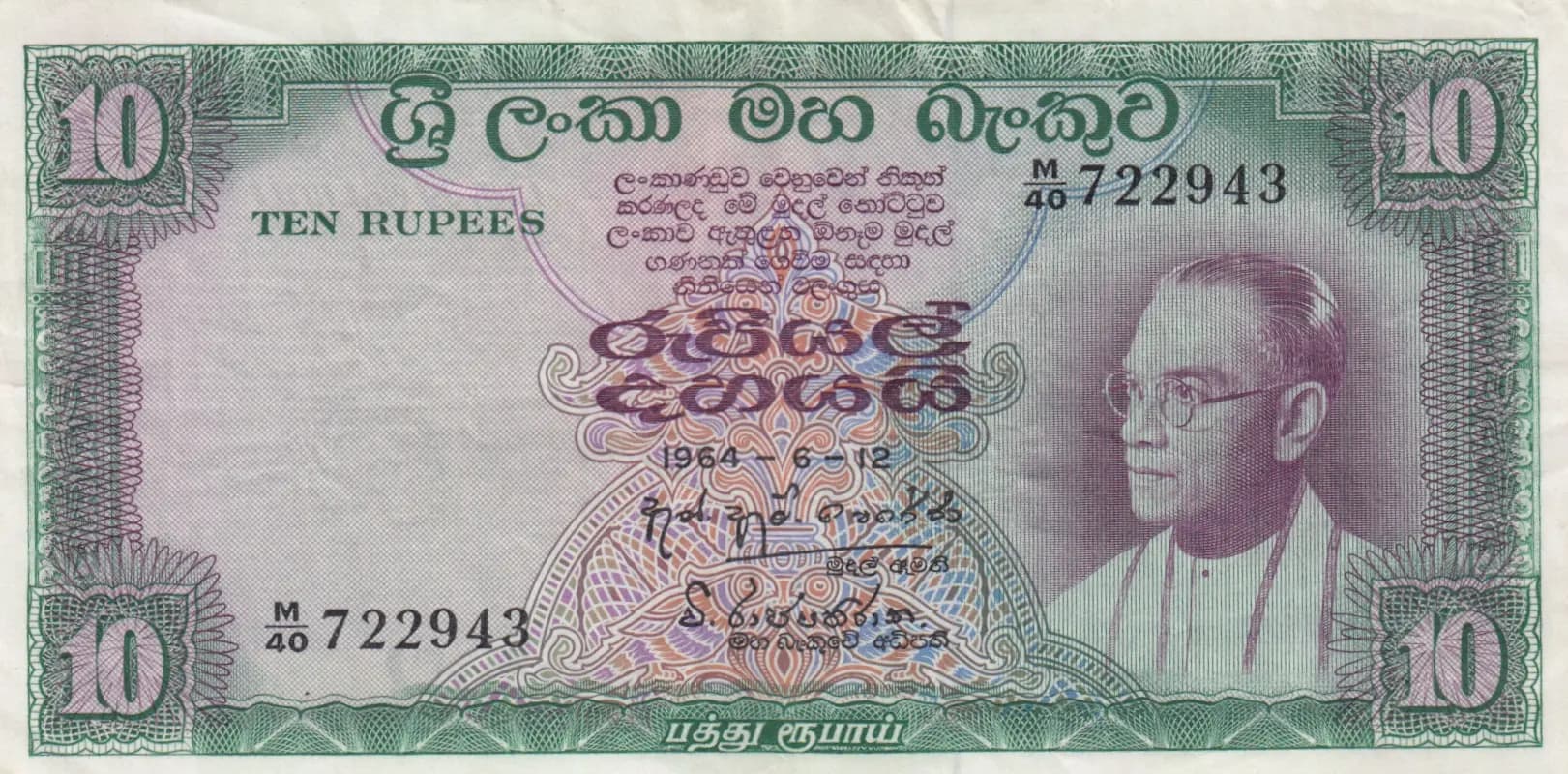
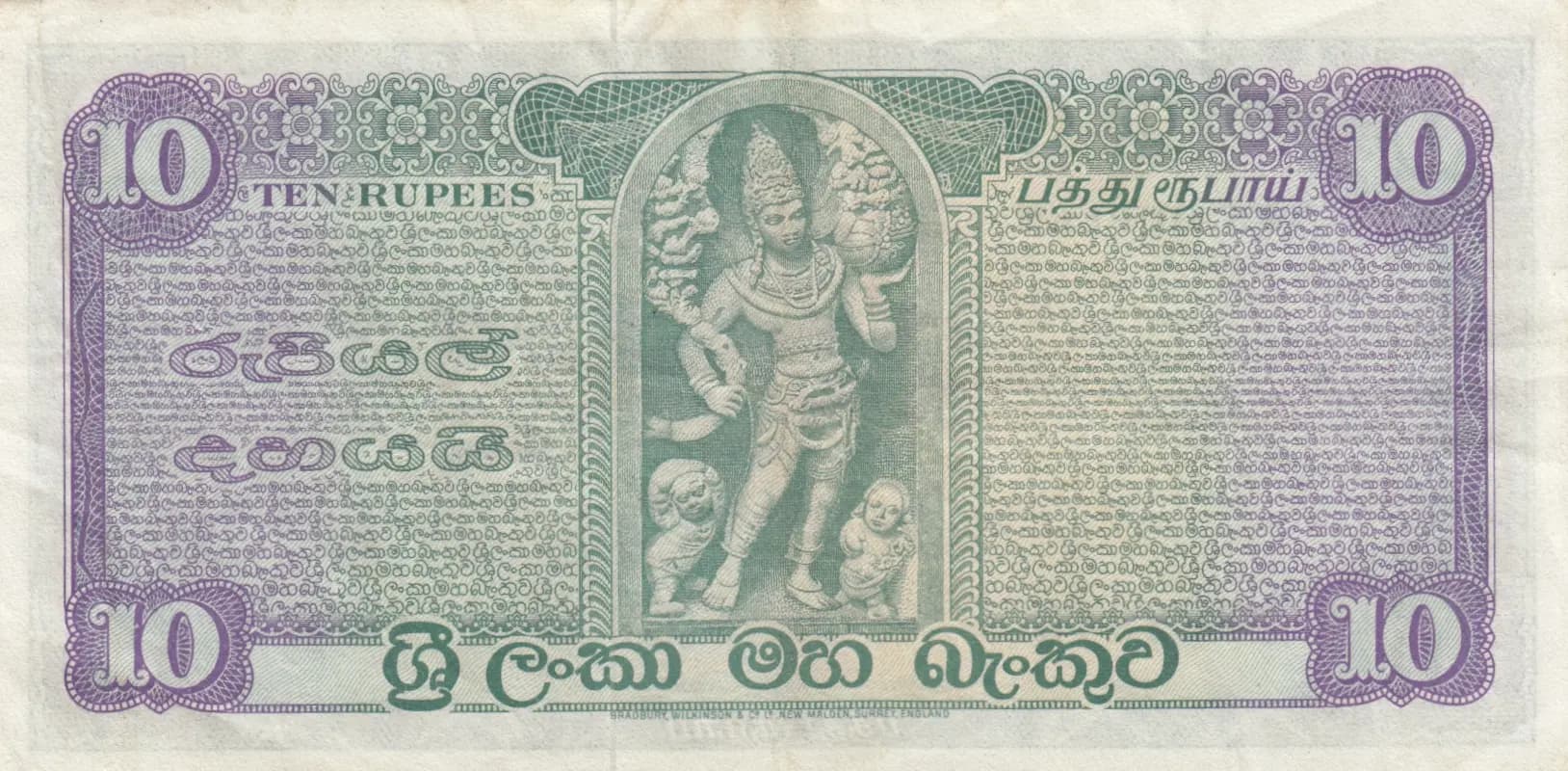
This 1964 Central Bank of Ceylon 10 rupees note (Pick 64) presents a fine example of mid-20th century Ceylon currency design, featuring an elegant portrait of Prime Minister S.W.R.D. Bandaranaike on the obverse and a cultural or religious figure in ornate ceremonial dress on the reverse. The note exhibits VF condition with well-preserved green and purple color printing, fine line engraving throughout, and only minor age-related discoloration around the edges. The sophisticated security features and multi-script inscriptions reflect Ceylon's cultural identity during the early post-independence period.
Common. The 1964 10 rupees note (Pick 64) from the Central Bank of Ceylon was issued in substantial quantities as a standard denomination in circulation during the 1960s. No historical evidence suggests a limited print run, recall, or short-lived issuing period. Standard denominations from established central banks of this era remain abundant in the collector market. VF condition examples are readily available and do not command premium prices.
This note was issued in 1964 by the Central Bank of Ceylon, the successor institution to the pre-independence monetary authority, reflecting Sri Lanka's establishment as an independent republic. The obverse portrays Solomon West Ridgeway Dias Bandaranaike, Ceylon's first Prime Minister and a pivotal figure in the nation's independence movement, while the reverse depicts a figure representing Ceylon's rich cultural and religious heritage—likely a Buddhist or Hindu deity. Together, these design elements celebrate both the nation's political leadership and its deep cultural traditions during a transformative period in Ceylon's post-colonial history.
The obverse features a formal right-profile portrait of Prime Minister S.W.R.D. Bandaranaike rendered in purple and burgundy tones, positioned on the right side of the note. The central motif consists of an ornate medallion with elaborate geometric and floral patterns in traditional artistic style, flanked by decorative scrollwork in the corners. The reverse displays a central standing figure—likely representing a Buddhist or Hindu deity or important cultural personage—depicted in an arched rectangular frame wearing elaborate jewelry, crown, and ceremonial clothing, with additional smaller background figures visible within the composition. Both sides feature denomination numerals '10' positioned in the corners and incorporate dense Sinhala script inscriptions as security and informational elements. The overall color scheme of green, purple, white, and mauve creates a distinguished appearance appropriate to the nation's cultural identity.
Front side: 'TEN RUPEES' (English denomination); 'ශ්රී ලංකා මුදල් දෙපාර්තමේන්තුව' (Sinhala: 'Sri Lanka Monetary Department' or Central Bank); Serial number designation 'M/46 7222943'; '10' (numeric denomination in corners). Back side: 'TEN RUPEES' (English denomination); 'ශ්රී ලංකා මුදල් දෙපාර්තමේන්තුව' (Sinhala: 'Sri Lanka Monetary Department'); '10' (numeric denomination in all four corners); Dense Sinhala script text along left and right margins (content not fully legible due to fine engraving).
Intaglio (line engraving) printing executed by Bradbury Wilkinson of New Malden, a world-renowned security printer. The fine line engraving is evident throughout the design, particularly in the intricate geometric patterns, decorative scrollwork, and microscopic detail visible in the dense script areas on the reverse. The precision of the color separation and the sharpness of the ornamental borders indicate the high-quality production standards characteristic of Bradbury Wilkinson's work during this period.
The observed specimen carries the serial number prefix 'M/46' with the number 7222943, indicating a mid-range serial from the printing run. The prefix system suggests there may be varieties based on different letter/number prefix combinations from different printing batches. Standard varieties for this Pick number would relate to signature variations of Central Bank officials and potentially different printer batches, though such distinctions are typically minor for this circulating issue. The visible watermark area and security thread configuration (if present) could indicate additional variety distinctions, though these cannot be fully assessed from the provided images.