10 rupees 1959
About This Note
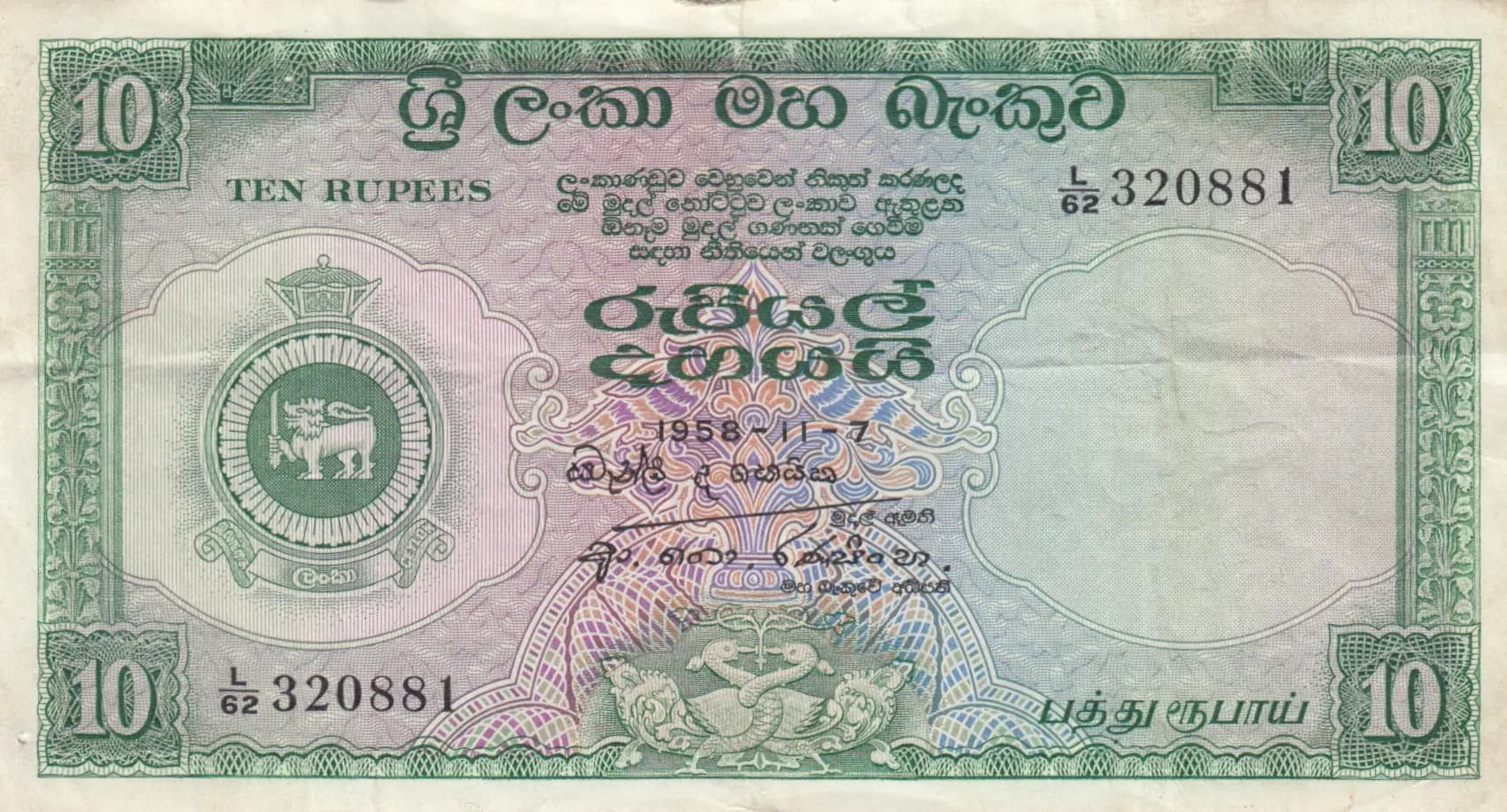
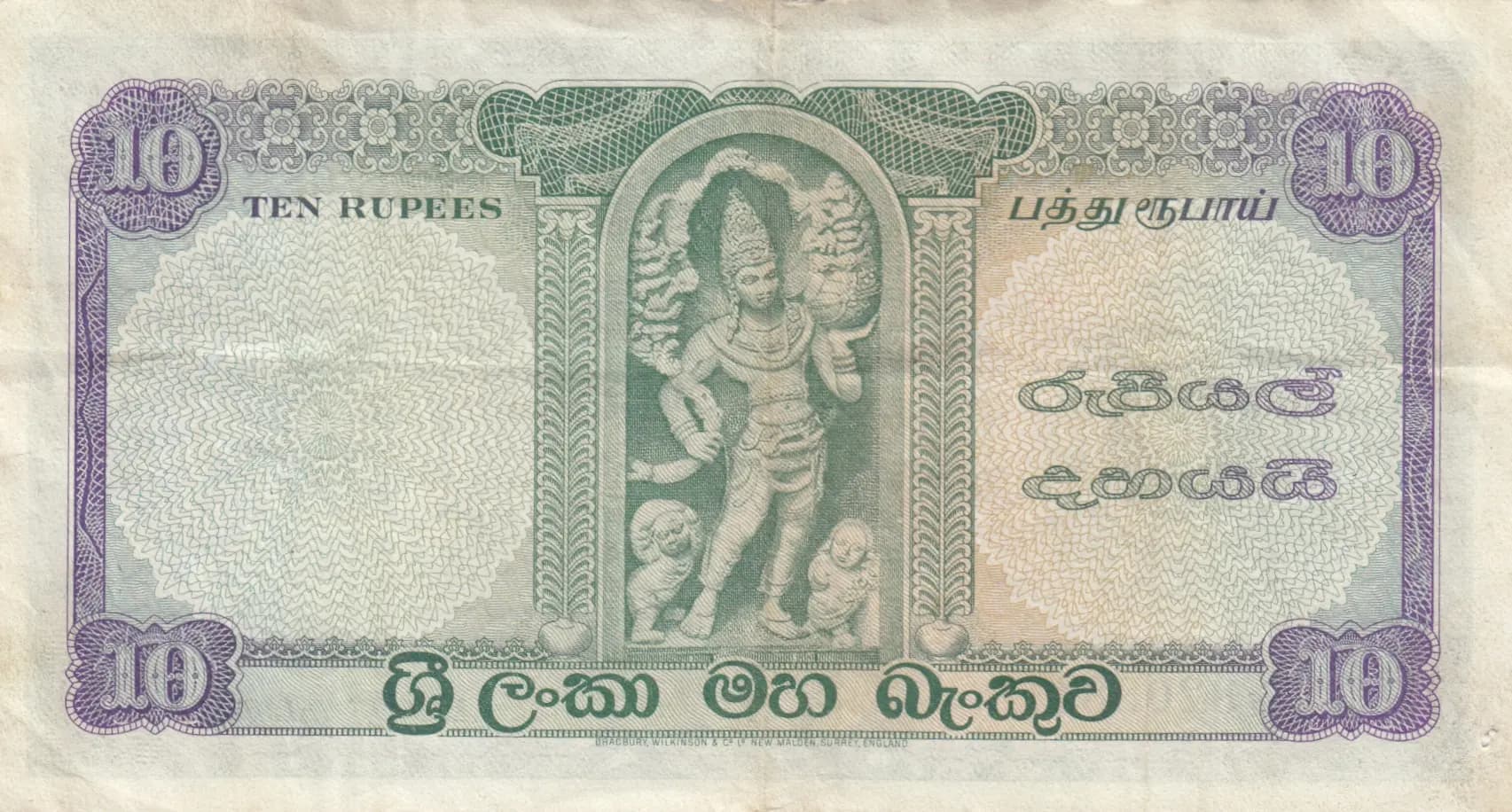
This 1959 Central Bank of Ceylon 10 rupees note (Pick 59a) presents a striking design centered on national heraldry and cultural heritage, featuring the Sri Lankan coat of arms with its characteristic lion rampant on the obverse and three carved historical heads in relief on the reverse. The note exhibits a predominantly green color palette with pink and purple ornamental accents, characteristic of Bradbury Wilkinson's refined engraving work from this mid-20th century period. In Fine condition, the note shows light aging and potential foxing in the center areas but remains free of major damage, making it a solid example of early post-independence Ceylon coinage.
Common. The 10 rupees denomination from the 1956-1963 series issued by the Central Bank of Ceylon was part of a standard circulation series during a stable economic period. Without specific evidence of a limited print run, early recall, or significant scarcity in numismatic market data, and given the note's straightforward design without special commemorative features, this Pick 59a should be classified as common. Fine condition examples remain readily available to collectors.
This note was issued during the early years of Ceylon's post-independence Central Bank, established in 1950, reflecting the nation's transition to monetary autonomy and national identity. The prominent display of the Sri Lankan coat of arms with the lion rampant symbolized the newly independent nation's sovereignty, while the carved stone heads depicted on the reverse likely represent important historical or cultural figures significant to Ceylonese heritage. The trilingual inscriptions in English, Sinhala, and Tamil underscore Ceylon's commitment to representing its multi-ethnic and multi-religious society during this formative constitutional period.
The obverse features the coat of arms of Sri Lanka—a lion rampant within a circular emblem positioned on the left side—accompanied by ornate heraldic crests with decorative floral elements in the center. The reverse displays three carved stone heads rendered in profile relief within a central rectangular panel, representing significant historical or cultural figures from Ceylon's heritage, surrounded by fine crosshatch patterns and decorative corner ornaments. Both sides employ elaborate guilloche borders and fine-line engraving work typical of Bradbury Wilkinson's security printing, with a unified color scheme of green, cream, and purple creating visual harmony across the denomination.
FRONT: '10' and 'TEN RUPEES' (English, denomination); 'ශ්රී ලංකා මහ බँකුව' (Sinhala: Central Bank of Sri Lanka); 'பத்து ரூபாய்' (Tamil: Ten Rupees); Serial number 'L 62 3208881'; Date '1958'. BACK: '10' and 'TEN RUPEES' (English, repeated in all four corners); 'ශ්රී ලංකා මහ බँකුව' (Sinhala: Central Bank of Sri Lanka); 'பத்து ரூபாய்' (Tamil: Ten Rupees).
Intaglio engraving, specifically line engraving and guilloche work executed by Bradbury Wilkinson, New Malden (a premier British security printer). The presence of intricate engraved patterns, fine line work throughout the design, and complex crosshatch/mesh background patterns are characteristic of traditional intaglio banknote production. The security features include fine guilloché patterning and the precision engraving evident in both the heraldic imagery and the relief-carved portrait heads.
This example is dated 1958 (printed in 1958 for issue in 1959 according to catalog listing), with serial number prefix 'L 62' visible. The catalog designation Pick 59a indicates this is the standard variety of the 10 rupees from this series. Varieties for this note may exist based on signature variations, different serial number prefixes, or minor design adjustments across the 1956-1963 issue period, but the visual specimen shows no unusual overprints or markings indicating a special variety.