10 rupees 1951
About This Note
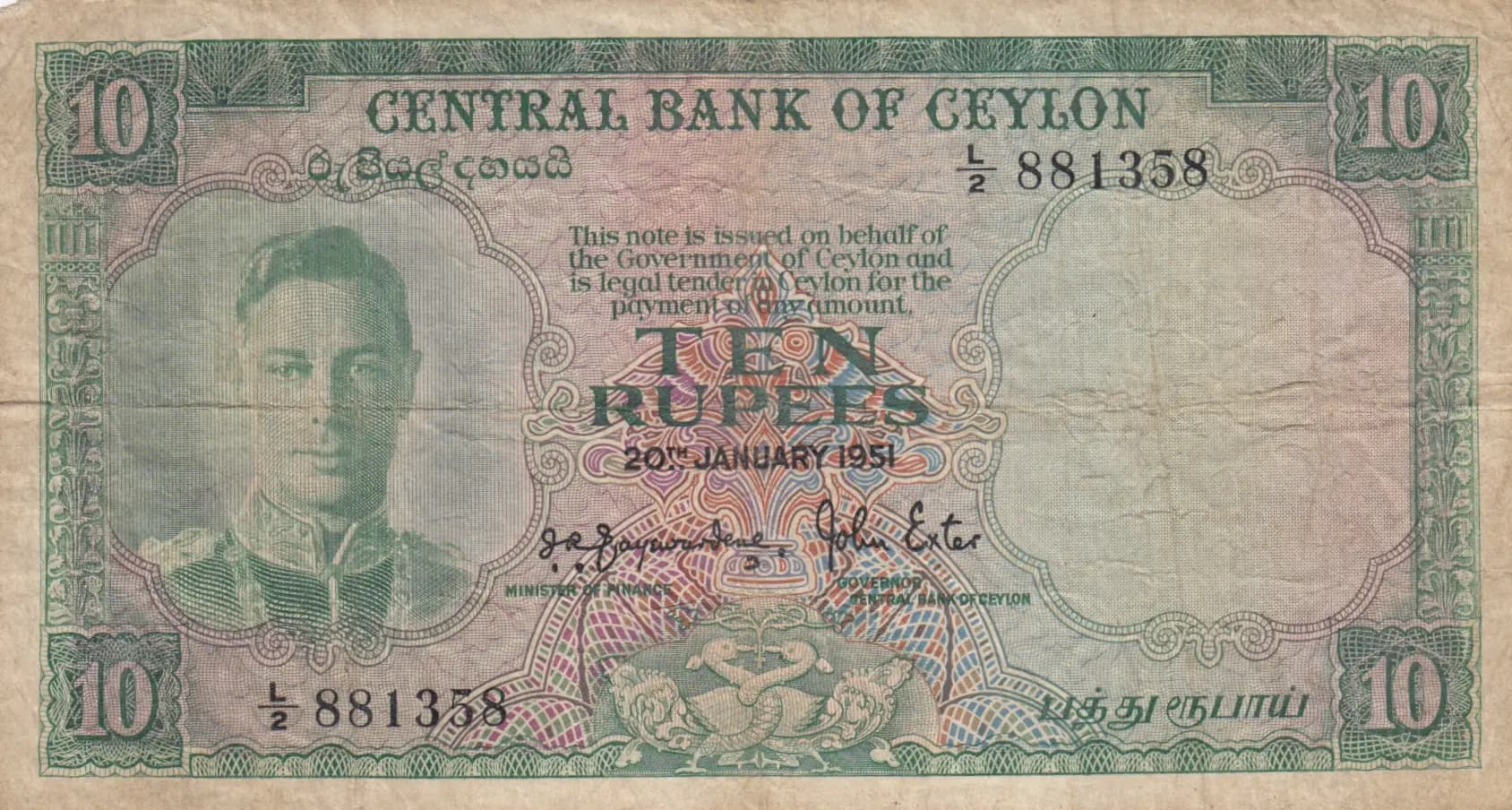
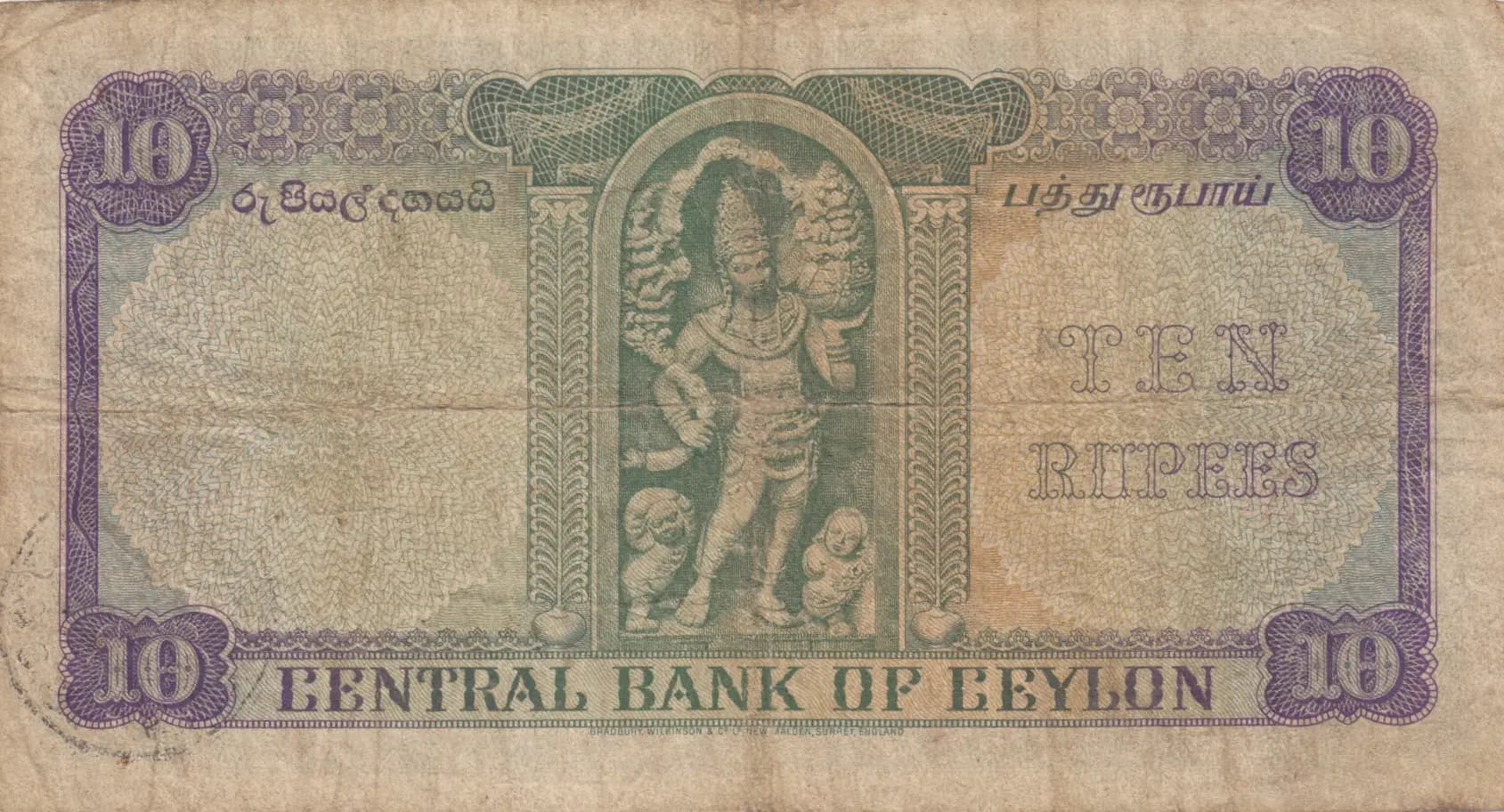
This is a Central Bank of Ceylon 10 Rupees banknote from January 20, 1951, representing one of the earliest issues following Ceylon's independence and transition to a sovereign central bank. The note features King George VI in military dress on the obverse, with classical sculptural reliefs on the reverse, printed by the prestigious Bradbury Wilkinson in fine engraved style. In Fair condition, it displays expected aging characteristics including creasing, foxing, and discoloration, but retains clear serial numbers and legible inscriptions, making it a historically significant example of Ceylon's formative currency period.
Common. The Central Bank of Ceylon's 1951 10 Rupees note (Pick P-48) was issued in substantial quantities as a foundational denomination for the newly established central bank's currency circulation. No historical evidence indicates restricted print runs, recalls, or short-lived issue periods that would make this note scarce. The observation of wear and circulation marks on this specimen reflects its widespread distribution and use in commerce. Fair condition examples of this denomination regularly appear in the secondary market at modest valuations, consistent with common-grade early Commonwealth currency from this period.
Issued on January 20, 1951, this note marks a pivotal moment in Ceylon's monetary history, as it was produced by the newly established Central Bank of Ceylon following the country's path toward independence and monetary sovereignty. The presence of King George VI in military uniform reflects Ceylon's continued Commonwealth ties during this transitional period, while the bilingual inscriptions in English and Sinhala (with Tamil on the reverse) demonstrate the note's role in a multilingual nation. The classical sculptural relief on the reverse exemplifies the artistic and cultural imagery Ceylon chose to represent its national identity during this formative era of the modern state.
The obverse features a formal portrait of King George VI positioned on the left side in full military dress uniform with medals and decorations, reflecting his status as Head of State for the Commonwealth nation of Ceylon. The center of the note is dominated by an ornate coat of arms of Ceylon—featuring the lion emblem—surrounded by elaborate decorative cartouches in purple/magenta and green with intricate floral and geometric patterns serving both aesthetic and security functions. The denomination and date are prominently overprinted diagonally across the center. The reverse presents a classical sculptural relief depicting three human figures in a carved architectural frame, flanked by ornamental borders in the classical style, with denomination numerals in all four corners. The overall palette of green, purple, pink/beige, and black creates a distinctive appearance characteristic of 1950s Commonwealth currency design.
FRONT SIDE: 'Central Bank of Ceylon' (English); 'ශ්රී ලංකාවේ' (Sinhala: 'Of Sri Lanka'); 'This note is issued on behalf of the Government of Ceylon and is legal tender in Ceylon for the payment of any amount' (English legal tender clause); 'TEN RUPEES' (English denomination); '20 JANUARY 1951' (Issue date); 'L/2 881358' (Serial number); 'MINISTER OF FINANCE' and 'GOVERNOR CENTRAL BANK OF CEYLON' (signature titles). BACK SIDE: 'Central Bank of Ceylon' (English); 'TEN RUPEES' (English denomination); 'පත්රධානය' (Sinhala: 'The Currency/Note'); 'பத்து ரூபாய்' (Tamil: 'Ten Rupees'); 'BRADBURY WILKINSON & CO LTD BANKNOTE PRINTERS SURREY ENGLAND' (Printer attribution).
This note was produced using fine line engraving, the hallmark security printing technique of Bradbury Wilkinson & Co Ltd of New Malden (Surrey), England—one of the world's premier banknote security printers. The engraved plates are evident in the fine detail work throughout the design, particularly in the classical relief on the reverse, the ornamental borders, and the portrait of King George VI. The multi-color printing with precise registration of green, purple, and black inks over the base stock demonstrates high-quality lithographic or intaglio printing typical of the firm's standards. The ornate decorative elements throughout serve dual purposes as both aesthetic design elements and anti-counterfeiting security measures inherent to the engraving technique.
The serial number visible on this specimen is L/2 881358, indicating a mid-range serial from the first series of 1951 issues. The 'L/2' prefix denotes the letter/number combination used for the initial production run. Varieties for this Pick number would be determined by serial number prefixes and ranges; no overprints or significant design varieties have been documented for this issue. The note bears no commemorative overprints or special markings beyond the standard 20 JANUARY 1951 date printed at issuance, making it a standard circulation type of the first printing.