10 cents 1942
About This Note
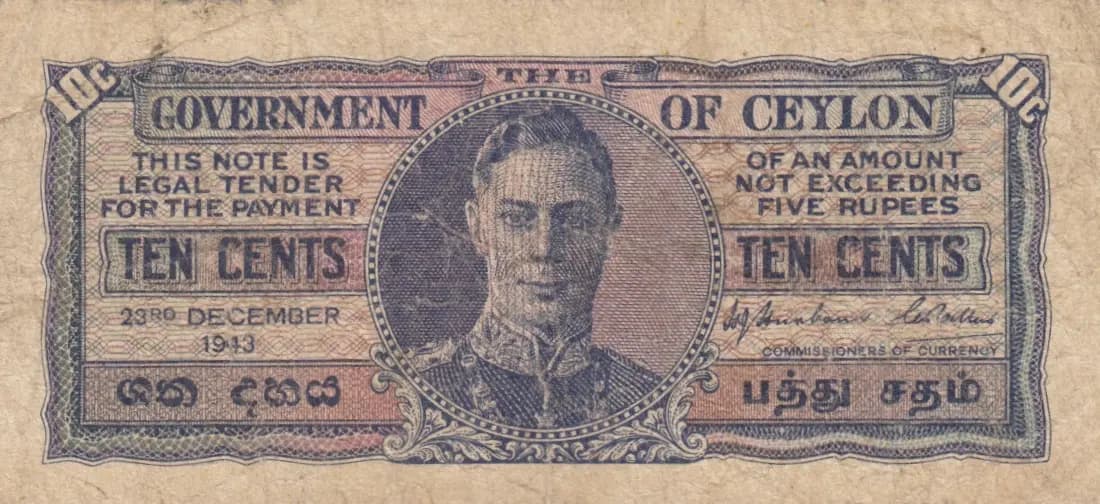
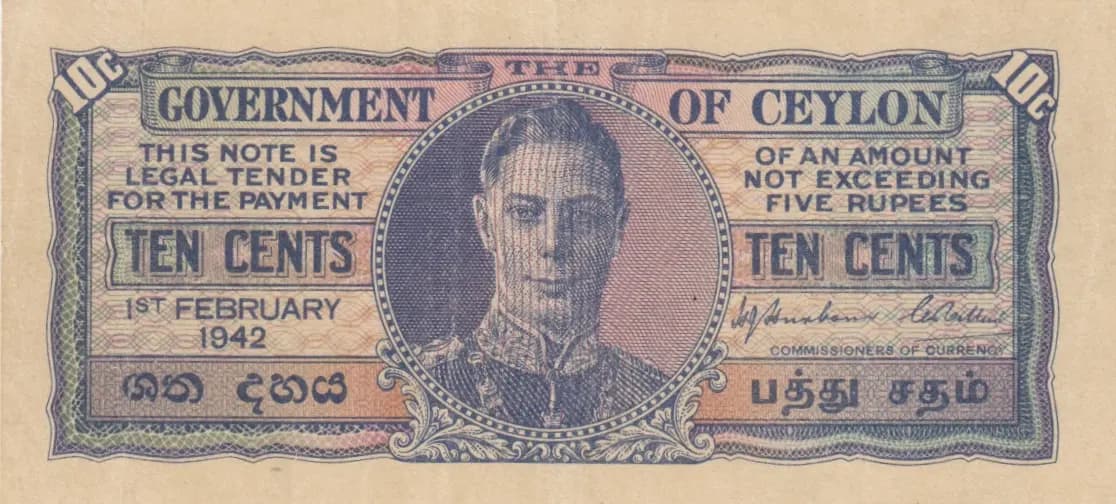
This is a Government of Ceylon 10 Cents note from 1942 (Pick P-43a) in Very Fine condition, featuring a striking portrait of King George VI in formal military dress within a circular vignette. The note displays excellent preservation with minimal wear, clear printing throughout, and the characteristic multicolored design (blue, purple, pink, and tan tones) typical of Ceylon's currency from this period. The trilingual inscriptions in English, Tamil, and Sinhala reflect Ceylon's linguistic diversity during the British colonial administration.
Common. The 10 Cents Government of Ceylon note from 1942 (Pick P-43a) was issued in substantial quantities as a fractional denomination for everyday commerce. No historical evidence suggests limited print runs, early recalls, or short-lived issuing authority status. These notes remain readily available in the collector market, particularly in mid-grade conditions, indicating widespread survival and relatively common status.
Issued on 1st February 1942 by the Government of Ceylon under British colonial administration, this note bears the portrait of King George VI, whose reign (1936-1952) spanned Ceylon's final years under British rule and transition to independence in 1948. The legal tender clause limiting redemption to 'an amount not exceeding five rupees' reflects the fractional currency system employed during this transitional period. The trilingual inscriptions underscore Ceylon's multicultural identity even as it moved toward self-governance.
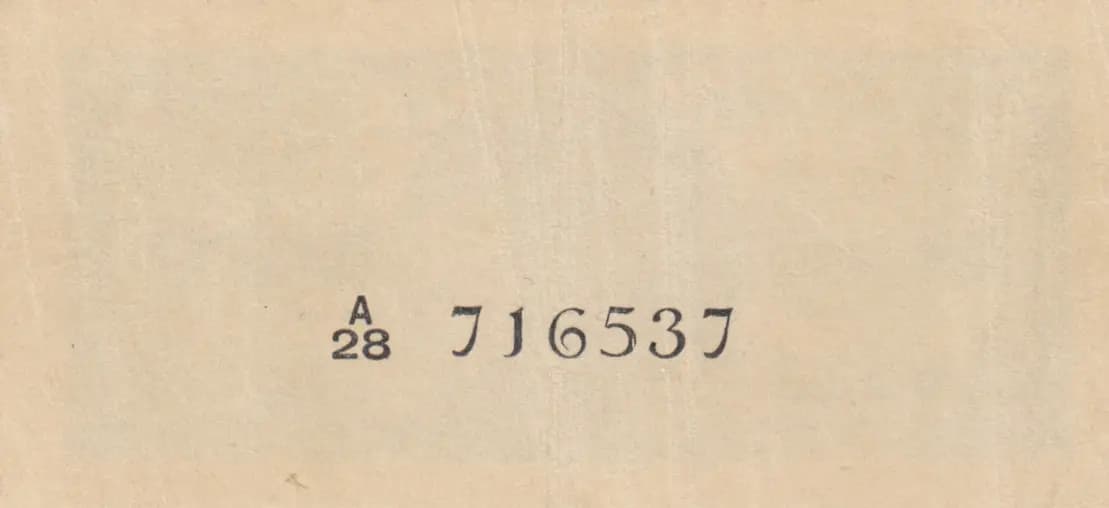
The obverse features a left-facing profile portrait of King George VI in formal military or official ceremonial dress, rendered in fine line engraving within a prominent circular vignette centered on the note. The portrait is surrounded by ornamental scrollwork and flourishes at the base of the circular frame. The denomination 'TEN CENTS' appears symmetrically on both the left and right margins in large text. A decorative border with ornamental patterns frames the perimeter of the note. The reverse is minimalist, displaying only the serial number 'A 28 J16537' on an otherwise plain cream-colored field. The overall color palette consists of blue, purple, pink/rose, and beige/tan tones, creating an elegant and distinctive appearance characteristic of Ceylon's mid-twentieth-century currency.
FRONT: 'THE GOVERNMENT OF CEYLON' (English); 'THIS NOTE IS LEGAL TENDER FOR THE PAYMENT OF AN AMOUNT NOT EXCEEDING FIVE RUPEES' (English); 'TEN CENTS' (English, appearing on both left and right sides); '1ST FEBRUARY 1942' (English, date of issue); 'COMMISSIONERS OF CURRENCY' (English); 'පැත්ත සතර' or similar (Sinhala denomination designation); 'பத்து சதம' (Tamil, meaning 'Ten Cents'). BACK: Serial number 'A 28 J16537' (alphanumeric designation).
Intaglio (recess) printing with fine line engraving, evidenced by the detailed line work visible throughout the portrait vignette, ornamental borders, and the precise definition of all design elements. The security printer for Ceylon currency during this period was typically De La Rue & Co., London, though specific printer identification would require examination of printer's marks not clearly visible in this analysis. The multi-color printing employs traditional intaglio techniques to produce the blue, purple, and pink tones.
This specific specimen is identified as Pick P-43a with the date '1ST FEBRUARY 1942' and serial number prefix 'A 28'. Varieties of this issue may exist based on serial number prefixes (indicating different printing batches), signature variants of the Commissioners of Currency, and the 1943 issue date variant (Pick P-43b). This particular example with the February 1942 date and 'A' series prefix represents the initial issue variety. The serial number 'A 28 J16537' is consistent with early printing runs of this denomination.