1 rupee 1951
About This Note
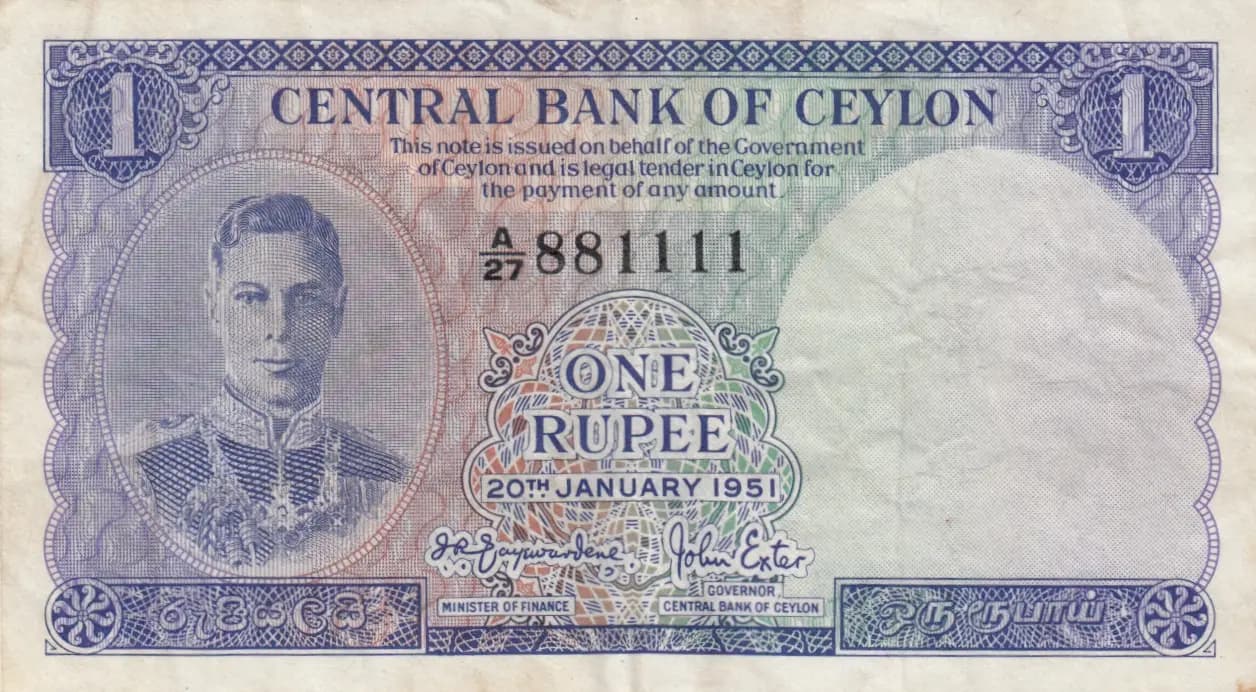
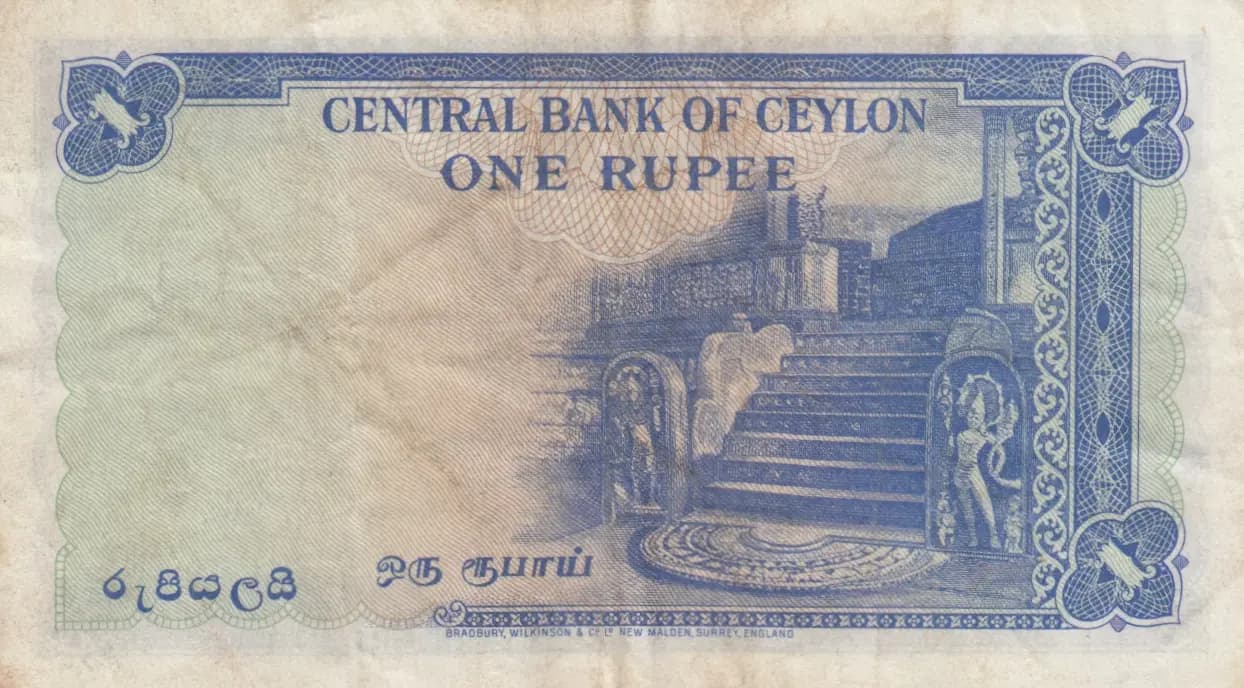
This is a Central Bank of Ceylon 1 Rupee note from January 20, 1951, graded VF, representing an early example of Ceylon's independent currency following the country's separation from British rule. The note features a striking portrait of a military officer in formal dress on the obverse and an ornate architectural scene on the reverse, with vibrant purple-blue coloring and intricate security printing by Bradbury Wilkinson. Despite showing expected age-related foxing and light discoloration consistent with its 1951 issue date and circulation history, the note retains clear impressions and vibrant colors, making it an attractive example of this important inaugural series.
Common. The 1 Rupee denomination from the Central Bank of Ceylon's 1951 inaugural series (Pick #47) was a high-circulation denomination produced in substantial quantities during Ceylon's early years of monetary independence. No documented print run restrictions, recall orders, or significant production variations have been recorded for this issue. VF condition examples remain readily available in the secondary market at modest valuations typical of early Commonwealth banknotes from this era.
Issued just months after Ceylon gained independence from British rule in February 1951, this 1 Rupee note represents the newly established Central Bank of Ceylon's assertion of monetary sovereignty. The portrait depicts a high-ranking military or governmental official of the post-independence era, reflecting Ceylon's transition to self-governance, while the ornate temple or significant architectural structure on the reverse emphasizes the nation's cultural heritage and historical significance during this pivotal moment of nation-building.
The obverse features a formal portrait of a high-ranking military officer wearing ceremonial dress uniform with decorated shoulder boards and medals, positioned on the left side of the note. The central design incorporates the denomination and issue date within an ornate circular emblem with elaborate guilloché work. The reverse displays a significant architectural landmark—likely a prominent temple or historic structure with distinctive steps, columns, and arches—rendered in fine line engraving and occupying the central focal point. Both sides feature elaborate decorative borders with geometric and floral patterns in all four corners, ornamental bands, and circular emblems. The color scheme employs purple, blue, pink-red, green, and white throughout, with careful tonal gradations achieved through cross-hatching and stippling to create depth and security against counterfeiting.
FRONT: 'Central Bank of Ceylon' (English header); 'One Rupee' (denomination); '20th January 1951' (issue date); 'This note is issued on behalf of the Government of Ceylon and is legal tender in Ceylon for the payment of any amount' (legal tender declaration); 'Minister of Finance' and 'Governor' (signature lines); Serial number format: A 001 prefix with sequential 27 881111. BACK: 'Central Bank of Ceylon' (header); 'One Rupee' (English denomination); 'ஒரு ரூபாய்' (Tamil: One Rupee); 'රු පයය' (Sinhala: One Rupee); 'Bradbury Wilkinson & C° Ltd. New Malden Surrey. England' (printer attribution).
Intaglio engraving (line engraving and steel plate engraving), combined with guilloché background patterns and complex microprint security features. Printed by Bradbury Wilkinson & Company Limited of New Malden, Surrey, England, a renowned security printer specializing in banknote production. The visible security elements include intricate geometric microprint patterns throughout the background, ornate guilloché borders, fine line engraving in the portrait and architectural details, and cross-hatching/stippled shading to prevent counterfeiting.
This specific example shows serial number prefix 'A' with sequential numbering (A 001 1111 and 27 881111), consistent with early production runs. The note is dated 20 January 1951, which is the official issue date for this series. No major varieties (such as signature variants, overprints, or printing errors) have been identified from the visual analysis. Standard varieties for this Pick number may include signature variations of the Governor and Minister of Finance, typical of banknote production spanning multiple print batches, but the specific signatories cannot be definitively read from the image resolution provided.