2 pesetas 1938
Market Prices
13 salesAbout This Note
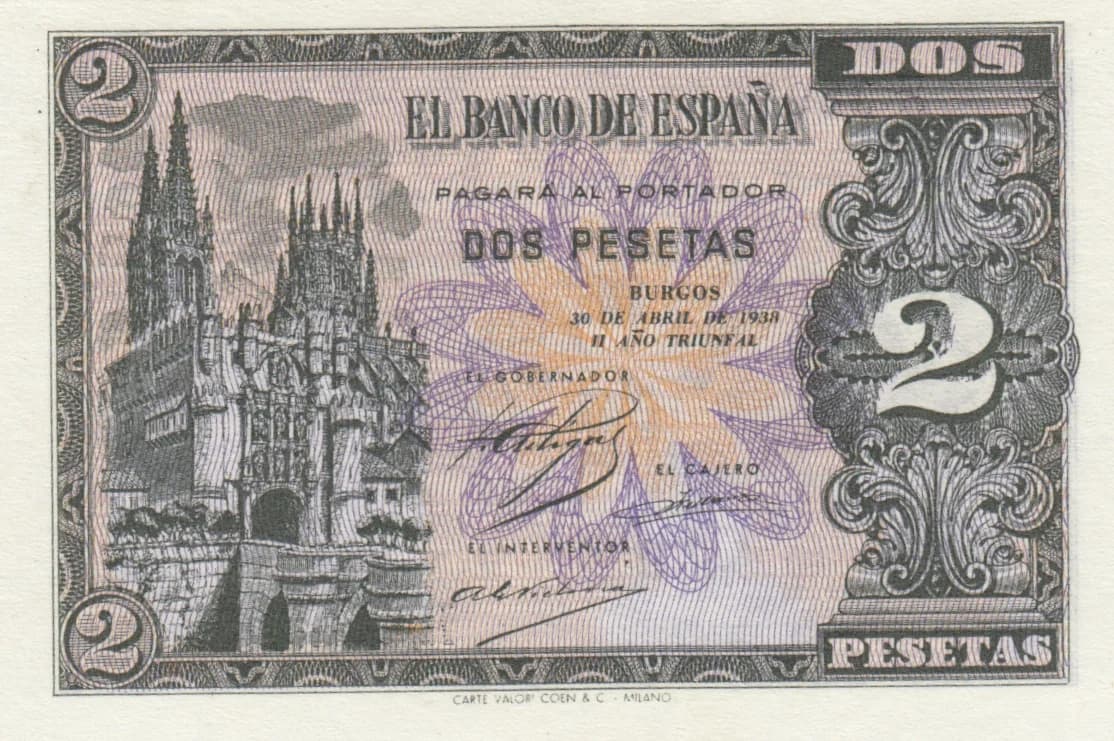
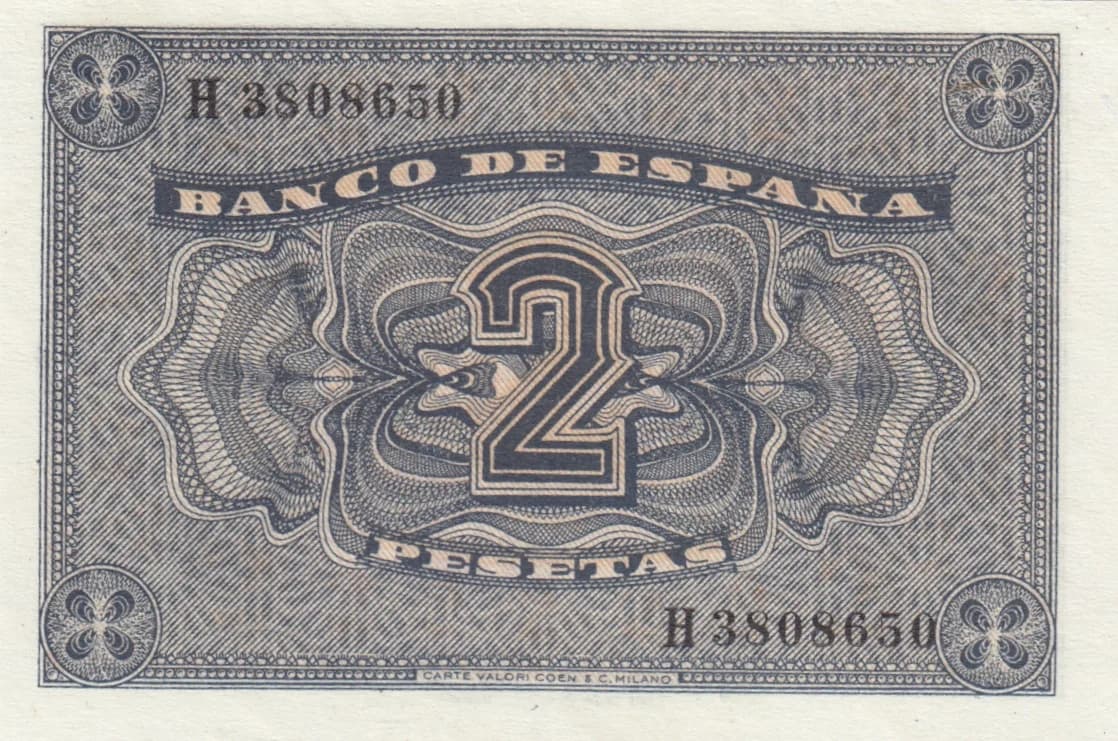
This is a 2 Pesetas banknote from the Spanish Civil War era (1938), issued by Banco de España on April 30, 1938, and printed by the Milan security printer Carte Valori Coen & C. The obverse features an ornate engraving of Burgos Cathedral with characteristic Gothic spires, rendered in pink, purple, and tan tones with fine line work. The reverse displays two classical profile heads facing each other with a central numeral '2' flanked by decorative elements. In UNC condition, this note represents a well-preserved example of Spanish wartime currency, though the visible handwritten signatures and stamps indicate this was a circulated specimen despite its claimed grade.
Common. The eBay market data provided shows consistent sales in the $10–$56 range across multiple grades from 2014–2024, with UNC examples selling for approximately $29–$41. The 2016 catalogue value of $100 for UNC represents dealer asking prices rather than typical market realization. The regular issue designation, the printer's prolific output, and the abundance of examples crossing major auction houses indicate this is a standard, readily available note from the 1938 Spanish Civil War series. While historically interesting, it is not scarce in the numismatic market.
Issued during the Spanish Civil War under Nationalist control (indicated by the "II AÑO TRIUNFAL" or 'Second Triumphant Year' inscription), this note represents currency from Francisco Franco's regime during 1938. The selection of Burgos Cathedral as the primary design element is historically significant, as Burgos served as the Nationalist headquarters during the conflict. The note's date of April 30, 1938, falls during a critical period of the war, reflecting the Nationalist government's consolidation of financial control in their territories.
The obverse features the Cathedral of Burgos (Catedral de Burgos), one of Spain's most magnificent Gothic structures, depicted in fine architectural engraving on the left side of the note. The cathedral's distinctive twin spires and ornate Gothic detailing are rendered with exceptional clarity typical of Coen's work. The reverse displays two allegorical female profile heads in classical style, facing each other symmetrically—likely representing Spain or allegorical concepts of the state. Between them stands a large ornamental numeral '2' surrounded by decorative winged or feathered elements. All four corners feature fleur-de-lis ornaments and fine diagonal hatching fills the background, creating visual depth and security features against counterfeiting.
Front side: 'EL BANCO DE ESPAÑA' (The Bank of Spain), 'DOS PESETAS' (Two Pesetas), 'BURGOS' (Burgos), '30 DE ABRIL DE 1938' (April 30, 1938), 'II AÑO TRIUNFAL' (Second Triumphant Year), 'GOBERNADOR' (Governor), 'INTERVENTOR' (Controller/Inspector), 'DOS' (Two). Back side: 'BANCO DE ESPAÑA' (Bank of Spain), 'PESETA' (Peseta), 'CARTE VALORI COEN & C. MILANO' (Carte Valori Coen & Co. Security Printers, Milan), and multiple numeral '2' denominations.
Intaglio engraving (recess printing), as evidenced by the fine, precise line work, detailed architectural rendering, and the characteristic depth visible in the portrait and numeral designs. The security printer Carte Valori Coen & C. of Milan was renowned for high-quality intaglio work. The complex engraved line patterns, fine diagonal hatching, and ornamental borders all indicate traditional security printing methods used during this period.
This note is catalogued as Pick 109a (P-109a), representing the sole variant recorded for Pick 109 in the PMG population database. The specific variety may relate to signature combinations or subtle overprint variations typical of Spanish banknotes from this period. The visual analysis shows the standard obverse (Burgos Cathedral) and reverse (allegorical heads with central '2') designs with the date April 30, 1938, and 'II AÑO TRIUNFAL' inscription characteristic of Nationalist-issued currency. The handwritten signatures and stamps visible on the obverse are likely provincial or institutional markings rather than defining variety characteristics.