1 peseta 1937
Market Prices
7 salesAbout This Note
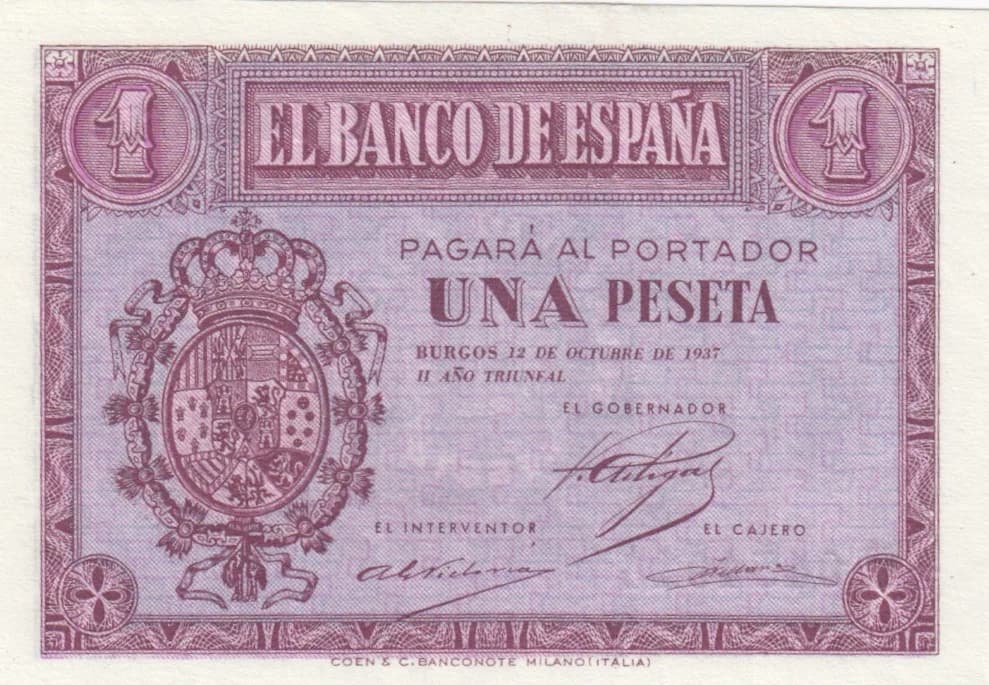
An exceptionally well-preserved example of the Spanish 1 peseta from October 12, 1937, issued by Banco de España during the Spanish Civil War under Nationalist control from Burgos. The note displays pristine uncirculated condition with vibrant purple and lavender coloring, featuring the Spanish royal coat of arms prominently displayed on the obverse and intricate geometric patterns on the reverse. This early Civil War-era currency represents an important transitional period in Spanish monetary history and remains highly collectible for its historical significance and artistic engraving quality by Coen & C. of Milan.
Common. While this is a historically significant Civil War-era note, the eBay market data shows consistent sales activity with multiple examples in various grades (UNC examples sold for $38-$157.50 across different years, 2016 catalog value UNC: $200). The catalog value of $200 and recurring sales at $30-$50 for UNC examples indicate healthy supply. This denomination and issue are not particularly scarce; common dates and serial numbers represent regular circulation during their issue period. The note is collectible for historical interest rather than extreme rarity.
This peseta was issued on October 12, 1937, marked as the 'II AÑO TRIUNFAL' (Second Triumphant Year), reflecting the Nationalist perspective during the Spanish Civil War when General Franco's forces controlled the Burgos region. The use of the Bourbon arms (depicted prominently on the obverse) symbolized the Nationalist regime's connection to Spanish monarchical tradition, contrasting with Republican currency of the same period. The issuing location of Burgos, rather than Madrid, underscores the geographic and political division of Spain during this conflict.
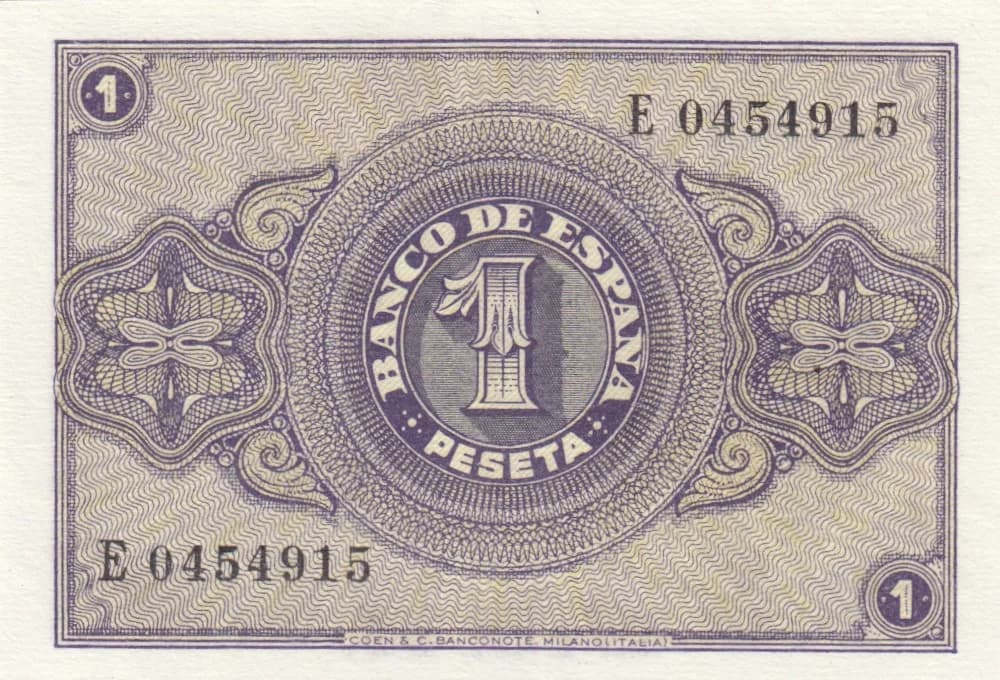
The obverse features the coat of arms of Spain as used by the Bourbon dynasty from 1761-1868 and 1874-1931, rendered in fine detail at center with ornamental crown and heraldic shield containing the various regional arms of Spain. The design is framed by intricate purple and magenta decorative borders with geometric corner elements and fine line work characteristic of high-quality engraving. The reverse displays a large circular ornamental medallion containing the numeral '1' within concentric geometric frames, surrounded by a complex pattern of wavy and parallel lines covering the entire background, creating a distinctive anti-counterfeiting visual effect. Four-lobed floral or geometric corner designs appear at each corner of both sides, with denomination numerals '1' in circular frames. The overall color palette of purple on lavender underprint provides strong visual distinction and elegance.
FRONT: 'EL BANCO DE ESPAÑA' (The Bank of Spain) - issuing institution; 'PAGARÁ AL PORTADOR' (Will pay to bearer) - standard bearer promise; 'UNA PESETA' (One peseta) - denomination; 'BURGOS 12 DE OCTUBRE DE 1937' (Burgos October 12, 1937) - issue location and date; 'II AÑO TRIUNFAL' (Second Triumphant Year) - Civil War era designation; 'EL GOBERNADOR' (The Governor), 'EL INTERVENTOR' (The Auditor/Inspector), 'EL CAJERO' (The Cashier) - signature lines; 'COEN & C. BANCONOTE MILANO(ITALIA)' (Coen & C. Banknote Milan Italy) - printer attribution. BACK: 'BANCO DE ESPAÑA' (Bank of Spain); '1 PESETA' (1 Peseta); 'E 0454915' (Serial number, appears twice); 'COEN & C. BANCONOTE MILANO(ITALIA)' (printer attribution).
Intaglio engraving (line engraving), the standard security printing method for banknotes of this era. The note was printed by Coen & C. Banconote of Milan, Italy, one of Europe's leading security printers during the interwar and World War II periods. The fine line work, intricate geometric patterns, and complex decorative borders visible throughout both sides demonstrate the precision capabilities of intaglio printing, which creates raised ink deposits that produce distinctive tactile and visual security features difficult to counterfeit with period printing technology.
Serial number E 0454915 is visible on this example. Varieties for this Pick-104 issue primarily relate to signature combinations of the three authorized signatories (Governor, Auditor/Inspector, and Cashier), though detailed signature variety catalogs for this specific date are limited in English-language numismatic literature. No overprints or special markings are evident on this example. The consistent use of the Burgos issue location across the entire series distinguishes these from any potential Madrid issues or later reissues.