1 rand 1966
Market Prices
13 salesAbout This Note
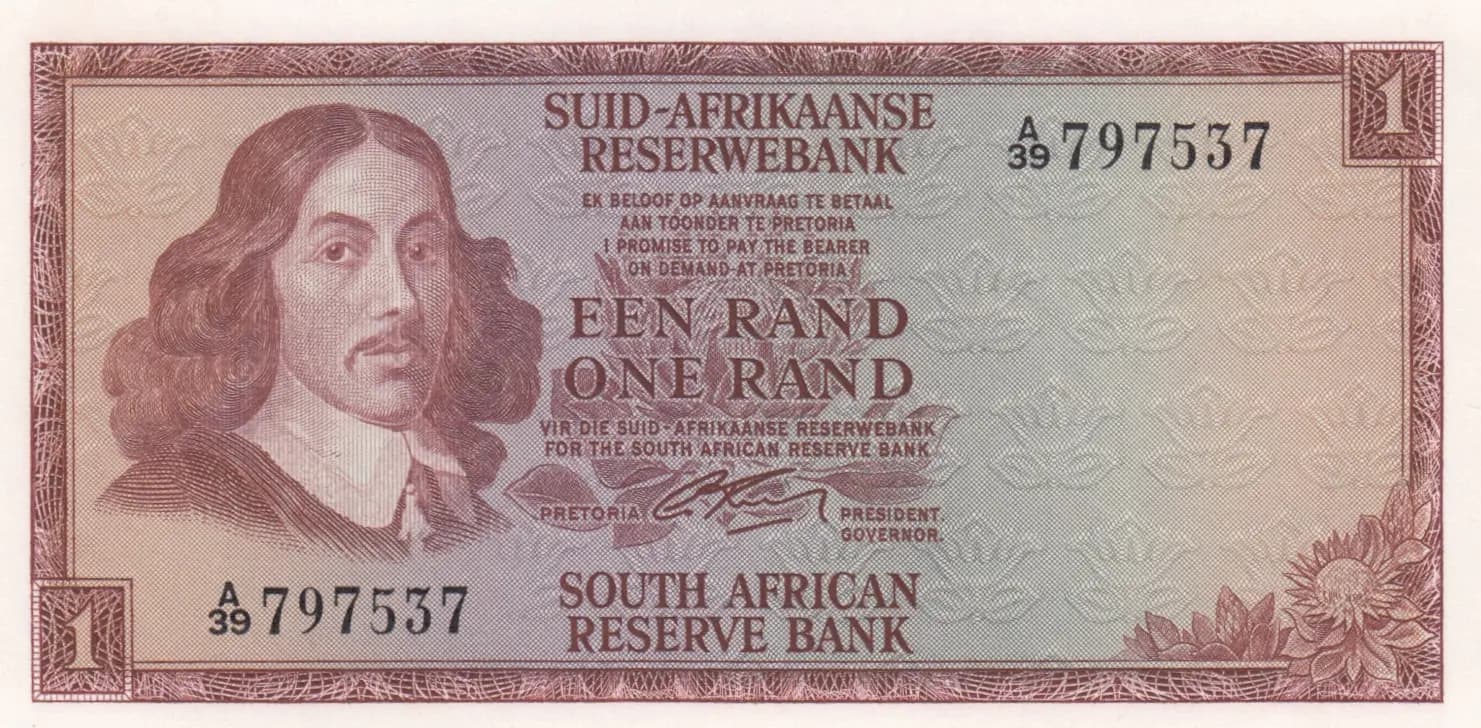
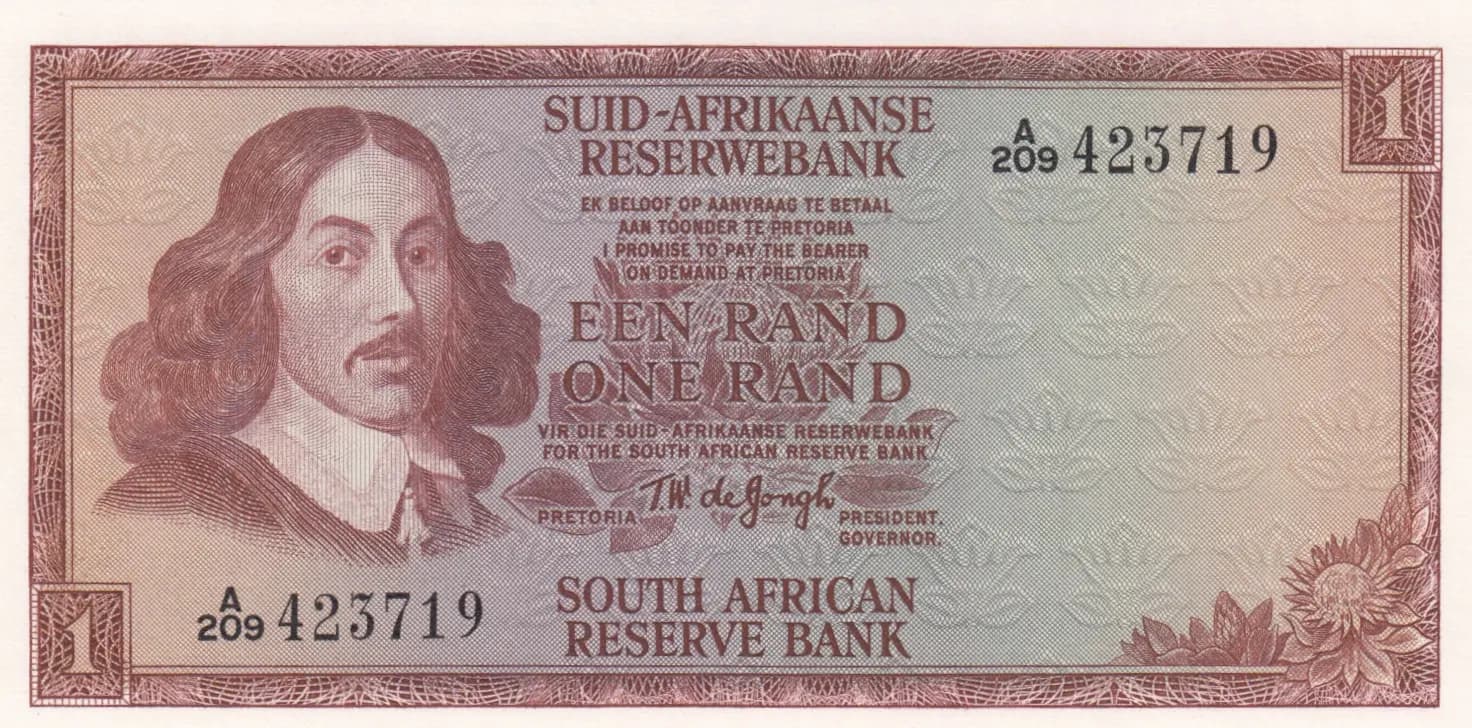
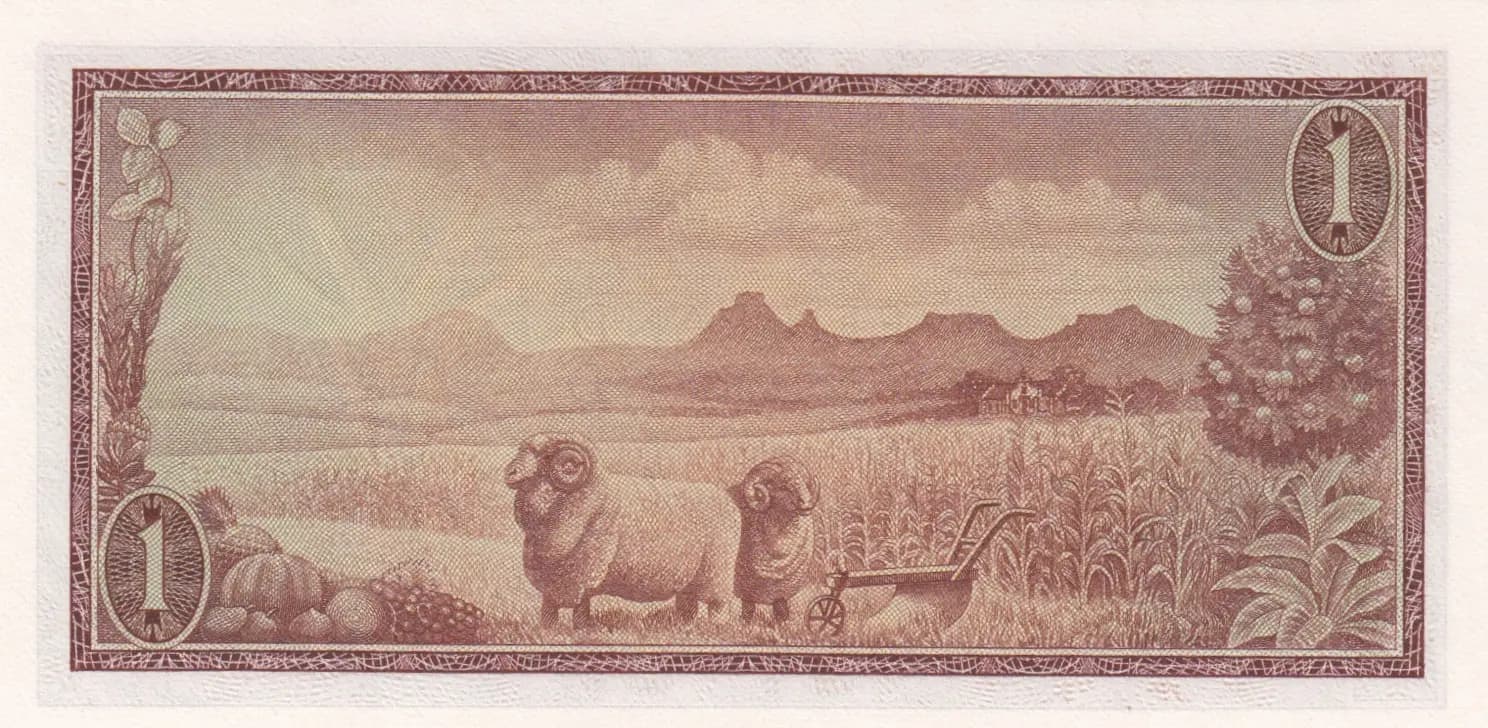
A pristine, uncirculated example of South Africa's first decimal currency issue from 1966, featuring the historical portrait of Bartholomeus Vermuyden (long misidentified as Jan van Riebeeck) on the obverse and a pastoral landscape with agricultural workers on the reverse. This bilingual Afrikaans-first variant (P-110b) displays exceptional preservation with no visible wear, creases, or damage, and showcases the fine line engraving technique characteristic of South African Reserve Bank notes from this era.
Common. This note is widely available in the collector market, with eBay transaction data showing regular sales across multiple condition grades (F, VF, EF, AUNC, UNC) at modest prices ranging from $1.52 to $8.00 between 2012 and 2020. The 2019 catalogue valuation of $3 UNC confirms typical pricing for the grade. Large print runs during the 1966-1972 issuance period and the absence of documented scarcity or recall conditions support a common classification. UNC examples, while more desirable than circulated specimens, remain readily obtainable and moderately priced.
Issued in 1966-1967 following South Africa's transition to decimal currency, this 1 Rand note represents the early years of the post-colonial South African Reserve Bank's independent monetary authority. The obverse portrait depicts a 17th-century Dutch settler figure, reflecting the note's connection to South Africa's colonial Dutch heritage, while the reverse pastoral landscape with agricultural workers symbolizes the nation's economic foundation in farming and pastoral industries during the mid-twentieth century.
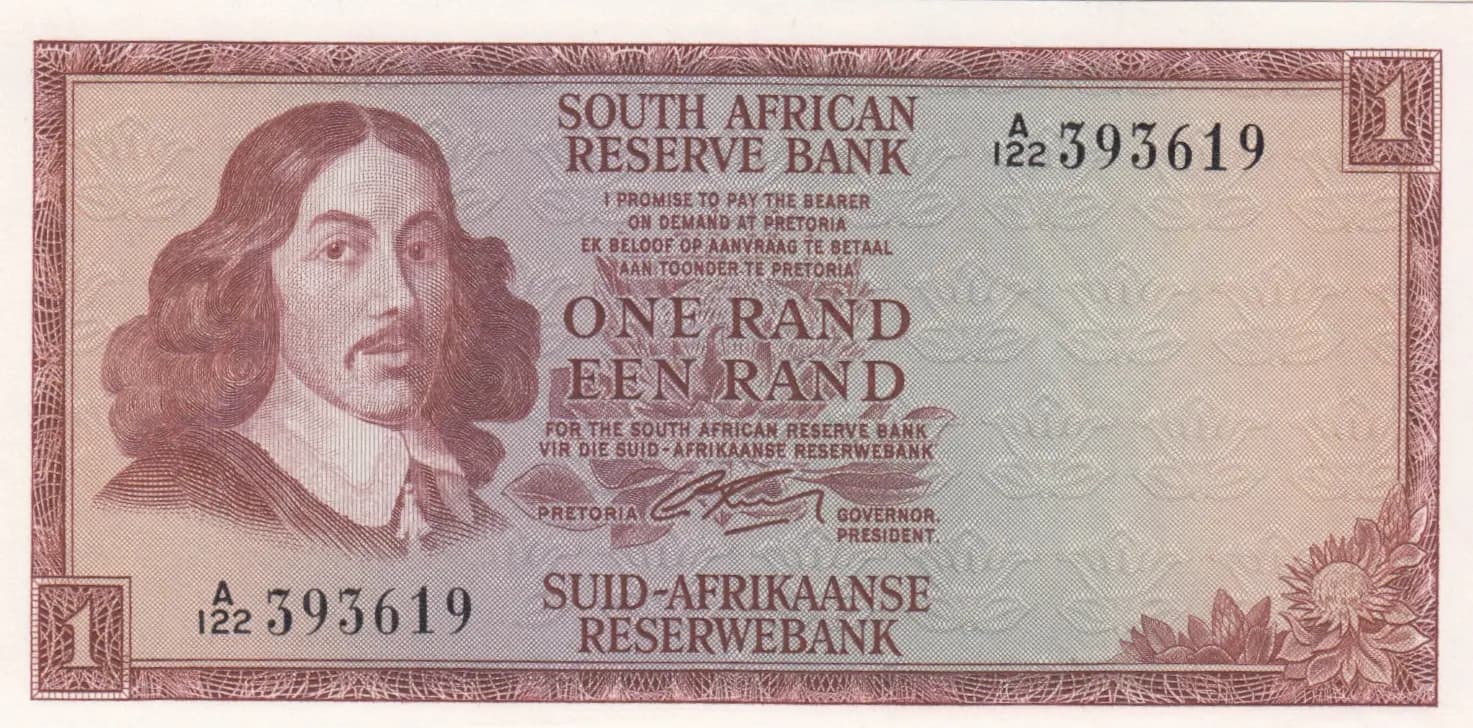
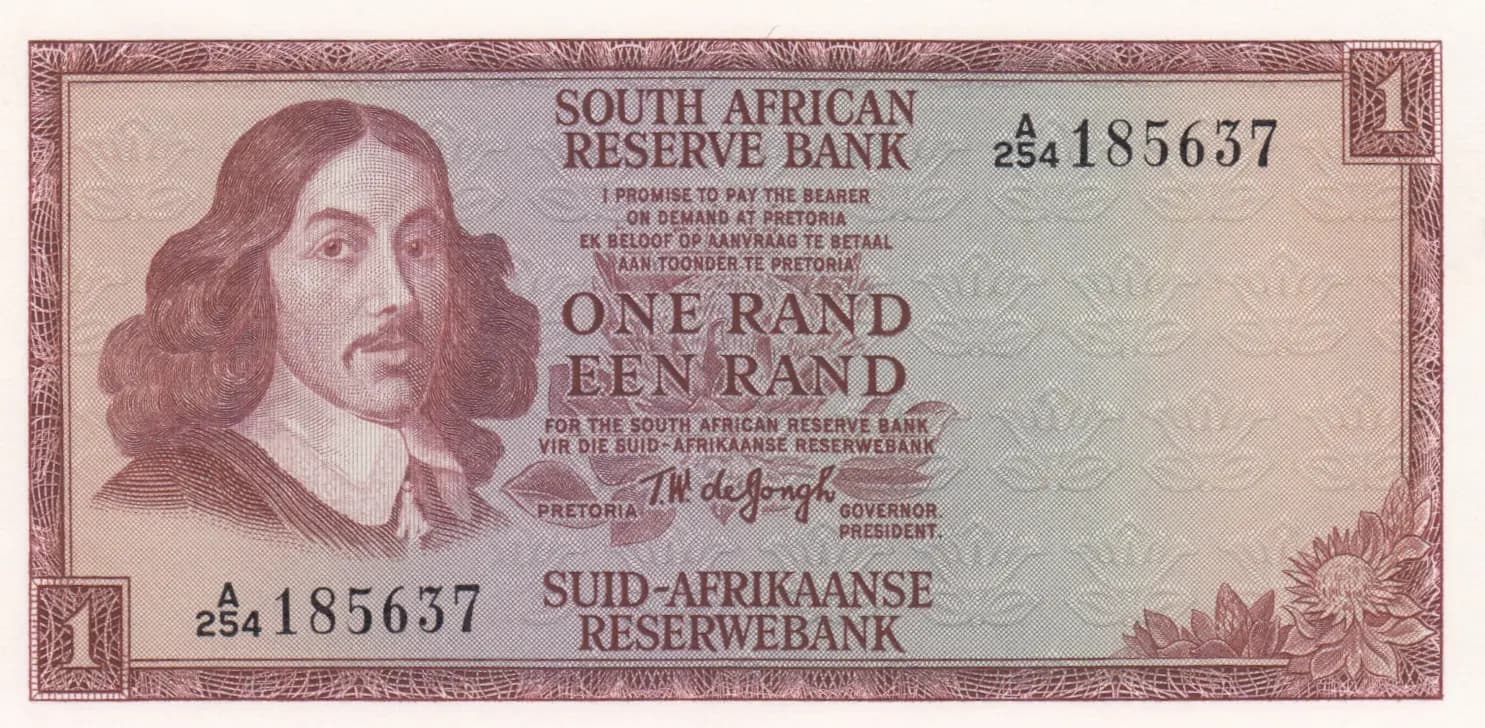
The obverse features a left-facing profile portrait of Bartholomeus Vermuyden, a 17th-century Dutch settler, rendered with fine engraving detail showing characteristic wavy, shoulder-length hair and period clothing. The portrait is positioned at left with institutional text and value declarations distributed across the center and right portions of the note. Ornamental corner designs appear in rectangular frames with sunflower motifs in the lower right. The reverse depicts a rural pastoral scene with two figures engaged in agricultural labor, mountains in the distant background, and vegetation including trees on the right side. Large oval-framed denomination numerals '1' appear in the upper right and lower left corners. The entire design employs the bilingual Afrikaans-first layout characteristic of P-110b, distinguishing it from the English-first P-109 variant.
Front Side: 'SUID-AFRIKAANSE RESERWEBANK' (South African Reserve Bank in Afrikaans) / 'EEN RAND' (One Rand in Afrikaans) / 'ONE RAND' (One Rand in English) / 'EK BELOOF OP AANVRAAG TE BETAAL AAN TOONDER TE PRETORIA' / 'I PROMISE AT THE REQUEST OF THE BEARER UNDERTAKING AT PRETORIA' (Promise text in Afrikaans and English) / 'VIR DIE SUID-AFRIKAANSE RESERWEBANK' / 'FOR THE SOUTH AFRICAN RESERVE BANK' (Authority attribution in Afrikaans and English) / 'PRETORIA' (Issuing city) / 'PRESIDENT' / 'GOVERNOR' (Officer titles) / 'SOUTH AFRICAN RESERVE BANK' (English issuer name) / Signature: 'TH de Jongh' (Governor's signature) / Serial Number: 'A 209 4237119' (Individual note identifier). Back Side: '1' (Denomination indicator in corner ovals). All text appears in bilingual format (Afrikaans-first variant) throughout.
Intaglio engraving (line engraving) is evident throughout both sides, with fine line patterns visible in the background, borders, and portrait rendering. The detailed scenic engraving on the reverse and intricate border designs on the obverse demonstrate high-quality security engraving typical of South African Reserve Bank currency production. The precision of the decorative corner ornaments and sunflower design indicates professional central bank-level printing standards characteristic of this era's currency security practices.
This note is identified as Pick P-110b, the Afrikaans-first variant (with 'SUID-AFRIKAANSE RESERWEBANK' and 'EEN RAND' appearing in the primary position on the obverse). The companion variant P-109 displays English-first text. The serial number prefix 'A' observed on this specimen indicates a standard issue note; replacement notes from this series carry prefixes Z/1, Y/1, X/1, or W/1. The watermark is a Springbok, standard for this series. The signature 'TH de Jongh' identifies this note within a specific issuing authority period, though multiple signatures exist across the 1966-1972 range.