1 rand 1966
Market Prices
6 salesAbout This Note
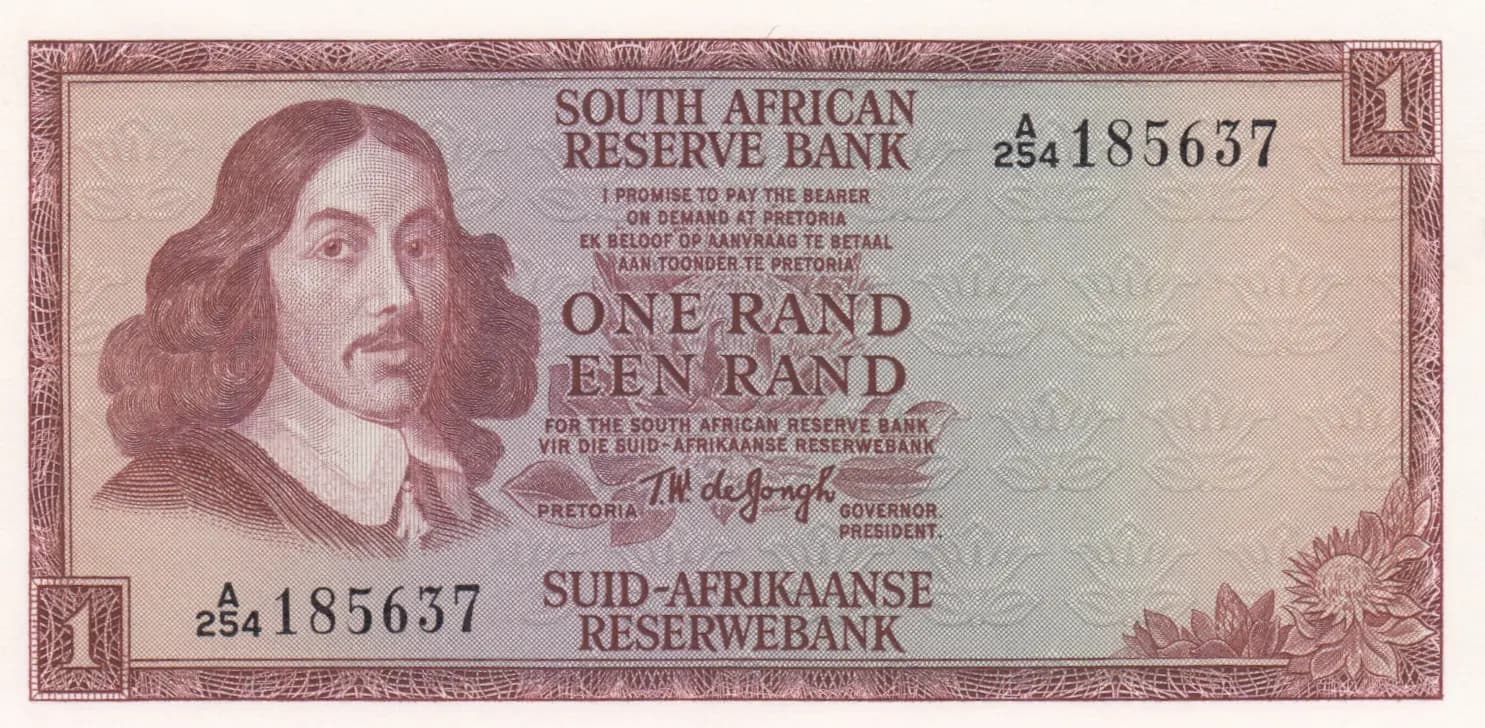
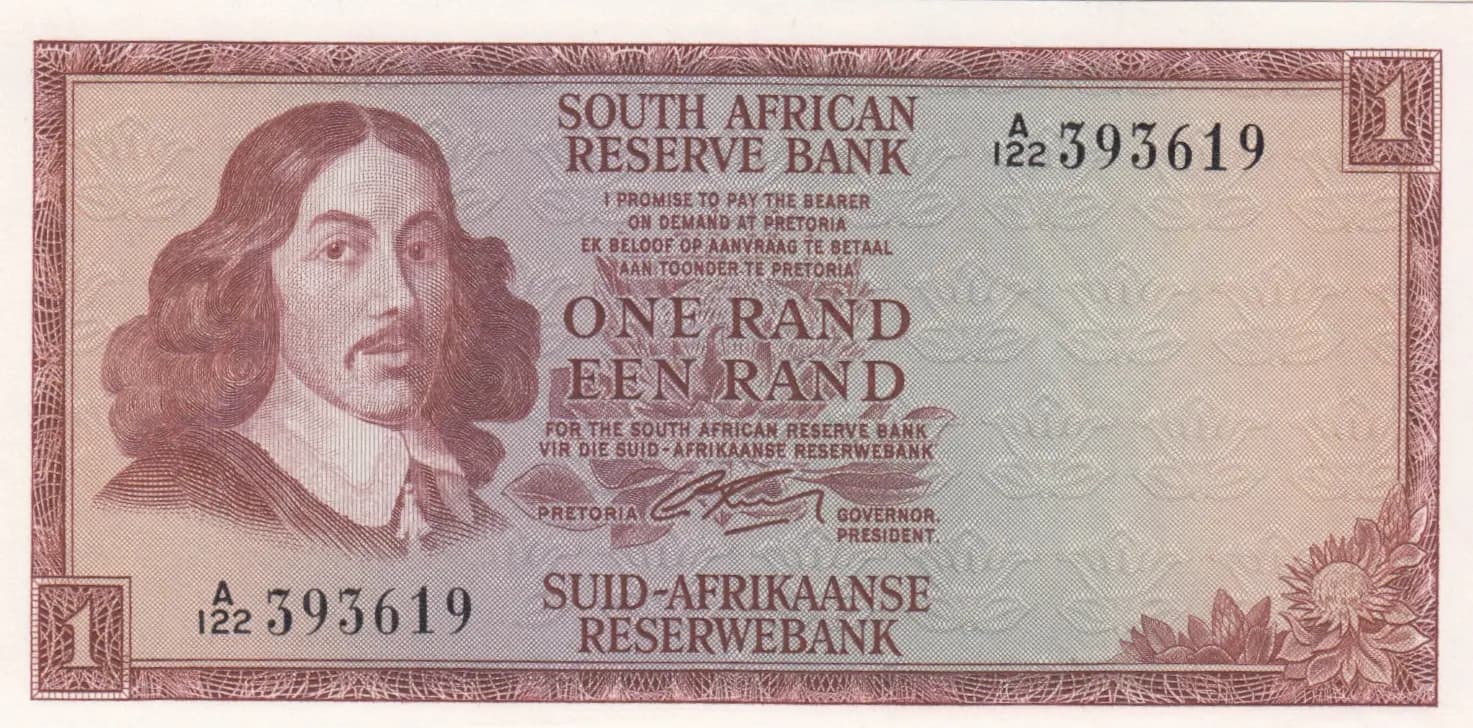
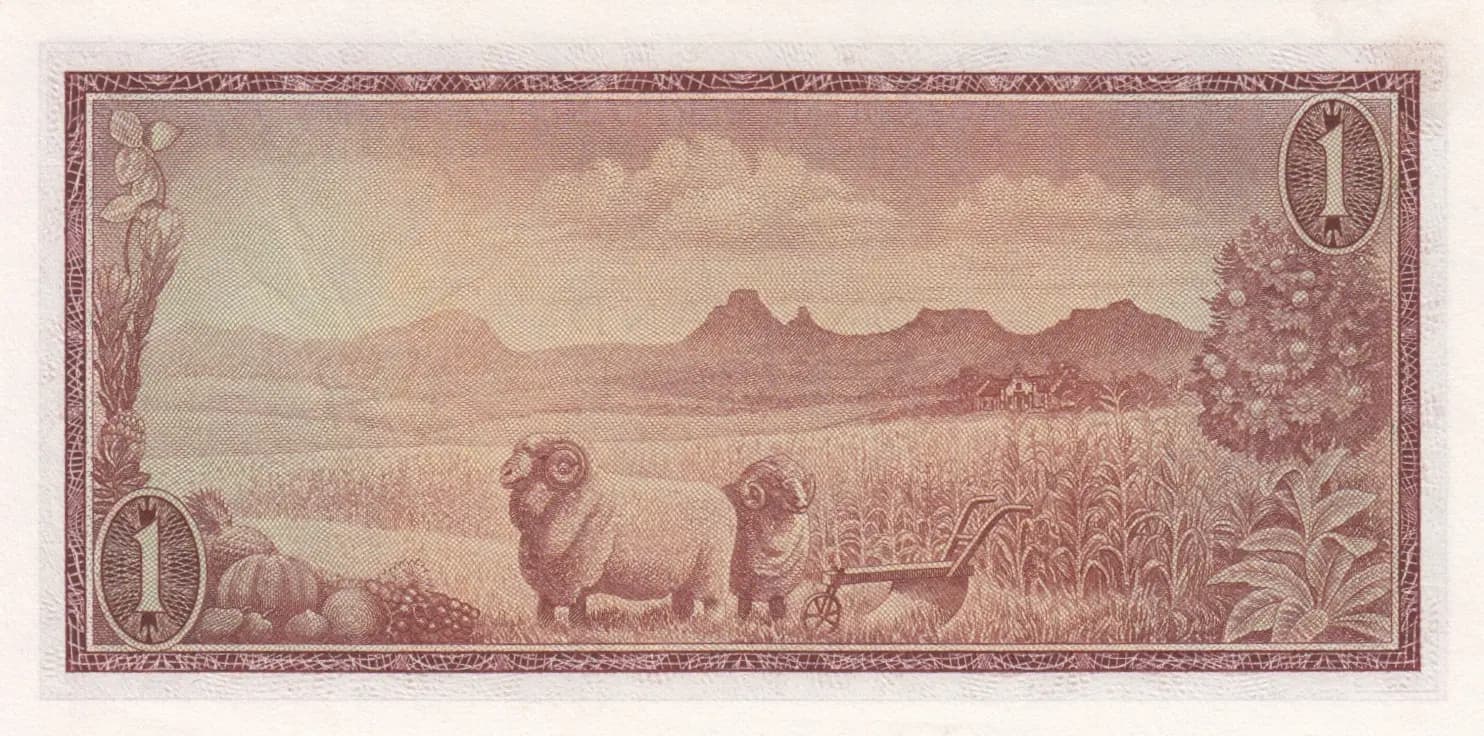
This is an uncirculated example of South Africa's first decimal currency 1 Rand note from 1966, featuring the iconic portrait of Jan van Riebeeck (the founder of the Cape Colony) on the obverse in rich reddish-brown tones. The reverse depicts a pastoral scene with sheep in an agricultural landscape, exemplifying the nation's pastoral heritage. In UNC condition with crisp, clear engraving throughout and no visible wear, this note represents the beginning of South Africa's modern numismatic era and commands modest collector interest.
Common. This note is a regular issue of the first decimal rand series with substantial print runs (1966-1972 date range covers multiple years of production). Contemporary eBay market data shows UNC examples selling in the $4 range, with even PMG-graded examples (PMG 67) at $31 representing the high end. The catalog valuation of $4 for UNC condition further confirms this is a commonly encountered note in the collector market. Serial number prefix 'A' is a standard issue variety, not a scarce replacement note prefix (Z/1, Y/1, X/1, W/1 carry premiums).
Issued in 1966 following South Africa's adoption of the decimal rand currency system, this note commemorates Jan van Riebeeck, the 17th-century Dutch East India Company official who established the Cape Colony in 1652. The reverse's agricultural imagery—featuring sheep and cultivated fields—reflects the economic foundations of mid-20th century South Africa during the apartheid era. The bilingual English-Afrikaans text reflects the official languages of the period's government.
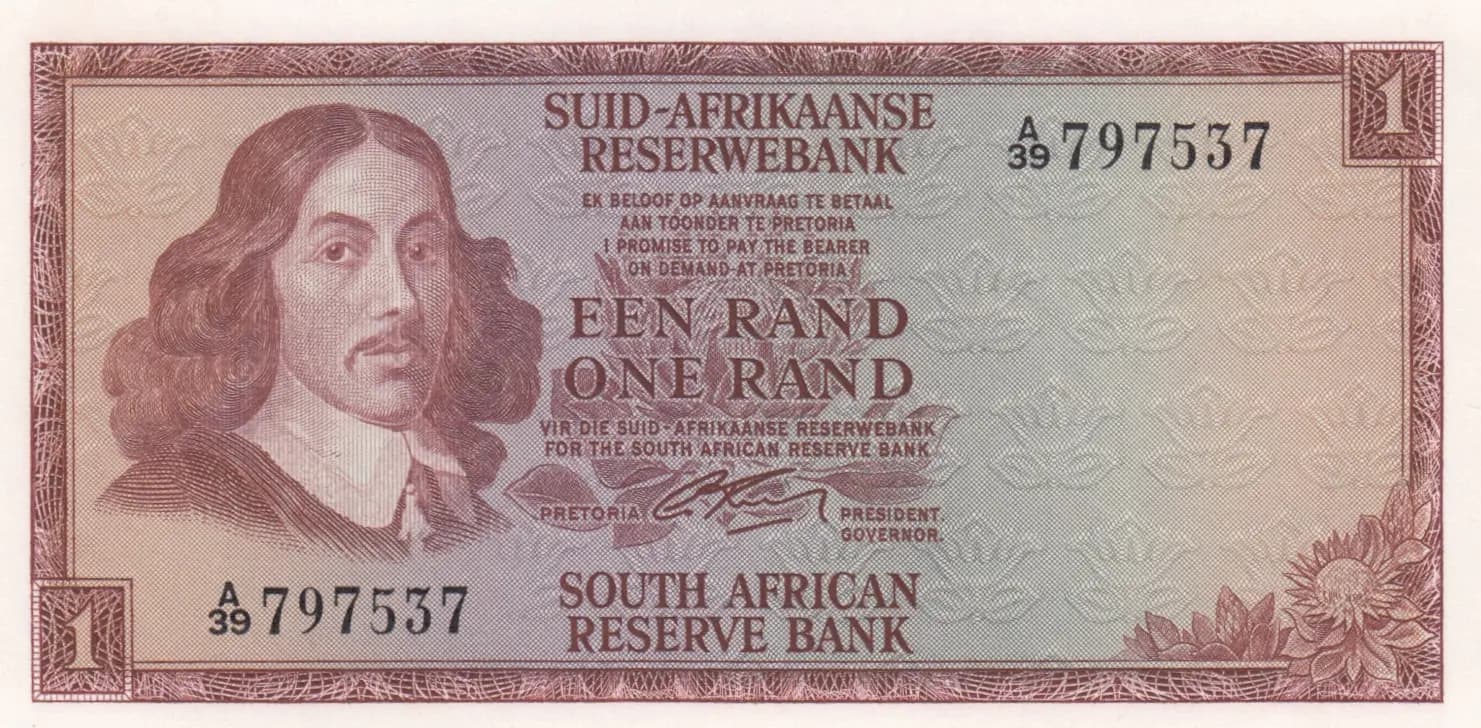
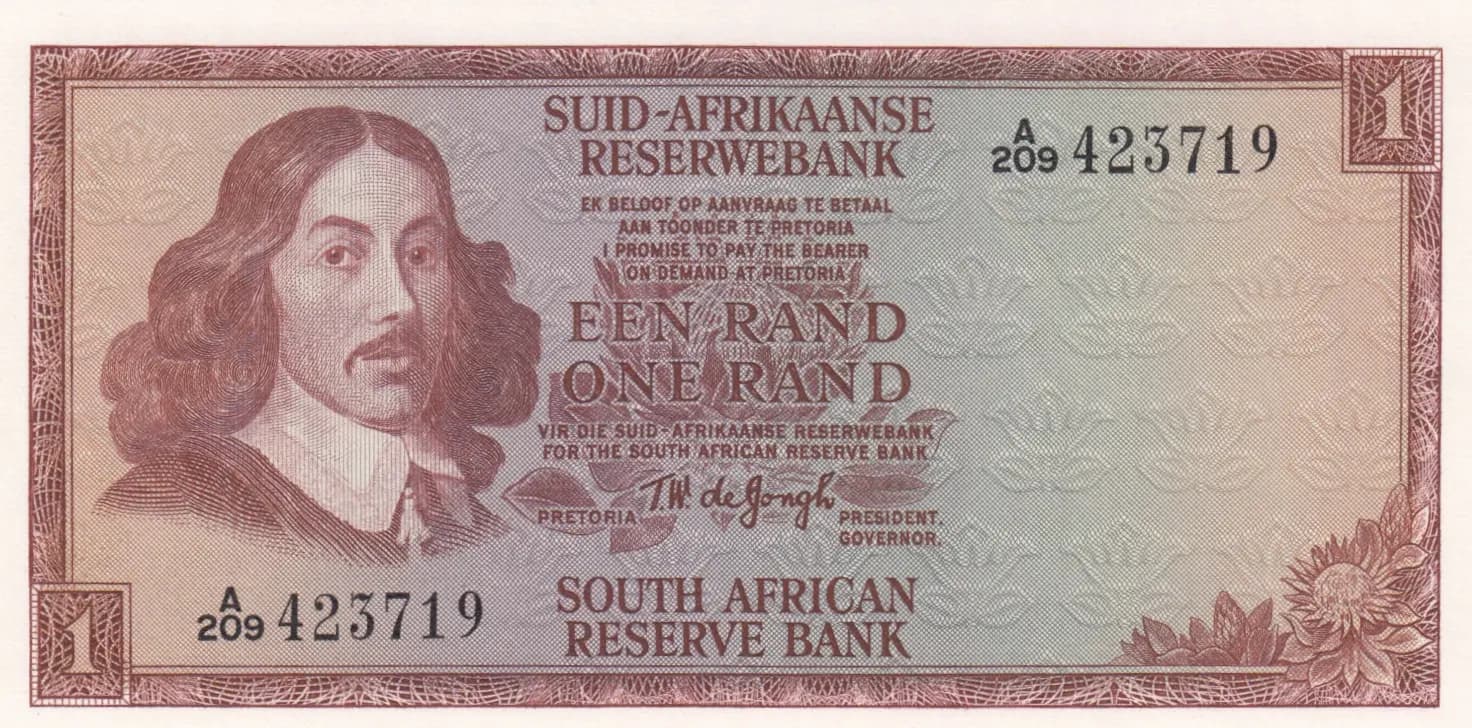
The obverse features a three-quarter portrait of Jan van Riebeeck (1618-1677) positioned at the left, rendered in profile facing right, showing the historical figure with characteristic period dress and collar. The portrait is surrounded by an ornamental rectangular border with fine decorative corner elements. The denomination and issuer name appear in bilingual format (English primary, Afrikaans secondary as indicated by Pick P-109a variant designation). The reverse depicts a pastoral agricultural scene representing the Cape Colony's economic heritage, with two rams or sheep positioned centrally in a cultivated field, flanked by indigenous South African flora including aloe plants on the left and additional vegetation on the right, with mountains visible in the background. Denomination numerals '1' appear in circular corner frames. A springbok watermark is present throughout.
FRONT: 'SOUTH AFRICAN RESERVE BANK' / 'ONE RAND' (English) and 'EEN RAND' (Afrikaans); 'I PROMISE TO PAY THE BEARER ON DEMAND AT PRETORIA' (English) / 'EK BELOOF AAN INHANGER TE BETAAL AAN TOONDER TE PRETORIA' (Afrikaans); 'FOR THE SOUTH AFRICAN RESERVE BANK' (English) / 'VIA DIE SUID-AFRIKAANSE RESERWEBANK' (Afrikaans); 'GOVERNOR PRESIDENT'; 'PRETORIA'. BACK: Numeral '1' appears in circular frames at upper right and lower left corners. No text inscriptions on reverse.
Steel engraving on multicolor intaglio press, typical of Reserve Bank currency production in the 1960s. The fine line engraving visible throughout both obverse and reverse, combined with the sharp detail definition in the portrait and landscape elements, indicates traditional currency-grade intaglio printing. The crisp, well-defined impressions suggest printing by one of the major international currency printers serving the South African Reserve Bank during this period, likely Bradbury, Wilkinson & Co. or De La Rue, who were primary suppliers to SARB.
This note is cataloged as P-109a, specifically identified by the English-language first line of the bank name and denomination value. The variant P-109b features Afrikaans as the primary language on the first line. Both variants share identical design elements and the springbok watermark. The serial number 'A 122 3953619' represents a standard-issue note; replacement notes are identified by the prefixes Z/1, Y/1, X/1, or W/1 and command a modest premium. No signatures, overprints, or other security features distinguishing this specific specimen are visible beyond standard production characteristics.