5 pounds 1981
Market Prices
11 salesAbout This Note
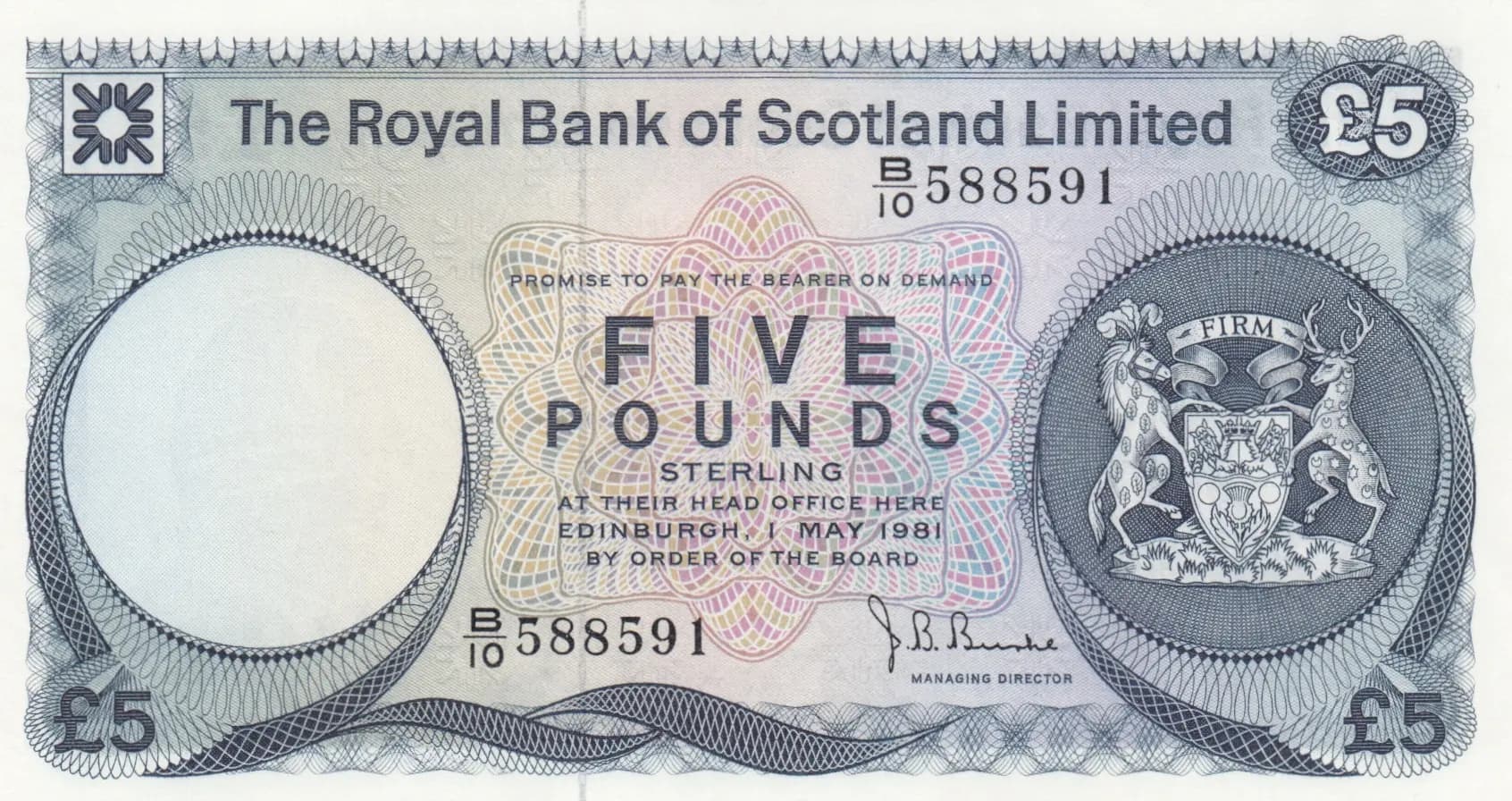
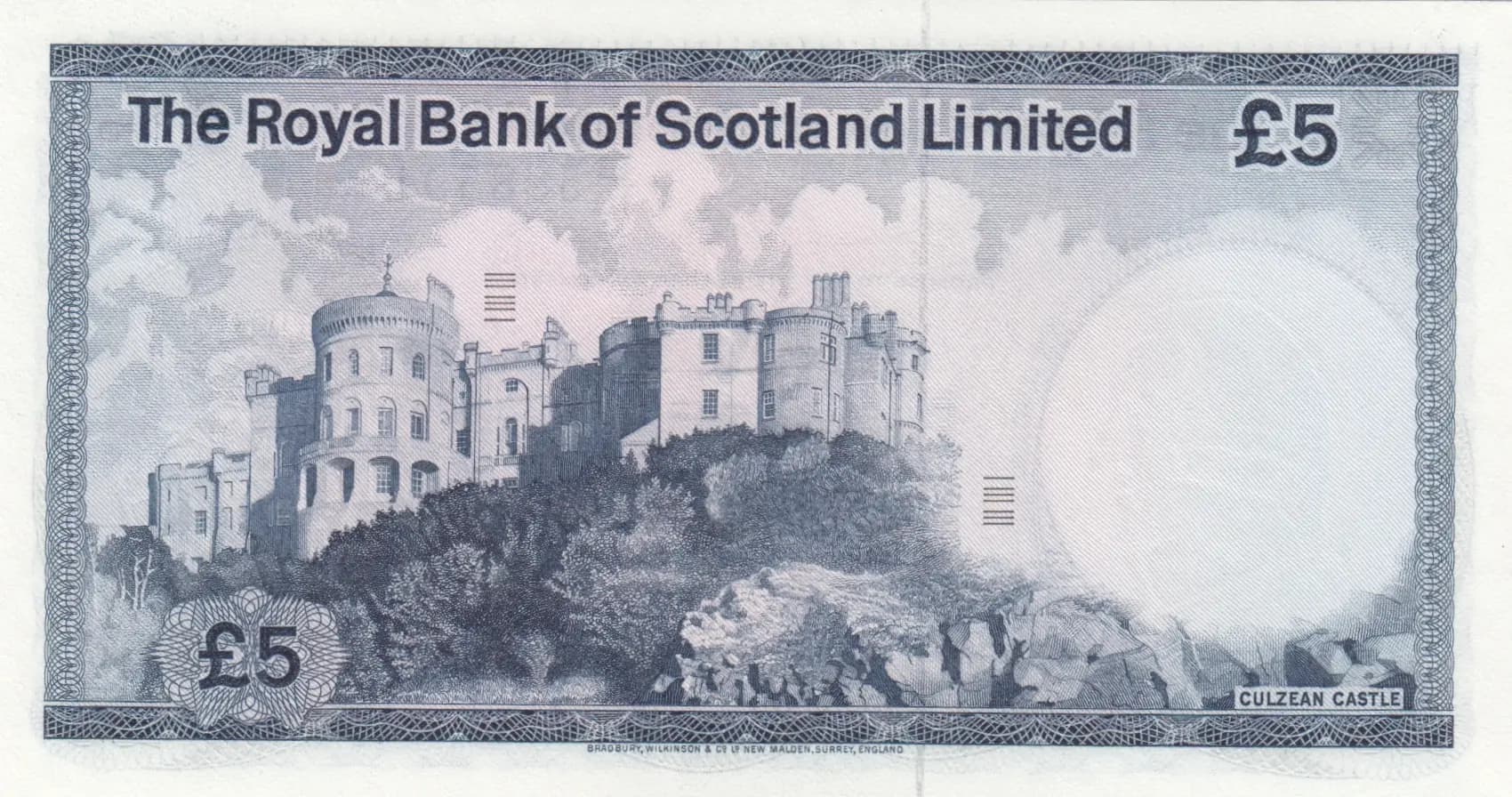
A 1981 Royal Bank of Scotland £5 note (Pick 337) featuring the distinctive arms of Scotland on the obverse and the iconic Culzean Castle on the reverse. The note exhibits moderate circulation wear with visible creasing and handling marks throughout, inconsistent with the assigned UNC grade—the paper shows age-related patina and light staining that suggests VF condition at best. Despite the condition discrepancy, this represents a classic example of Scottish banknote design from the early 1980s, notable for its fine engraving quality and the prominent heraldic symbolism of the Royal Bank of Scotland.
Common. While the 1981 date is the final year of this design series, the Royal Bank of Scotland £5 note was in standard circulation and produced in substantial quantities. eBay market data shows consistent sales in the $8–$35 range for VF examples, with UNC specimens reaching approximately $100–$150 at auction. The series was not recalled, and no print-run restrictions are known. The abundance of examples in the secondary market confirms common status.
Issued on 1 May 1981 by the Royal Bank of Scotland Ltd from their Edinburgh head office, this note represents the tail end of a design series that began in 1972. The choice of Culzean Castle—a prominent 18th-century Scottish castle in Ayrshire—reflects the Royal Bank's commitment to showcasing Scotland's architectural heritage during a period of growing Scottish cultural identity. The heraldic arms depicted on the obverse emphasize the bank's role as a major Scottish financial institution authorized to issue currency.
The obverse features an elaborate ornamental design centered on the Royal Bank of Scotland's coat of arms (lion rampant with supporters) positioned at the right side, flanked by decorative geometric frames rendered in pink, yellow, and blue-grey tones. The reverse showcases a detailed intaglio engraving of Culzean Castle, a multi-towered baronial fortress set dramatically on elevated terrain with surrounding landscape elements including trees, vegetation, and rocky outcrops at the base. Both sides employ fine guilloche patterning and decorative borders with wave patterns, characteristic of high-security banknote design from this era. The color scheme is predominantly blue-grey with black line work and white highlights, reflecting the classical aesthetic of British banknote design.
Front side: 'The Royal Bank of Scotland Limited' (header); 'PROMISE TO PAY THE BEARER ON DEMAND' (legal tender promise); 'FIVE POUNDS STERLING' (denomination); 'AT THEIR HEAD OFFICE HERE EDINBURGH, 1 MAY 1981' (issue location and date); 'BY ORDER OF THE BOARD' (authorization); Serial number 'B/10 588591'; '£5' (denomination marker). Back side: 'The Royal Bank of Scotland Limited' (issuer name); 'CULZEAN CASTLE' (landmark identification); 'BRADBURY, WILKINSON & CO LTD, ENGRAVERS, SURREY, ENGLAND' (printer attribution); '£5' (denomination).
Intaglio (copperplate) engraving, as confirmed by the credit line 'Bradbury, Wilkinson & Co Ltd, Engravers, Surrey, England' visible on the reverse. The fine line work, detailed landscape rendering on Culzean Castle, and the intricate geometric guilloche patterns are all characteristic of traditional intaglio security printing. Multi-color offset printing was used for the ornamental decorative frame on the obverse to achieve the pink and yellow accent colors over the blue base.
This example displays the 1 May 1981 issue date, representing the latest date in the 1972–1981 series (Pick 337). The serial number prefix 'B/10' indicates the printing batch assignment. No major varieties are documented for this final date within the 1972–1981 series. Signature variants exist across the series' run, but the 1981 date represents a single, well-documented issuing period without documented sub-varieties of numismatic significance.