1 pound 1952
Market Prices
1 saleAbout This Note
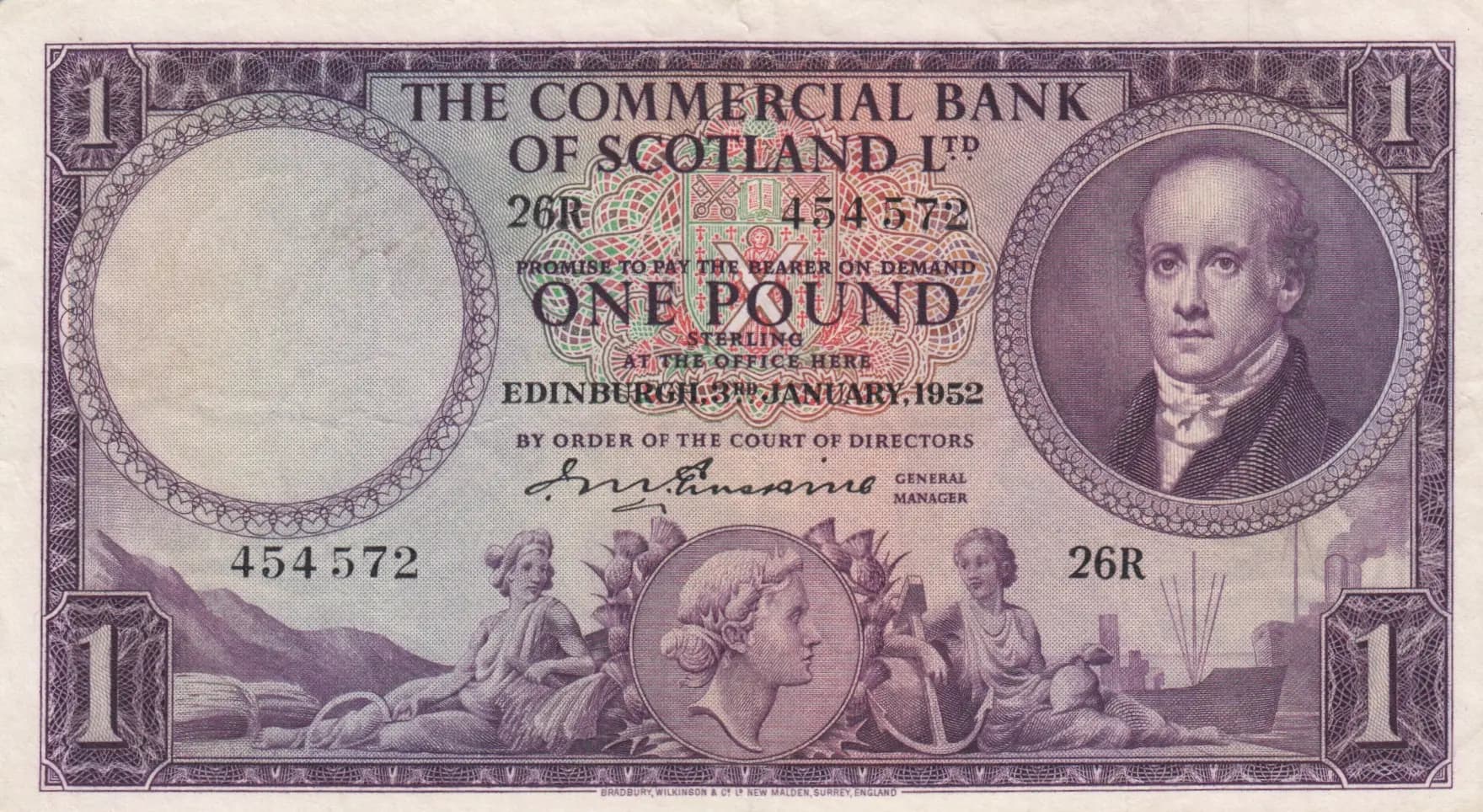
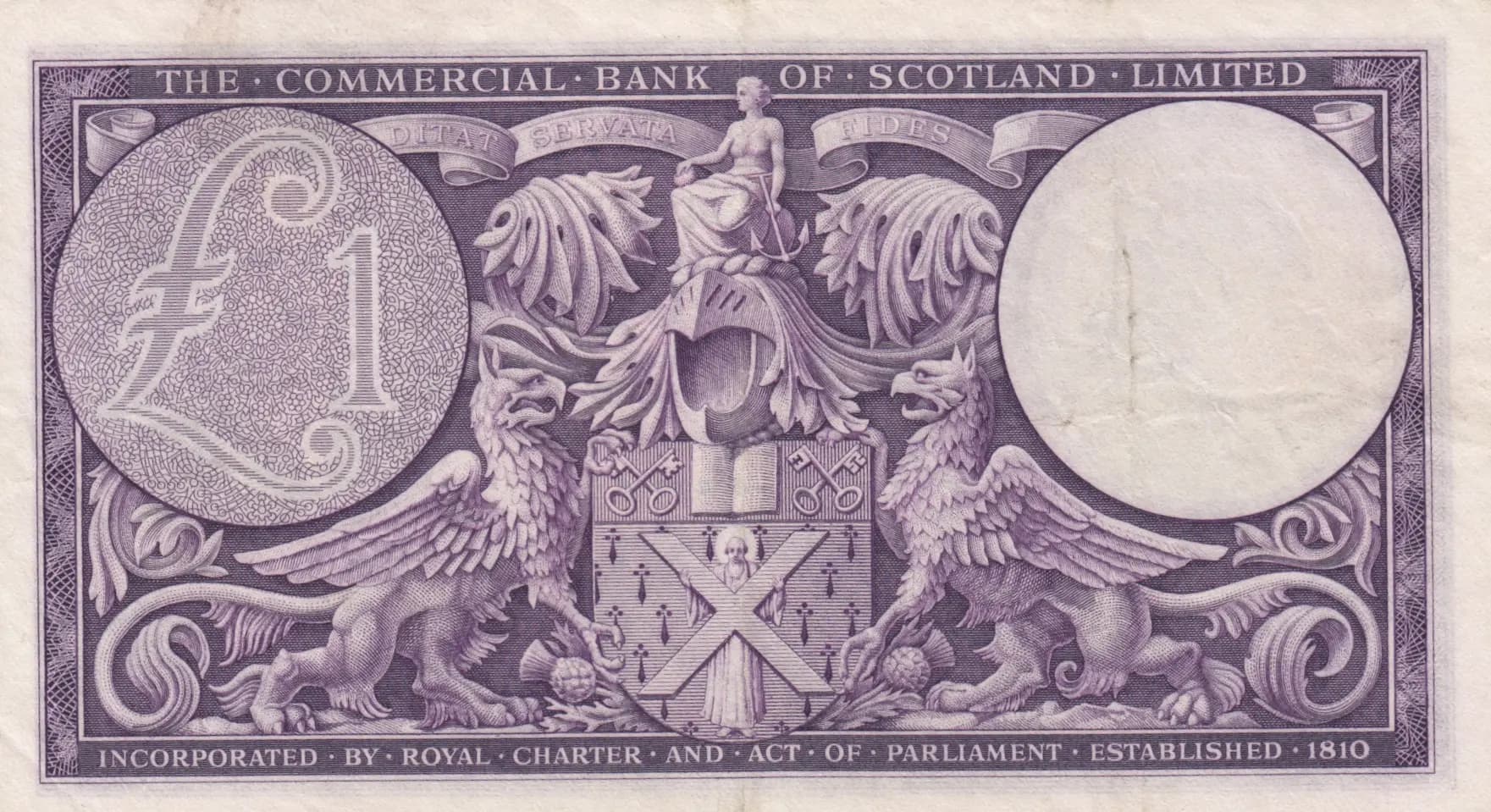
This is a VF-graded one pound note from the Commercial Bank of Scotland dated January 1952, displaying the bank's characteristic purple/mauve color scheme and classical design elements. The note features a formal portrait on the obverse and an elaborate heraldic coat of arms with allegorical figures on the reverse, printed by Bradbury, Wilkinson & Co. The observable wear—creasing, foxing, and faded coloration—is consistent with genuine circulation from the post-war period and represents a desirable example of Scottish regional currency.
Common. The Commercial Bank of Scotland's 1947-1952 series pound notes were issued in substantial quantities during a period when Scottish banks maintained active circulation of their currency. The eBay reference data showing a PMG 64 specimen selling for approximately $155 in November 2025 indicates these notes have established market prices reflective of common circulation issues rather than scarce varieties. The observed condition (VF) is neither exceptional nor rare for this note type. No evidence of small print runs, early recall, or short-lived issuance exists for this standard regional note.
This note was issued in January 1952, during the early reign of Queen Elizabeth II and at a time when Scottish banks retained the right to issue their own currency under the Bank Notes (Scotland) Act. The Commercial Bank of Scotland, established in 1810 as inscribed on the reverse, remained one of the three principal Scottish note-issuing banks until its absorption into the National Commercial Bank in 1958. The classical allegorical imagery and heraldic symbolism reflect 19th-century design traditions that persisted in Scottish banknote production well into the 20th century.
The obverse features a formal portrait of a middle-aged gentleman in 19th-century formal dress positioned on the right side within a circular frame, flanked by ornamental circular border areas. The center displays classical allegorical female figures (representing Commerce or Industry) with a central medallion profile, likely of a historical figure or bank founder. The reverse showcases the bank's heraldic achievement with two lions rampant as supporters flanking a shield bearing the Scottish lion rampant and the Scottish saltire cross, with an ornate numeral '1' in decorative scrollwork on the left. A seated female allegorical figure (representing Britannia or a similar national personification of prosperity) appears centrally. The overall design emphasizes the bank's established authority, Scottish national identity, and connection to classical principles of commerce and faith.
FRONT SIDE: 'THE COMMERCIAL BANK OF SCOTLAND, LTD' (The Commercial Bank of Scotland, Limited); 'PROMISE TO PAY THE BEARER ON DEMAND' (Standard currency promise); 'ONE POUND STERLING' (Denomination); 'AT THE OFFICE HERE' (Redemption location); 'EDINBURGH, JANUARY, 1952' (Issue date and place); 'BY ORDER OF THE COURT OF DIRECTORS' (Authorization); 'GENERAL MANAGER' (Signing authority); 'BRADBURY, WILKINSON & CO LTD, NEW MALDEN, SURREY, ENGLAND' (Printer identification); Serial number 454572; Reference 26R. BACK SIDE: 'THE COMMERCIAL BANK OF SCOTLAND LIMITED' (Issuer name); 'DITAT SERVATA FIDES' (Latin motto: 'Wealth preserved by faith'); 'INCORPORATED BY ROYAL CHARTER AND ACT OF PARLIAMENT ESTABLISHED 1810' (Bank's official charter and founding date).
Intaglio (line engraving) printing, executed by Bradbury, Wilkinson & Co Ltd, the renowned British security printer. The technique is evidenced by the fine line work, complex geometric hatching patterns, detailed portraiture, and intricate decorative scrollwork visible throughout both sides. Security features include ornate circular watermark areas (present but unfilled on this note), fine-line engraving with tightly spaced parallel lines creating tonal gradation, and elaborate multi-layered decorative elements characteristic of high-security banknote production of the era.
This example is dated January 1952 with serial number 454572 and reference number 26R. The Pick catalog designation P-S332 encompasses the 1947 issue with the January 1952 date variant observed here. Signature varieties exist within this series (General Manager signatures varied), and serial number prefixes may indicate different printing sessions, but these represent normal production variations rather than distinct catalog varieties. The note belongs to the final years of Commercial Bank of Scotland note issuance before the bank's 1958 merger.