1 pound 1952
Market Prices
9 salesAbout This Note
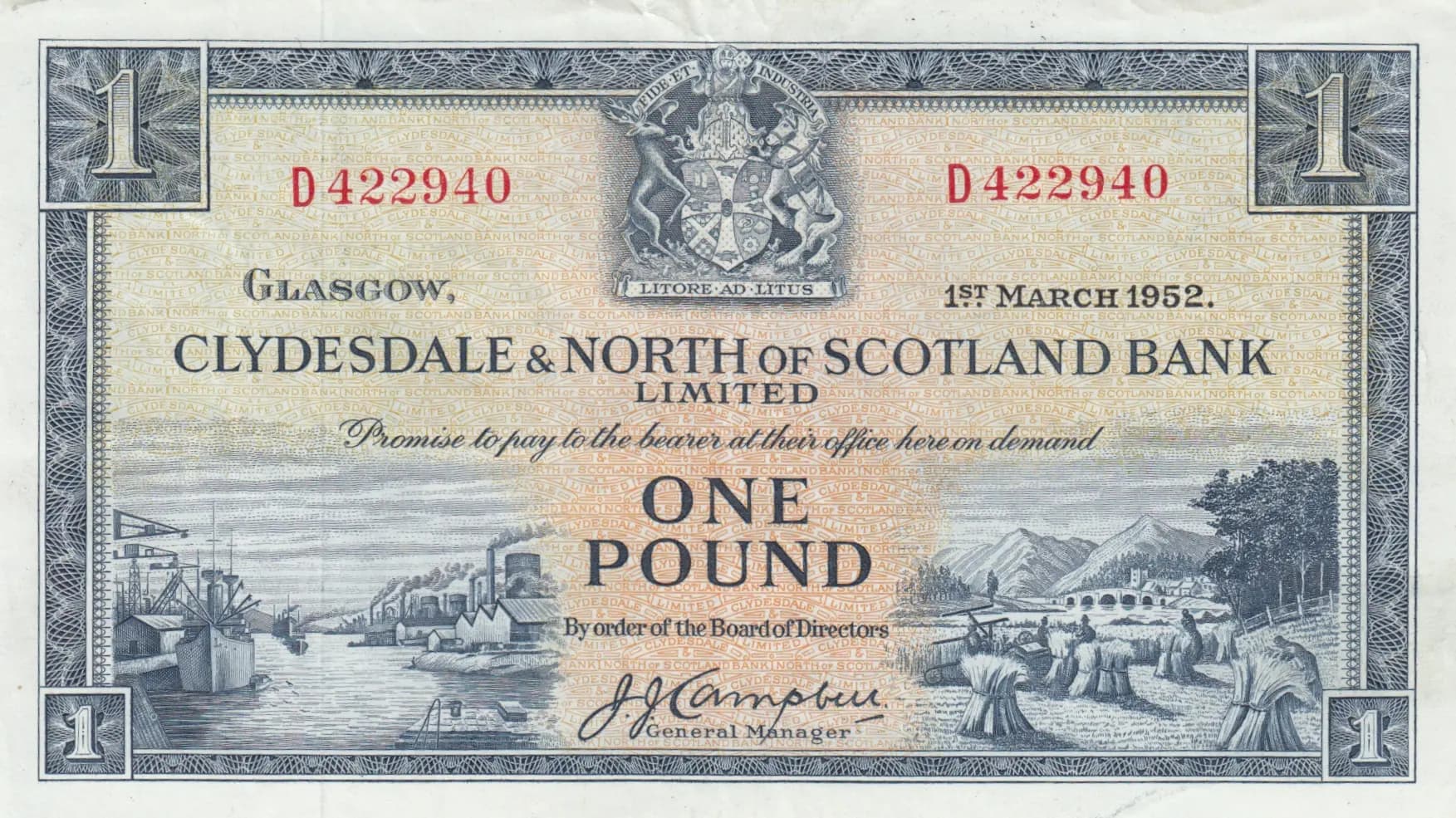
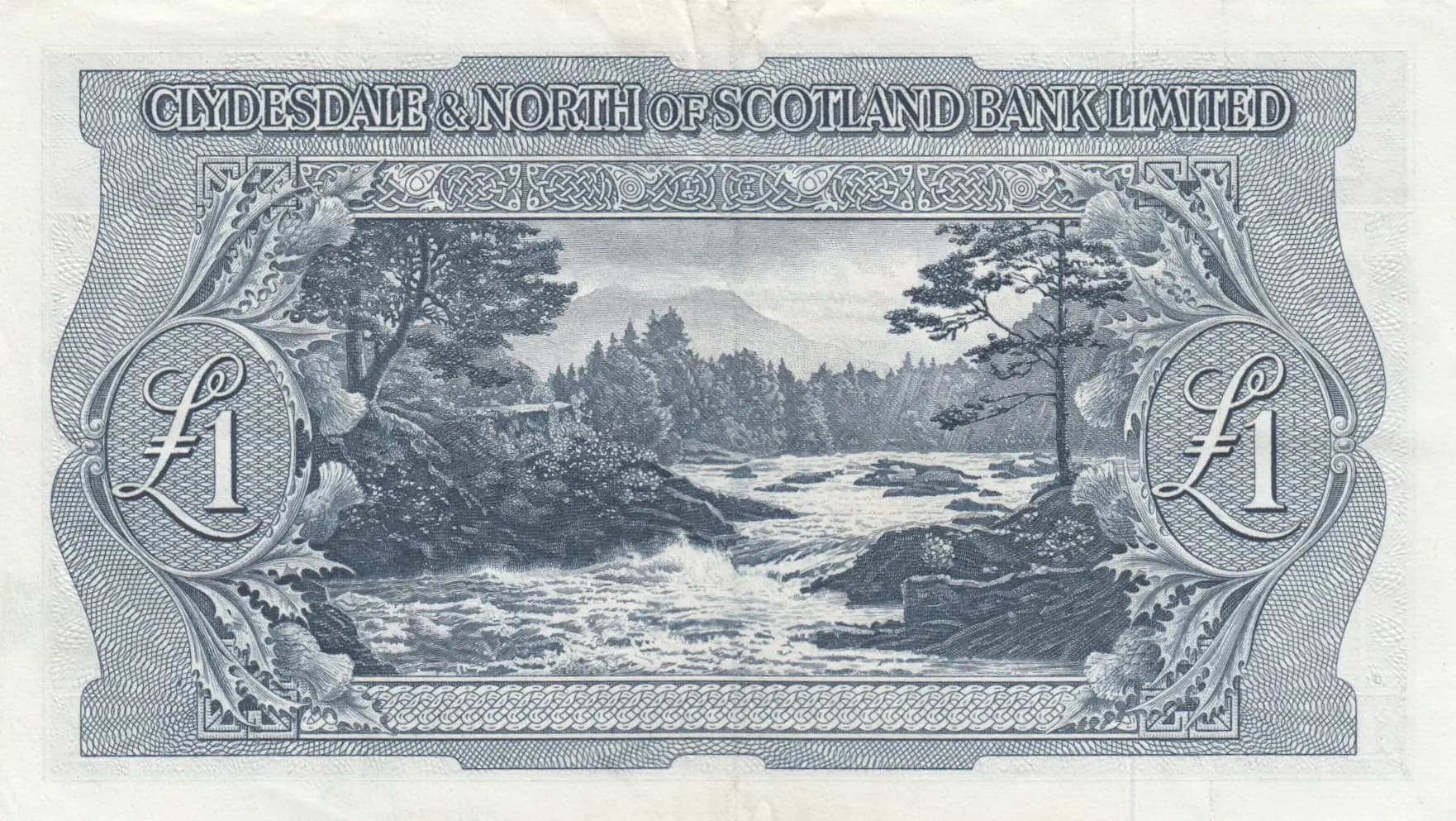
A handsome VF example of the 1952 Clydesdale & North of Scotland Bank £1 note (Pick 191a), featuring the bank's distinctive design with a royal coat of arms, industrial riverside scenes, and pastoral landscapes on the obverse. The reverse displays an elegant Highland river landscape within a Celtic-bordered oval frame. Despite clear evidence of circulation—horizontal and vertical fold creases, foxing, and general aging on the cream background—the note remains intact with no tears, representing a solid collector specimen of this Scottish regional issue.
Common. The eBay sales data strongly supports this assessment, with VF-graded examples consistently selling for $20-28 in recent years (2012-2019), indicating strong availability in the secondary market. Multiple VF sales across a decade of records demonstrate regular circulation of this denomination and Pick number among collectors. The Pick 191a designation (the 'a' variant) represents the standard issue in this series. Print runs for Scottish pound notes of this period were substantial, and this particular 1952 issue has not been subject to recalls or scarcity factors.
This 1952 note was issued during the post-World War II period when Scottish banking institutions maintained their right to issue distinctive pound notes. The front design's juxtaposition of industrial riverside scenes (representing Glasgow's shipbuilding heritage and commercial shipping) with rural agricultural landscapes reflects Scotland's dual economy during the mid-20th century. The Latin motto 'Litore ad Litus' (Shore to Shore) on the coat of arms and the Highland river scene on the reverse underscore the bank's regional identity and Scotland's geographical character.
The obverse features Scotland's royal coat of arms (lion and unicorn supporters with heraldic shield) positioned centrally and prominently, flanked by ornamental corner pieces with large decorative numerals '1'. The lower portion is divided into two thematic scenes: on the left, an industrial riverside composition depicting Glasgow's famous shipbuilding and dock infrastructure with vessels and commercial activity; on the right, a pastoral Highland scene showing agricultural harvesting, pastoral landscape, trees, mountains, and a bridge structure. The reverse presents a romanticized Highland landscape—a rushing river flowing through a forested valley with coniferous trees and mountains in the background—contained within an ornate oval frame decorated with Celtic knot patterns and scrollwork. Large denomination markers '£1' appear in ornate frames on both sides of the reverse.
FRONT: 'Clydesdale & North of Scotland Bank Limited' (bank name and authority); 'Glasgow, 1st March 1952' (place and date of issue); 'Promise to pay to the bearer at their office here on demand' (standard banknote promise); 'One Pound' (denomination); 'By order of the Board of Directors' (authorization statement); 'J.J. Campbell, General Manager' (signatory and title); 'Litore ad Litus' (Latin motto on coat of arms, translating 'Shore to Shore'); Serial numbers 'D422940' in red (left and right); Repeating background text with bank name variations. BACK: 'Clydesdale & North of Scotland Bank Limited' (bank name at top); Multiple denomination markers '£1' in ornate frames (left and right sides).
Fine line engraving throughout, characteristic of high-security British banknote production of the era. The note employs multiple color printing (blue-gray primary engraving with red-ink serial numbers), layered background security patterns with repeating text, ornate decorative borders, and intricate linear detail work. This production method was typical of British regional note printers of the 1950s, with the Clydesdale & North of Scotland Bank notes commonly produced by De La Rue or similar security printers. The fine engraving quality and multi-color approach were state-of-the-art anti-counterfeiting measures for the period.
The visual analysis confirms this as the standard Pick 191a variety, issued 1st March 1952, signed by J.J. Campbell (General Manager). The serial number D422940 appears in red on both sides, which is consistent with the standard printing of this issue. Known varieties for this Pick number may include different signature combinations and serial number prefix variations (representing different printing batches), but the 1952 date and Campbell signature represent a common variant. No overprints or special markings are evident on this specimen.