5 pounds 1967
Market Prices
3 salesAbout This Note
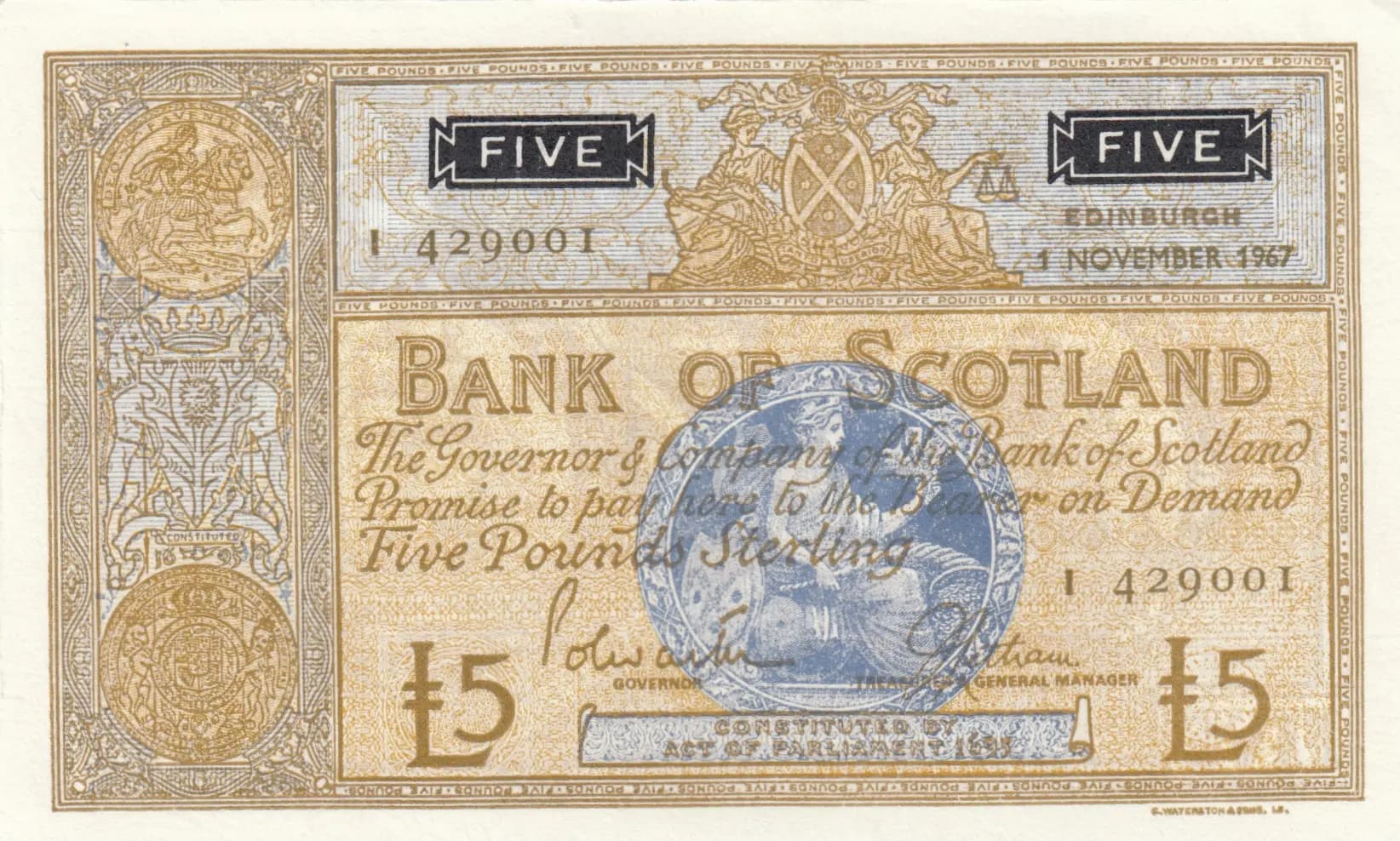
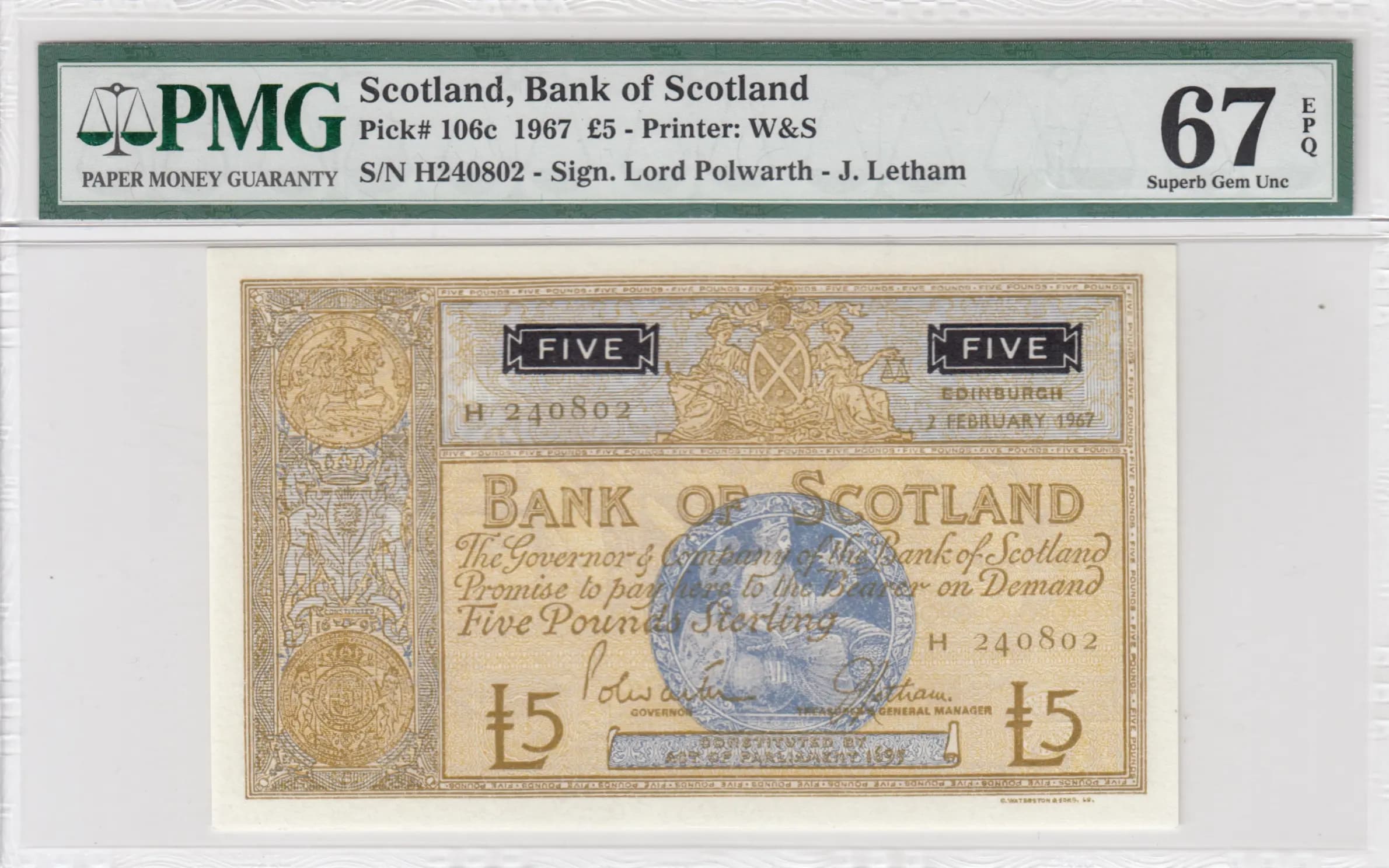
This is a Bank of Scotland £5 note from February 1967, graded PMG 67 EPQ, representing an excellent example of mid-20th century Scottish currency design. The note displays the characteristic cream and brown color scheme with a striking blue portrait medallion on the obverse and heraldic/maritime imagery on the reverse, all executed in sharp detail with vibrant coloring and no visible wear. As a PMG 67 grade note, this example sits at the upper end of circulated grades with exceptional eye appeal, making it an attractive acquisition for collectors of Scottish banknotes or mid-century British currency.
Common. This note represents a regular issue from the Bank of Scotland's 1961-1967 series with substantial print run. While the specific serial number H 240802 may be unique, the issue itself is widely available in numismatic markets. eBay sales data confirms common market availability with sales across multiple condition grades ranging from $20 to $222, with 2019 catalogue values of $50 (VF) and $180 (UNC). The PMG 67 EPQ grade represents a premium condition example, which commands higher prices than lower grades, but the underlying note type is not scarce.
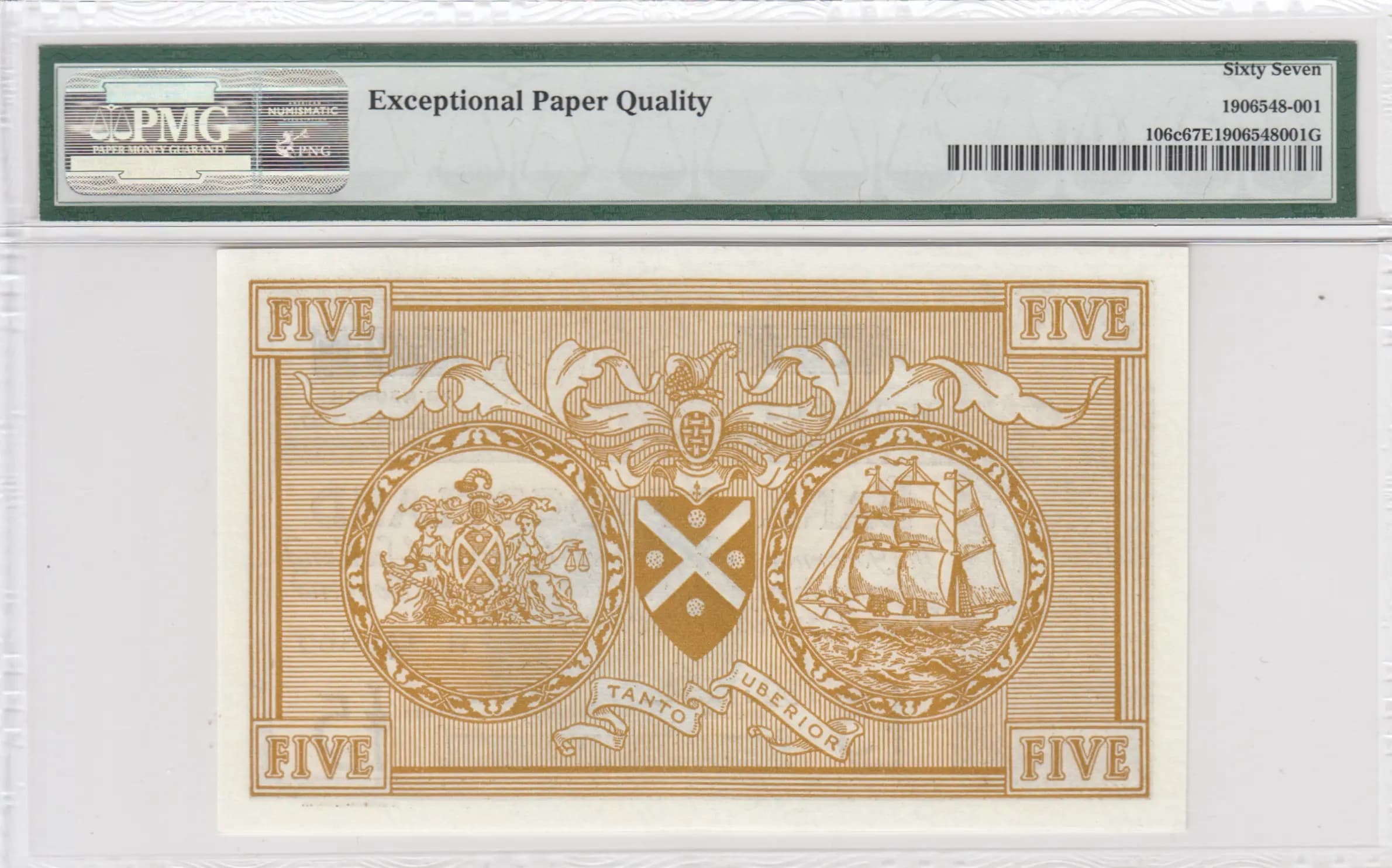
Issued during a period when Scottish banks retained their privilege to issue their own banknotes alongside the Bank of England, the Bank of Scotland £5 note reflects the institution's long heritage dating to 1695. The heraldic elements, including the coat of arms and St Andrew's Cross (saltire) on the reverse, emphasize Scottish national identity and sovereignty in currency design. The maritime imagery (sailing ship) references Scotland's historical importance as a seafaring nation, while the classical portrait medallion on the obverse suggests a distinguished historical figure from Scottish banking or governance.
The obverse features a centrally positioned blue portrait medallion depicting a historical Scottish figure, flanked by ornate circular medallions containing intricate heraldic patterns. The note is framed by decorative brown borders with floral and heraldic motifs in cream and gold tones. The reverse displays two prominent circular medallions: the left containing heraldic coat of arms imagery with lion and unicorn elements representing Scottish heraldry, and the right depicting a sailing ship symbolizing Scotland's maritime heritage. A central shield with St Andrew's Cross (saltire) separates these medallions, with decorative line patterns and heraldic flourishes completing the design. The overall color palette of cream, gold, brown, and tan creates a warm, dignified appearance befitting currency of this era.
Front side: 'FIVE' (denomination in words), 'BANK OF SCOTLAND' (issuing institution), 'The Governor & Company of the Bank of Scotland Promise to pay to the Bearer on Demand Five Pounds Sterling' (legal tender promise), 'EDINBURGH' (place of issue), 'FEBRUARY 1967' (issue date), '£5' (denomination symbol), 'H 240802' (serial number). Back side: 'FIVE' (repeated in four corners), 'UNION INTRA' (Latin phrase, roughly translating to 'Union Within' or 'United Within', referencing the union between England and Scotland).
The note was produced using traditional intaglio engraving, the standard security printing method for banknotes of this period. The printer was G. Waterston & Sons, Edinburgh, a renowned Scottish security printer. The crisp detail visible in the portrait medallion, intricate border work, and fine line patterns characteristic of the reverse design all evidence the multi-plate engraving process typical of mid-20th century banknote production. The precise color registration and sharp impression of text and decorative elements further confirm professional intaglio printing with careful plate preparation.
This example is specifically identified as Pick P-106c, the 1967 issue variant of the Bank of Scotland £5 note. The February 1967 date and serial number H 240802 are consistent with the final issues from this series. No major varieties (such as signature variants or overprints) are apparent in the visual analysis. The note represents the standard design from this pick number's timeframe.