1 pound 1978
Market Prices
21 salesAbout This Note
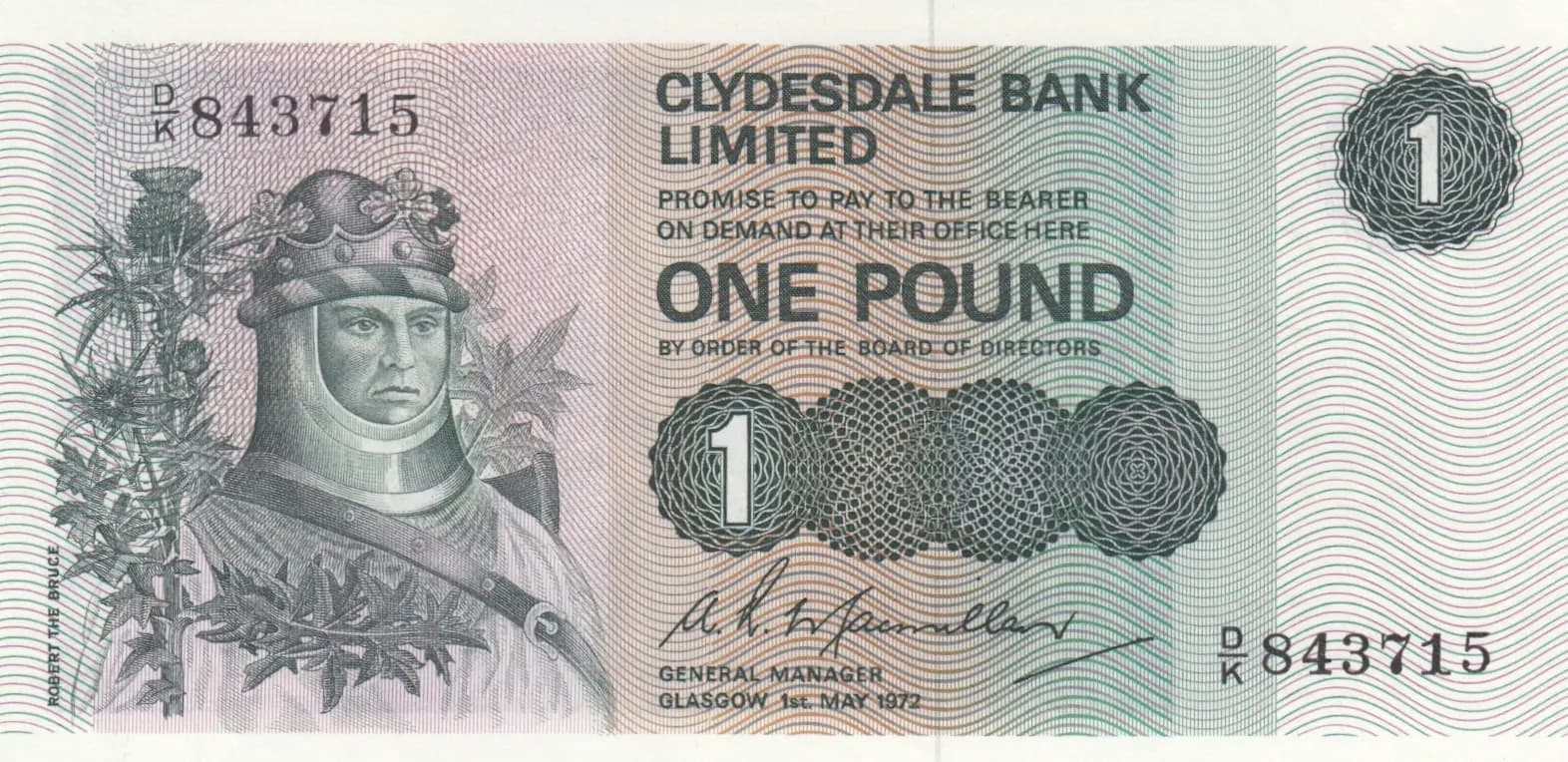
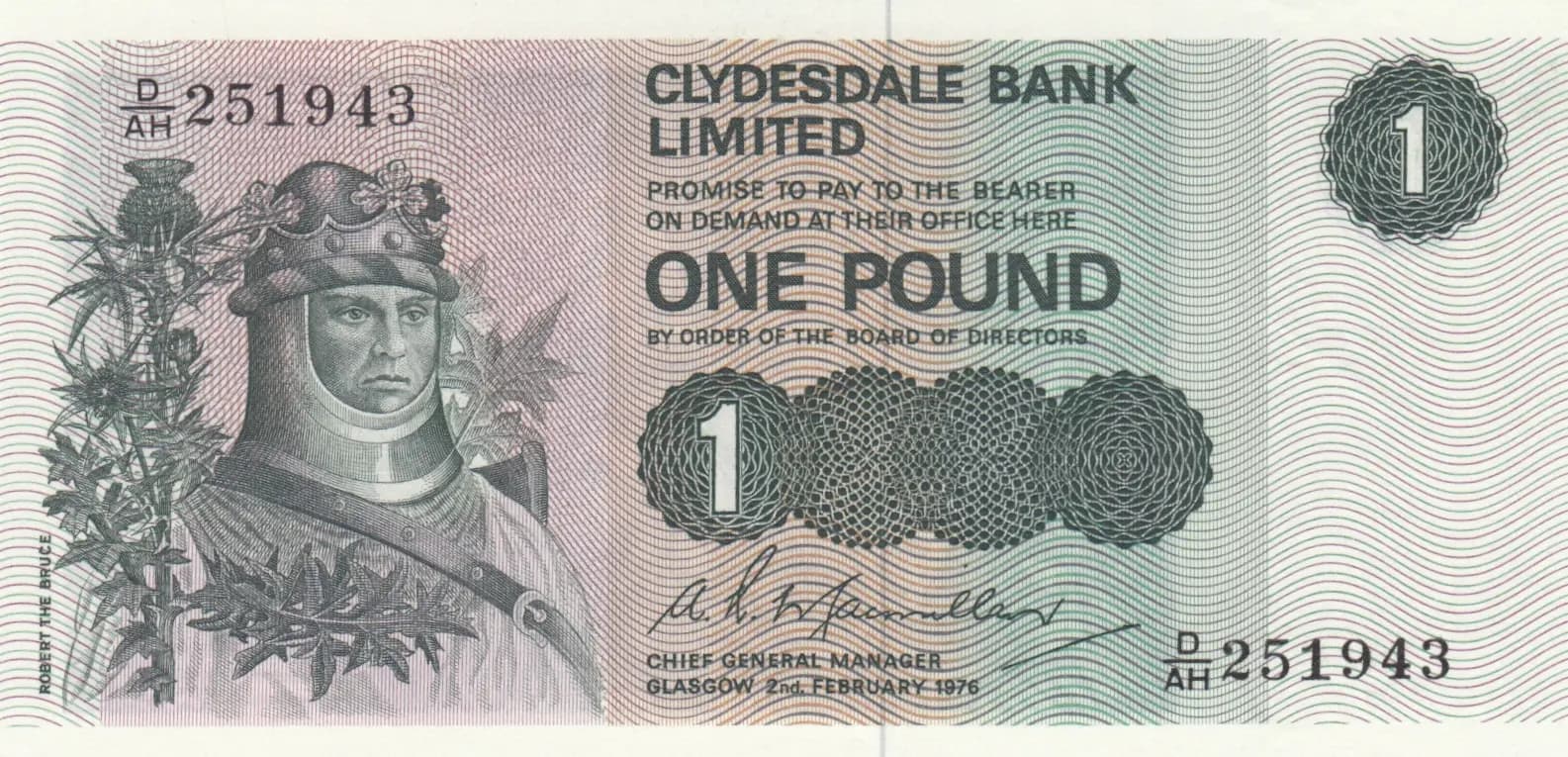
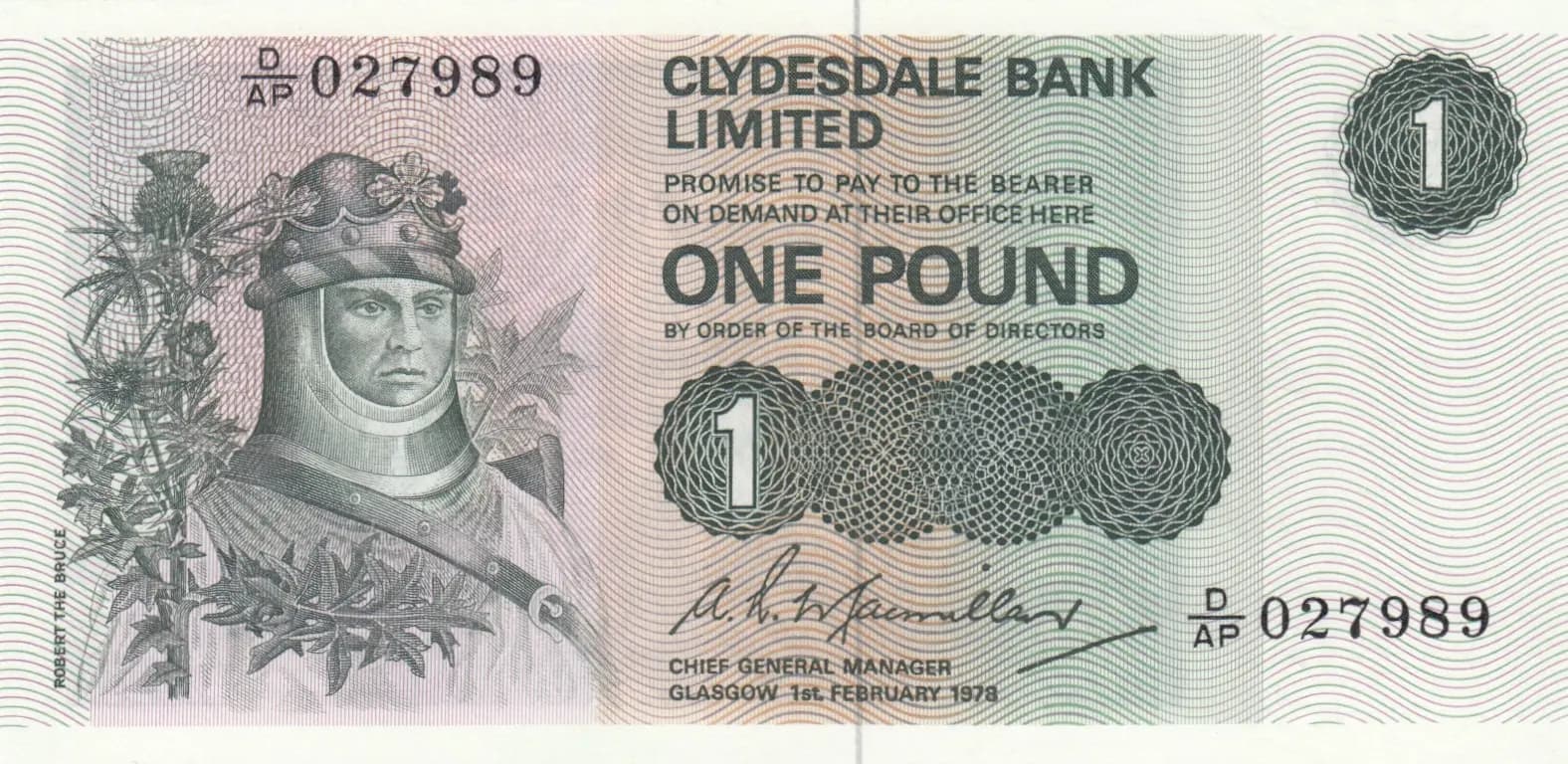
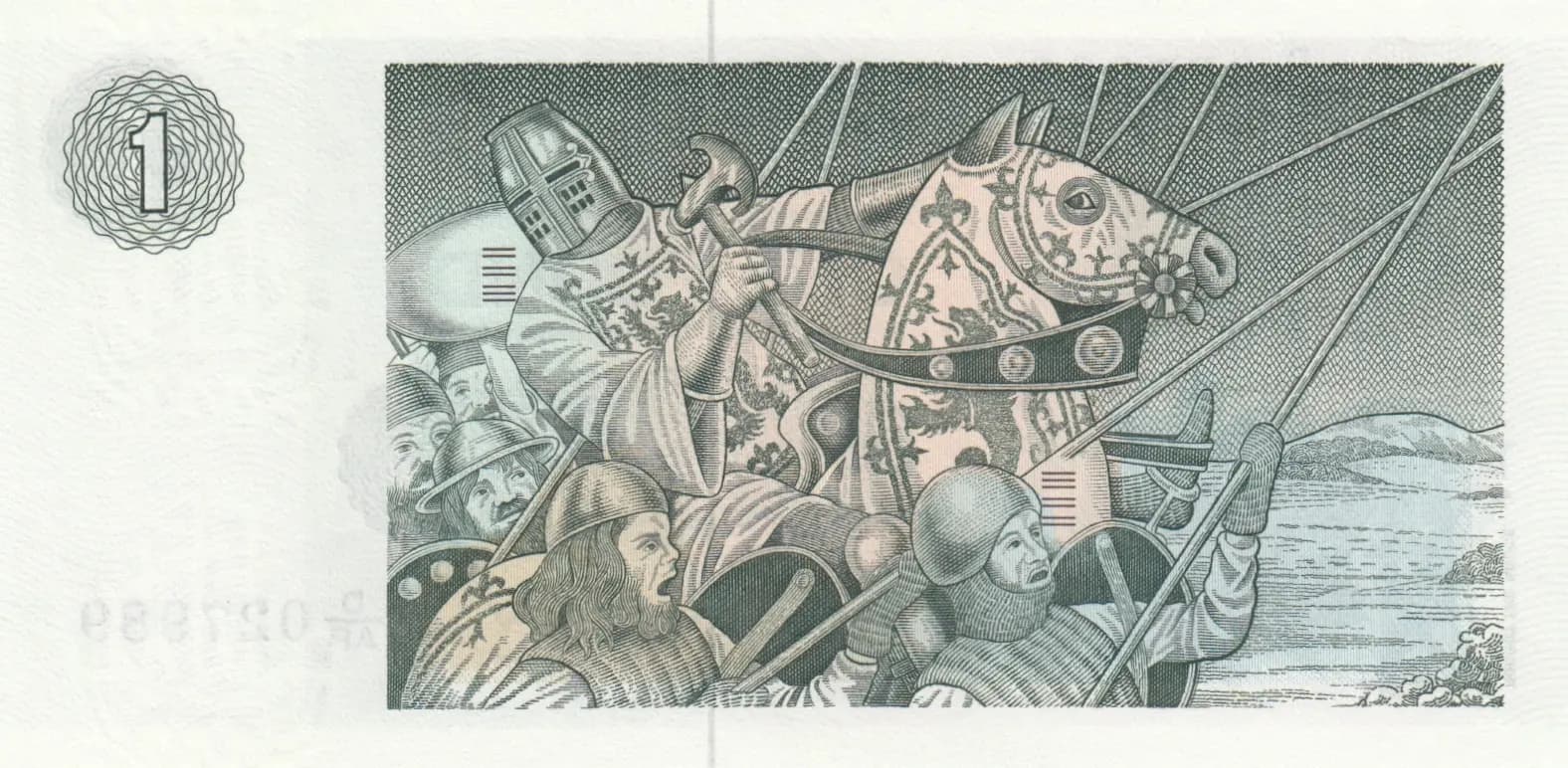
This is a 1978 Clydesdale Bank Limited one pound note (Pick 204c) in UNC condition, featuring the iconic portrait of Robert the Bruce on the obverse rendered in distinctive pink and salmon tones with green accents. The reverse depicts a dramatic historical scene of the Battle of Bannockburn with medieval knights, soldiers, and ships in fine detail. While the note shows a visible vertical center fold inconsistent with a true UNC grade, the crisp printing and clear security features remain well-preserved, making it an attractive example of Scottish regional currency from this period.
Common. eBay market data shows consistent sales in the $5–$35 range across multiple condition grades (2012–2026), with UNC examples averaging around $20–$35. The 1974–1981 Clydesdale Bank series was a regular, widely-circulated issue with substantial print runs. The catalog values (2019) of $10 for VF and $35 for UNC align with typical secondary market pricing for common Scottish regional notes. No evidence of short print runs, recall status, or scarcity exists for this Pick number.
Issued by Clydesdale Bank Ltd during their 1974-1981 series, this note commemorates Robert the Bruce, the 14th-century Scottish king who secured Scottish independence through his victory at the Battle of Bannockburn in 1314—the very scene depicted on the reverse with its detailed rendering of medieval naval and military forces. The thistle symbolism and Glasgow issue location reinforce the note's celebration of Scottish heritage during a period when Scottish regional notes remained important expressions of national identity within the UK currency system.
The obverse features Robert the Bruce, identifiable by his medieval crown, armor plating, and forward-facing royal bearing, positioned on the left with decorative thistle elements beside him. His portrait is rendered against an intricate pink and orange geometric guilloche pattern with green accents, providing sophisticated security patterning. The denomination '1' appears in circular ornamental frames in the upper and lower right corners. The reverse presents a complex historical narrative scene depicting the Battle of Bannockburn (1314) with multiple armored knights and soldiers aboard medieval sailing ships, a prominently featured ornamental horse with elaborate barding on the right side, and a rocky coastal landscape. The fine cross-hatching, stippling, and detailed engraving create depth throughout both sides, emphasizing the note's artistic quality and historical significance.
Front side: 'CLYDESDALE BANK LIMITED' (issuing bank), 'PROMISE TO PAY TO THE BEARER ON DEMAND AT THEIR OFFICE HERE' (standard promise clause), 'ONE POUND' (denomination), 'BY ORDER OF THE BOARD OF DIRECTORS' (authority statement), 'CHIEF GENERAL MANAGER' (signatory title), 'GLASGOW 1st FEBRUARY 1978' (place and date of issue), 'D AP 027989' (serial number). Back side: No text inscriptions; design-only reverse.
This note was produced using traditional intaglio engraving (line engraving and recess printing), evidenced by the fine guilloche patterns, detailed cross-hatching in the Battle of Bannockburn scene, and crisp definition of portrait elements. The color separation and multi-color printing technique visible in the pink, green, orange, and cream tones indicate advanced security printing methods typical of Bank of England-contracted printers (likely Bradbury, Wilkinson & Co. or De La Rue, who produced Scottish regional notes during this period). The combination of engraved portraiture with color security printing was state-of-the-art for 1970s British currency.
This specific example is dated 1st February 1978 (as printed on the obverse) with serial number prefix 'D AP 027989,' identifying it within the 1974–1981 issuance period. The 'CHIEF GENERAL MANAGER' signature designation is standard for this series. No significant varieties are known for Pick 204c beyond normal serial number variations and minor printing shifts common to long production runs. The vertical center crease visible in both images suggests post-production folding rather than a printing or cutting variety.