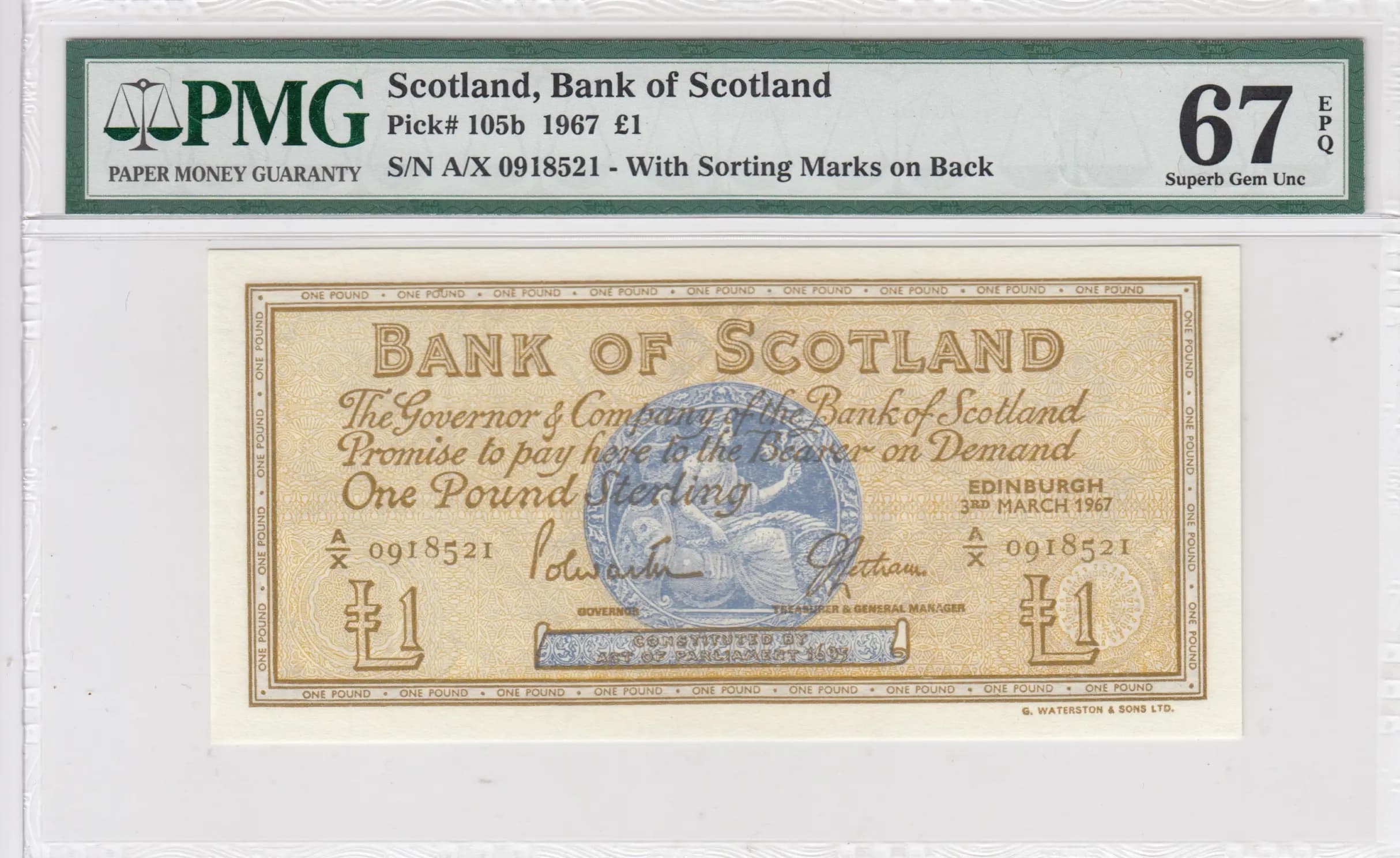
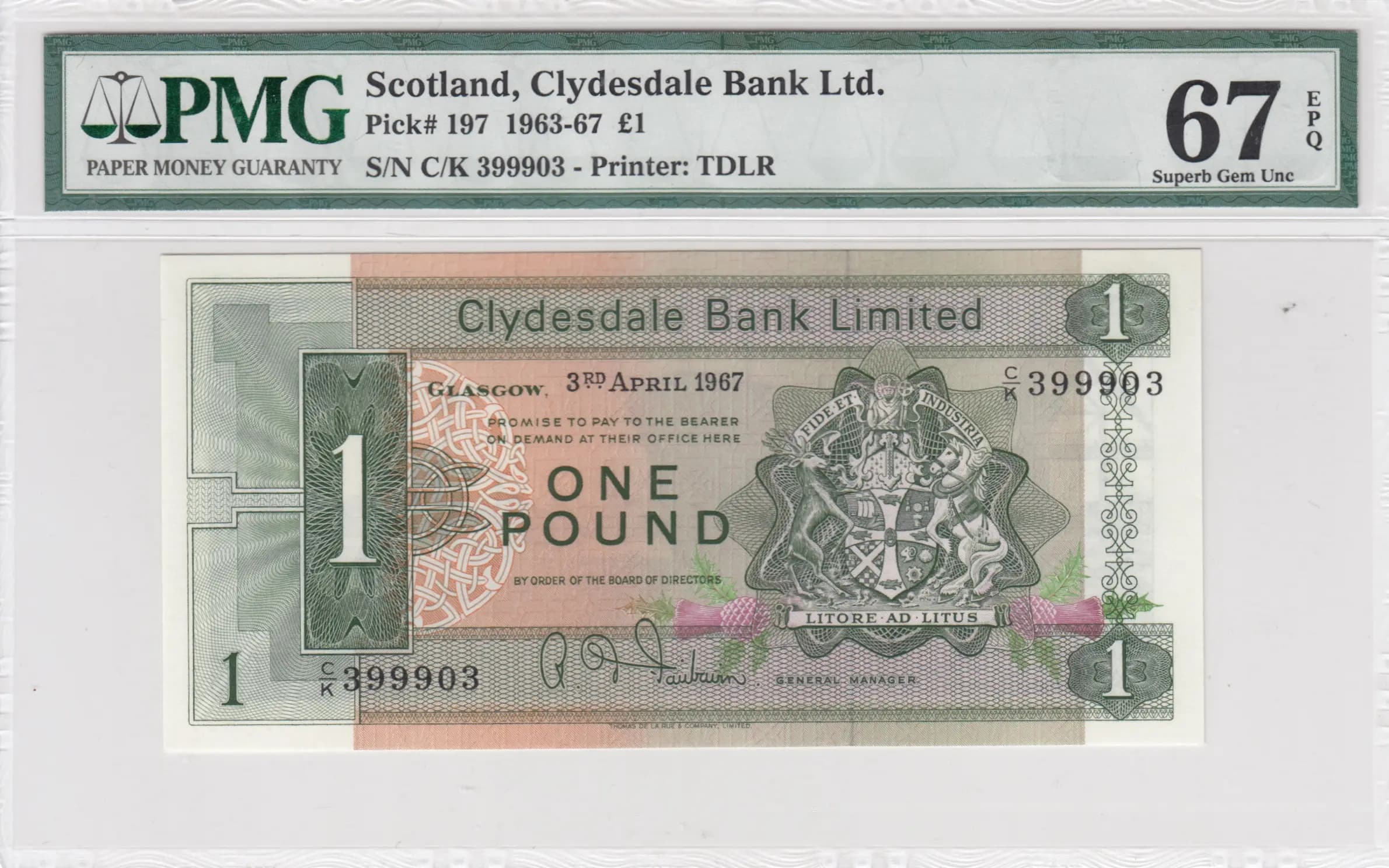
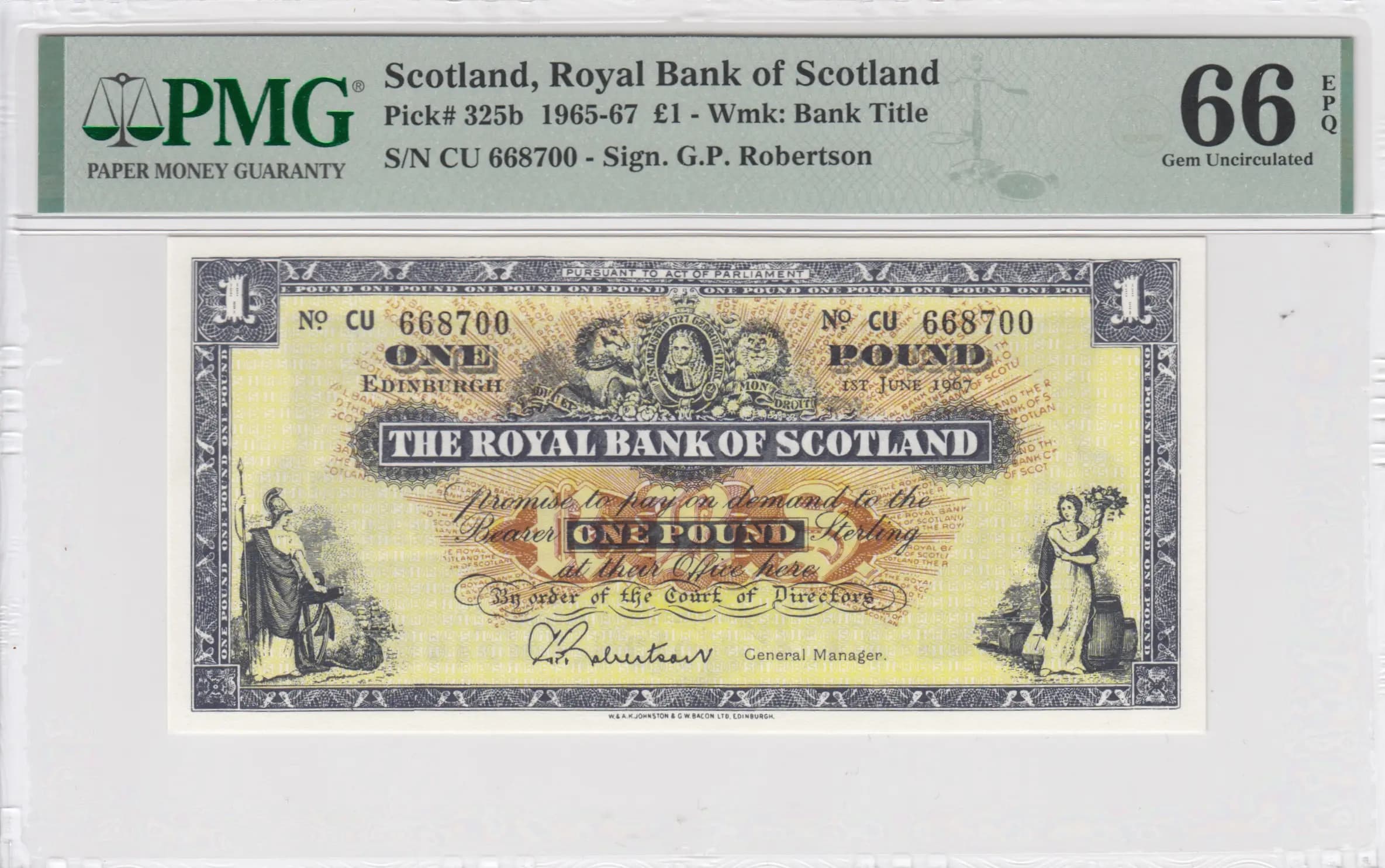
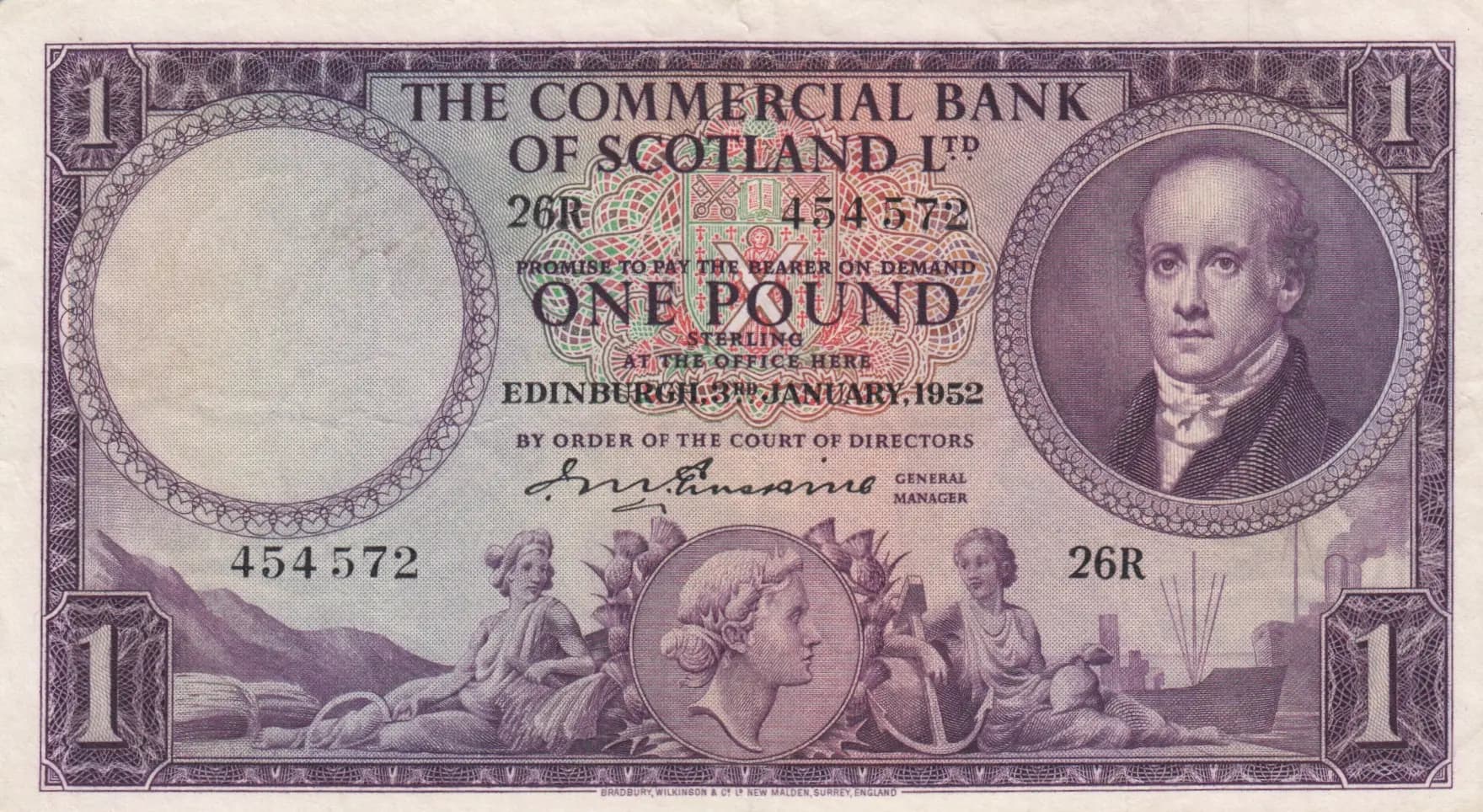
1 pound 1967
Market Prices
2 salesAbout This Note
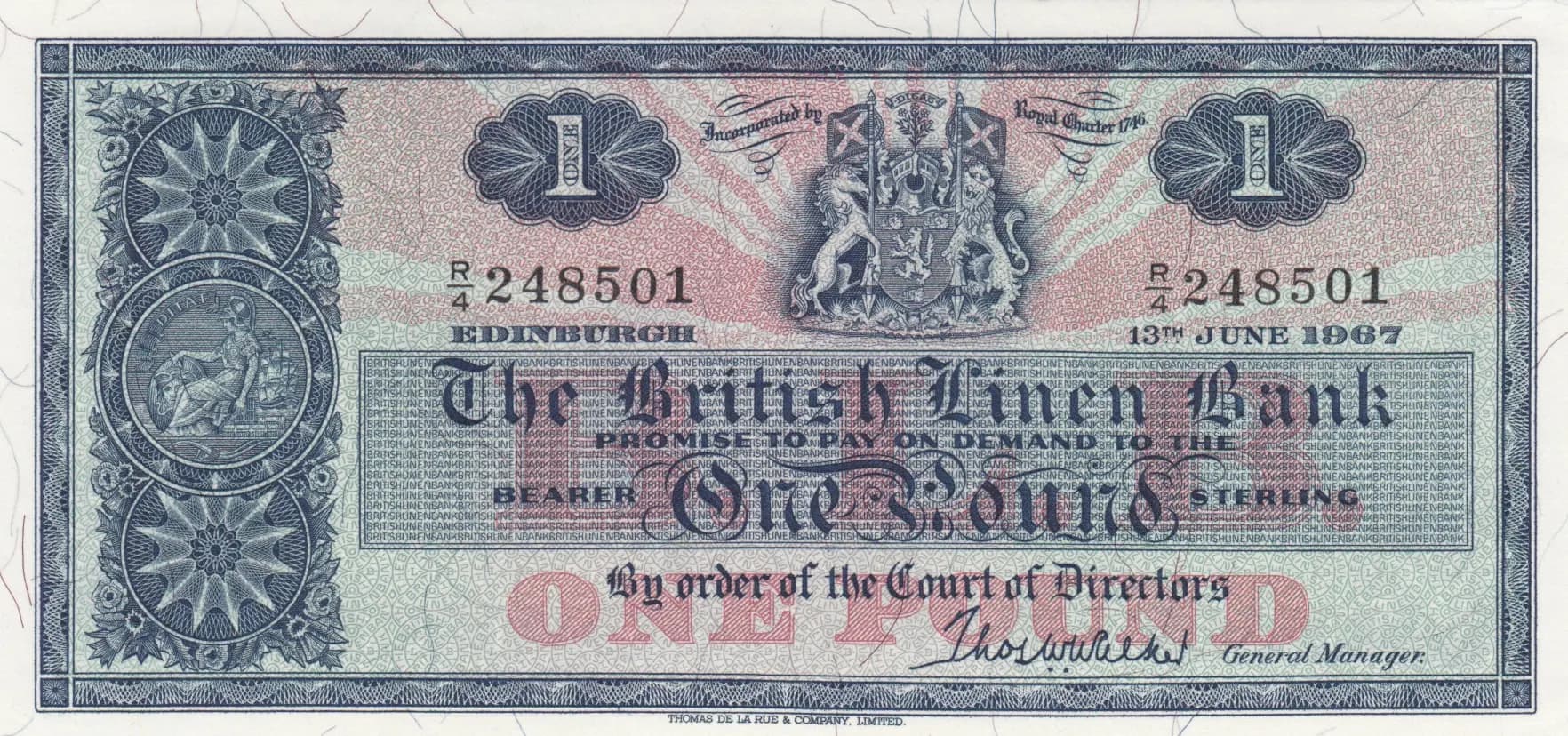
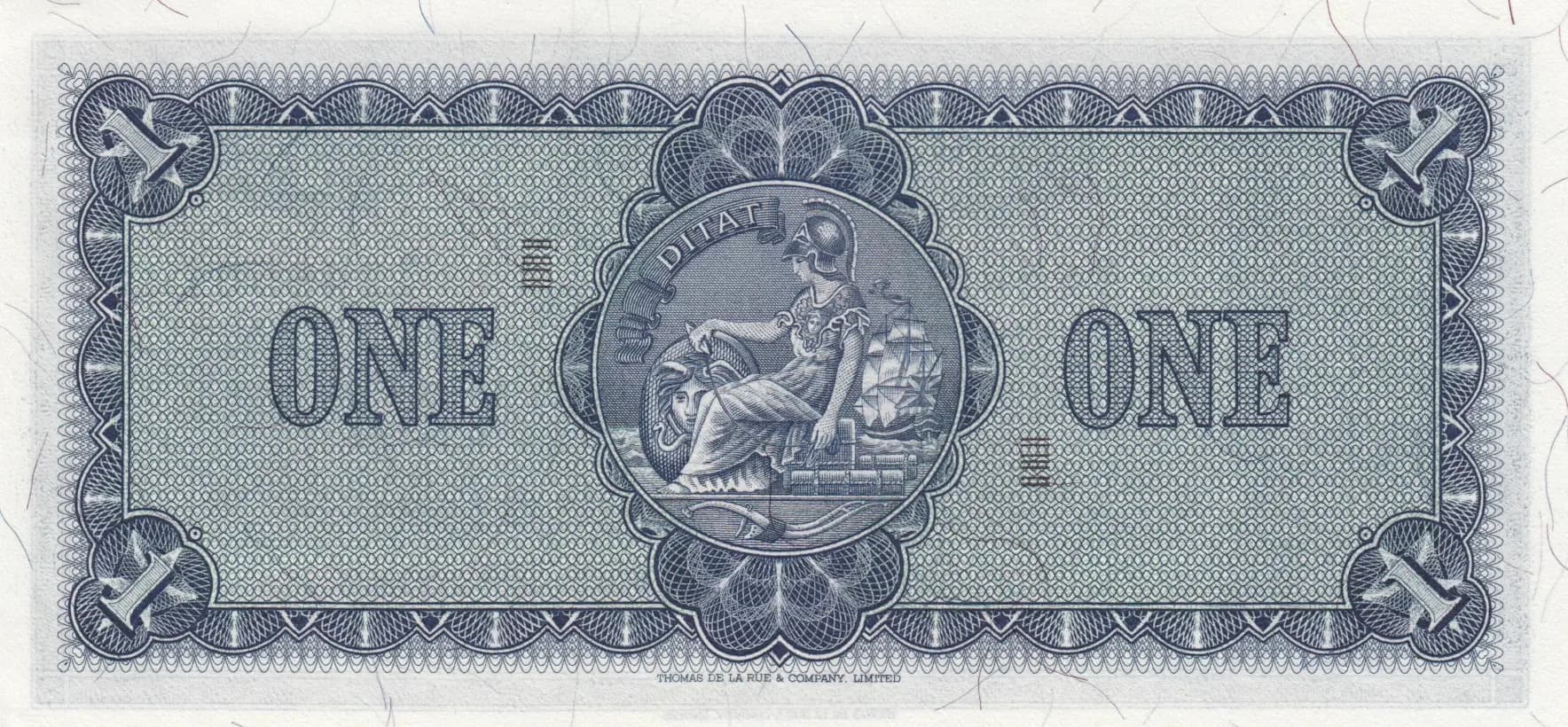
This is a British Linen Bank 1 Pound Sterling note issued on 13 June 1967 (Pick P-168), printed by Thomas de la Rue. The obverse features an ornate design with dual circular medallions on the left—the upper showing a radial sunburst pattern and the lower depicting a seated allegorical Britannia figure—complemented by a heraldic crest at top center. The reverse displays a large central medallion containing Britannia seated with shield, ship, and industrial elements, flanked by four corner medallions with dove motifs. The note exhibits circulation wear consistent with regular use, including creasing and fold marks, though the design remains clearly legible and the multicolored printing (navy blue, pink/mauve, pale cyan on cream) is well-preserved.
Common. While this specific variety (P-168 with sorting codes) is catalogued separately from P-166c (without sorting codes), the British Lien Bank 1967 pound notes had substantial print runs. eBay market data shows UNC examples selling for $42.99-$60 USD as of 2019-2020, well within the range for common circulated banknotes. The note was issued during a period of normal currency circulation before the bank's 1969 merger, not from a restricted or short-lived series. Condition grade UNC represents a premium example, but the underlying note type itself remains readily available to collectors.
Issued in 1967, this note represents the final period of the British Linen Bank's independent note circulation before its absorption into Barclays Bank in 1969. The prominence of Britannia and heraldic symbols reflects Scotland's historical banking autonomy and national identity during the post-war era. The incorporation of the bank's Royal Charter date (1746) and references to the Court of Directors underscore the institution's prestigious three-century heritage as one of Scotland's most established financial institutions.
The obverse features the coat of arms of the British Linen Bank prominently centered with heraldic lion and shield elements. The dual left medallions contain symbolic imagery: the upper exhibits a classical radiating sunburst design representing authority or banking stability, while the lower presents a seated figure identifiable as Britannia in classical dress, representing national sovereignty and commercial strength. The reverse centers on a large allegorical composition depicting Britannia seated with a heraldic shield (featuring a cross design), surrounded by background elements including a sailing ship and industrial architecture, symbolizing Scotland's maritime and industrial heritage. Corner medallions on the reverse feature doves with spread wings, a symbol of peace and commerce. The overall design employs scalloped circular frame motifs and ornamental floral corner pieces throughout.
Front: 'The British Linen Bank' (issuing authority), 'One Pound Sterling' (denomination), 'By order of the Court of Directors' (authorization), 'General Manager' (signature designation), '13TH JUNE 1967' (issue date), 'Incorporated by Royal Charter 1746' (historical charter), 'R 248501' (serial number, repeated), 'EDINBURGH' (place of issue), 'BANKNOTE' (note classification), 'THOMAS DE LA RUE & COMPANY, LIMITED' (printer). Back: 'ONE' (denomination, repeated left and right), 'THOMAS DE LA RUE & COMPANY, LIMITED' (printer).
Intaglio engraving (line engraving), the traditional security printing method characteristic of Thomas de la Rue's banknote production. The visual analysis confirms fine line patterns, intricate engraved details in medallions and borders, and complex geometric background patterns typical of intaglio work. Repeated security text integrated into the background design and the precise detail in decorative borders are hallmarks of this anti-counterfeiting technique. The multicolor printing effect results from the application of multiple intaglio plates in succession.
This is Pick P-168, distinguishable from the closely related P-166c variety by the presence of sorting codes (visible reference lines) on the reverse, designed for electronic banking equipment processing. The note displays the standard signature line and 'General Manager' designation typical of 1967 British Linen Bank issues. Serial number prefix 'R' and issue date of 13 June 1967 are consistent with documented regular issues from this period. No overprints or error varieties are evident in the visual analysis.