1 pound 1967
Market Prices
9 salesAbout This Note
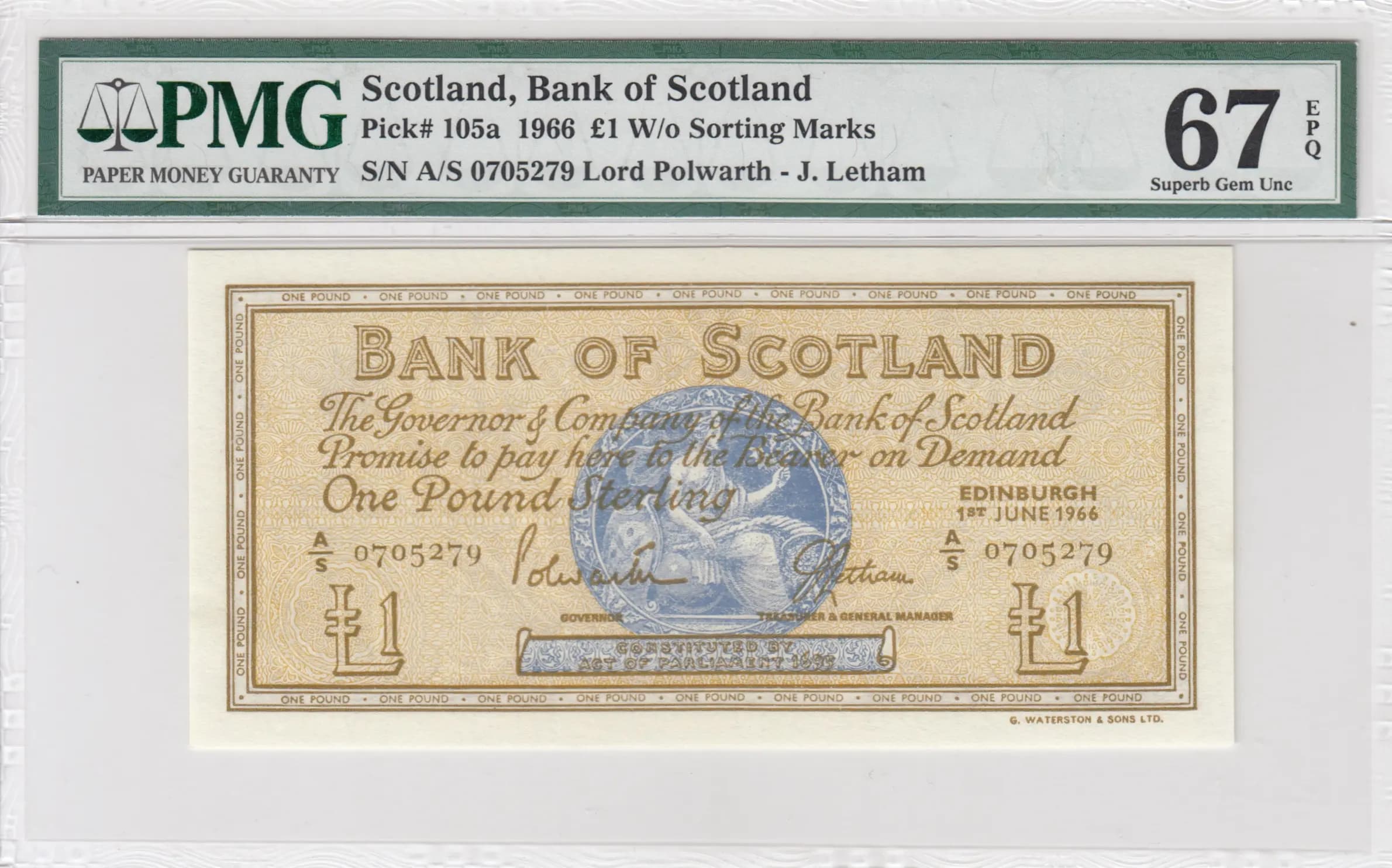
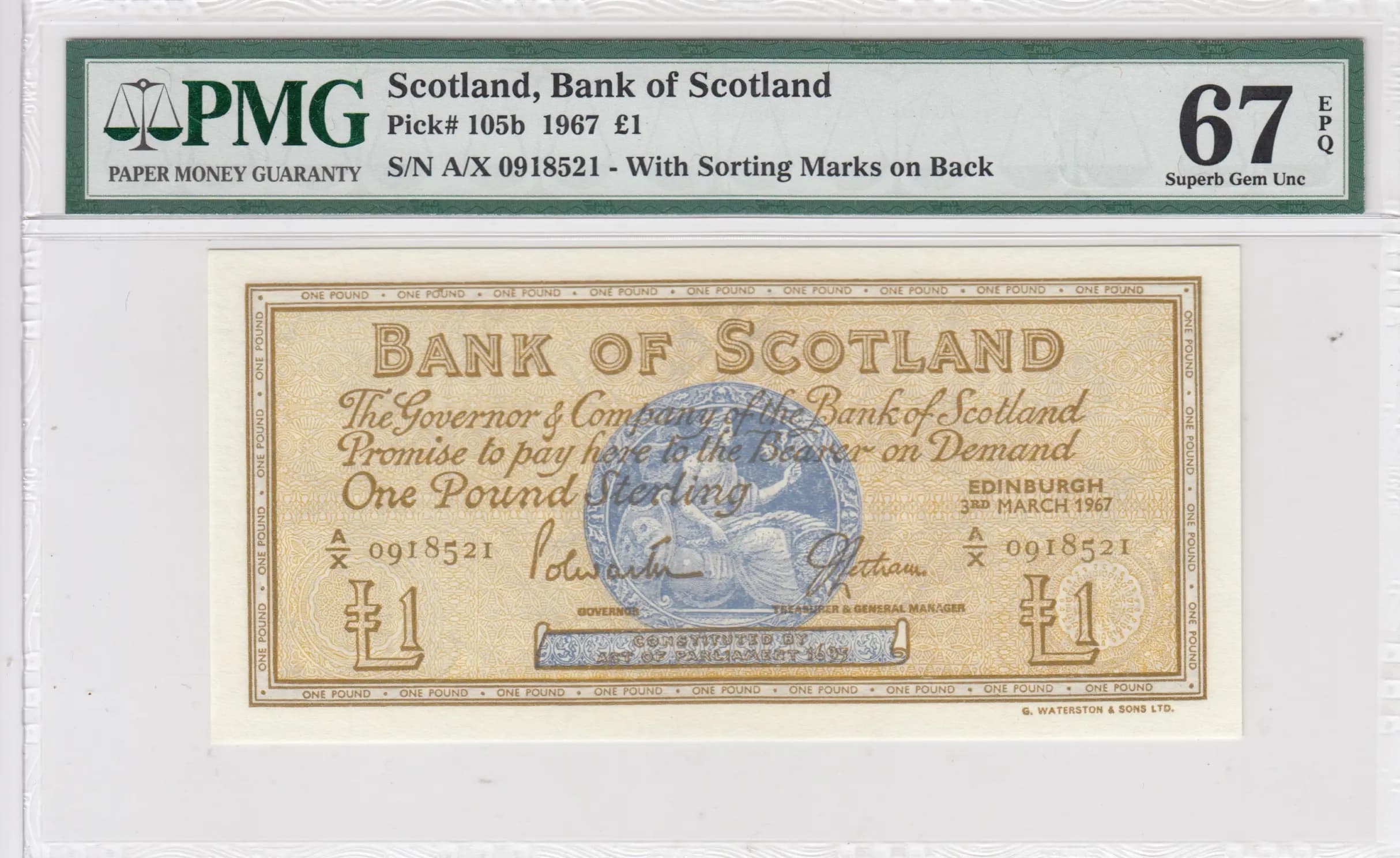
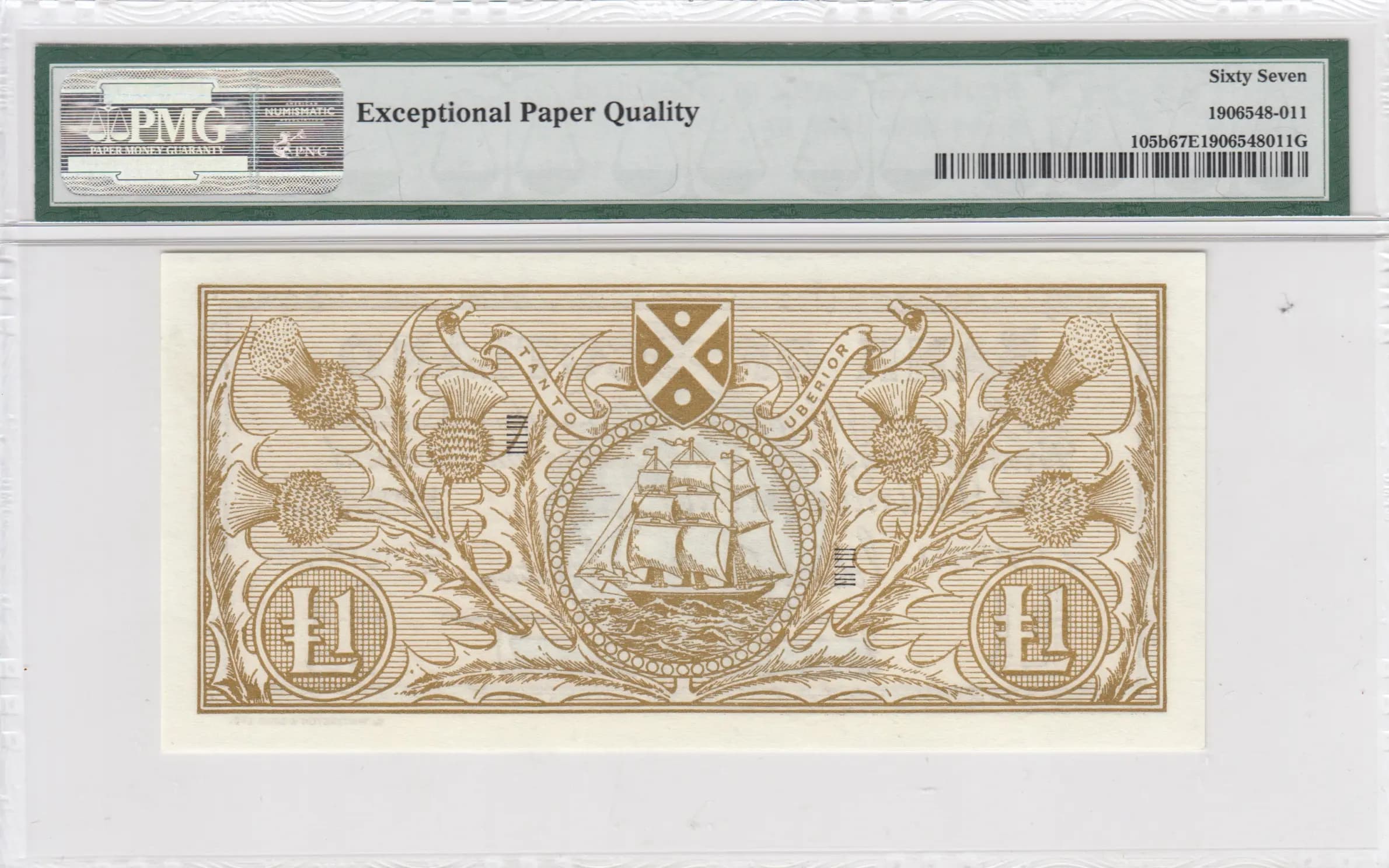
This Bank of Scotland 1 Pound note from 1967 is a superb example of Scottish currency design, graded PMG 67 Superb Gem Uncirculated with Exceptional Paper Quality. The note features a striking blue circular seal containing a lion rampant on the obverse and an elaborate engraved sailing ship surrounded by thistles and heraldic imagery on the reverse, exemplifying the fine engraving techniques of mid-20th century British currency production. In this exceptional condition, it represents a well-preserved specimen of Bank of Scotland's 1967 issue.
Common. eBay sales data shows regular circulation of this note type across multiple condition grades, with prices ranging from $3.55 (F grade) to $121.50 (UNC) based on condition. While PMG 67 examples command higher prices (recorded at $61 for PMG 64 in 2019, suggesting PMG 67 might achieve $80-120), the consistent supply of this issue across various grades and the regular transaction volume indicate this is a commonly available note. The 1967 issue was part of a standard circulation series with no indication of extremely limited print runs or recall status.
This 1967 note was issued by the Bank of Scotland during a period when Scottish banks retained the right to issue their own currency, a unique privilege within the United Kingdom. The heraldic lion rampant and prominent thistle designs reinforce Scottish national identity during this era, while the sailing ship motif reflects Scotland's maritime heritage and historical commercial importance. The formal 'Promise to pay to the Bearer on Demand' language reflects the gold-standard era conventions of British banking, even as the pound sterling was moving toward fiat currency status.
The obverse features the coat of arms/seal of the Bank of Scotland rendered as a prominent blue circular medallion containing a lion rampant (the royal lion of Scotland in heraldic form), positioned centrally within an ornamental beige and brown decorative border. The design emphasizes institutional authority through formal typography and the repeated 'ONE POUND' text around the perimeter. The reverse showcases fine engraving work displaying a three-masted sailing ship (representative of Scotland's maritime history) enclosed within an oval rope border, flanked symmetrically by thistle plants (Scotland's national flower). Above the ship is a heraldic coat of arms, with elaborate ornamental scrollwork and floral elements completing the design. The overall color palette of cream/beige with brown and gold accents is characteristic of Bank of Scotland notes from this period.
OBVERSE: 'BANK OF SCOTLAND' (main title); 'The Governor & Company of the Bank of Scotland' (formal institution name); 'Promise to pay to the Bearer on Demand One Pound Sterling' (promise clause); 'EDINBURGH 3RD MARCH 1967' (issue date and location); Handwritten signatures of 'Polwarth' (Governor) and 'Pletham' (Treasurer & General Manager) with their respective titles; 'A/X 0918521' (serial number); 'ONE POUND' (denomination, repeated in border). REVERSE: '£1' (currency symbol in circular frames at bottom corners); 'Sixty Seven' (PMG grade designation); 'Exceptional Paper Quality' (PMG designation); Reference numbers '1906548-011' and '105b67E1906548011G' (archival/grading references).
Intaglio/engraved printing on bank note paper, produced by G. Waterston & Sons of Edinburgh. The visual analysis shows the characteristic fine line work, sharp detail definition, and multi-layered engraved imagery typical of traditional currency production. The complex ornamental borders, heraldic imagery, and fine cross-hatching throughout demonstrate the high-security engraving standards employed for banknote production during this era.
Pick 105b designation indicates this is the 1967 dated variety (distinct from earlier undated or differently dated versions). The note exhibits the 'EDINBURGH' location marking and the signature combination of Lord Polwarth (Governor) and J. Letham/Pletham (Treasurer & General Manager), which are diagnostic features of this specific issue. Two watermark varieties are known to exist for this issue according to catalog references. Serial number prefix 'A/X 0918521' indicates standard circulation production. The printed date of '3RD MARCH 1967' places this in the initial release period of this design variant.