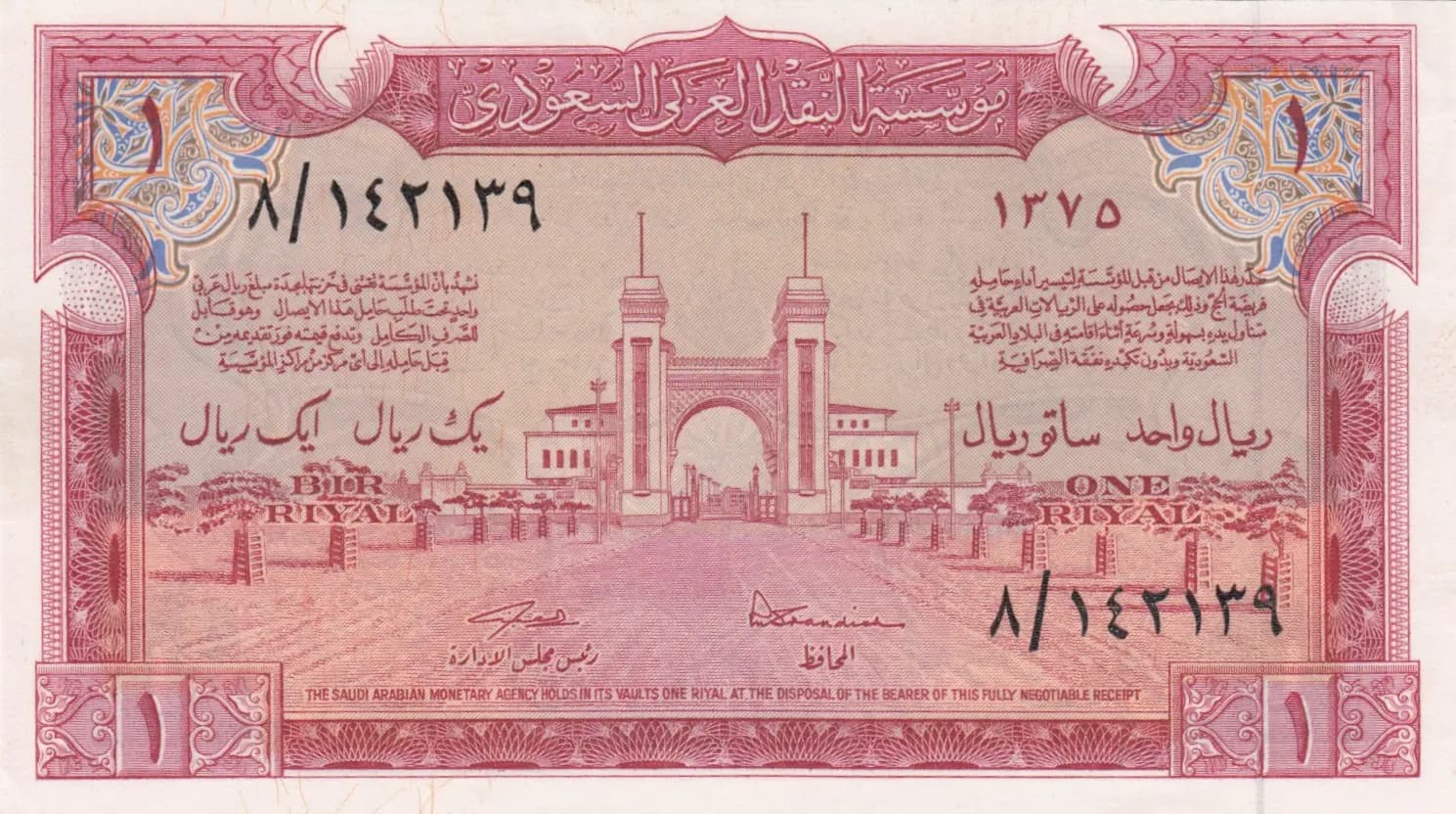
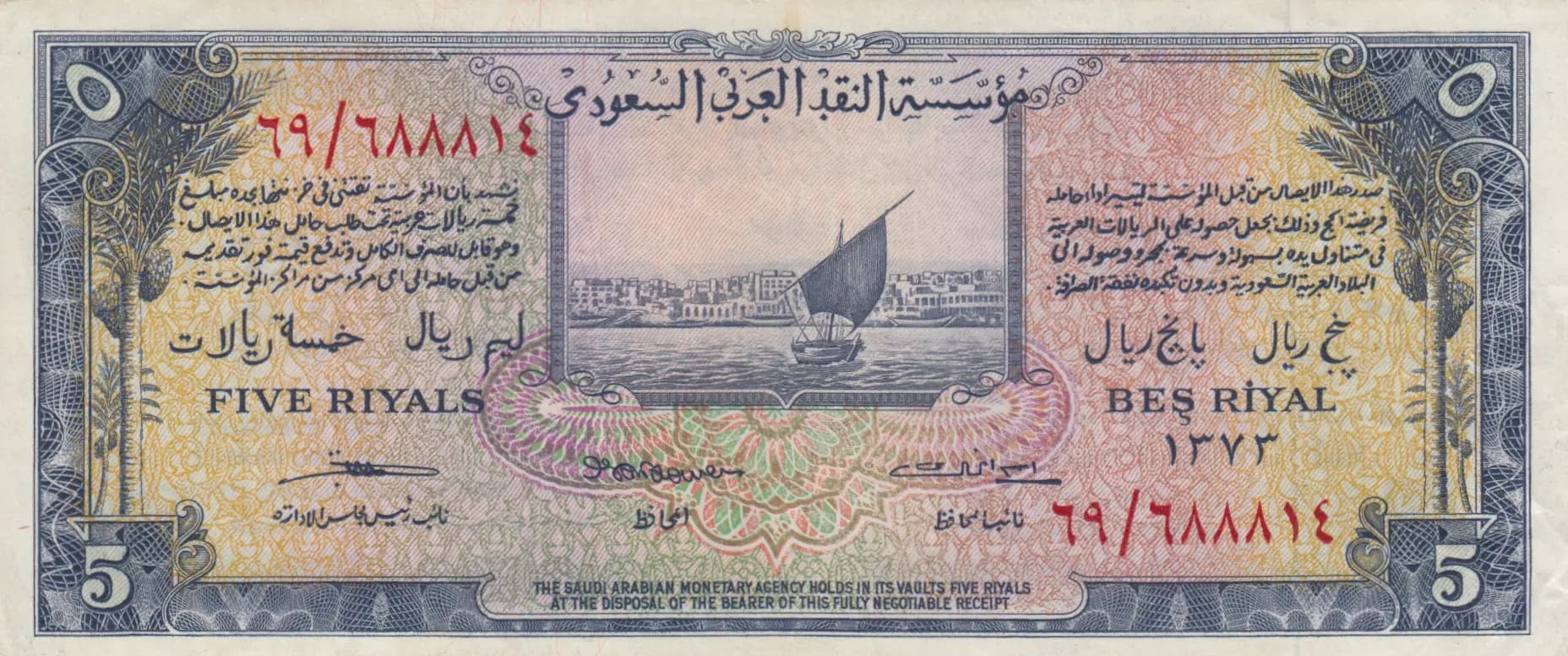
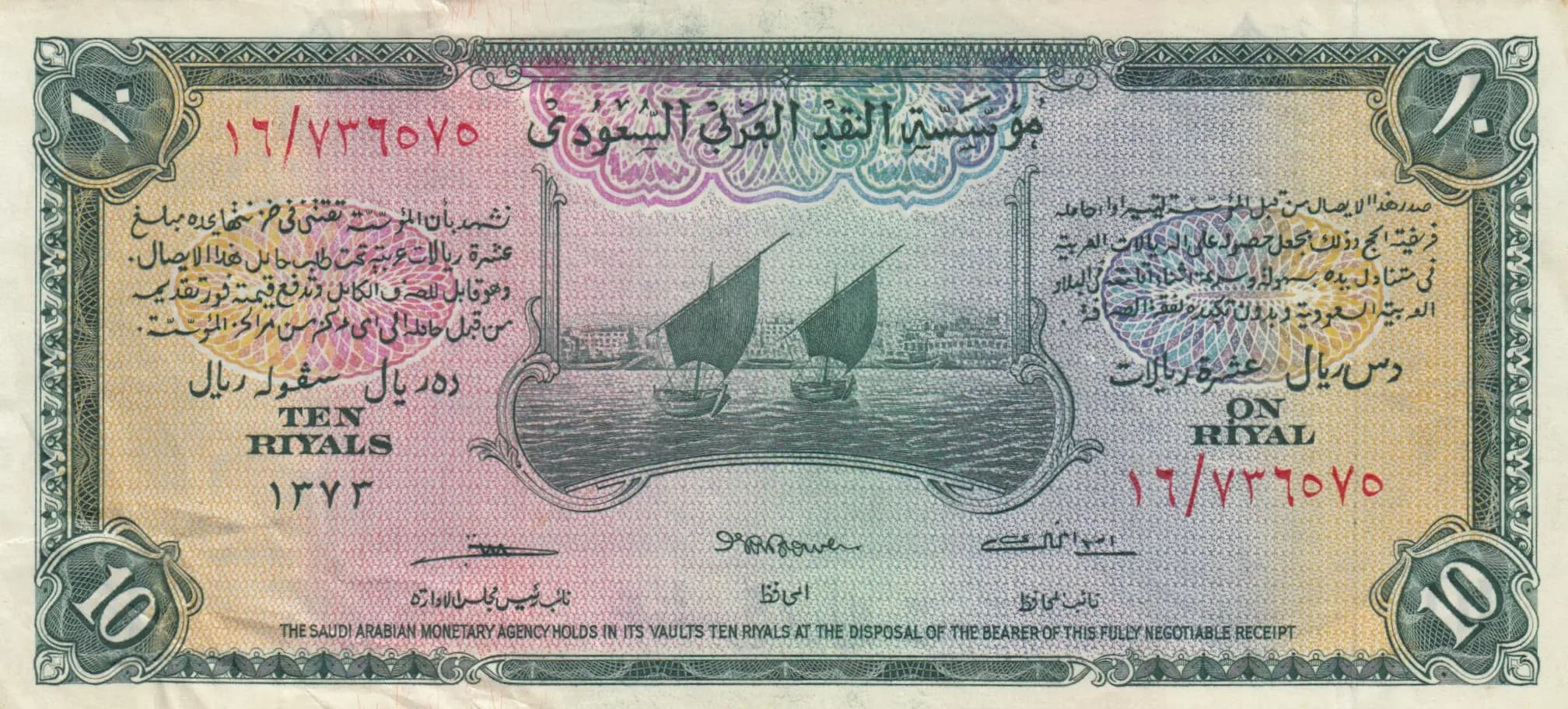
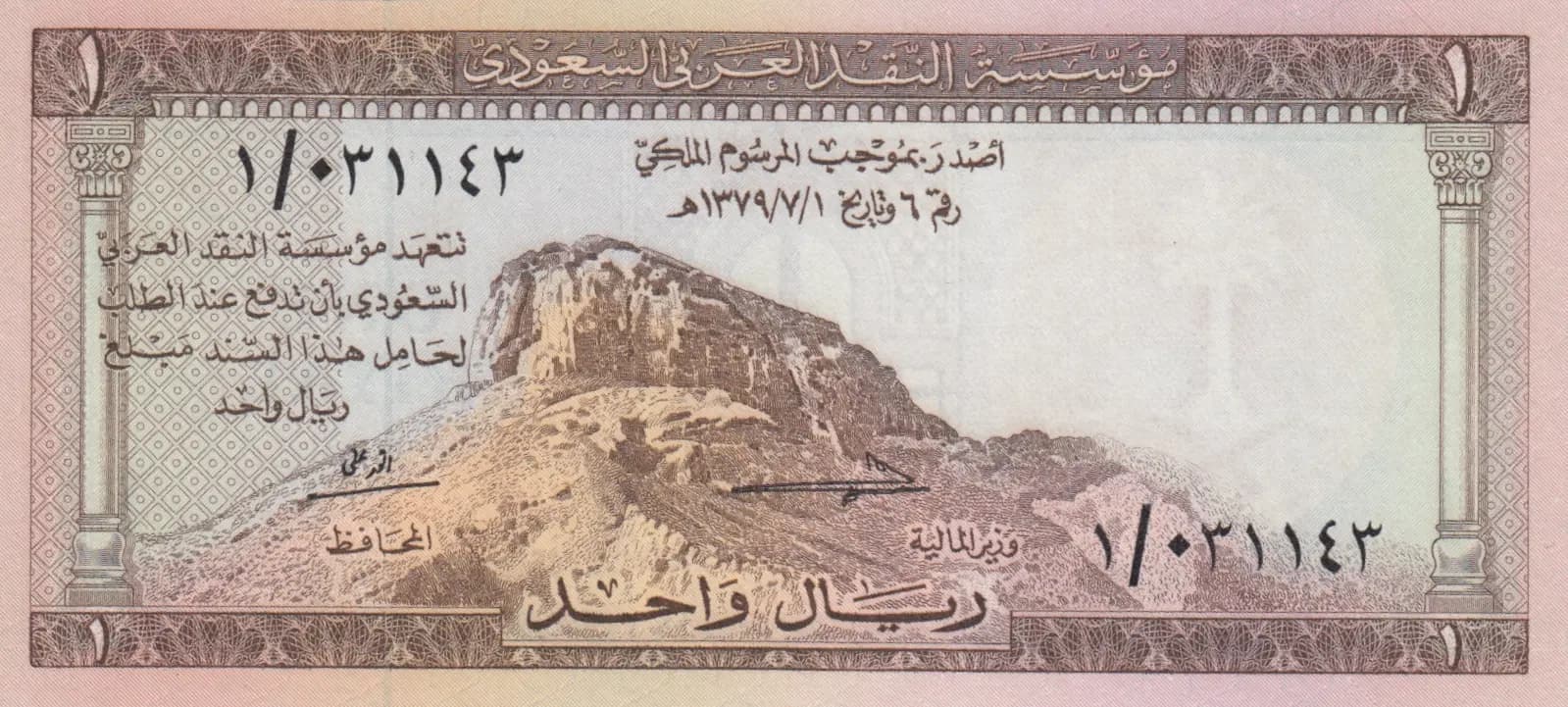
5 riyals 1961
Market Prices
9 salesAbout This Note
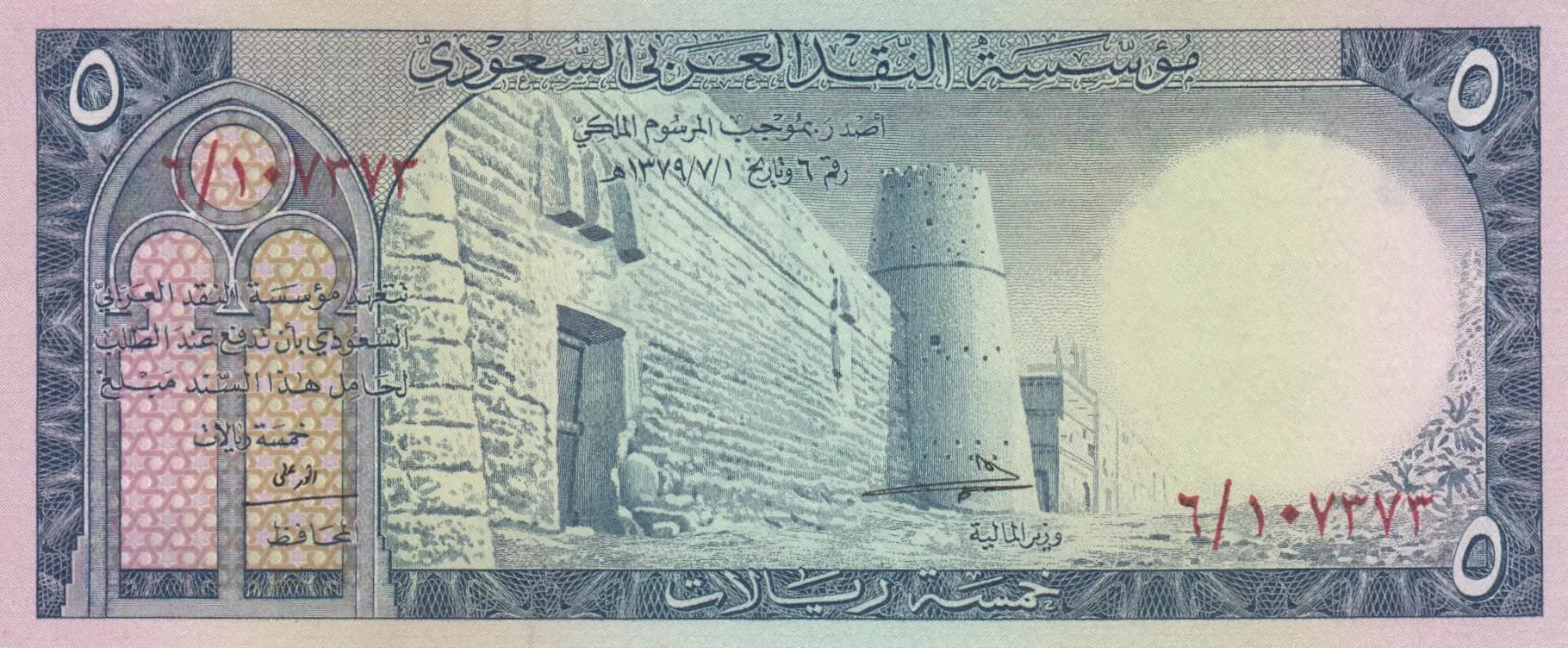
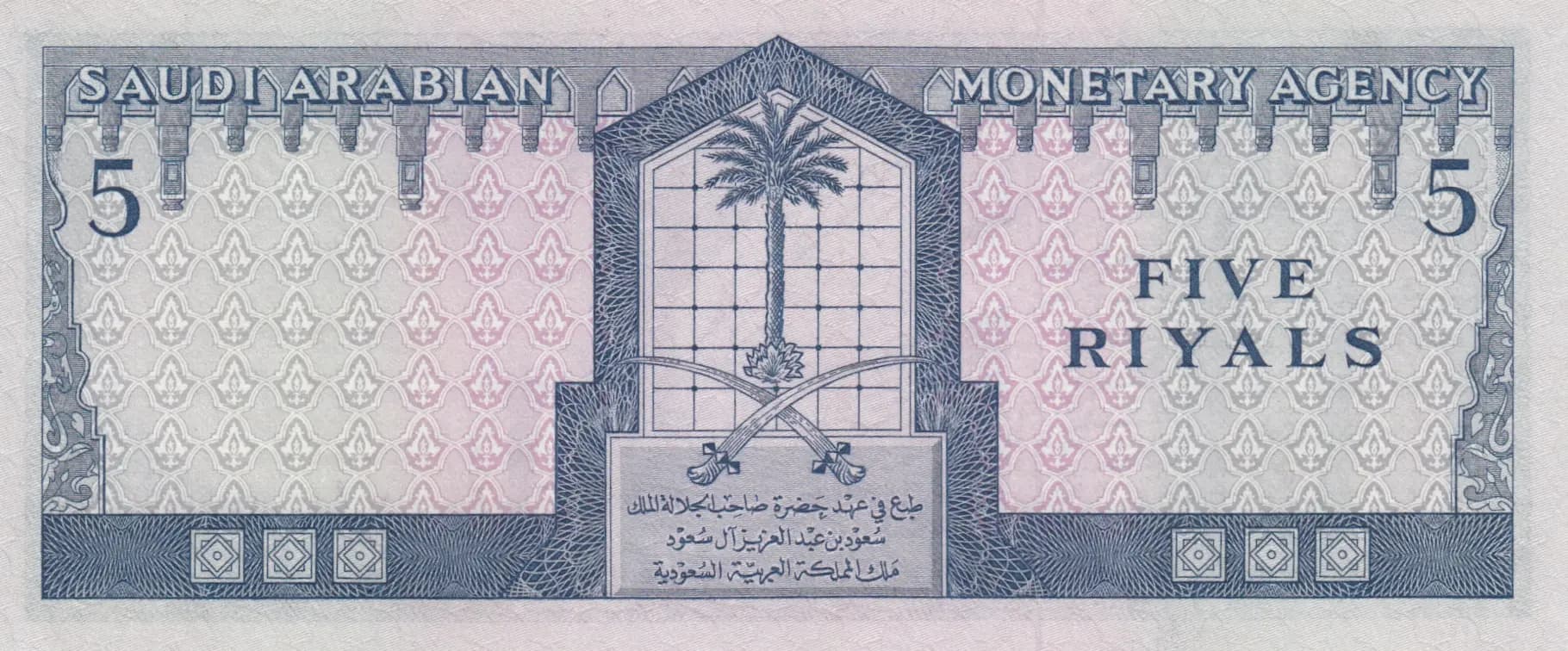
This is a Saudi Arabian 5 Riyals banknote from 1961 (AH 1379), issued by the Saudi Arabian Monetary Agency and graded UNC. The note features exquisite Islamic architectural imagery on both sides—notably the fortress of Al-Masmak on the obverse and a fortified gateway with palm tree on the reverse—rendered in warm earth tones with pink and gold accents. In uncirculated condition, this early Saudi issue represents a significant piece of Arabian numismatic history, with recent market sales of comparable UNC examples commanding $700+, reflecting strong collector demand for this foundational series.
Common. The 5 Riyals P-7a from 1961 is a regular issue of the foundational Saudi Arabian Monetary Agency series. Market data shows consistent availability across all grade levels, with F to VF grades readily obtainable for $50-180. UNC examples, while premium, have multiple recorded sales ($556-730 for graded specimens), indicating sufficient circulation in the collector market to classify this as a common early issue. Large print runs and the note's foundational status in Saudi currency history support a common rating.
The 5 Riyals of 1961 represents one of the earliest banknote issues of the newly established Saudi Arabian Monetary Agency, coinciding with the modernization of Saudi Arabia's financial infrastructure under King Abdulaziz Al Saud. The deliberate choice to feature Al-Masmak fortress—a symbol of Saudi unity and the capture of Riyadh that unified the kingdom—served as a nationalist emblem on currency, while the Islamic geometric patterns and palm tree imagery reinforced both religious identity and the nation's cultural heritage. This issue marks the transition of Saudi Arabia into the modern era of centralized monetary authority.
The obverse features the Al-Masmak fortress of Riyadh as the central architectural element, a historic fortified structure with defensive towers and crenellated walls rendered in blue-gray stone tones. The fortress photograph is flanked by ornate Islamic geometric arch designs in pink and gold, with large circular medallions in the corners serving as watermark areas and security elements. The reverse displays a fortified gateway or bastion with an arched window framing a Saudi palm tree, symbolizing national identity, set within defensive stone walls with geometric battlements. The entire design employs a warm beige and tan background with repeating Islamic geometric patterns in pink and white, creating a cohesive aesthetic that blends historical architecture with contemporary security printing. Decorative borders frame both sides, with fine line engraving visible throughout.
Front Side: 'مؤسسة النقد العربي السعودي' (Saudi Arabian Monetary Agency). Back Side: English text reads 'SAUDI ARABIAN MONETARY AGENCY / 5 / FIVE RIYALS'. Arabic inscriptions include references to the Kingdom of Saudi Arabia and the reigning monarch. The note includes regulatory text indicating issuance in accordance with Saudi Central Bank regulations.
Intaglio engraving (copperplate), the standard security printing method for high-security banknotes of this era. The fine line work, intricate geometric patterns, and three-dimensional effect of the fortress and architectural elements are characteristic of intaglio production. The note employs multiple color layers with careful registration of the photographic architectural elements against the geometric pattern backgrounds, typical of mid-20th century banknote production by European security printers contracted by the Saudi Arabian Monetary Agency.
Pick catalog P-7a identifies this as the primary 5 Riyals variety of the 1961 AH 1379 issue. Specific varieties may exist based on signature variations, serial number prefixes, or printer marks, though the visual analysis does not reveal sufficient detail to distinguish such varieties. Collectors should examine signature combinations and serial number series prefixes to identify specific printings, as Saudi notes from this period are known to have multiple signature combinations corresponding to different officials of the Saudi Arabian Monetary Agency. The observed specimen shows no visible overprints or special markings indicative of a scarce sub-variety.